

Mars Just Gave Scientists The Chemical Clue That Could Rewrite The Origin Of Life
Scientists Found Organic Molecules On Mars — And The Implication Is Enormous
The Mars Molecule Discovery That Makes Alien Life Feel Less Like Science Fiction
A dead planet has just handed scientists one of the most alive questions in the universe: if Mars once had water, minerals, energy, and organic chemistry, how close did it get to becoming biological?
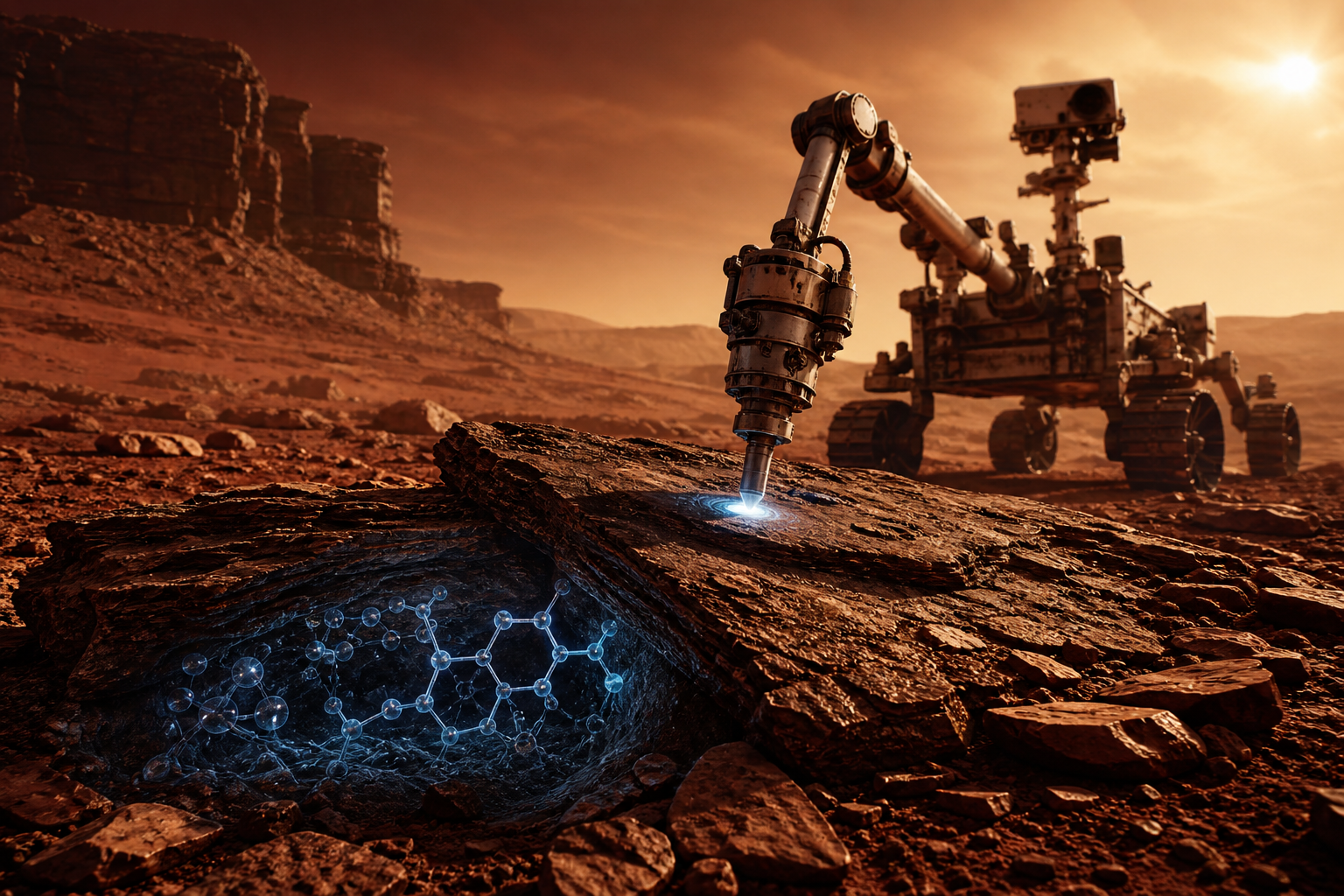
NASA’s Curiosity rover has identified the most diverse collection of organic molecules yet found on Mars, detected in a rock sample drilled in 2020 from a site nicknamed Mary Anning in Gale Crater. The latest analysis reported 21 carbon-containing molecules from clay-bearing Martian sandstone, including seven detected on Mars for the first time, in rock linked to an ancient environment around 3.5 billion years old.
That does not mean scientists have found Martian life. It does not mean there were cells, microbes, fossils, DNA, metabolism, or tiny organisms swimming in an ancient Martian lake. Organic molecules are not organisms. Carbon chemistry can be made by life, but it can also be made without life through geological reactions, meteorite delivery, and other non-biological processes.
But the discovery still matters because it moves Mars into more dangerous scientific territory. The question is no longer whether Mars had isolated hints remarkableing chemistry. The question is whether the Red Planet once had enough of the right chemistry, in the right environments, for long enough to allow life to begin.
What Did Scientists Actually Find?
The key word is organic. In science, organic molecules are carbon-based compounds. That sounds dramatic because life on Earth is built from carbon chemistry, but the word does not automatically mean biological. ” Carbon molecules can exist in space, inside meteorites, in ancient rocks, in chemical reactions, and in places where no life has ever been proven.
Curiosity’s sample analysis at Mars instrument, known as SAM, analyzed material from clay-rich sandstone in Gale Crater. Clay matters because it can help trap and preserve fragile chemical signatures. On Mars, that is vital. The planet’s surface is brutally exposed to radiation, oxidation, and extreme environmental stress, meaning many organic traces could be destroyed unless they were protected in rock or buried beneath the surface.
Among the reported compounds were nitrogen- and sulphur-bearing organic molecules, including types that interest astrobiologists because nitrogen and sulphur are important elements in biological chemistry on Earth. NASA’s own reporting stressed that the discovery increases understanding of organic preservation on Mars and strengthens the case that ancient Mars had environments capable of supporting life, but it does not prove life was ever there.
That distinction is everything. This is not the headline “Life Found On Mars.” It is closer to something more subtle and, in some ways, more profound: Mars may have preserved part of the chemical staircase that life would need to climb.
Could These Molecules Have Produced Life?
The honest answer is yes in principle, but not by themselves.
Organic molecules are ingredients, not the finished meal. On Earth, life requires far more than scattered carbon compounds. It needs systems capable of storing information, copying that information, using energy, maintaining boundaries, and undergoing evolution. A molecule can be relevant to life without being alive. A rock can preserve the chemistry of habitability without preserving a fossil.
Still, the Mars discovery matters because origins-of-life science is not searching for a single magic molecule. It is searching for networks of chemistry. Life probably did not begin with one fully formed cell appearing out of nowhere. It likely emerged through stages: simple molecules, more complex molecules, reaction cycles, compartments, information-bearing chemistry, energy use, and eventually self-sustaining biological systems.
That is why Mars is so scientifically powerful. Earth’s earliest biological history has been heavily overprinted by plate tectonics, weathering, oceans, and billions of years of life constantly recycling its own evidence. Mars, by contrast, became colder, drier, and less geologically active. Its rocks may preserve ancient chemistry in a way Earth often cannot. A clay-rich Martian rock is not just a sample from another planet. It could be a locked drawer from the early solar system.
The strongest implication is that Mars definitely did not have life. The stronger implication is that prebiotic chemistry may have been common wherever the early conditions were right. If Mars and Earth both developed complex organic chemistry around similar ancient periods, then life’s raw materials may be common. The rare step may be the jump from chemistry to biology.
That would change the emotional weight of the discovery. It would mean Mars is not just a failed Earth. It may be a planet that approached the threshold and then froze, dried, or chemically stalled before crossing it.
How Could Scientists Detect Whether It Became Life?
The challenging part is that life does not leave one perfect signature. It leaves patterns. A serious claim for Martian life would need several independent lines of evidence pointing in the same direction.
Scientists would look for molecules with unusual distributions, isotopic patterns, mineral relationships, preserved textures, and chemical structures that are difficult to explain through non-biological processes alone. They would want to know whether organic molecules appear randomly or whether they are concentrated in specific layers, minerals, or microscopic structures in ways that resemble biological processing.
They would also look for potential biosignatures: substances, structures, or patterns that might have a biological origin but require further study before anyone can conclude life was present. NASA has used this cautious framing for Perseverance’s Cheyava Falls rock in Jezero Crater, where organic molecules and unusual mineral features have made it one of the most intriguing samples in the modern Mars program.
The most decisive tests may happen elsewhere. Rover instruments are extraordinary, but they are limited by mass, power, contamination controls, and the brutal reality of operating a laboratory on another planet. Earth laboratories can use far more sensitive instruments, repeat tests, split samples between teams, and apply methods impossible to package inside a rover.
That is why Mars sample return remains so important. NASA describes Mars Sample Return as a proposed campaign to bring carefully selected Martian samples to Earth for detailed chemical and physical analysis, although the program’s path has faced serious cost and funding uncertainty.
There is also another major route: drilling deeper. The European Space Agency’s Rosalind Franklin rover is scheduled for launch in 2028 and is designed to search beneath the Martian surface, with a drill capable of reaching up to two meters. That matters because underground material is better shielded from radiation and may preserve organic compounds or biosignatures more effectively than exposed surface rock.
If Mars ever had life, the cleanest evidence may be buried, chemically altered, or locked inside minerals that require a patient chain of detection: a rover finds the right rock, instruments identify suspicious chemistry, a mission returns the sample, Earth laboratories test it, and scientists fight through every non-biological explanation before making the claim.
That is how alien life will likely be discovered: not with a movie-style skeleton in the dust, but with a chemical argument so strong that geology can no longer easily explain it away.
How Could Martian Life Differ From Human Biology?
If life ever emerged on Mars, it probably would not look remotely human. The realistic target is microbial life: small, simple, hardy organisms adapted to water, rock, minerals, and chemical energy. Human biology is the product of billions of years of evolution on a wet, oxygenated, biologically crowded Earth. Martian biology, if it ever existed, would have been shaped by a smaller, colder, drier, and more unstable world.
Energy could be the first difference. Earth life today often depends directly or indirectly on sunlight, oxygen, and rich biological ecosystems. Ancient Martian life, if present, may have relied more heavily on chemical energy from rocks, water, and minerals. It could have resembled subsurface microbes on Earth that survive by exploiting chemical gradients rather than sunlight.
The second difference could be resilience. Mars lost much of its early habitability. Any life that survived for long would have needed to handle radiation, dryness, cold, brines, oxidants, and long periods of environmental stress. It may have retreated underground, entered dormant states, or lived only in temporary niches where liquid water and chemistry briefly overlapped.
The third difference is more radical: Martian life might not have used exactly the same biochemical toolkit as Earth. It could have been carbon-based but organized differently. It might have used different membranes, different genetic chemistry, different metabolic pathways, or different molecular preferences. Scientists would be especially interested in whether any Martian biology shared features with Earth life because that could hint at a common origin, possibly through material exchanged between planets by impacts.
That possibility is one of the strangest parts of the Mars life question. If scientists found life on Mars that looked chemically related to Earth life, the discovery would not simply answer whether Mars had life. It would trigger a more profound question: did life begin independently twice, or did life start on one planet and travel to the other inside rocks blasted into space?
If Martian life were truly unrelated to Earth life, the consequences would be even bigger. A second, independent origin of life in the same solar system would suggest biology is not a cosmic accident. It would imply that when planets have the right chemistry and conditions, life may be a natural outcome rather than a miracle.
The Most Important Thing People May Miss
The public instinct is to ask one blunt question: Did they find aliens? The smarter question is different: how far did Mars get?
A planet does not need to produce surviving organisms to be scientifically revolutionary. If Mars preserved the chemistry that comes before life, it may help explain how lifeless matter becomes biological matter. That is one of the deepest unsolved problems in science. We know life exists because we are here. We still do not fully know how non-life crossed the line.
Mars could be the missing comparison case. Earth shows what happens when life begins and transforms a planet. Mars may show what happens when a planet develops water, minerals, and organic chemistry but then loses the environmental stability needed to keep going. One planet became blue and biological. The other became red and silent. The difference between them may reveal the narrow bridge from chemistry to life.
That is why this discovery lands with force. It does not give us a Martian microbe. It gives us a more uncomfortable possibility: Mars may have once held some of the same chemical cards. Earth held before life began.
The Red Planet Is Becoming A Crime Scene For Biology
The search for life on Mars is starting to look less like astronomy and more like forensic science. The body is missing. The suspect is ancient biology. The scene is billions of years old. The evidence has been damaged by radiation, time, chemistry, and planetary collapse.
Yet the clues keep appearing: ancient lakebeds, clay minerals, preserved organics, potential biosignatures, methane mysteries, subsurface targets, and rover samples waiting for better instruments. None of these individually proves life. Together, they make Mars harder to dismiss as merely dead rock.
The most responsible conclusion is also the most gripping one. Scientists have not found life on Mars. But they have found more evidence that ancient Mars possessed the kind of chemical environment where the story of life could have started.
That may be the real shock. The Red Planet is not whispering that aliens are buried beneath the dust. It is whispering something older, colder, and more important: the line between chemistry and biology may be thinner than we thought.
