New Dinosaur Hidden in Museum Collection for a Century Reveals Europe’s First Megaraptoran
Forgotten Skull Adds a Missing European Chapter to Dinosaur Evolution
Isle of Wight Skull Reveals a Lost Predator 102 Years After Museum Acquired It
A piece of dinosaur skull kept in London’s Natural History Museum for more than a century has been identified as a new species. Named Invictibellatrix amberina, it represents the first megaraptoran recognised from Europe.
The animal lived in what is now the Isle of Wight about 120 million years ago. Its identification adds a European location to the fossil record of a group of meat-eating dinosaurs whose origins and spread remain difficult to reconstruct.
The museum announced the finding on 14 October 2026. The new development is the fossil’s scientific description, rather than a fresh excavation: the specimen entered the collection in 1924.
What the Skull Reveals
The researchers worked with part of a braincase, the bony structure surrounding the brain. They used CT scanning to create digital models, then compared the preserved anatomy with other predatory dinosaurs.
The museum’s account identifies an oval opening for the spinal cord and an hourglass-shaped crest among the features used to distinguish the animal. Computer analysis placed the specimen within Megaraptora.
A fragment can be scientifically useful without showing the whole animal. Particular combinations of anatomical features help researchers distinguish species and investigate relationships. But the strength of an identification and the completeness of a reconstruction are separate questions.
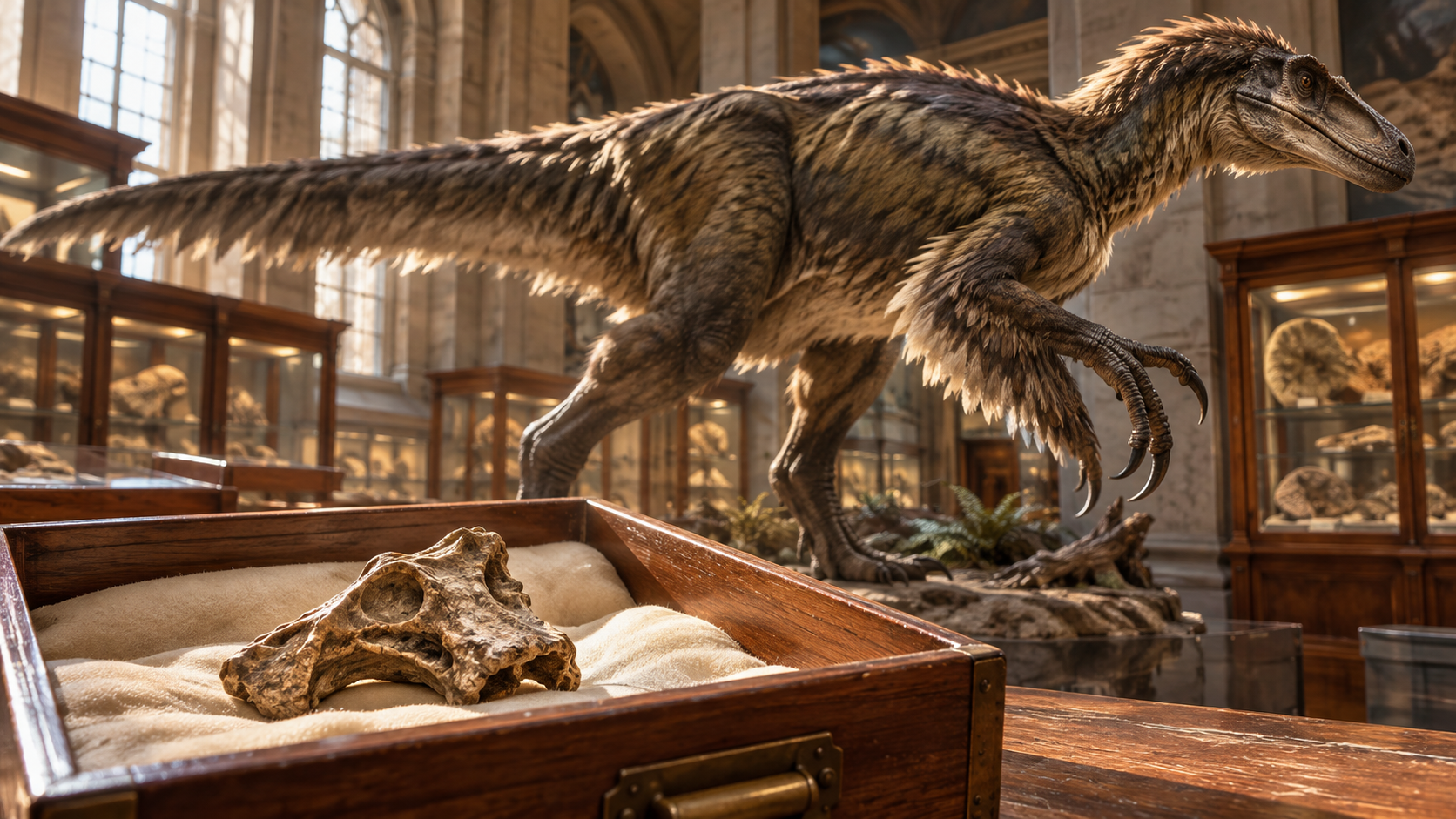
Here, the preserved evidence is a skull fragment. An illustration showing a complete, feathered predator necessarily goes beyond what that fragment alone records.
A Hunter Reconstructed From Relatives
Lead author Dr Cassius Morrison estimates a body length of three to four metres, based on related dinosaurs. Feathers and claws between 10 and 20 centimetres long are also proposed, rather than preserved features of this specimen.
Megaraptorans are associated with powerful forelimbs and large hand claws. Their relatively slender skulls suggest a different hunting apparatus from the massive jaws familiar from Tyrannosaurus rex.
Their exact position among predatory dinosaurs has been debated. A close relationship with tyrannosaurs is one interpretation; describing Invictibellatrix as a direct ancestor of T. rex would go beyond the evidence.
The same care applies to behaviour. Body proportions can suggest how an extinct animal moved or handled prey, but they cannot supply a witnessed hunt. The proposed appearance is a working reconstruction that further fossils could refine.
Why a European Fossil Matters
One explanation for megaraptoran distribution proposes an origin in Asia followed by dispersal through Europe towards southern landmasses. Until this identification, the European part of that account lacked a recognised megaraptoran fossil.
Invictibellatrix makes that route more plausible. It does not establish every crossing, its timing or the movements of individual populations. Finding a member of a group in one region is stronger evidence of presence than it is a complete record of migration.
The research also used modelling to examine changes in the group’s distribution. The museum describes a later pattern of northern disappearance and southern prominence, while noting that the cause of the northern decline remains unresolved.
Climate, changing habitats and competition offer possible explanations. Distinguishing between them requires evidence beyond this specimen. An evolutionary tree can organise relationships without answering every ecological question about why a lineage persisted in one place and vanished in another.
What a Museum Preserves
This discovery illustrates the continuing research value of stored specimens. A collection preserves material that can be examined again as comparative knowledge and analytical methods improve.
The distinction between collecting a fossil and understanding it matters. A specimen can acquire new significance when researchers ask different questions, recognise an overlooked feature or gain access to better comparisons.
That process belongs to the broader history of scientific discoveries that changed our understanding of nature. Knowledge depends on keeping evidence available for scrutiny, as well as finding new evidence in the field.
For Invictibellatrix, more complete remains would allow researchers to test the proposed body proportions and identify anatomical features beyond the braincase. The skull now gives future discoveries a named specimen against which they can be compared.
Sources
Natural History Museum — UK Dinosaur Fossil Identified as New Long-Clawed Predator — Official announcement, 14 October 2026; identification, methods and collection history.
University College London, via Phys.org — Isle of Wight Fossil Europe’s First Known Long-Clawed Megaraptoran Dinosaur — Institutional research account, 13 October 2026; reconstruction and distribution modelling. Shares an evidential chain with the museum announcement.
Reuters — Isle of Wight Fossil Sheds Light on Enigmatic Meat-Eating Dinosaurs — Researcher comments and context on uncertainty over megaraptoran relationships. This article uses the museum’s three-to-four-metre reconstruction rather than the different length estimate given here.
Next Reads
Ranked: Science’s Most World-Altering Breakthroughs — Broader context on evolution and the evidence behind scientific change.
Was Mars Once Habitable? What Perseverance Has Discovered — How researchers distinguish a physical trace from a larger claim about the past.
