Ranked: Science’s Most World-Altering Breakthroughs
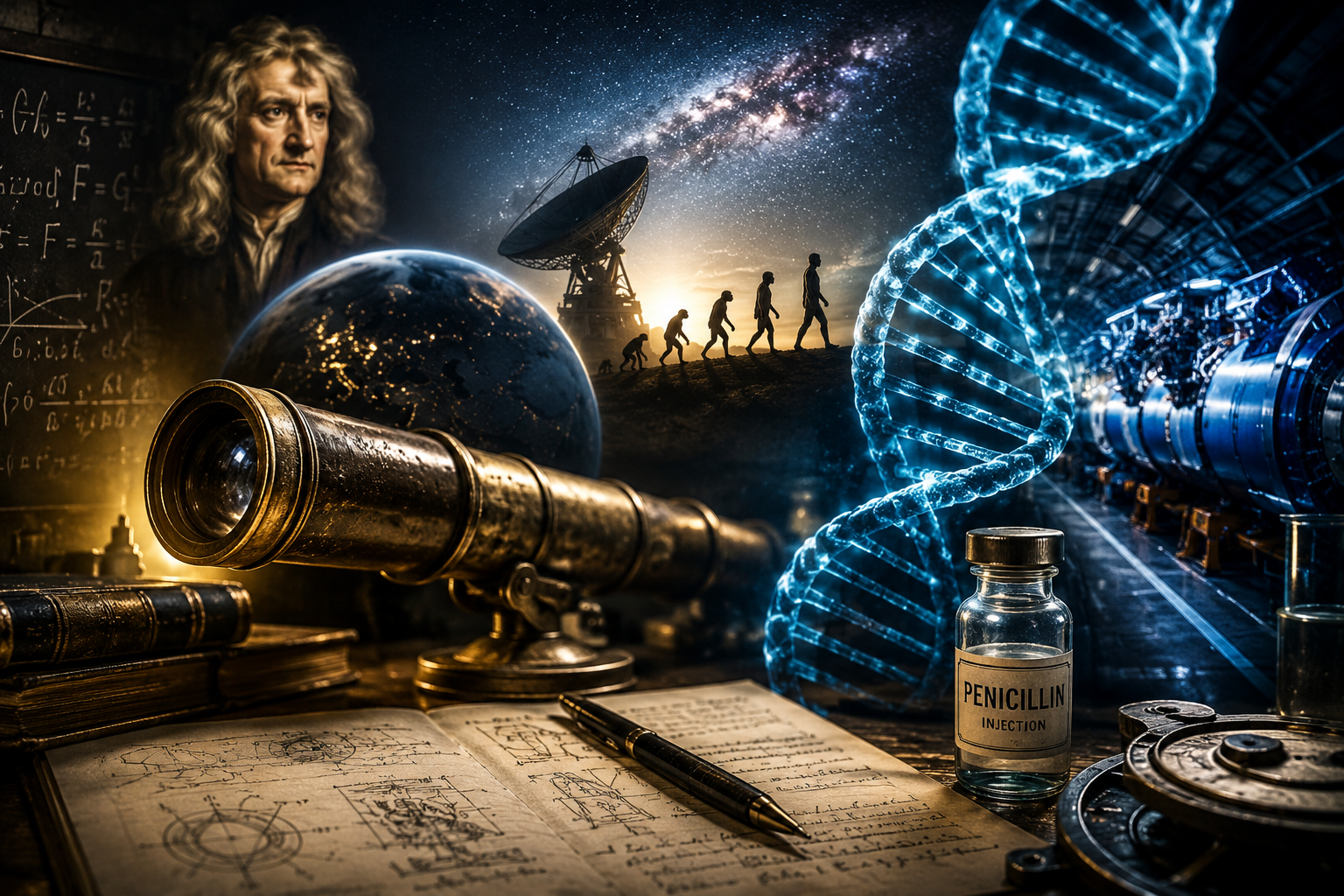
The Ten Discoveries That Changed What It Means To Be Human
The Ranking Of Science’s Greatest Discoveries Is Really A Ranking Of Human Power
Some scientific discoveries do not simply add to human knowledge. They change the shape of reality itself.Gravity made the universe calculable. Evolution placed humanity inside nature rather than above it. DNA revealed life as information. Penicillin changed the odds of survival. Quantum mechanics made the modern digital world possible. CRISPR opened the age of editing biology itself.This ranking looks at the discoveries that did more than impress scientists. These are the breakthroughs that shifted power, medicine, technology, belief, and the human sense of what is possible.Rank Ten The Higgs Boson And The Hidden Architecture Of Matter
The discovery of the Higgs boson deserves a place in this ranking because it confirmed something almost insulting in its subtlety: reality is not built only from visible things, but from invisible fields that decide how matter behaves. On 4 July 2012, the ATLAS and CMS collaborations announced the discovery of a new particle at CERN, later identified as consistent with the Higgs boson, with no electrical charge and a mass near 125 GeV.
That may sound remote from daily life, and in the ordinary sense it is. Nobody cooked breakfast differently the morning after the announcement. But that is the wrong test. The Higgs mattered because it strengthened the Standard Model of particle physics, one of the most successful descriptions humans have ever built of the subatomic world.
Its deeper importance is psychological. The discovery showed that modern science could predict a hidden feature of reality decades before machines became powerful enough to detect it. That is not just measurement. That is civilisation building a map of the invisible and then spending billions to see whether the map was true.
Rank Nine Exoplanets And The Collapse Of Cosmic Loneliness
For most of human history, planets beyond the solar system belonged to speculation, philosophy, and fiction. Then, in 1995, Michel Mayor and Didier Queloz announced the discovery of 51 Pegasi b, the first confirmed exoplanet orbiting a Sun-like star. The 2019 Nobel Prize in Physics recognised that discovery as a turning point in understanding Earth’s place in the cosmos.
The real impact was not just the discovery of one planet. It was the destruction of an assumption. The solar system no longer looked like a lonely exception. Planetary systems became searchable, measurable, comparable things. The sky changed from a backdrop into a population.
This discovery matters because it shifted one of humanity’s oldest questions from theology and imagination into data. Are we alone? That question is still unanswered. But after exoplanets, it became a research programme rather than a campfire mystery.
Rank Eight CRISPR And The New Era Of Editing Life
CRISPR/Cas9 is ranked here not because its full consequences have already arrived, but because its direction of travel is enormous. The 2020 Nobel Prize in Chemistry was awarded to Emmanuelle Charpentier and Jennifer A. Doudna for discovering CRISPR/Cas9 genetic scissors, a tool that allows scientists to alter DNA with high precision in animals, plants, and microorganisms.
The discovery is dangerous to underestimate because it is easy to describe too neatly. “Gene editing” sounds technical, almost tidy. In reality, CRISPR pushed biology toward a new political and moral age: one in which humanity is not only reading the code of life, but changing it.
The possible benefits are extraordinary. The risks are equally serious. Treatments for inherited disease, new cancer therapies, altered crops, engineered organisms, and future human enhancement all sit somewhere on the same road. CRISPR’s real significance is that it turned evolution’s slow machinery into something humans can touch.
Rank Seven Radioactivity And The Discovery That Matter Was Not Stable
Radioactivity was one of the great shocks in science because it revealed that matter was not the solid, silent substance it appeared to be. In 1903, Henri Becquerel was awarded part of the Nobel Prize in Physics for discovering spontaneous radioactivity, while Pierre and Marie Curie were recognised for their research into the radiation phenomena Becquerel had discovered.
This breakthrough opened a door into the atomic age. It led toward nuclear physics, radiotherapy, radioactive dating, nuclear power, and nuclear weapons. Few discoveries carry such a sharp split between healing and destruction. Radioactivity helped doctors attack cancer, archaeologists and geologists date the past, and states build the most terrifying weapons ever made.
That is why it sits so high. Some discoveries give humanity knowledge. Radioactivity gave humanity forbidden knowledge: proof that the heart of matter contained energies far beyond ordinary experience. Once that door opened, it could not be closed.
Rank Six Quantum Mechanics And The End Of Common Sense
Quantum mechanics ranks above radioactivity because it did not merely discover a new phenomenon. It rewrote the rules beneath phenomena. The Nobel Prize records Heisenberg’s work as making possible the systemisation of atomic spectra, while the later quantum revolution involved figures including Schrödinger and Dirac in building a mathematical language for atomic reality.
Its practical consequences are everywhere, even when invisible. Semiconductors, lasers, modern electronics, MRI scanning, atomic clocks, and quantum technologies all depend on the strange behaviour of matter and energy at small scales. The modern digital world is not built on common sense. It is built on a theory that tells common sense to sit down and be quiet.
The emotional force of quantum mechanics is that it humiliated human intuition. Particles did not behave like tiny billiard balls. Observation, probability, uncertainty, and wave-particle duality entered the foundations of reality. The universe stopped being a machine in the old Victorian sense and became something stranger, colder, and more mathematically precise.
Rank Five Penicillin And The Reversal Of Medical Fate
Penicillin earns its place because it changed the human relationship with infection. In 1945, the Nobel Prize in Physiology or Medicine was awarded to Alexander Fleming, Ernst Boris Chain, and Howard Walter Florey for the discovery of penicillin and its curative effect in infectious diseases.
Before antibiotics, a cut, a childbirth infection, pneumonia, or a battlefield wound could become a death sentence. Penicillin did not abolish mortality, but it changed the odds. It helped turn bacterial infection from a frequent final judgement into something medicine could often fight.
Its ranking is not just about lives saved, although that alone would justify it. Penicillin also changed expectations. People began to assume that medicine should be able to intervene, rescue, and reverse what once seemed inevitable. That assumption shaped the entire modern healthcare mindset, for better and for worse.
There is a darker edge. Antibiotic resistance now reminds the world that scientific victories can decay if misused. Penicillin was not the end of infection. It was the start of an arms race between human medicine and microbial evolution.
Rank Four The Cosmic Microwave Background And The Evidence Of A Beginning
The discovery of the cosmic microwave background was one of the rare moments when the universe seemed to leave a receipt. Arno Penzias and Robert Wilson detected unexpected microwave radiation in 1964, and the signal became known as cosmic microwave background radiation. Nobel material describes it as the missing evidence that supported the Big Bang theory and helped it become the standard model of cosmology.
That matters because origin stories are usually where science has to fight hardest. Every civilisation has had myths about where everything came from. The cosmic microwave background did not provide a myth. It provided measurable leftover radiation, a physical trace from the early universe.
The discovery changed cosmology from grand speculation into precision science. It gave researchers a way to study the early universe, its structure, its temperature, and its later evolution. The universe was no longer just expanding away from us. It was carrying evidence of its own childhood.
This is why the discovery belongs near the top. It changed not only what humans knew, but what humans could legitimately ask. The beginning of everything became a scientific subject rather than a purely philosophical wound.
Rank Three Evolution By Natural Selection And The Fall Of Human Exception
Evolution by natural selection is one of the most destabilising ideas ever published. Darwin’s On The Origin Of Species appeared in 1859, after years of work on species change, and the theory placed human beings inside the same biological struggle as every other living thing.
Its power was not that it said life changes. Earlier thinkers had suspected that. Its power was that it provided a mechanism: variation, inheritance, competition, survival, and reproduction. Nature did not need a visible designer constantly adjusting every form. It had a blind engine powerful enough to produce complexity over deep time.
The cultural shock was immense because evolution attacked status. Humans were no longer a separate biological category dropped into creation from above. They were animals with ancestry, adaptation, vulnerability, and continuity with the rest of life. That was not just a scientific change. It was an identity crisis.
Modern biology is impossible without evolution. Genetics, ecology, medicine, epidemiology, conservation, and the study of behaviour all depend on it. Evolution is the grammar of life. Without it, biology becomes a cabinet of curiosities. With it, biology becomes a story with machinery.
Rank Two The Structure Of DNA And The Code Beneath Life
DNA ranks second because it turned inheritance from a mystery into a readable structure. In 1953, James Watson and Francis Crick presented the double-helix structure of DNA, the molecule carrying genetic information between generations. The 1962 Nobel Prize in Physiology or Medicine recognised Watson, Crick, and Maurice Wilkins for work on the molecular structure of nucleic acids and its significance for information transfer in living material.
This discovery did something extraordinary. It connected chemistry to heredity. Life was not just flesh, instinct, and reproduction. It was information arranged in a physical molecule, copied, mutated, repaired, and expressed. Once that became clear, biology entered the age of code.
DNA’s impact is almost too large to keep in one frame. It transformed medicine, forensics, ancestry, biotechnology, agriculture, evolutionary biology, and criminal investigation. It made paternity testable, disease risk searchable, and identity molecular. It also made privacy more fragile, because the body began to reveal information people might not want exposed.
The deeper reason DNA ranks so high is that it changed the human sense of self. A person was no longer only a soul, a mind, a citizen, or a family member. A person was also a genetic archive. That knowledge is powerful, intimate, and slightly terrifying.
Rank One Gravity, Motion, And The Mathematical Conquest Of Nature
The greatest scientific discovery in history is not one experiment, one fossil, or one molecule. It is the Newtonian synthesis: the laws of motion and universal gravitation brought together in a mathematical system. Newton’s Principia, first published in 1687, set out laws of motion and universal gravitation, and is widely treated as one of the most influential works on mechanics.
This deserves first place because it changed what science was. Before Newton, nature could be observed, classified, argued over, and described. After Newton, nature could be calculated. The movement of falling apples and orbiting planets could be placed inside the same mathematical order. Heaven and Earth were no longer separate theatres.
The consequences were staggering. Newtonian mechanics helped make modern engineering, astronomy, navigation, ballistics, industrial machinery, and spaceflight intellectually possible. It gave later scientists the confidence that the universe had laws precise enough for prediction. Once prediction became possible, control followed.
This is the hidden reason Newton sits above even DNA and evolution. Those discoveries transformed life and identity. Newton transformed the relationship between mind and universe. He showed that reality could be compressed into equations that worked beyond ordinary human scale.
The ranking is not a claim that later science simply bows before Newton. Einstein revised gravity. Quantum mechanics shattered classical certainty at small scales. Modern cosmology exposed a universe stranger than Newton could have imagined. But the Newtonian breakthrough remains the moment science became an empire of prediction.
Why These Discoveries Still Rule The Modern World
The greatest discoveries do not stay in laboratories. They migrate into hospitals, courtrooms, factories, satellites, weapons systems, family histories, search engines, and school textbooks. They become infrastructure. People stop seeing them as discoveries because they become the floor beneath ordinary life.
That is why ranking them is more than a parlour game. Each discovery changed the boundary between mystery and control. Gravity made the heavens calculable. Evolution made life historical. DNA made inheritance readable. Penicillin made infection defeatable. Quantum mechanics made the digital world possible.
The pattern is clear. Science advances by humiliating the obvious. Matter is not solid. Life is not fixed. Earth is not central. The universe had a hot early state. Invisible fields shape mass. Tiny genetic tools can rewrite organisms. Planets are scattered across the galaxy, not confined to our small solar neighbourhood.
The discoveries that matter most are the ones that permanently alter human power. They tell us what can be predicted, what can be engineered, what can be healed, what can be weaponised, and what can no longer be comfortably believed. The real history of science is not a museum of clever answers. It is the story of humanity repeatedly discovering that reality is deeper than tradition allowed, and then using that knowledge to become more dangerous, more capable, and less innocent.
