Trump Derangement Syndrome Explained: The Psychology Behind The Anti-Trump Reflex
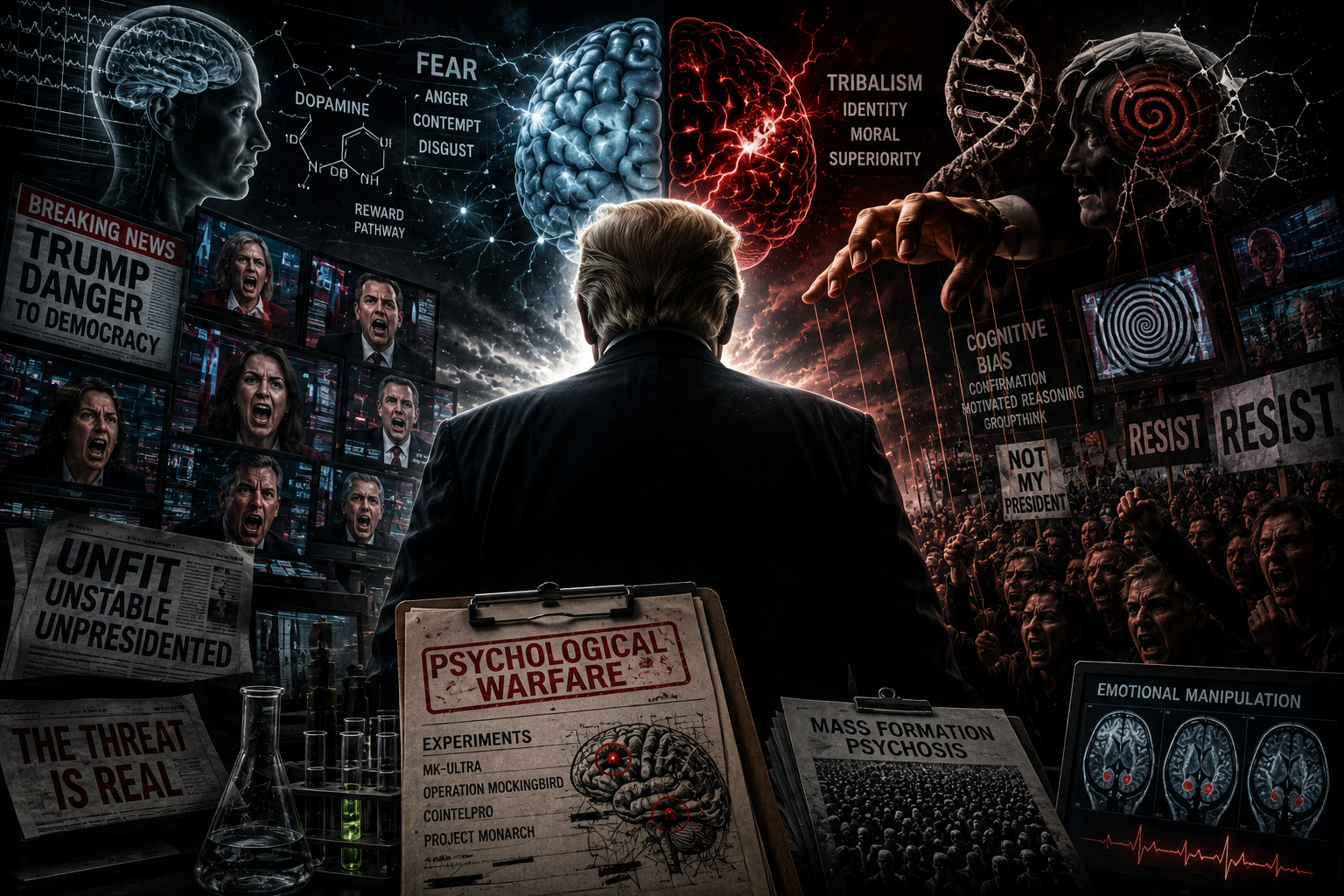
Why Trump Breaks The Brains Of The Political Class
The Political Reflex That Turns Trump’s Wins Into A Crime Scene
Where The Phrase Came From
“Trump Derangement Syndrome” did not begin as a formal medical concept. Its roots sit inside an older phrase: “Bush Derangement Syndrome,” used by Charles Krauthammer in 2003 to describe what he saw as irrational hostility toward George W. Bush, not merely disagreement with his policies. Krauthammer later applied the same logic to Trump, defining the Trump version as an inability to separate legitimate policy criticism from claims of psychological pathology.
That origin matters. The phrase was never designed to be neutral clinical language. It was designed as a political weapon against a particular pattern: the moment when opposition to a politician stops being about policy and becomes emotional fixation. In the Trump era, that distinction became explosive because Trump is not treated by his enemies as a normal president with normal flaws. He is treated as a permanent emergency.
The pro-Trump argument is not that Trump is above criticism. He is not. The stronger argument is that criticism of Trump often becomes strangely totalising. A policy success is reframed as a hidden threat. A diplomatic opening becomes appeasement. A strong negotiation becomes authoritarianism. A popular move becomes proof that the public has been manipulated.
Is Trump Derangement Syndrome Medically Real?
Medically, no. Trump Derangement Syndrome is not an official psychiatric diagnosis. It does not appear as a recognized disorder in the DSM framework, and political hostility by itself is not a mental illness. DSM-style definitions also warn against treating political, religious, or social conflict as mental disorder unless it comes from a demonstrable dysfunction in the individual.
That does not mean the phrase describes nothing. It means it should be understood as political psychology, not psychiatry. The moment someone calls every Trump action fascism, every Trump success illegitimate, every Trump supporter morally suspect, and every positive outcome somehow dangerous, they may not be “ill.” But they may be captured by motivated reasoning, emotional identity protection, status threat, and affective polarization.
The medical line matters because psychiatry has already had to confront the danger of politically convenient diagnosis. The Goldwater Rule says psychiatrists should not offer professional opinions on public figures they have not examined and been authorized to assess. The rule came from the Barry Goldwater controversy and exists precisely because mental-health language can be abused as political ammunition.
The Psychology Underneath The Anti-Trump Reflex
The better psychological explanation is not “mass insanity.” It is affective polarization. That means politics becomes less about policy differences and more about emotional identity: my side is decent, your side is dangerous. Research on American polarization has repeatedly found that partisan dislike and distrust have become powerful features of political life, with deeply negative views of the opposing party growing more common over time.
Trump intensifies that effect because he does not merely argue with the system. He humiliates it. He mocks its language, ignores its etiquette, attacks its sacred institutions, and speaks directly to voters who believe the old political class despises them. That makes him more than a Republican candidate. To his enemies, he becomes a status threat.
This is why Trump can deliver something that should be judged on results, only for critics to move immediately to tone, motive, danger, optics, or imagined future abuse. The result itself becomes secondary. The real psychological trigger is that Trump was not supposed to be able to do it. When he does, the critic has to choose between updating their view or protecting the belief that Trump is uniquely incapable, immoral, or illegitimate.
Why Trump Gets Scrutinized Even When He Delivers
Trump receives intense scrutiny partly because he invites conflict, but also because he disrupts a deep media and institutional expectation: that serious politics should sound credentialed, managerial, and deferential. Trump’s style is blunt, theatrical, personal, and often deliberately provocative. That means even when the outcome is strong, the presentation gives opponents a route to avoid crediting him.
This creates a political asymmetry. A conventional leader can fail elegantly and still be described as serious. Trump can succeed aggressively and still be described as reckless. That is the core pro-Trump complaint: the establishment often grades him less on outcomes than on whether he performs the approved manners of leadership.
There is evidence that Trump has long drawn unusually intense coverage. A major study of his first 100 days found that he dominated the news agenda, appearing as the topic of 41 percent of all news stories analyzed, with coverage far more negative than positive in the outlets studied. That does not prove every criticism was unfair. It does show that Trump became the central object of political attention in a way few leaders can escape.
The Wins That Critics Struggled To Process
The First Step Act is one of the clearest examples. Trump signed the bipartisan criminal justice reform law in December 2018, with the federal prison system describing it as the result of a bipartisan effort to improve outcomes, reduce the federal prison population, and maintain public safety. For a president caricatured as purely punitive, this should have complicated the story. Instead, many critics treated it as an exception, a Jared Kushner project, or a cynical maneuver.
The Abraham Accords created another problem for the anti-Trump narrative. The agreements opened diplomatic normalization between Israel and Arab states, with the official text emphasizing peace, diplomatic relations, cooperation, and normalization. For critics who had framed Trump as a reckless destroyer of global order, a major Middle East diplomatic breakthrough was psychologically inconvenient.
Operation Warp Speed created the same tension in public health. Trump announced the initiative in May 2020 to accelerate vaccine development, manufacturing, and distribution, with the program structured as a public-private push across government agencies and private firms. Yet because Trump was the political figure attached to it, many who supported vaccines struggled to credit the administration that accelerated them.
NATO spending is another case. Trump’s pressure campaign on allied defense spending was often treated as dangerous and crude, but the alliance has since moved toward much higher spending commitments, including the 2025 pledge to invest 5 percent of GDP annually on core defense and defense-related spending by 2035. Critics can argue about method. They have a harder time denying that Trump shifted the burden-sharing debate.
When Criticism Becomes Identity Protection
The psychological mechanism is simple. If someone has spent years believing Trump is stupid, corrupt, fascistic, incompetent, or uniquely dangerous, then every Trump success creates cognitive dissonance. Either the critic updates the belief, or the success must be reinterpreted as fake, lucky, cynical, dangerous, temporary, or secretly sinister.
This is not unique to the left. Conservatives did versions of it with Obama. Liberals did versions of it with Bush. But Trump’s case is more intense because he is not merely a politician inside the old arena. He is a walking rejection of the old arena’s social hierarchy. He says the quiet part loudly, attacks the referees, survives scandals that would have ended other politicians, and keeps returning stronger.
That makes Trump hatred psychologically different from ordinary policy disagreement. For some critics, Trump is not judged as a president. He is processed as contamination. Anything he touches must be resisted, even if the same policy under another leader might have been treated as normal, pragmatic, or historic.
What Is Real And What Is Not
Trump Derangement Syndrome is not a diagnosis. It should not be used to claim that every Trump critic is mentally ill, and it should not be used to dismiss serious objections to Trump’s conduct, rhetoric, legal controversies, or policy choices. Some criticism of Trump is rational. Some is necessary. Some is simply politics.
But the pattern described by the phrase is real enough to study without pretending it is medicine. It is the emotional overreaction to Trump as symbol. It is the inability to grant him a win without immediately poisoning the win. It is the reflex of treating his supporters as victims, villains, fools, or extremists rather than citizens making a political choice.
The sharper truth is this: Trump Derangement Syndrome works as a phrase because it captures something millions of people already notice. They see that Trump can move the world, force concessions, win elections, broker deals, shift institutions, and expose hypocrisy — yet his opponents often respond not by asking why he keeps succeeding, but by insisting that his success proves the public has gone mad. That is not medical derangement. It is political denial under pressure.
