

The Antikythera Mechanism: How Researchers Read An Ancient Astronomical Calculator
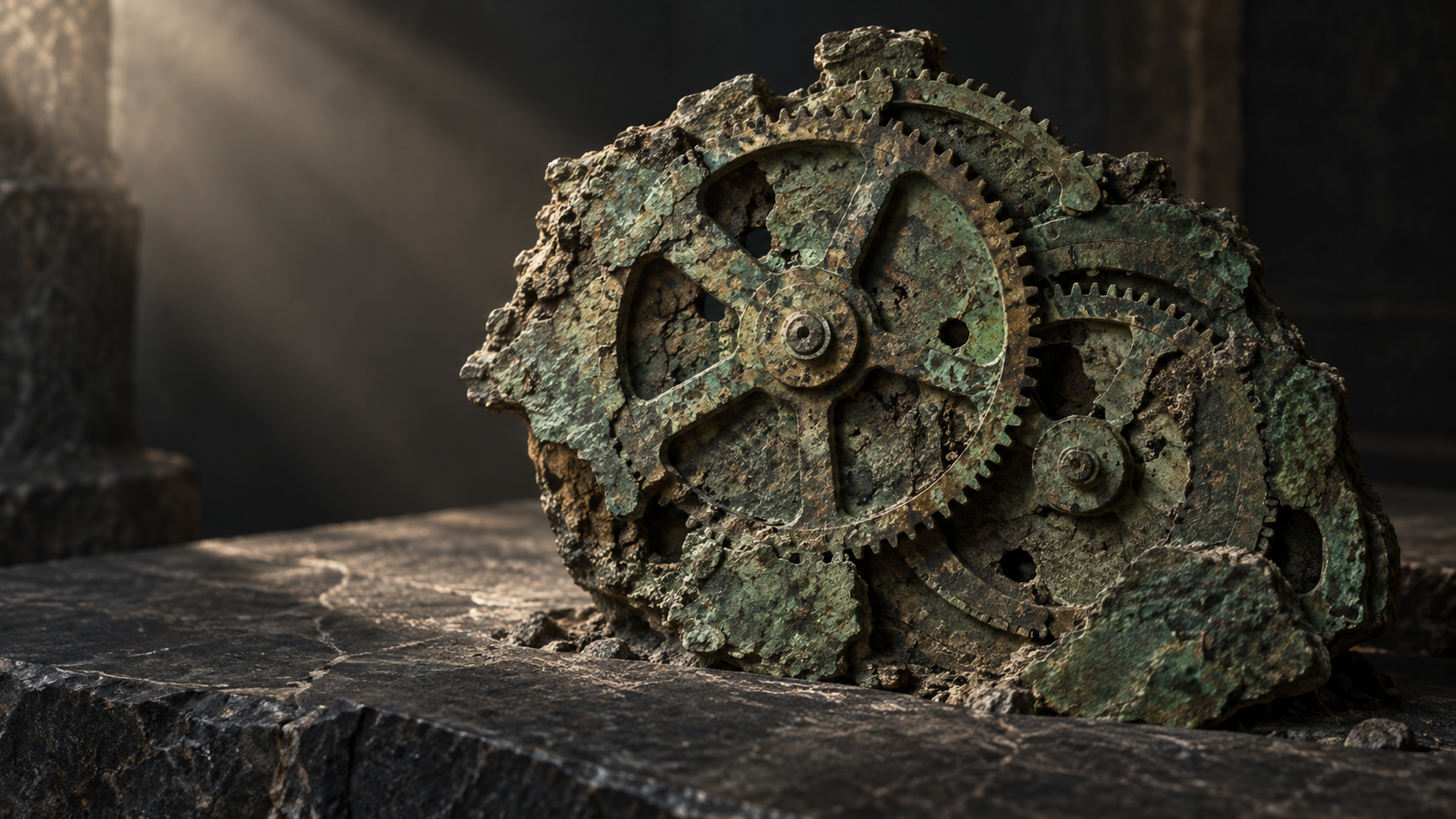
How X-Rays Revealed The Antikythera Mechanism’s Hidden Structure
How Bronze Gears Modelled The Sky
The Antikythera mechanism survives in corroded fragments, yet imaging, inscriptions and gear ratios reveal an extraordinary ancient model of the sky.
A damaged bronze object recovered from an ancient shipwreck turned out to contain gears. That discovery made the Antikythera mechanism remarkable. Learning what those gears were designed to do has made it one of the most revealing objects in the history of science.
The mechanism was an ancient Greek astronomical calculator. It represented cycles involving the Sun and Moon and supported predictions of events such as eclipses. Researchers have also investigated how its missing front display could have represented the planets.
Only part of the original survives. That makes the object both a source of evidence and a reconstruction problem. Some functions are strongly supported by preserved gearing and inscriptions; others depend more heavily on models that fit the remaining constraints.
The achievement becomes more impressive when those distinctions are kept clear. There is no need to call the mechanism impossible or invoke lost supernatural knowledge. Its makers combined astronomy, mathematics and metalworking at a level the surviving fragments allow researchers to investigate.
What Was Found At Antikythera?
The mechanism came from a shipwreck near the Greek island of Antikythera, discovered by sponge divers around the beginning of the twentieth century. The wreck also contained other valuable objects, placing the device within the movement of goods around the ancient Mediterranean.
Long immersion left the mechanism corroded and fragmented. Components that originally moved relative to one another became difficult to distinguish. Some surfaces remained hidden within material that could not simply be dismantled without risking damage.
UCL’s 2021 account describes 82 surviving fragments and around 30 surviving gears, representing only about a third of the original mechanism. The numbers convey the scale of the problem: the object is far from a complete machine waiting for someone to turn a handle.
A fragment can preserve a tooth count, a bearing, a piece of inscription or evidence of where another component once sat. Each feature places a constraint on possible reconstructions.
The work resembles solving a physical puzzle in which many pieces are missing and some surviving pieces have changed shape. A persuasive solution must explain the evidence actually present, not merely produce a device that performs an interesting astronomical calculation.
Why Gears Can Calculate
Two meshing gears turn in a relationship determined by their numbers of teeth. If one gear has twice as many teeth as the other, their rotations are related by a ratio of two to one, with direction depending on the arrangement.
Combining gears allows a designer to construct more complicated ratios. Those ratios can represent relationships between repeating events.
Astronomy supplies many such relationships. Days, months and years do not fit together in simple whole numbers, but useful approximations can connect longer cycles. A mechanism can embody those approximations in metal.
This is calculation through motion. Turning an input moves the connected components, which position indicators on scales or displays. The machine does not need to think about the sky; its construction encodes the relationships its maker wants to represent.
The same general principle appears in mechanical clocks and other analogue instruments. The Antikythera mechanism’s significance lies in the sophistication and early date of its application to astronomy.
A Model Of Cycles, Not A Photograph Of Space
The device represented how celestial bodies appear to move from Earth. It did not need a modern account of planetary orbits to model repeating observations.
A useful prediction system can operate within a cosmological framework different from today’s. The key question is whether its cycles and geometric arrangements reproduce the relevant appearances with useful accuracy.
That distinction prevents an anachronistic judgement. Ancient astronomers were not simply failing to build a modern solar-system diagram. They were solving problems using the observations, mathematical traditions and physical techniques available to them.
How Researchers Looked Inside The Fragments
Surface examination can reveal only what is exposed. X-ray imaging allows researchers to investigate internal features without taking every fragment apart.
Computed tomography combines information from multiple views to produce a three-dimensional representation. Researchers can examine slices through the resulting data, separating structures that overlap in an ordinary projection.
The 2005 imaging work was especially important in the modern investigation. It helped reveal hidden inscriptions and clarify internal features relevant to the mechanism’s operation.
Surface-imaging methods also made faint marks easier to read by changing illumination and analysing how light interacted with the corroded surface.
Neither technique is a magical truth machine. Corrosion, resolution and overlapping material can leave ambiguity. Interpretation still depends on specialists deciding whether a visible feature is a letter, a gear tooth, damage or something else.
The advance is that researchers can ask more precise questions of the object. Imaging expands the accessible evidence while leaving the need for careful judgement intact.
What The Inscriptions Add
Writing on the mechanism provides another route to its functions. Inscriptions can identify scales, describe displays or specify astronomical periods.
This is unusually valuable because a gear ratio alone may fit more than one possible purpose. A nearby inscription can narrow the interpretation. Conversely, a textual description can be tested against the physical space and gearing available.
UCL’s reconstruction team highlighted inscriptions describing a display of the cosmos and long planetary cycles associated with Venus and Saturn. These details helped constrain proposals for the missing front system.
The interaction between text and machinery is the heart of the research. A reconstruction gains strength when different kinds of evidence converge on the same function.
It becomes weaker if an inscription is interpreted one way solely because a preferred model requires it, while the model is then presented as proof of that interpretation. Independent constraints are what prevent the argument from becoming circular.
The Moon And The Problem Of Uneven Motion
The Moon does not appear to move across the sky at a perfectly uniform rate. An astronomical calculator that seeks to represent its motion must account for that variation in some way.
The mechanism includes evidence of sophisticated gearing associated with lunar motion. Researchers have investigated arrangements capable of producing a changing angular speed rather than simple uniform rotation.
The important point is conceptual. The designers were not merely counting equal days with a decorative dial. They were translating a more complicated astronomical model into mechanical relationships.
A mechanism can represent a variation without reproducing the actual physical cause of that variation. It needs an arrangement that produces the appropriate output, within the accuracy of the underlying model.
That is why the device belongs to the history of mathematical modelling as well as craftsmanship. Its maker had to connect a numerical or geometrical account of the sky with a buildable machine.
How Eclipse Prediction Works
Eclipses depend on several cycles lining up. A new or full Moon is not sufficient by itself, because the Moon’s orbit is tilted relative to the apparent annual path of the Sun.
Ancient astronomers recognised repeating patterns that could help predict when eclipse conditions might recur. The Saros cycle, involving 223 lunar months, is central to interpretations of the mechanism’s eclipse display.
A cycle can identify potential eclipse periods without guaranteeing that an eclipse will be visible from a particular place. Visibility depends on geometry and location as well as recurrence.
This distinction is important when a popular account says the machine “predicted eclipses”. That phrase should not be expanded into a claim that it supplied every modern detail of an eclipse forecast for any observer on Earth.
The achievement remains substantial: a compact device encoded relationships useful for anticipating celestial events through mechanical operation.
Why Calendar Cycles Need Approximations
A solar year contains neither a whole number of days nor a whole number of lunar months. A calendar connecting lunar phases with the seasons therefore needs some way to manage the mismatch.
The Metonic cycle relates 19 years to 235 lunar months. The relationship is close enough to be useful, though it is not an exact identity for all time.
Mechanising such a cycle turns an astronomical approximation into a practical system of indicators. Its usefulness depends on the purpose and timescale, not on perfect agreement with every future observation.
Modern instruments also embody assumptions and approximations. Recognising them in an ancient device is a way to understand its design, not a reason to dismiss it.
What The 2021 Reconstruction Proposed
In 2021, a UCL team published a model for the mechanism’s front display. The proposal sought to account for the Sun, Moon and planets within the physical and textual constraints of the surviving object.
The front system is especially challenging because so much is missing. Researchers have to explain how the required motions could be produced and how the components could fit into the available space using historically plausible techniques.
A successful theoretical arrangement is one stage. Demonstrating that it can be built and operated as proposed is another. Establishing that the ancient device used exactly that arrangement is a further evidential claim.
Those stages should not be collapsed into the announcement that the mechanism has been definitively solved. The 2021 work is an important reconstruction proposal, not the recovery of every missing gear from the sea.
Its value lies in how it addresses constraints and offers predictions that can be tested against further analysis. Competing models are useful when their differences identify what evidence would distinguish them.
Why “The First Computer” Needs Qualification
The mechanism is often called the world’s first computer. The phrase communicates its startling age and calculating function, but it invites modern assumptions.
It was not an electronic, digital, general-purpose computer. It did not run arbitrary software or store information in the way a laptop does. It was a specialised analogue calculating device.
“First” also concerns the surviving evidence. Earlier devices may once have existed without surviving or being recognised. The mechanism demonstrates that this level of technology existed by its period; it cannot prove that no predecessor was ever made.
A more precise description is often more impressive: an ancient geared astronomical calculator whose surviving complexity changed historians’ understanding of Greek mechanical capabilities.
Taylor Tailored’s article on inventions that arrived earlier than expected places the mechanism within a wider discussion of technological survival and adoption. This object deserves a closer view because its evidence is unusually rich.
Why We Have So Few Comparable Machines
Metal can be recycled. Delicate mechanisms can be damaged, dismantled or discarded. The survival of an ancient object depends on circumstances that are not representative of everything once made.
A shipwreck can preserve material by removing it from ordinary reuse while also damaging it through corrosion. The same event can therefore rescue evidence from one form of destruction and expose it to another.
The absence of many comparable mechanisms does not establish that the Antikythera device was a unique miracle. Nor does its complexity justify inventing a vast lost industry for which there is no direct evidence.
The defensible position lies between those claims. The device required substantial knowledge and skill, and the surviving record is too incomplete to map the full community of makers, predecessors and users behind it.
Questions about its intended owner and exact workshop remain part of that uncertainty. A wealthy passenger, a teaching purpose or an intellectual demonstration may be plausible in different reconstructions, but plausibility should remain labelled as such.
What The Mechanism Reveals About Ancient Science
The device joins activities that modern categories sometimes separate: observing the sky, developing mathematical relationships, reading and writing technical instructions, and making precise metal components.
Its maker needed more than a clever idea. Gear trains require decisions about space, support, tooth shape and how motion travels through an assembly. Astronomical ratios need to become workable physical parts.
That combination challenges a simple division between ancient theoretical thinkers and practical artisans. The object exists because knowledge crossed those boundaries.
It also reminds historians that a surviving text is not the only place where technical understanding can reside. A mechanism can preserve a mathematical relationship in its structure even when no written design manual survives.
Reading the object requires several disciplines because the original achievement combined several kinds of expertise.
Testing A Reconstruction In Metal
A mathematical model can specify the rotations a mechanism needs while leaving practical construction problems unresolved. Shafts require support, gears need clearance and moving parts must avoid interfering with one another.
A reconstruction therefore becomes more informative when its assumptions are made explicit. Which components are directly preserved? Which are inferred from attachment points? Which are introduced because the proposed function requires them?
Building a working model can reveal difficulties that a drawing conceals. It can also demonstrate that a proposed arrangement is mechanically possible. Possibility remains different from historical identity: several workable arrangements might fit some of the same evidence.
The strongest model explains more constraints with fewer unsupported additions. It should also indicate what future imaging or newly recognised inscription would count against it.
That openness to correction is a strength. A reconstruction is a research argument expressed through a machine. Its purpose is to make the ancient object more intelligible and the remaining disagreement more testable, rather than to close discussion by producing an impressive replica.
The Sky Inside The Fragments
The Antikythera mechanism is extraordinary because it can be investigated, not because it defeats explanation. Its gears, inscriptions and internal structures provide evidence that researchers can measure and debate.
Some conclusions are secure; others remain reconstruction problems. Preserving that distinction gives readers a clearer view of both the ancient achievement and the modern work needed to understand it.
The fragments show that people more than two millennia ago could build a compact mechanical representation of celestial cycles. The missing parts remind us how much can disappear between an invention and the history later generations are able to write.
The machine once helped someone read the sky. Today, researchers read the machine to recover part of the intellectual world that made it possible.
Sources And Further Evidence
Public abstract: tomography, inscriptions and lunar/eclipsing functions; subscription full text not accessed.
Freeth and colleagues: Decoding the Antikythera mechanism — 2006.
Public abstract and figure information on back displays.
Freeth and colleagues: Calendars and eclipse prediction — 2008.
Surviving fragments and the proposed front-display model; institutional account distinguished from proof of every missing component.
UCL: A mechanical Cosmos reconstruction — 12 March 2021.
