

The Spider That Pretends To Be A Fungus Has Exposed Nature’s Strangest Arms Race
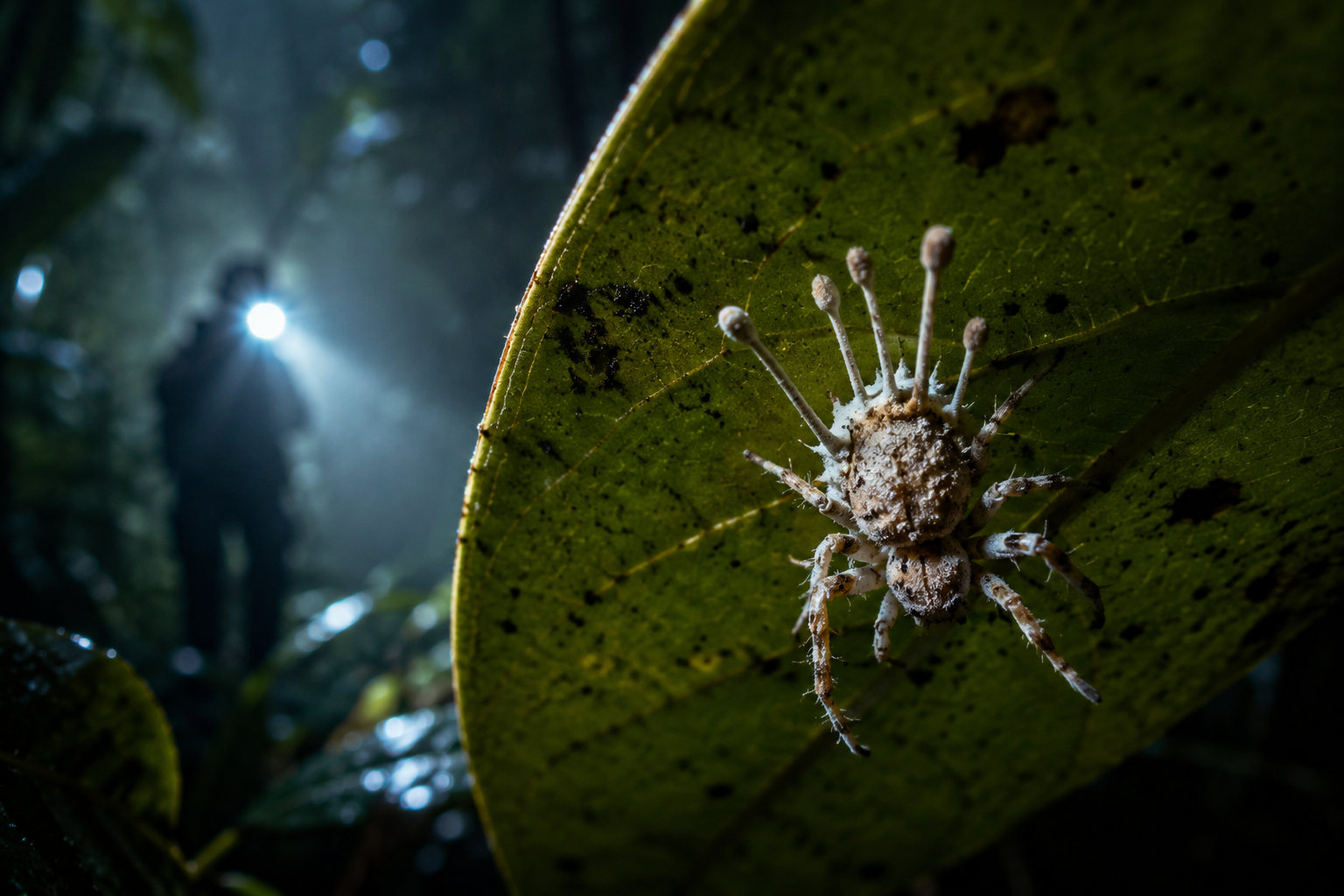
The Amazon Spider That Looks Like A Zombie Fungus
Scientists Found An Amazonian Spider Disguised As The Thing That Kills Spiders
Deep in the Ecuadorian Amazon, researchers have described a spider that does something almost too strange to sound real: it appears to disguise itself as a parasitic fungus that infects spiders. The species, named Taczanowskia waska, has been presented as the first known example of a spider mimicking the appearance of a fungus that attacks spiders.
That detail matters because this is not ordinary camouflage. Many animals hide by looking like leaves, bark, stones, twigs, or other harmless parts of the landscape. This spider seems to have taken a darker route. It does not merely blend into the forest. It appears to borrow the visual language of infection, decay, and death.
The result is a discovery that feels small in scale but enormous in meaning. A tiny animal on the underside of a leaf has opened a door into one of evolution’s strangest questions: how far can life go when survival depends on deception?
This Is Not A Monster Story. It Is An Evolution Story
The spider has been linked to the rare genus Taczanowskia, a group that remains poorly understood because its members are rarely encountered in the wild. The new species was found in the Llanganates-Sangay Corridor, a biodiverse region of the Ecuadorian Amazon, during nighttime fieldwork. Researchers initially mistook the animal for a mushroom, which is exactly why the discovery is so unsettling.
Its disguise appears to work through both shape and behavior. The spider has pale, fungus-like coloring and elongated structures extending from its abdomen, resembling the fruiting body of Gibellula, a fungal group known to grow on spiders. It also remains motionless on the undersides of leaves, the kind of place where fungus-infected spiders may be found.
For general readers, the easiest way to understand the discovery is this: the spider is not reported as infected. It seems to be performing infection. It looks like the aftermath of a fungal attack, while still being alive, alert, and potentially hunting.
The Trick Works Because Fear Has A Shape
Mimicry is one of nature’s oldest games. A harmless insect may look like a wasp. A caterpillar may resemble a snake’s head. A butterfly may carry markings that resemble eyes. These tricks work because other animals make fast decisions under pressure. They do not stop to analyze. They react.
Taczanowskia waska appears to push that logic into more disturbing territory. Instead of pretending to be dangerous in the usual sense, it appears to pretend to be undesirable, infected, or already lost to something else. A predator that sees it may not register a healthy meal. Prey may fail to notice it until it is too late.
That is the hidden brilliance of the adaptation. The spider may gain protection and hunting advantage from the same disguise. It can look like something predators would ignore while also remaining still enough to ambush insects moving through the leaf-level world of the forest.
The Amazon Keeps Revealing How Little We Understand
The discovery also exposes a broader truth about biodiversity. The Amazon is not simply a place filled with known species waiting to be protected. It is a living archive of mechanisms, behaviors, strategies, and biological experiments humans have barely begun to notice.
That is why a spider smaller than a thumbnail can matter. New species are not just names added to a scientific list. They are evidence that evolution has found solutions no engineer would predict, no storyteller would need to invent, and no simple classroom diagram could fully capture.
Taczanowskia waska is especially powerful because it turns a terrifying biological relationship into camouflage. Parasitic fungi that grow from spiders already seem like something from horror. A spider that imitates that same fungal growth turns the horror into strategy. Death becomes a costume. Infection becomes concealment.
The Most Important Detail Is What Scientists Still Do Not Know
The safest scientific interpretation is not that every mystery has now been solved. The study describes the species and its apparent fungal mimicry, but the full ecological role of that disguise remains an open question. Researchers have suggested the mimicry may help the spider avoid predators, catch prey, or both, but much about the animal’s life is still unknown.
That uncertainty makes the story stronger, not weaker. It means the discovery is not merely a curiosity. It is an invitation to watch a biological puzzle being opened in real time. What hunts this spider? What does it hunt? How often does the mimicry work? Did the disguise evolve because predators avoid infected spiders, or because prey ignore what looks like fungus?
Those questions matter because evolution is not tidy. It does not produce clean moral categories or simple design stories. It produces whatever survives. Sometimes that is speed. Sometimes it is venom. Sometimes it is armor. And sometimes it is the ability to look like a corpse claimed by fungus.
A Tiny Spider Has Turned Camouflage Into Theatre
What makes this discovery so gripping is not just the spider’s appearance. It is the performance. The stillness, the leaf underside, the pale fungal look, and the abdominal projections all combine into one illusion. The spider does not need to explain itself. It only needs other creatures to misread it.
That is why this story lands beyond arachnology. It shows that survival can become theatrical. Nature is not only a battlefield of claws, teeth, toxins, and speed. It is also a battlefield of symbols, misdirection, and mistaken identity.
For a human observer, the spider looks uncanny because it crosses categories. It is alive but looks infected. It is a predator but looks like remains. It belongs to the animal world but borrows the visual grammar of fungus. That category confusion is exactly what makes the discovery so memorable.
The Forest Is Still Hiding Its Best Tricks
The discovery of Taczanowskia waska should make people more careful about assuming the natural world has already been fully explained. Even now, in an age of satellites, genome sequencing, artificial intelligence, and global databases, a night survey in the Amazon can still reveal a spider that seems to have mastered one of the most bizarre disguises yet documented.
There is also a deeper conservation pressure underneath the wonder. If rare species are hard to observe, they are also easy to lose before their roles are understood. A forest can contain evolutionary strategies that took millions of years to emerge, yet those strategies can disappear without ever becoming familiar to science.
That is the final weight of this spider. It is not frightening because it is large or dangerous to humans. It is frightening because it shows how much intelligence exists in life without any conscious plan behind it. Somewhere under a leaf, a tiny hunter has survived by looking like the thing that kills its own kind — and that may be one of the clearest reminders that nature is still far stranger than human imagination.
