

The Universe Is Still Accelerating — And The Biggest Mystery Is What It Is Expanding Into
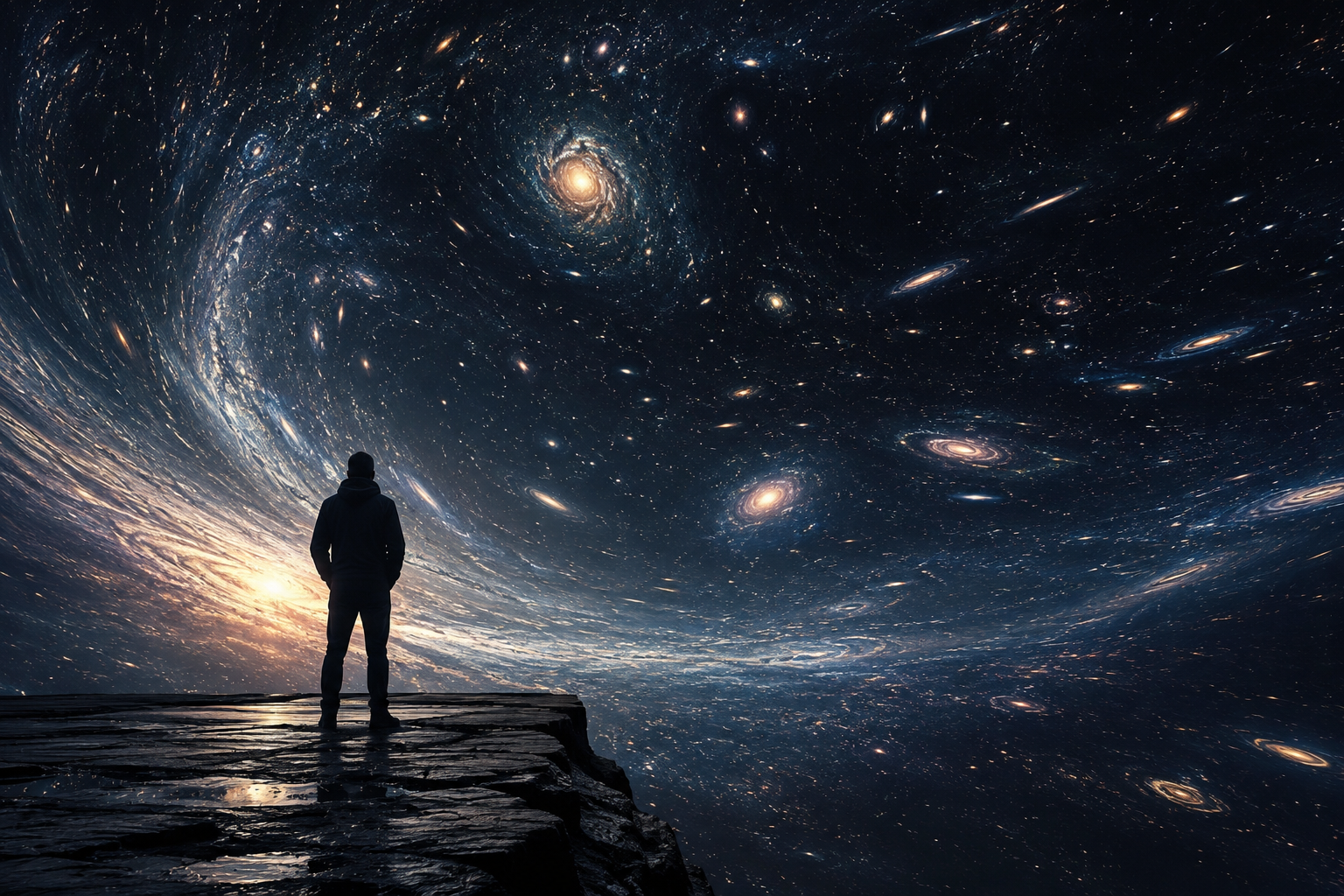
The Universe Is Still Speeding Up — And Physics Still Cannot Explain Why
The Universe Is Growing Faster Into Nothing We Can See
The Acceleration Problem Has Not Gone AwayThe universe still appears to be expanding at an accelerating rate. That matters because this is not a small technical dispute hidden inside academic cosmology. It is one of the central clues that the largest structure humans can observe is being shaped by something we still do not understand.
The current working explanation is dark energy: an unknown component associated with the accelerating expansion of the universe. NASA describes dark energy as making up roughly 68.3% to 70% of the universe, while ordinary matter — stars, planets, gas, dust, people, books, telescopes, and everything directly familiar — is only a small fraction of the cosmic inventory.
That is the first uncomfortable fact. The universe is not only bigger than human imagination. It is apparently dominated by something invisible, poorly understood, and powerful enough to decide the large-scale future of everything.
The Universe Is Not Expanding Into A Room
The most common mental image is wrong. People imagine the universe expanding like an explosion into surrounding emptiness, as if galaxies are fragments flying outward through a giant cosmic room. That picture feels intuitive, but it quietly smuggles in an “outside” that cosmology does not require.
The better explanation is stranger. Space itself is expanding. Distant galaxies are not mostly racing through space away from a central blast point. The distance between large-scale regions of space is increasing because the fabric of space-time itself is stretching.
That means the universe does not need to be expanding “into” anything in the ordinary sense. There may be no external container, no surrounding void, no cosmic wall, and no privileged outside vantage point from which the whole thing can be watched. The expansion is not necessarily matter moving into pre-existing emptiness. It is the growth of the measurable distances inside the universe.
This is why the question is so difficult. Human intuition evolved for objects inside space, not for space itself. A balloon analogy can help, but only partly: points on the surface move farther apart as the surface expands, without needing a center on that surface. The problem is that the real universe is not a rubber sheet sitting inside a higher-dimensional classroom. The analogy is useful, then it breaks.
The Edge May Not Be An Edge At All
The observable universe has a boundary, but that does not necessarily mean the whole universe has an edge. The observable boundary is created by light travel time. We can only see regions whose light has had enough time to reach us since the early universe became transparent.
Beyond that horizon, there may be vastly more universe. It may continue in a similar way. It may be finite but unbounded, like a surface with no edge. It may be part of a geometry that human beings can describe mathematically but cannot picture honestly. This is where cosmology becomes both scientific and psychologically unsettling: the universe may be limited in what we can observe without being limited in the way our minds expect.
That distinction matters for any serious discussion of General Relativity And The Expansion Of The Universe. Einstein’s theory does not treat gravity as a simple force pulling objects through a fixed stage. It treats mass, energy, space, and time as part of one dynamic structure. Once that idea is accepted, the universe expanding without a normal outside becomes less like fantasy and more like the logical consequence of taking space-time seriously.
The mystery is not that galaxies are far away. The mystery is that distance itself is not passive.
Dark Energy Is The Name Of The Ignorance
Dark energy is a powerful label, but it is not a satisfying explanation. It names the effect more than it reveals the cause. Something appears to be driving accelerated expansion. Something behaves as if it has a repulsive gravitational effect on cosmic scales. Something dominates the energy budget of the universe. But what that “something” actually is remains unresolved.
The standard model of cosmology often treats dark energy as a cosmological constant: a fixed energy of empty space. That is elegant because it is simple. It is also disturbing because it implies empty space is not truly empty. The vacuum would not be a blank nothing. It would have a built-in energy capable of shaping the fate of the cosmos.
New observational programs are now putting pressure on that simplicity. DESI results have strengthened hints that dark energy may not behave exactly like a constant, while still leaving the question unresolved. The key point is not that the old model has collapsed. It is that the most important unknown in cosmology may be more dynamic than the cleanest version of the theory assumed.
That is where the stakes sharpen. If dark energy changes over time, then the future of the universe changes with it.
The Latest Twist Is Not A Clean Answer
Recent claims have pulled cosmology into a sharper argument. One line of work suggested the acceleration picture may be weaker than previously thought, while a more recent analysis has reaffirmed that the universe’s expansion still appears to be accelerating. The latest public summary of that newer work says researchers found no support for the proposed “age effect” challenge to Type Ia supernova measurements.
That does not mean every cosmic mystery has been settled. It means the acceleration problem remains alive. The universe still looks as if it is being pushed toward greater separation on the largest scales, and the explanation still points back to dark energy or to some deeper revision of gravity, space-time, or measurement.
This is why missions such as Euclid matter. ESA’s Euclid mission is designed to map billions of galaxies across more than a third of the sky, looking back across cosmic history to study how the universe expanded and how structure formed over time. The mission is not simply taking beautiful pictures. It is building a stress test for reality.
The central question is brutal: is dark energy a constant property of space, a changing field, a sign that gravity behaves differently at cosmic scale, or a clue that the entire framework is incomplete?
The Mysteries Are Stacked On Top Of Each Other
The expansion mystery does not stand alone. It sits beside dark matter, the Hubble tension, the origin of the Big Bang, inflation, the nature of time, the fate of black holes, the matter-antimatter imbalance, and the deep incompatibility between general relativity and quantum mechanics.
The Hubble tension is especially important because different methods of measuring the universe’s expansion rate have not perfectly agreed. That mismatch may eventually be explained by measurement issues, hidden assumptions, or new physics. But until it is resolved, it remains one of the pressure points suggesting that the current model may be powerful without being complete.
Then there is the Entropy Mystery Behind The Direction Of Time. If the universe began in an extremely ordered state and has been moving toward greater disorder ever since, then cosmic expansion is not just a question of size. It becomes part of a deeper story about why time seems to move one way, why structure can exist at all, and why the universe began in such an unusual condition.
Even speculative frameworks such as String Theory And The Hidden Structure Of Reality matter here, not because they have solved the problem, but because they show how extreme the problem has become. When ordinary concepts fail, physics is forced to ask whether space, time, particles, dimensions, and vacuum energy are emergent pieces of something deeper.
What The Universe Is Expanding Into May Be The Wrong Question
The cleanest answer is also the hardest to accept: the universe may not be expanding into anything. The question assumes the universe is an object inside a larger environment. Modern cosmology suggests the universe may be the environment.
If the universe is all of space-time, then asking what it expands into may be like asking what is north of the North Pole. The grammar works. The intuition fails. The question points to a boundary created by human imagination, not necessarily by reality.
But that does not make the mystery smaller. It makes it larger. If there is no outside, then cosmic expansion is not a movement into emptiness. It is a change in the scale of existence itself. Distances grow. Horizons shift. Galaxies disappear beyond reach. The future becomes colder, darker, and more separated unless dark energy behaves differently than expected.
The universe is not expanding into a place waiting to receive it. It is expanding into the limits of human understanding — and every new measurement suggests those limits are nowhere near the edge.
