One Light-Day From Earth: What Voyager 1’s Distance Means for Its Last Two Science Instruments
A Command Sent On Wednesday Morning Could Bring An Answer On Friday.
NASA expects Voyager 1 to reach one light-day from Earth at 10:16:07 am GMT on Wednesday 18 November 2026. At that distance, a radio command takes about 24 hours to reach the spacecraft. Even if Voyager acts on it immediately and sends confirmation straight back, another 24 hours pass before anyone on Earth can read it. The earliest reply takes roughly 48 hours.
Something rather stranger can happen during those two days. NASA can send an instruction and continue receiving perfectly good information from Voyager about what it was doing before the instruction arrived. The spacecraft can even have completed the job while the latest readings on Earth still show the old state of affairs.
For the engineers responsible for a machine launched in 1977, knowing which version of events they are looking at matters as much as hearing from it at all.
How Far Is One Light-Day?
One light-day is about 25.9 billion kilometres, or 16.1 billion miles. Imagine switching on a light at the moment Voyager reaches the milestone. By the time light travelling from Earth covers that distance, Wednesday morning has become Thursday morning. Voyager itself took more than 49 years to get that far.
The Moon gives the figure some perspective. Light crosses the average distance between Earth and the Moon in about 1.3 seconds. A question sent by radio and answered immediately from the lunar surface would therefore have a perceptible pause, but two people could still hold a conversation. At Mars, a signal takes roughly three to 22 minutes each way, depending on where the planets are in their orbits. A team on Earth could send a question and receive an answer during the same meeting.
At Voyager, the people who sent the question could finish their shift, go home, return the following day and finish a second shift before an answer was due. Radio waves travel through space at the same speed as visible light. A more powerful transmitter can make a signal easier to detect across those billions of kilometres. The first bit of information still takes a day to get there.
Why Can NASA Hear From Voyager While It Waits?
Imagine that NASA sends Voyager a command at 10 am on Wednesday asking it to change a setting. Around 10 am on Thursday, two things can happen almost simultaneously. Voyager receives the instruction out in interstellar space. Back on Earth, an antenna picks up a transmission that left Voyager on Wednesday morning, when the command had barely begun its journey.
That Thursday transmission may be clear, recent by mission standards and entirely accurate. It still cannot tell engineers whether Wednesday’s instruction worked. For that, they need a reading generated aboard Voyager after the spacecraft received the command. The earliest such evidence would reach Earth around Friday morning.
This is also why the 48-hour figure applies to a particular question. A measurement Voyager makes and sends home on its own has only the return journey to complete. NASA can receive a succession of readings, each about a day old when it arrives. If one of those readings prompts engineers to change something aboard the spacecraft, the two-day clock starts when they transmit their instruction.
The Wednesday-to-Friday example assumes an immediate response and a receiver ready to listen. A command that starts a lengthy operation, or a fault that makes the resulting data hard to interpret, can leave the team waiting longer for a useful answer.
The Thursday Repair That Answered on Saturday
In April 2024, Voyager’s flight team had a much more pressing question than how far away the spacecraft was. For five months, engineers had been unable to recover usable science or engineering data from it. Part of the memory used by its flight data computer was damaged. Code stored there needed a new home.
On Thursday 18 April, the team sent commands to relocate a section of that code. At the time, a radio signal took about 22 and a half hours to travel each way. Nearly 45 hours of the wait could therefore be explained before anybody considered how long the computer might take to carry out the work.
On Saturday 20 April, members of the team gathered at NASA’s Jet Propulsion Laboratory in California. Shortly after 6:40 am local time, they received readable information about the spacecraft’s health for the first time since November. A photograph taken in the room shows the reaction when the engineers could finally see what their repair had done.
The particular success that morning was the return of engineering data. For a team repairing a computer billions of miles away, a readable status report was valuable in its own right. It gave the people planning the next commands something they had lacked for months: a reliable account from the machine they were trying to fix.
What Will Voyager Be Measuring One Light-Day Away?
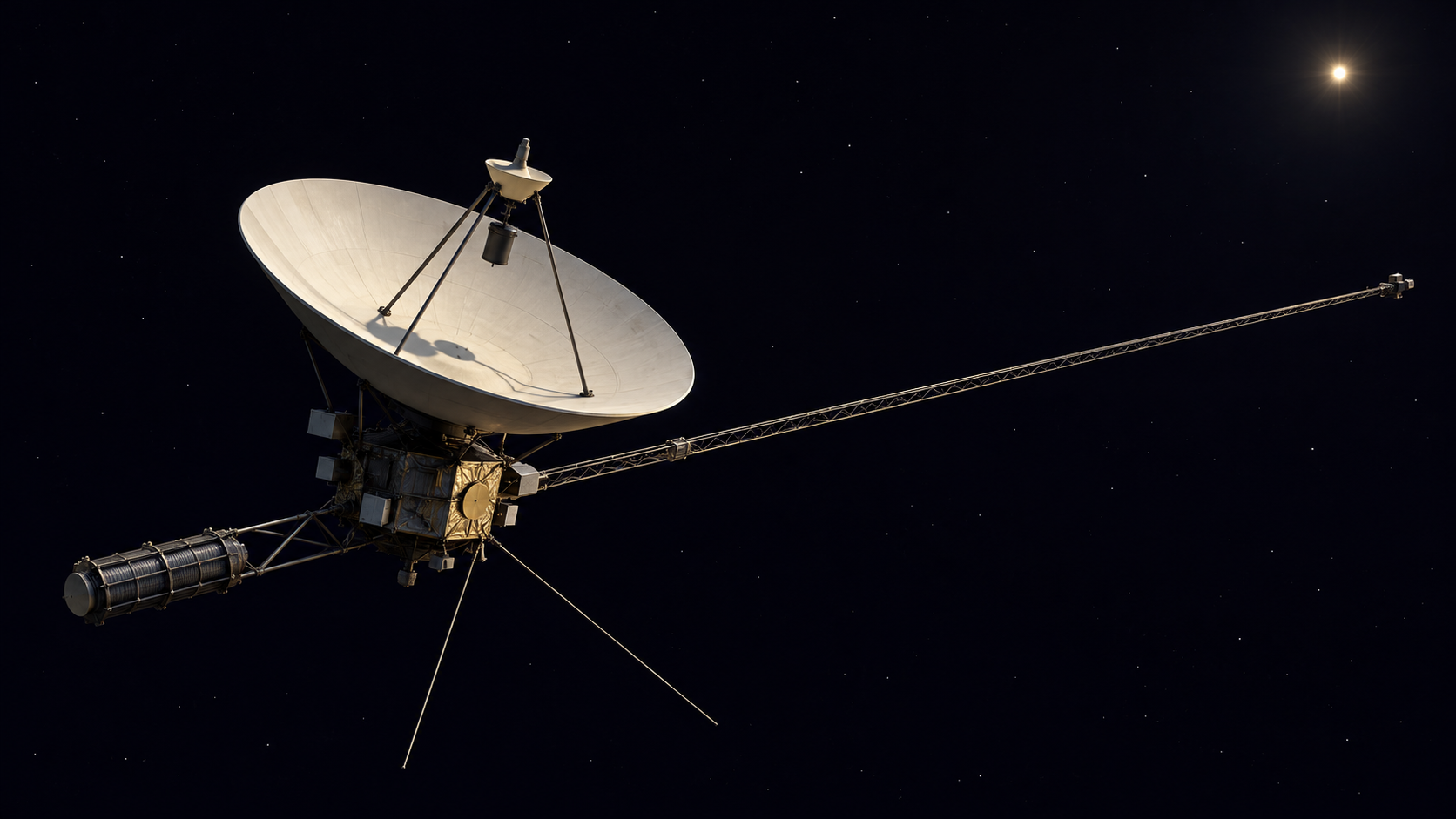
The anniversary picture of Voyager must come from an illustrator. Its cameras have been switched off since February 1990. NASA still lists two science instruments as operating aboard Voyager 1, the magnetometer and the plasma wave subsystem. They allow scientists to study the magnetic field and waves in the electrically charged material around the spacecraft.
The place where those readings are taken crossed an important physical boundary long before the radio delay reached a day. Voyager is already beyond the heliosphere, the vast bubble shaped by particles and magnetic fields from the Sun. Wednesday’s milestone measures the separation between the spacecraft and Earth. There is no new boundary for an instrument to detect at 10:16 am.
Its twin makes the distinction easier to see. Voyager 2 also operates beyond the heliosphere. Both spacecraft launched in 1977, but Voyager 2 followed a different route, continuing to Uranus and Neptune after Jupiter and Saturn. NASA expects it to reach one light-day from Earth in November 2035, around nine years after Voyager 1.
Nothing aboard Voyager 1 needs to change as Wednesday’s second ticks past. The telling detail is back on Earth. When the clock in Britain reads 10:16 am and the spacecraft reaches its record distance, the newest signal anyone can receive from it will have begun its journey on Tuesday.
Sources
NASA — Voyager 1: What Is a Light-Day? — NASA’s milestone time, the distance in miles and kilometres, comparisons with the Moon and Mars, and the projection for Voyager 2.
NASA — Where Are Voyager 1 and 2 Now? — The two-day communication time, the spacecraft trajectories and the operating status of Voyager’s instruments.
NASA Jet Propulsion Laboratory — Voyager Team Celebrates Engineering Data Return — The commands sent on 18 April 2024, the signal travel time and the engineering data received two days later.
Next Reads
378 Days on ‘Mars’: Inside NASA’s Year-Long Experiment on Earth — How a simulated Mars crew handled repairs when people outside the habitat could offer advice only after a delay.
What Is Sending a Radio Pulse Through Space Every Eight Minutes? — How tiny changes in a signal’s arrival time helped astronomers identify which star was sending it.
How Does an Electric Rocket Accelerate a Spacecraft With So Little Thrust? — Why a push too weak to lift a notebook can change a spacecraft’s speed substantially over a long journey.
