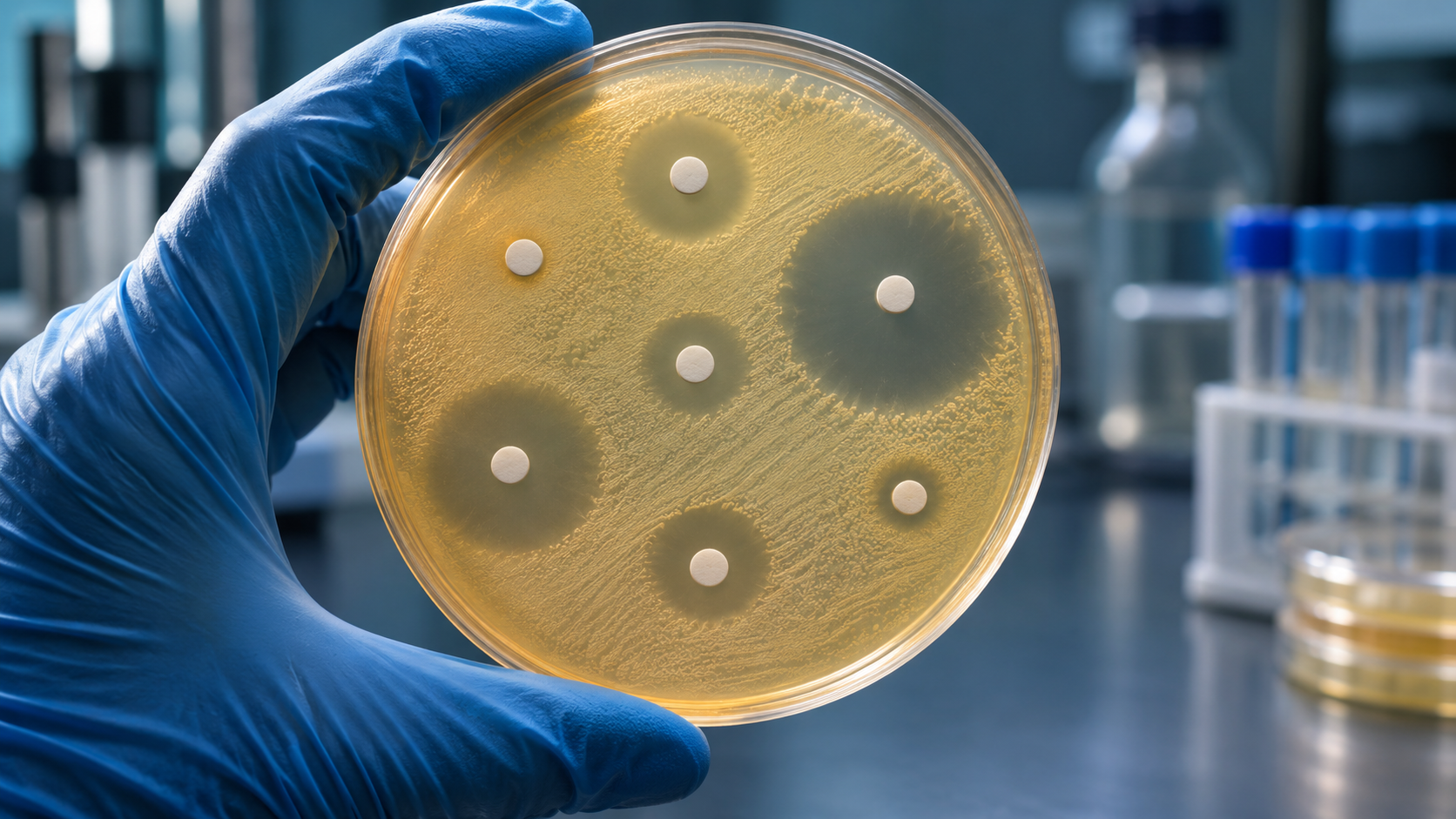
One Infection, Two Antibiotics and Two Very Different Resistance Rates
WHO’s One-in-Six Figure Comes From 93 Different Comparisons
A patient wants to know whether an antibiotic will work. The World Health Organization asked a question on a different scale. Across common bacterial infections worldwide, how often did laboratory tests show resistance to the antibiotics used to treat them?
WHO’s answer for 2023 was roughly one in six. The number behind that phrase was 17.2%, the middle value among 93 estimates of resistance. Each estimate concerned a particular infection, the bacterium causing it and the antibiotic tested. WHO published the finding in October 2025 and cited it again on 16 November 2026. The November announcement brought fresh evidence about access to testing and treatment. The global resistance figure still describes 2023.
That distinction matters if you picture six people collecting prescriptions and one going home with medicine that will fail. WHO did not follow six patients through treatment. Its evidence came from laboratories, and one of the most revealing findings was how much the answer changed when the laboratory tested a different drug against the same bacterium.
Where the 17.2% Came From
WHO’s surveillance report drew on more than 23 million laboratory-confirmed cases across the years from 2016 to 2023. In 2023 itself, 104 countries submitted data. The analysis covered bloodstream infections, urinary tract infections, gastrointestinal infections and genital gonorrhoea. Across those groups, WHO examined eight common bacterial pathogens and 22 antibiotics.
Think of the results as a list. One entry might give the estimated percentage of a particular bacterium from bloodstream infections that resisted a particular antibiotic. A second entry might concern the same bacterium and a different drug. WHO produced 93 such estimates for 2023. Arrange them from lowest to highest and the 47th entry, the one in the middle, is 17.2%.
Why go to the trouble of finding the middle entry? Because the calculation determines what you can say about the people behind it. A common infection can contribute many more patients than a rarer one, yet each combination occupies one place in the ordered list. Multiplying the 23 million cases by 17.2% would therefore give a misleading count. It would also apply a figure for one year to records collected over several years.
The spread gives a better sense of what WHO found. The middle half of the 93 estimates ran from 3.5% to 39.5%. Even after setting aside the lowest and highest quarters, the results stretched from occasional resistance to combinations where it affected around two in five.
The Same Infection Gave Two Very Different Answers
Consider genital gonorrhoea. The infection and the bacterium causing it stay the same, so it is possible to see what changes when just the antibiotic changes. WHO estimated global resistance in 2023 at 0.3% for ceftriaxone and 75% for ciprofloxacin. That is approximately three in a thousand for one drug and three in four for the other.
Both figures belong in an account of antibiotic resistance. Each is more informative than “one in six” for someone investigating that particular infection and drug. And neither percentage, on its own, records what happened to patients after treatment. To measure that, researchers would also need to know which medicine each person received and whether they recovered.
It is the bacterium that carries resistance. A person can acquire a resistant infection, including one caused by bacteria already resistant before that person needed treatment. A laboratory finding of resistance to one drug can leave other options available. The practical question then becomes whether an effective alternative is suitable for the infection, available where the patient is being treated and accessible in time.
Who Gets Tested Changes What Laboratories See
The phrase laboratory-confirmed deserves as much attention as one in six. Before an infection can appear in these records, someone must reach care, a sample must be taken, and a laboratory must be able to identify the organism and report a result. An infection that passes through none of those stages leaves no entry.
That can affect the picture in two directions. A hospital with limited testing may reserve it for its sickest patients. Its results can then overrepresent severe cases compared with the wider community. Meanwhile, people who cannot reach a laboratory may have resistant infections that go entirely unrecorded. A small number of reports from an area offers little reassurance unless there is good reason to believe the testing would have found the cases.
It also means that an apparent change can have more than one explanation. Suppose a country expands testing beyond a handful of specialist hospitals. It could identify more resistant infections while reporting a lower percentage of positive samples with resistance. The count rises because more people are tested. The percentage can fall because the newly tested patients differ from those seen at the specialist centres. Both figures can be accurate.
What Europe’s New Hospital Figures Show
On 18 November 2026, WHO’s European office and the European Centre for Disease Prevention and Control published a finding with a much more specific setting. They examined 2025 data on serious infections involving Klebsiella pneumoniae, a bacterium that can cause bloodstream infections. In 21 of the 43 countries reporting data on it, at least half the samples tested showed resistance to a group of antibiotics called third-generation cephalosporins.
There are two separate counts in that sentence. The first is a count of countries. The second is the share of samples within each country. A country with relatively few samples counts once towards the 21, just as a country with many samples does. To work out the share across all European patients, you would need different information.
For a hospital, the concern is immediate. Doctors may have to start treatment for a serious infection before the patient’s own test result arrives. They use knowledge of the likely bacteria and local resistance patterns to help choose the first antibiotic. Where resistance to commonly used drugs is widespread, that first decision becomes harder. In the European analysis, even carbapenems, a group doctors may turn to in these circumstances, faced resistance in at least half the Klebsiella samples in 10 of the 43 reporting countries.
Those European results cannot establish how far the global 17.2% figure has moved since 2023. They answer a narrower question that matters on a hospital ward today. Which treatment options are becoming less dependable for patients with a particular serious infection?
What One Laboratory Result Can Do for the Next Patient
In its November 2026 global update, WHO said 173 countries had developed national plans to tackle antimicrobial resistance. Only 22% of countries reported both having the necessary funding and implementing their plans in full. A patient experiences that gap in practical ways. Can the hospital test the sample? Will the result reach the clinician in time to guide care? Is the medicine it points to actually available?
A single result has two uses. It can help a clinician choose treatment for the person whose sample was tested. Gather enough comparable results from the people a hospital serves, and they can also guide the first choice for the next patient, while that patient’s result is still pending.
That is the value of looking past the fraction. WHO’s global estimate tells us how widespread the loss of antibiotic effectiveness has become. A well-run local testing service can answer the question that brings someone to care in the first place. Which medicine is likely to work here?
Sources
World Health Organization — Global antibiotic resistance surveillance report 2025 — Figure 2 gives the 17.2% median and its spread. The report explains the 93 comparisons and gives the drug-specific estimates for gonorrhoea. who.int
World Health Organization — More countries have antimicrobial resistance plans but patients still lack testing and treatment — The 16 November 2026 update identifies the year behind the headline and reports the gap between national plans and implementation. who.int
WHO/Europe — Resistance to key antibiotics is the norm for 2 common hospital bacteria in nearly half of reporting countries in the WHO European Region — The joint European analysis gives the country counts, hospital findings and limits of testing coverage. who.int
Next Reads
British Health Worker Tests Positive for Ebola in DR Congo. Could This Outbreak Become a Pandemic? — How the timing of a diagnosis changes what a confirmed case means for the people around it.
Congo Ebola Outbreak Reaches 7,258 Cases And 3,510 Deaths As Officials See Signs Of Progress — Why a rising case total can coexist with encouraging evidence from individual health zones.
Congo Ebola Death Toll Passes 3,000 as Unprecedented Outbreak Accelerates — How laboratory confirmation helped turn reports of illness among healthcare workers into a recognised outbreak.
