

Webb Telescope Uncovers Evidence Of An Ancient Disaster Around Neptune
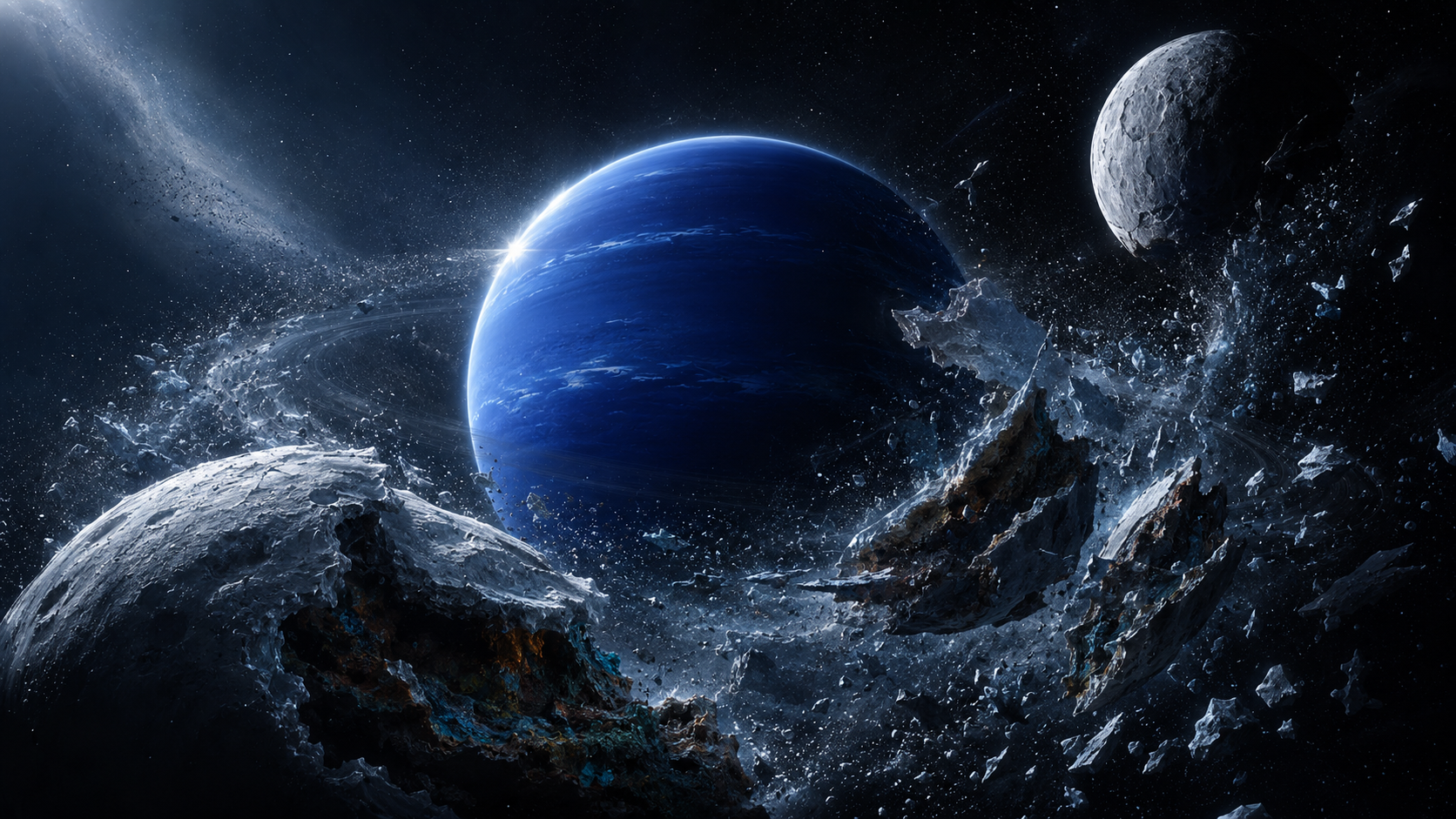
Webb Reveals How An Interloper Reshaped Neptune
Triton May Have Destroyed Neptune’s Original Moon System
The James Webb Space Telescope may have uncovered the physical remains of a catastrophe that transformed Neptune billions of years ago. Strange minerals detected across the planet’s inner moons and rings suggest that entire ancient worlds were destroyed, exposing material that should normally have remained buried deep inside them.
Researchers believe the upheaval may have begun when Neptune captured Triton, a Pluto-sized object that formed elsewhere in the Solar System. Triton’s arrival could have destabilised Neptune’s original moons, driving them into collisions and leaving the rings and small satellites visible today to form from a fraction of the wreckage.
Webb Found Something That Should Not Be There
Scientists used Webb’s near-infrared instruments to examine three of Neptune’s small inner moons—Larissa, Galatea and Proteus—along with its rings. By separating reflected light into different wavelengths, the team could identify chemical signatures that had previously been impossible to study in such faint objects beside the much brighter planet.
The most striking result was evidence of magnesium-rich phyllosilicates on Larissa, Galatea and within the rings. These clay minerals form when rock remains in contact with liquid water, yet the moons are now too small and cold to have produced that chemistry themselves.
No phyllosilicates had previously been detected in the outer Solar System beyond Jupiter. Their presence at Neptune therefore points towards material that formed inside a substantially larger body, where internal heat could once have melted ice and allowed water to react with rock.
The team also detected an unidentified hydrated mineral across all three observed moons and the rings. Its precise identity remains unknown, but its widespread presence strengthens the possibility that these objects share material inherited from a much older and more destructive event.
Triton Is The Leading Suspect
Triton dominates Neptune’s surviving satellite system, accounting for more than 99 per cent of its total mass. It also travels around Neptune in the opposite direction to the planet’s rotation, making it the Solar System’s only large moon with such a retrograde orbit.
That motion is powerful evidence that Triton did not form alongside Neptune. The leading explanation is that it originated in the Kuiper Belt before being captured by Neptune during the first billion years after the Solar System formed, when the giant planets were still moving towards their present orbits.
Capturing an object of Triton’s size would not have been a quiet addition. Its evolving orbit and gravitational influence could have thrown Neptune’s original moons onto unstable paths, causing repeated collisions that demolished the system.
Only a small proportion of that debris may have remained around Neptune. Some of it could then have gathered together again, creating the comparatively tiny inner moons and rings now circling the planet.
Why The Discovery Is So Significant
Neptune has always possessed an unusually disordered collection of moons. Jupiter, Saturn and Uranus have several substantial satellites moving in broadly regular, prograde orbits, while Neptune is dominated by one enormous captured object surrounded by much smaller companions.
Webb’s observations provide a chemical clue that could finally connect that strange modern arrangement to an ancient destruction event. The moons may not simply look irregular because of Triton’s arrival; they may contain material physically excavated when Neptune’s former satellites were torn apart.
That gives scientists an opportunity unavailable almost anywhere else. The interiors of large icy moons are normally concealed beneath thick frozen shells, leaving researchers dependent on indirect measurements and computer models.
If the new interpretation is correct, Neptune’s catastrophe effectively turned its lost moons inside out. Their reconstructed remnants could preserve accessible samples of deep planetary material, offering evidence about how water, rock and heat interacted inside ancient icy bodies.
The significance also extends beyond Neptune. Planetary systems are often studied as though their present arrangements reveal how they originally formed, but Neptune demonstrates how one captured object can erase an earlier system and replace it with something radically different.
That lesson matters when astronomers interpret distant planetary systems. A strange collection of planets, moons or debris may represent the aftermath of migration, capture and collision rather than the orderly result of their original formation.
One Survivor May Still Remain
Nereid, one of Neptune’s outer moons, may provide a second and independent trace of the lost satellite system. Webb observations found that its composition appears more similar to the moons of Uranus than to objects from the Kuiper Belt.
Computer simulations have also shown that Triton’s arrival could have thrown an original Neptunian moon into an eccentric orbit resembling Nereid’s present path. This raises the possibility that Nereid survived the disaster while most of its neighbouring moons were destroyed.
Together, the two lines of evidence produce a more complete reconstruction. Nereid may represent a displaced survivor, while Neptune’s rings and inner moons may contain material recovered from the worlds that did not survive.
What Remains Unproven
The evidence does not yet establish every stage of the catastrophe as fact. Scientists cannot directly observe the original moons, determine exactly how many existed or reconstruct every collision that followed Triton’s capture.
Another explanation remains possible. A differentiated Kuiper Belt object roughly comparable to Pluto could have passed too close to Neptune, been torn apart by the planet’s gravity and deposited its interior material into the moon and ring system.
Proteus also complicates the picture because the magnesium-rich clay signature seen on Larissa, Galatea and the rings was not detected there. It may have formed from a different part of the debris field, or later heating could have altered its mineral composition.
What Happens Next
Researchers now want to identify the unknown hydrated mineral and model how Triton’s capture would have destroyed and rebuilt Neptune’s satellite system. Those simulations could help estimate the number, composition and size of the moons that once surrounded the planet.
A dedicated mission to Neptune would provide much more detailed measurements, but no space agency currently has a confirmed return mission. Voyager 2 remains the only spacecraft to have visited the planet, completing its fly-by in 1989.
Until another probe reaches Neptune, Webb offers the most powerful means of examining its distant and exceptionally faint moons. Its discovery has already transformed scattered mineral signatures into evidence of a lost planetary system—and shown that the quiet objects orbiting Neptune may be the surviving wreckage of one of the Solar System’s greatest ancient upheavals.
