

What If Neanderthals Survived Into The Modern World?
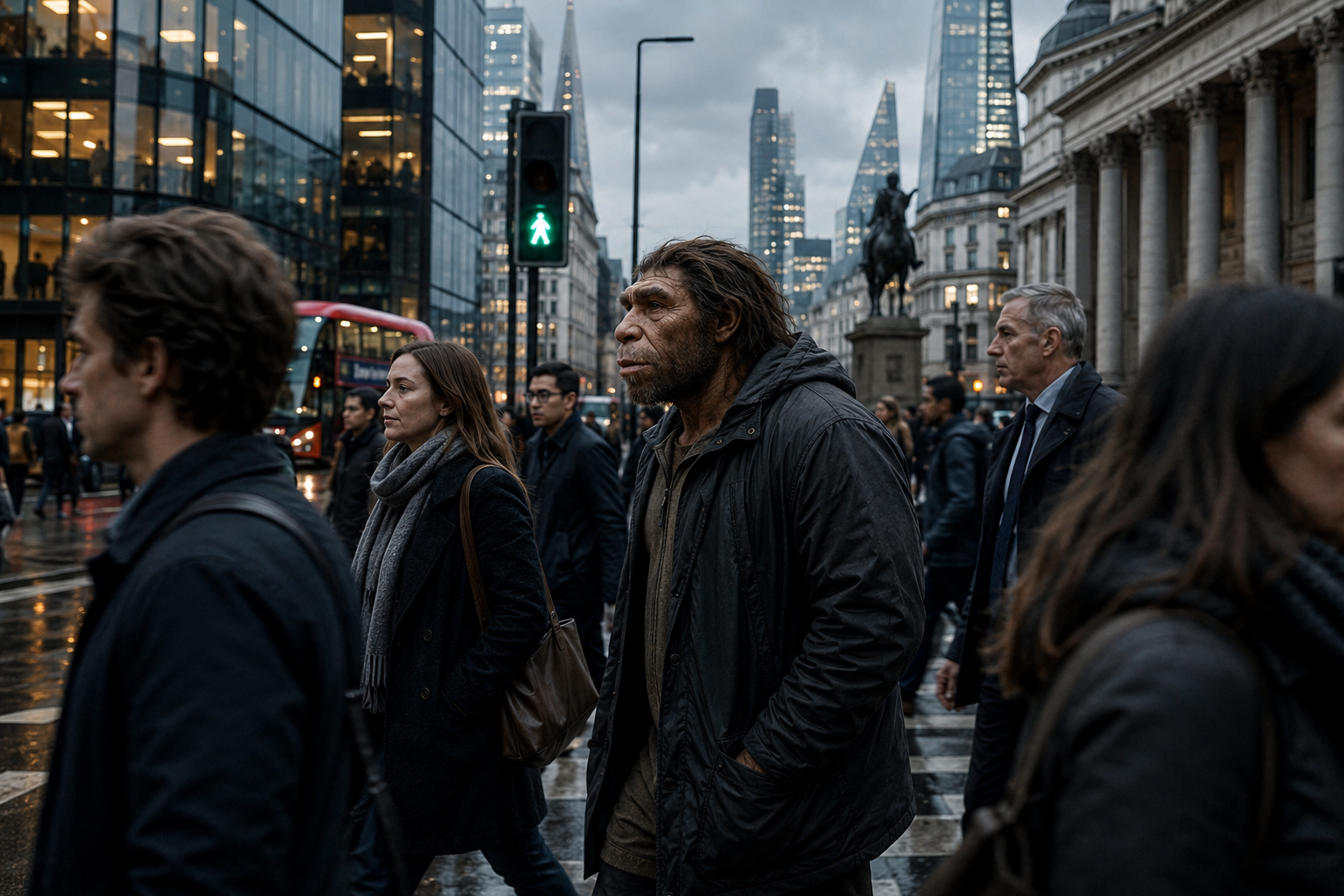
The Other Humans Europe May Have Tried To Conquer, Convert And Classify
If Neanderthals Survived, The World Would Not Look The Same
The Humans Who Did Not Vanish
The disappearance of the Neanderthals is usually treated as a prehistoric ending. A branch of humanity adapted to cold Eurasia survived for hundreds of thousands of years, met expanding Homo sapiens, mixed with them, and then vanished as a distinct population. The real evidence points not to a single dramatic massacre, but to a convergence of pressures: climate instability, small population size, competition, demographic absorption and interbreeding. Modern Eurasians still carry Neanderthal ancestry, often around one to three percent, which means the Neanderthals did not disappear completely from biology, only from the map as a living people.
The alternate history begins by changing one variable, not by inventing a fantasy species. Neanderthals do not need cities, empires or secret genius to survive. They need protected geography, enough genetic exchange to avoid collapse, and enough cultural adaptation to keep Homo sapiens from overwhelming every refuge. The survival problem is demographic before it is military. A small, slow-growing human population can be swallowed by a larger, more connected one without anyone intending genocide.
In this timeline, Neanderthals survive because extinction is delayed long enough for refuges to harden into homelands. Some bands remain in mountain valleys, deep forests, Atlantic coastal zones and northern cold refuges where sapiens settlement is thinner, agriculture arrives later, and local knowledge matters more than numerical scale. They are not frozen in the Stone Age. They adapt unevenly, selectively and slowly, preserving a distinct lineage while borrowing what works from the humans pressing around them.
That survival changes everything. The central question of this world is not whether Neanderthals are human. Biologically, emotionally and culturally, they are another kind of human. The question is whether Homo sapiens, after inventing kingdoms, churches, empires, racial hierarchies, passports and international law, would be willing to treat another human species as equal.
The Last Neanderthal Refuges
The most plausible Neanderthal survival zones are not open plains. Open plains reward numbers, mobility, long-distance exchange and eventually farming states. Neanderthals survive in broken landscapes where intimate ecological knowledge can beat scale: the Cantabrian mountains of northern Iberia, the Pyrenees, parts of the Balkans, the Caucasus, the Carpathians, Atlantic cave systems, boreal forests and cold uplands on the margins of early farming expansion.
Iberia matters especially. In real prehistory, southern Europe acted as a refuge during harsh climatic swings. A surviving Neanderthal population in northern Spain and southern France would make sense because the region combines caves, mountains, coast, game corridors and delayed full agricultural saturation. The Caucasus offers a second anchor: rugged terrain, ecological diversity and a long history as a corridor and barrier between worlds. A third survival belt could stretch across parts of northern and eastern Europe, where dense farming arrived later and forest life remained viable for longer.
These groups would not be large. The global Neanderthal population in this timeline may never exceed a few hundred thousand before the modern era, and for most of history it may be far smaller. Their survival depends on being difficult to dislodge, difficult to absorb completely, and useful enough to neighboring sapiens communities that extermination is not always the default outcome.
Their bodies shape their geography. Neanderthals were powerfully built, broad, cold-adapted and physically suited to high-calorie survival in demanding environments. That does not make them brutish. It makes them expensive. A Neanderthal community needs food, territory and seasonal planning. Their survival is therefore strongest where fishing, big-game hunting, forest gathering, herding partnerships and mountain pastoralism can support their energy demands without forcing them into dense crop agriculture too early.
Coexistence With Homo Sapiens
Contact with Homo sapiens would be intimate, tense and uneven. There would be trade, violence, intermarriage, imitation, disease exchange, hostage-taking, adoption and myth-making. Some sapiens groups would see Neanderthals as kin. Others would see them as dangerous forest people, mountain rivals or spiritually ambiguous beings. The evidence from real genetics already shows that contact between the two lineages included interbreeding, not absolute separation. Recent ancient DNA work has also sharpened the timeline of contact between early modern humans and Neanderthals in Eurasia.
The key difference in this timeline is that interbreeding does not dissolve the Neanderthals entirely. Hybrid communities emerge along contact zones, especially in Iberia, the Balkans, the Levant and the Caucasus. Some children move into sapiens groups. Some remain in Neanderthal groups. Some become brokers between worlds, valued for language, kinship and trade.
This creates the first political category problem. Are mixed people sapiens, Neanderthal or both? In a tribal world, the answer depends less on biology than belonging. A child raised in a Neanderthal valley may be Neanderthal by culture even with sapiens ancestry. A child raised among farming sapiens may become fully absorbed into local human society. Identity begins as kinship before it becomes law.
Coexistence also changes technology. Neanderthals adopt some sapiens tools, ornaments and exchange practices, while sapiens borrow local hunting techniques, winter survival strategies and mountain routes. The Neanderthals do not become modern humans with different faces. Their social worlds may remain smaller, more local and more kin-heavy. Their cultural conservatism, if real, becomes both weakness and strength: slower expansion, but deeper environmental memory.
Farming Changes The Balance
Agriculture is the great demographic earthquake. Hunter-gatherers can be strong, skilled and sophisticated, but farming produces density. Density produces villages, surplus, hierarchy, disease pools, soldiers, taxation and states. Once farming spreads into Europe, Neanderthals face the same pressure many later hunter-gatherers and pastoral peoples faced: adapt, retreat, trade, intermarry or be pushed aside.
Some Neanderthals remain hunter-gatherers. In the far north, the mountains and forests, hunting and seasonal mobility continue to make sense. But others adopt parts of farming without becoming classic farmers. They keep goats, herd pigs, manage woodland, fish rivers, trade hides and metal ores, and cultivate small plots in sheltered valleys. Their transition is not ideological. It is practical. The groups that treat agriculture as a toolkit survive better than those that treat it as a foreign invasion.
They probably do not build major early states on their own. This is not because they lack intelligence. It is because state formation rewards population density, administrative standardization, grain storage, surplus extraction and large-scale labor coordination. Neanderthal ecology pushes against that model. Their societies are more likely to form confederations, clan territories, sacred valley systems and warrior-trader networks than bureaucratic kingdoms.
But they do not stay outside history. As farming spreads, sapiens rulers begin to value Neanderthal lands for timber, metal, grazing, passes and military routes. The Neanderthal question becomes a land question. Once land becomes taxable, another human species becomes an administrative problem.
Rome Meets Another Humanity
Rome would classify Neanderthals before it understood them. The Roman mind was skilled at turning human difference into legal hierarchy: citizen, ally, freedman, slave, barbarian, provincial, enemy. Living Neanderthals in the Alps, Iberia, Gaul, the Balkans and the Caucasus would be pulled into that machine. Some would fight Rome. Some would guide Roman armies. Some would be displayed in triumphs. Some would be recruited as auxiliaries.
Rome would not initially ask whether Neanderthals are a separate species. It would ask whether they can be governed, taxed, punished, traded with and used. If they speak, bargain, swear oaths, marry, worship and fight, Roman law would have to place them somewhere. The most likely outcome is not equal citizenship at first. It is layered status. Romanized Neanderthals near cities might become legal persons under provincial arrangements. Remote groups would be treated as barbarian peoples. Captured individuals could be enslaved.
The empire would also create the first large-scale assimilation pressure. Roads, forts, markets and military service would pull Neanderthal men and women into sapiens-majority society. Hybrid families would become more common in frontier zones. Latin names would appear among Neanderthal elites. Some communities would negotiate protected status in exchange for military service, especially in mountain passes and cold borderlands.
A Roman writer would almost certainly turn them into a moral symbol. To some, they would be noble primitives: strong, austere, loyal and close to nature. To others, they would be half-human mountain brutes. Both views would be distortions. Rome’s great contribution to the Neanderthal story would be administrative: it would transform a prehistoric coexistence into a legal classification problem.
Religion And The Soul
Christianity and Islam would face a question sharper than any pagan empire: do Neanderthals have souls? If they bury their dead, love their children, make tools, speak, suffer, pray and understand moral obligation, exclusion becomes difficult. But religious institutions have often been capable of both universalism and hierarchy. Neanderthals would test both impulses at once.
Christianity would likely split early. Missionaries working among Neanderthal communities would baptize converts and argue that any being capable of receiving God must be part of the moral human family. Church authorities would debate whether Neanderthals descend from Adam, whether interbreeding proves shared humanity, and whether their physical difference is merely another form of human variety. Over time, the practical answer would win: baptized Neanderthals become Christians, and Christian Neanderthals become impossible to classify as animals.
Islam would face the question through its own universal frame. If Neanderthals can understand revelation, make moral choices and join the community of believers, they would be treated as accountable beings before God. Frontier Muslim polities in the Caucasus, Anatolia and parts of Iberia might classify them as peoples of treaty, conversion or protection, depending on political circumstances. Again, theology would bend under contact.
The deeper tension is that religion could protect and dominate at the same time. A Neanderthal convert might be recognized as spiritually equal while still socially marginalized. Mission schools, monasteries and frontier settlements could preserve Neanderthal lives while eroding Neanderthal culture. Salvation and assimilation would travel together.
Medieval Fear And Fascination
Medieval Europe would turn Neanderthals into legend. In remote valleys, they become the old people of the caves, the winter kin, the mountain folk, the heavy-browed guardians of forests. Some stories would be affectionate. Others would be monstrous. Folklore would preserve memory but distort reality, turning living communities into warnings, miracles and border myths.
Feudal lords would care about labor, loyalty and land. Neanderthal communities in Europe might be granted charters, forced into serfdom, hired as specialist hunters, used as border scouts or targeted as pagan remnants. Their treatment would vary wildly. In one valley, they might be protected by a monastery. In another, hunted by a count. In another, absorbed into a frontier town through marriage and trade.
Medieval classification would be unstable because medieval society did not think in modern biological species categories. It thought in orders, estates, faiths, oaths and obligations. A Christian Neanderthal blacksmith in a town could be socially odd but legally embedded. A non-Christian Neanderthal clan in a forest could be treated as a threat. Belonging would depend on religion, lordship and usefulness as much as ancestry.
This is where the central moral pattern hardens. Neanderthals are protected when powerful institutions find them useful, sacred or governable. They are endangered when they occupy desirable land, resist conversion, or stand outside taxation. Their humanity is never judged in a vacuum. It is judged through power.
Empire, Slavery And Science
The age of European empire would be catastrophic for many Neanderthal communities. By the fifteenth and sixteenth centuries, states are stronger, weapons deadlier, records more systematic and ideologies more expansive. If Neanderthals survive in Iberia, the Caucasus, the Balkans and northern Europe, they become objects of royal policy, church doctrine and commercial exploitation.
Some would be enslaved. Some would be displayed in courts. Some would be studied by physicians and natural philosophers. Some would be forcibly settled, taxed, converted or removed from strategic land. Empires that justified conquest over other sapiens populations would have little difficulty creating hierarchies over a visibly distinct human lineage. Neanderthal difference would become politically usable.
Colonialism would also export the Neanderthal category. European empires might compare colonized sapiens peoples to Neanderthals in order to degrade both. Scientific racism would become even more dangerous in this world because it would have a living human species to misread, rank and weaponize. Nineteenth-century race theorists would not need fossils alone. They would measure living skulls, bodies, reaction times, lung capacity and family structures, then dress prejudice as science.
Yet empire would also create Neanderthal resistance. Mountain rebellions, mixed frontier militias, religious sanctuaries and abolitionist campaigns would emerge. Some Neanderthals would become symbols of ancient European authenticity. Others would be treated as embarrassing evidence that Europe’s own humanity was never singular. The imperial world would not simply discover Neanderthals. It would try to use them.
Darwin In A World With Living Neanderthals
Darwin’s theory lands differently if Neanderthals are alive. In our world, evolution challenged the idea that humans were separate from nature. In this alternate world, the challenge is visible in the street, the army barracks, the mission school and the courtroom. A living Neanderthal population would make human evolution harder to deny and easier to abuse.
The scientific revolution would be enormous. Comparative anatomy, genetics, medicine, linguistics and psychology would all develop around the Neanderthal question. Are they a species, subspecies, sister humanity or legally protected people? How much interbreeding is possible? Which traits are inherited? Which are cultural? Which medical risks are lineage-specific? These questions would accelerate human biology, but also intensify the temptation to rank people by evolutionary distance.
Darwin himself might be more cautious, or more controversial. His opponents would point to Neanderthals as evidence of a divinely ordered hierarchy. His supporters would point to them as evidence of shared descent. Both sides would drag living people into arguments about origins. Neanderthals would not be allowed to exist privately. Their bodies would become evidence in someone else’s debate.
Modern genetics would later destroy many crude assumptions. It would show extensive shared ancestry, ancient interbreeding and deep human relatedness. It would also reveal medically important differences: immune variants, metabolism, cold adaptation, skeletal load, childbirth risks in mixed pregnancies, respiratory vulnerabilities, pain response and drug metabolism. Medicine would improve. So would discrimination. Every genetic discovery would carry a political shadow.
The Twentieth-Century Rights Crisis
The twentieth century would be the great Neanderthal rights crisis. Nationalism, racial science, total war, eugenics and industrial bureaucracy would make their position dangerous. States obsessed with purity would not treat a visibly distinct human lineage gently. Forced sterilization, segregated schooling, military exploitation and population registration are all plausible in the darker parts of this timeline.
Neanderthals would fight in modern wars. Their reputation for strength, endurance in cold conditions and mountain familiarity would make them valuable in alpine units, winter campaigns, engineering corps and close infantry roles. This would create a brutal contradiction: states that denied full equality would still use Neanderthal bodies in war. Service would become a pathway to citizenship in some countries and a source of bitter betrayal in others.
After the Second World War, the legal order would be forced to respond. The Universal Declaration of Human Rights states that all human beings are born free and equal in dignity and rights. In a world with living Neanderthals, those words would require immediate interpretation: does “human beings” mean Homo sapiens only, or every human lineage capable of reason, conscience, culture and suffering?
The answer would likely become one of the defining legal victories of the postwar era. International law would recognize Neanderthals as human persons, not animals, property or protected wildlife. Genocide law would apply. Citizenship law would be amended. Medical experimentation would be restricted. Marriage bans would fall slowly. The twentieth century would end with Neanderthals formally inside humanity, but not necessarily equal within society.
Neanderthals In The Modern Day
Neanderthals would have citizenship in most democratic states where they live. The European Union would recognize Neanderthal citizens under the same legal rights framework as sapiens citizens. The United Nations would treat them as human beings under international human rights law. The remaining disputes would not be about whether they are people, but about autonomy, land, medical protection, genetic privacy, discrimination and cultural survival.
Europe would look subtly but profoundly different. Northern Spain might have autonomous Neanderthal cultural regions. The Caucasus might contain recognized Neanderthal-majority districts with contested sovereignty politics. Parts of the Balkans and Carpathians might have protected mountain communities. Scandinavia and northern Russia might include mixed sapiens-Neanderthal populations shaped by cold adaptation, military history and forest economies.
They would not all live traditionally. Most Neanderthals would use phones, work jobs, vote, study, drive, argue online, watch sport, serve in militaries and move through the same modern systems as everyone else. Some would be doctors, soldiers, athletes, engineers, artists, clergy, activists and politicians. Others would remain in culturally distinct communities with land rights, language preservation programs and strict controls over genetic sampling.
Sport would become one of the fiercest battlegrounds. Neanderthal athletes might have advantages in strength, grip, collision sports, throwing power or cold endurance, but disadvantages in heat management, long-distance running or injury patterns. Governing bodies would face ugly questions: are Neanderthals simply another human population, or a separate competition category? Any separate category would risk reviving biological hierarchy. Any refusal to discuss physiology would risk ignoring real differences.
Medicine would become both protective and invasive. Neanderthal-specific healthcare would be necessary in orthopedics, obstetrics, respiratory medicine, pharmacology and metabolic health. But medical care could easily slide into surveillance. Genetic databases would become politically explosive. A society that once measured skulls for hierarchy might now sequence genomes for “health,” “security” or “performance.” The technology would be cleaner. The temptation would be old.
Winners And Losers
The winners in this timeline are not simply the Neanderthals who survive. Survival comes at a cost. Many communities lose land, language and autonomy. Many are absorbed into sapiens-majority populations. Many become symbols rather than sovereign actors. The greatest winners may be the mixed societies that learn earlier that humanity is not a single biological template.
Science gains enormously. Living Neanderthals transform medicine, genetics, anthropology and psychology. They force researchers to separate intelligence from conformity, culture from biology, and difference from inferiority. The existence of another human lineage makes lazy human exceptionalism harder to sustain. It becomes impossible to pretend that Homo sapiens is the only possible expression of humanity.
But supremacists also gain material. Every visible difference can be turned into propaganda. Every medical average can be twisted into destiny. Every sporting debate can become a proxy war over status. Neanderthal survival would not automatically make civilization wiser. It would merely expose civilization sooner.
The biggest loser is the comforting myth of a single human story. In this world, Europe cannot tell itself that all other humans vanished before morality began. It must confront another humanity in its courts, churches, armies, schools and parliaments. The ancient past does not stay buried. It demands representation.
Final Verdict
The most realistic Neanderthal survival timeline is not a world where they conquer sapiens or build a rival global civilization. It is a world where they survive in refuges, adapt at the edges of farming society, enter empires as frontier peoples, are converted by religions, classified by states, abused by racial science, recruited into modern wars and finally recognized as human under law after centuries of pressure.
They would interbreed with sapiens, but not disappear into them. They would adopt farming in some places, but not everywhere. They would build political structures, but probably not vast early empires. They would be enslaved in some eras, protected in others, assimilated in many places and exterminated in some. Today, they would be citizens, minorities, indigenous peoples, athletes, patients, voters, soldiers and symbols of the oldest unresolved question in civilization.
That question is not scientific alone. It is moral. Would modern humans recognize another human species as equal, or would civilization create a hierarchy of humanity? The evidence from our own history gives no easy comfort. Sapiens has struggled to treat even other sapiens as equal when power, land, labor and fear are involved.
A world with living Neanderthals would have forced humanity to face its own prejudice earlier, more visibly and with less room for denial. It would have made the word “human” less neat, less exclusive and perhaps more honest. Neanderthals did not need to
