

What If Other Human Species Never Died Out?
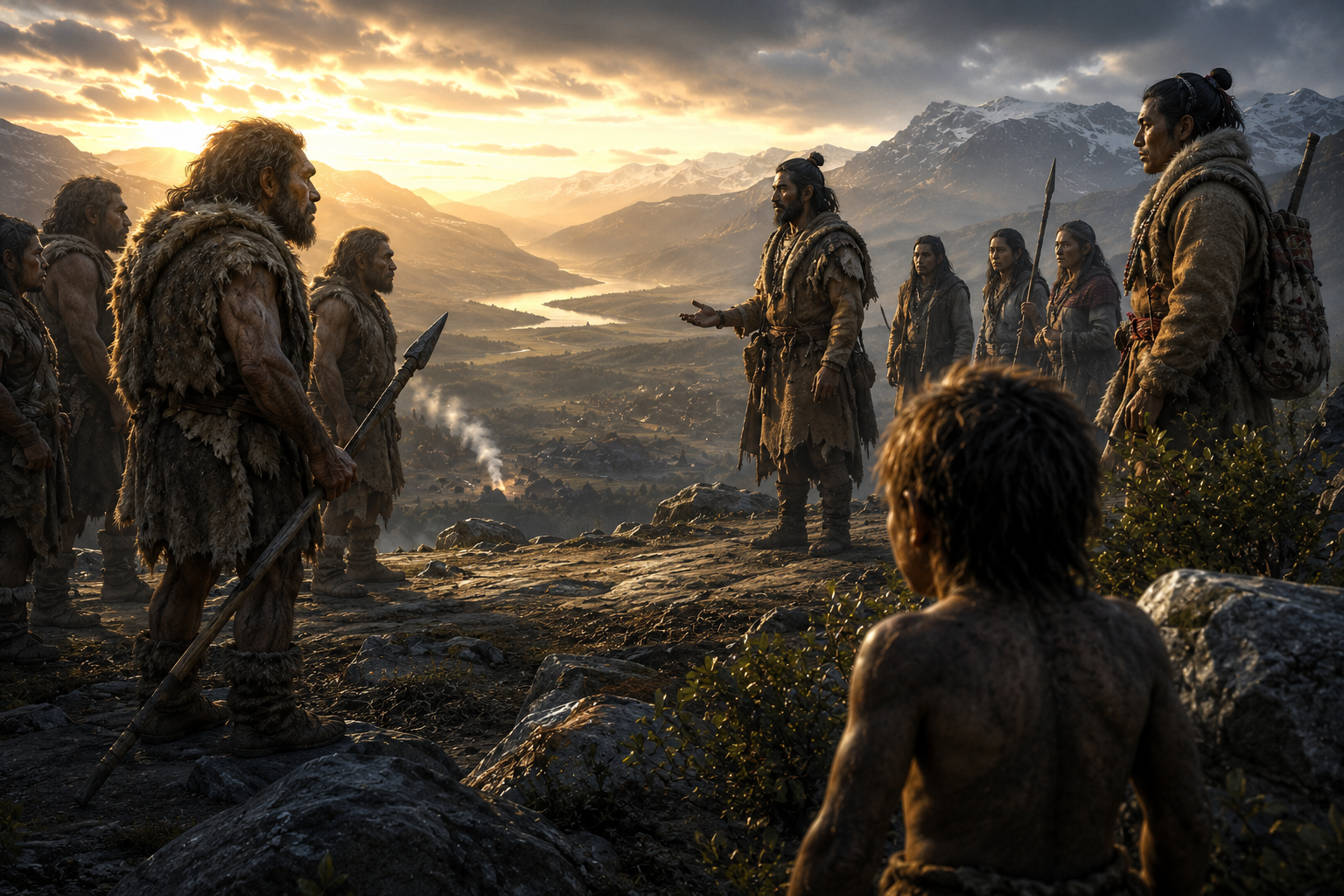
What If Humanity Was Never Alone?
The Lost Human World That Could Have Changed Civilization Forever
The Lonely Species
Modern humans live under one of the strangest conditions in evolutionary history: we are alone. Not alone as animals, not alone as intelligent beings, not alone as social creatures, but alone as the last surviving human species. The planet has chimpanzees, bonobos, gorillas, orangutans and billions of people, but only one living member of the genus Homo.
That was not the normal condition of prehistory. For most of the deep human story, Homo sapiens existed in a crowded family tree. Neanderthals lived across Europe and western Asia. Denisovans occupied parts of Asia and left genetic traces in people from Tibet to Oceania. Homo floresiensis survived on the island of Flores until roughly the same broad period in which modern humans were moving through the region. Homo erectus lasted in Java far later than older textbook timelines once assumed. Homo naledi, far earlier and more distant, showed that small-brained human relatives could exist surprisingly late in Africa. Fossil and genetic evidence has made the old ladder of progress impossible to defend. Human evolution was not a parade. It was a branching, violent, intimate, unstable forest.
The question is not whether other human species could have existed. They did. The question is what civilisation would have become if some of them had survived long enough to meet agriculture, empire, scripture, capitalism, nationalism, democracy, genetics, television, the internet and artificial intelligence.
This is not a fantasy world of elves, dwarves and monsters. It is a harder scenario. It is a world in which different kinds of human remain biologically real, socially visible and politically inconvenient.
The World Of Many Humans
Around 50,000 BC, Homo sapiens was not entering an empty world. In Europe and western Asia, Neanderthals had already spent hundreds of thousands of years adapting to cold, seasonal, dangerous environments. They were powerfully built, skilled hunters, capable toolmakers and socially complex enough to survive in ecosystems that would have killed most animals without cooperation. They were not failed humans. They were another human strategy.
In Asia, the Denisovans are harder to see because their fossil record remains sparse, but their genetic shadow is enormous. They were not a small footnote in Siberia. Their DNA appears in modern human populations across parts of Asia and Oceania, and Denisovan ancestry contributed to high-altitude adaptation in Tibet through variants associated with the EPAS1 gene. That single fact matters. It proves that archaic humans were not just obstacles to Homo sapiens expansion. They were also reservoirs of adaptation, carrying biological solutions to environments modern humans had only recently entered.
On Flores, Homo floresiensis was small-bodied, island-adapted and radically different from modern humans in physical form. Its fossils date to roughly 100,000 to 60,000 years ago, while associated stone tools at Liang Bua extend to around 50,000 years ago. That places it dangerously close to the arrival of Homo sapiens in the wider region. In Java, Homo erectus appears to have survived until around 117,000 to 108,000 years ago, making it one of the longest-running human experiments in Earth’s history.
The real world ended with contraction. Neanderthals disappeared by about 40,000 years ago, though their DNA survives in many people outside sub-Saharan Africa. Denisovans vanished as a living population, but not from the human genome. Floresiensis disappeared from Flores. Erectus ended in Java. Naledi was gone long before recorded history, though its very existence reminds us that brain size alone does not map neatly onto human complexity.
The multi-human world did not need magic to survive. It needed margins.
The Divergence Point
The most plausible divergence point is not one grand battle in which Homo sapiens loses. Homo sapiens still expands. Homo sapiens still becomes the most numerous, flexible and technologically dominant human species. The realistic alternate timeline begins with something smaller: survival pockets.
Between 50,000 and 35,000 BC, climate instability, disease exchange, interbreeding and competition still batter Neanderthals and Denisovans. But a few refuges hold. In Europe, Neanderthal populations retreat not only to the far western edges but into mountain belts, deep forests, cold uplands and broken terrain where small sapiens bands cannot easily dominate. The Pyrenees, Alps, Balkans, Carpathians, Caucasus and parts of the northern forest become survival corridors rather than extinction traps.
In Asia, Denisovans hold in a wider belt because their geography is less easily overrun. High Asia, Siberia, the Tibetan Plateau, parts of western China and pockets of Southeast Asia allow separated Denisovan-related populations to persist. They do not form one empire. They remain fragmented, locally adapted and genetically varied. Their survival depends on altitude, cold, terrain and the ability to trade selectively with sapiens without being absorbed completely.
On Flores and nearby islands, Homo floresiensis survives because sea crossings remain difficult, local ecology remains protective and early sapiens expansion into the region is less destructive. The crucial change is not that sapiens never arrive. They do. The difference is that disease, volcanic disruption, freshwater stress or direct conflict does not tip the island population into final collapse. A small living population persists into the Austronesian age.
Homo erectus is the hardest case. By 50,000 BC, the known fossil evidence does not support living erectus in Java. For erectus to survive into recorded history, the divergence must happen much earlier. Isolated island or rainforest populations in Southeast Asia would need to persist unseen, small, scattered and technologically conservative. This is possible only at the edge of plausibility. In this timeline, erectus-related humans survive not as a major civilisation, but as rare, vulnerable, forest-zone peoples repeatedly mistaken, mythologised and exploited.
Homo naledi is more relevant as a warning than as a survivor. Its known age is hundreds of thousands of years earlier, not a realistic bridge to modern day. But in this alternate world, its discovery in South Africa does something profound: it teaches modern societies that human-like social behaviour may have emerged in multiple forms, not as a single clean march toward us.
Neanderthal Europe
A Europe with surviving Neanderthals does not become a continent of two equal civilisations. It becomes a continent of overlapping human ecologies. Sapiens dominate river valleys, coasts, plains and eventually farmland. Neanderthals endure first in cold upland hunting territories, then in politically recognised mountain regions, then in shrinking enclaves.
The early relationship is mixed. There is trade in hides, stone, bone tools, pigments, ornaments, meat, salt, obsidian and information about landscapes. There is also raiding, abduction, retaliatory violence and interbreeding. Real genetics already shows that Neanderthals and Homo sapiens interbred; in this timeline, that does not stop after a narrow prehistoric window. It becomes a long border phenomenon, socially regulated in some places and violently forbidden in others.
Neanderthal societies in this scenario are unlikely to become early agricultural states in the same way as sapiens farming cultures. Their strengths lie in small-group cooperation, hunting expertise, local ecological knowledge, physical resilience and deep territorial familiarity. That does not make them primitive. It makes them politically different. Their early polities resemble confederated kin-territories rather than tax states: seasonal councils, marriage alliances, ritual territories, defensive networks and negotiated access to hunting grounds.
The arrival of farming sapiens from Anatolia changes everything. Agriculture is not just a food system. It is a demographic weapon. Farmers can sustain denser populations, clear forests, store surplus, breed livestock, create property law and fight wars of attrition. Neanderthal Europe survives the Ice Age, then begins losing ground to the plough.
By the Bronze Age, Neanderthal territories still exist in the Alps, Pyrenees, Balkans and Caucasus. They are not states in the Mesopotamian sense. They are border peoples, sometimes mercenaries, sometimes sacred mountain clans, sometimes hated raiders, sometimes marriage partners for frontier communities. Sapiens farmers tell stories about them. Some stories turn them into giants. Others turn them into ancestors. Others turn them into demons.
By Rome, the question becomes administrative: are Neanderthals people under law, wild tribes beyond law, or useful auxiliaries? Rome would likely do what Rome did best. It would classify, tax, recruit, relocate and absorb. Neanderthal men might serve as mountain troops. Neanderthal communities might be granted treaty status. Some would be enslaved. Some would be displayed. Some would become citizens. The empire would not need to decide whether they were human in a philosophical sense. It would decide whether they were useful, governable and taxable.
Denisovan Asia
Denisovan Asia would be less visible to early Mediterranean history but more important to the long balance of Eurasia. Unlike Neanderthals, Denisovans would not be concentrated in one obvious European frontier. They would survive across difficult Asian zones: Tibetan highlands, Siberian valleys, Inner Asian mountain systems, perhaps remote areas of western China and Southeast Asia.
Their political role would depend on geography. In high-altitude zones, Denisovan-descended communities could become indispensable intermediaries between lowland agricultural states and upland trade routes. The Tibetan Plateau, the Pamirs, the Altai and Himalayan corridors would not just be strategic terrain. They would be human borderlands where sapiens states needed Denisovan knowledge to move people, animals and goods.
This changes Asian civilisation quietly before it changes it loudly. Chinese states expanding west and north encounter not merely nomads but different humans adapted to cold, altitude and rugged terrain. Indian, Tibetan and Central Asian religious traditions absorb Denisovan communities into cosmology. Some are treated as mountain guardians. Some are tribute peoples. Some become hereditary frontier soldiers. Some vanish into hybrid populations.
Denisovan survival would also reshape trade. The Silk Road becomes a multi-human contact zone. Sapiens merchants cross routes maintained by Denisovan guides. Buddhist monasteries debate whether Denisovan practitioners share the same path to enlightenment. Imperial courts classify Denisovan envoys by status, usefulness and threat. Marriage across species lines becomes a diplomatic question, not merely a private act.
Over time, Denisovan political power would likely be defensive rather than imperial. High-altitude peoples can control passes, extract tribute and resist occupation, but large agrarian empires still hold demographic weight. The result is not a Denisovan China or Denisovan India. It is a belt of Denisovan autonomy inside the pressure systems of Chinese, Turkic, Mongol, Tibetan, Persian, Russian and later modern state power.
In the modern age, those zones become geopolitically explosive. Whoever controls Denisovan lands controls water towers, mineral corridors, military heights, genomic heritage and symbolic legitimacy. A surviving Denisovan population in Tibet, Xinjiang, Siberia or the Himalayas would turn human rights, territorial sovereignty and strategic geography into one fused crisis.
The Island Humans
Homo floresiensis surviving into history would change the moral imagination of the world more than its military balance. Small-bodied island humans would not conquer continents. They would not field vast armies. They would not build Rome. Their significance would come from one terrifying fact: they would be visibly, undeniably human, yet so physically different that sapiens societies would struggle to place them inside ordinary categories.
On Flores, their survival depends on negotiated isolation. They live in small communities adapted to island ecology, using tools, fire, social memory, coastal foraging, hunting and trade with neighboring sapiens groups. Austronesian expansion does not erase them because some islanders learn to trade with them, marry occasionally into border communities, mythologise them and avoid their core territories.
Their political structure would likely be local rather than urban. A Floresian civilisation would not look like a miniature Athens. It would look like a protected island network: clans, ritual landscapes, oral law, coastal exchange, restricted forests and sacred caves. Their intelligence would not need to mirror sapiens literacy to be real. Their vulnerability would be precisely that they could be intelligent without being easily legible to sapiens institutions.
When European colonial powers arrive in Southeast Asia, the Floresians become a global scandal before the modern word “human rights” fully exists. Are they indigenous people? Scientific specimens? Colonial subjects? Labour? Protected wards? Mission targets? Living fossils? The temptation to collect, display, convert, measure and control them would be enormous.
Modern Indonesia would inherit that burden. By modern day, Floresian territories would likely be among the most protected and most surveilled places on Earth: part national park, part indigenous homeland, part UNESCO-level heritage zone, part biosecurity perimeter, part political wound. Tourism would be restricted. Genetic sampling would be controversial. Every schoolchild would know they exist. Every research institution would want access. Every serious ethics board would fear repeating the crimes of colonial science.
The Oldest Humans
Homo erectus surviving into the modern world is the least plausible and therefore must be treated with the most caution. Erectus was one of the great long-term successes of the human family, but known late survival in Java still ends more than 100,000 years ago. A living erectus population in today would require deep isolation, low numbers and repeated historical misidentification.
In this timeline, erectus-related humans survive in remote Southeast Asian rainforest and island margins. They are not numerous. They are not a hidden empire. They are the human equivalent of a biological emergency: small populations at constant risk from disease, habitat loss, violence, capture and assimilation.
Their contact history is ugly. Sapiens groups sometimes avoid them, sometimes trade with them, sometimes kill them, sometimes fold them into myth. Colonial administrations classify them poorly. Missionaries debate whether they can be converted. Scientists fight over whether they are a separate species, a deeply divergent human population or the last echo of a lineage older than every living nation.
If any erectus-related people survive, their location is likely protected and partly undisclosed. Their population may be too small for long-term survival without outside intervention, but intervention itself could destroy them. Modern medicine would face an impossible question: how do you protect an ancient human lineage without turning its people into a managed breeding population?
That dilemma would expose the central truth of the multi-human world. Survival is not the same as freedom.
Agriculture With Other Humans
Agriculture is the point where coexistence becomes harder. Hunter-gatherer overlap can remain fluid for thousands of years because populations are small, territories are wide and borders are ecological rather than legal. Farming changes the arithmetic. It turns land into inheritance, surplus into power, animals into wealth and population growth into strategy.
Sapiens farmers do not need to be individually stronger, smarter or more violent than other humans. They simply become more numerous. Their villages multiply. Their diseases spread. Their livestock transform landscapes. Forests shrink. Hunting ranges fracture. Rivers become irrigation systems. Wild corridors become property. The pressure on Neanderthal, Denisovan, Floresian and erectus-related communities becomes structural.
Some non-sapiens humans adapt. Neanderthals trade meat, hides and mountain products for grain, metal and pottery. Denisovans become caravan partners, highland pastoralists and frontier specialists. Floresians cultivate gardens and manage island ecosystems. Hybrid frontier populations emerge wherever law is weak and survival is more important than purity.
Others are absorbed or enslaved. Early states need labour, and human difference is easily turned into hierarchy. If sapiens elites can define other humans as outside the full moral community, agriculture becomes the foundation of species caste. Non-sapiens people are used in mines, forests, armies, transport networks and elite households. Some are valued precisely because they are strong, adapted or exotic. Others are treated as less governable and pushed into marginal zones.
The result is not one global pattern. It is a mosaic. Some regions become mixed. Some become genocidal. Some develop sacred protections. Some create slave castes. Some interbreed extensively. Some enforce separation with religious law. But everywhere, agriculture forces the same brutal question: when land is scarce, which humans count?
The First Empires
The first empires would not invent speciesism, but they would bureaucratise it. Mesopotamian city-states encountering non-sapiens peoples through trade might classify them as foreign tribes, temple dependents or labour populations. Egyptian religion could absorb them into cosmology more easily than equality, placing them inside divine order but not necessarily inside social parity. Persia, with its imperial habit of managing many peoples, might grant some non-sapiens communities protected status if they paid tribute and supplied soldiers.
Rome would be the decisive test in the West. Roman law was flexible enough to absorb foreigners, brutal enough to enslave entire populations and practical enough to care more about order than purity. Neanderthals in imperial territory could become provincials, auxiliaries, slaves, gladiators, rural communities or mythologised mountain peoples depending on location and rebellion history. Roman citizenship might eventually include some Neanderthals, but citizenship would not erase prejudice. It would merely place prejudice inside law.
In India, the existence of other human species would interact dangerously with caste, tribal frontiers and religious pluralism. Some communities might be incorporated as forest peoples or border groups. Others might be sacralised, degraded or treated as outside orthodox social categories. In China, imperial bureaucracy would likely classify Denisovan groups through tribute systems, border administration and civilisational hierarchy. The question would not be whether they were metaphysically human. It would be whether they could be made legible to the state.
Islamic caliphates inherit the theological and legal problem at scale. If non-sapiens humans can speak, trade, worship, marry and submit to law, then they cannot easily be treated as animals. Islamic jurisprudence would likely develop categories for non-sapiens believers, protected communities and intermarriage disputes. In practice, treatment would vary by region, ruler and economic incentive.
Empires do not need hatred to become cruel. They need categories, armies, tax records and a reason to believe hierarchy is natural.
Religion And The Soul
A multi-human world would detonate inside religion. Not because religion cannot adapt, but because visible plural humanity would force the issue earlier and harder. Do Neanderthals have souls? Are Denisovans descendants of Adam? Can Floresians be baptised? Can a Denisovan become a monk, an imam, a priest, a saint, a legal witness, a spouse?
Christianity would face the sharpest Adamic problem. If all humans descend from Adam and Eve, where do other Homo species fit? The likely responses would split. Some theologians would argue that all rational humans share spiritual descent, regardless of body. Others would claim non-sapiens humans are separate creations, morally protected but not fully equal. A darker tradition would deny them souls when convenient, especially where slavery and conquest need justification.
Islam would face related questions through Adam, fitrah, legal personhood and moral accountability. If a Denisovan understands revelation and submits to God, excluding him from the community becomes difficult. The practical legal question would become capacity: language, intention, testimony, marriage, inheritance and responsibility. Some schools would develop inclusive doctrines. Others would preserve hierarchy.
Buddhism and Hinduism might absorb plural humanity with less initial shock because their cosmologies already contain multiple forms of sentient life, rebirth, beings, realms and spiritual capacities. But theological flexibility does not guarantee social equality. A tradition can recognise sentience while still tolerating caste, hierarchy, patronage or exclusion.
The deeper effect is that religion would discover universalism under pressure. The soul would become the first human rights battlefield. Long before modern genetics, priests, monks, rabbis, jurists and philosophers would be forced to decide whether moral worth belongs to a body type, a lineage, a mind, a soul or a relationship with the divine.
The Age Of Empire
European colonialism in a multi-human world becomes more brutal, not less. The existence of visibly different human species would give imperial ideology a more dangerous ladder to climb. Real colonialism already classified human populations into hierarchies using religion, skin colour, technology, language and invented racial science. Add living non-sapiens humans, and the machinery of domination gains a new category.
In the Americas, Africa, Asia and Oceania, European powers would use species difference selectively. Where non-sapiens groups control land or resources, they are called savage, backward or subhuman. Where they can be used as labour, soldiers, guides or symbols, they are called loyal tribes, protected peoples or natural allies. Scientific institutions measure skulls, bodies, languages, fertility, pain tolerance and intelligence. Museums become crime scenes with marble floors.
Abolitionism might emerge earlier in some circles because the moral horror is more visible. If a Neanderthal soldier saves a city, if a Denisovan scholar translates scripture, if a Floresian child learns a colonial language and asks why her people are caged as curiosities, the old categories become harder to defend. But visibility cuts both ways. Difference can awaken conscience. It can also harden disgust.
Scientific racism becomes species science before it becomes genetics. Nineteenth-century Europe would not merely debate racial hierarchy within Homo sapiens. It would debate whether all human species belong inside one moral family. Darwin’s theory of evolution, when it arrives, would land in a society already surrounded by evidence that humanity is not singular. The danger is that evolution could be used either to deepen kinship or to naturalise domination.
Colonial empires would likely create “human protection acts” that protect non-sapiens peoples on paper while controlling their land in practice. Mission schools, research stations, labour compounds and reservations would become familiar institutions. The twentieth century would inherit not just racial injustice, but species administration.
Darwin’s Bombshell Arrives Early
In our timeline, evolution was intellectually explosive because it placed humans inside nature. In this alternate timeline, that explosion happens earlier and with less room for denial. Living Neanderthals, Denisovans and Floresians would make the human family tree visible in markets, armies, monasteries, courts and colonial exhibitions.
Naturalists would still argue. Religious authorities would still resist. Empires would still distort science. But the evidence would be unavoidable. Comparative anatomy would not be built only from fossils and apes. It would include living human relatives with different bodies, different developmental patterns and partial interbreeding histories. The idea that species are fixed would weaken faster.
Genetics also develops under different pressure. If hybrid populations exist openly, inheritance becomes more than a curiosity. States want to classify ancestry. Churches want to regulate marriage. Armies want to recruit by trait. Doctors want to understand disease differences. Employers want labour categories. The darker side of modern biology arrives early because the incentives arrive early.
Evolutionary theory might therefore become both more humane and more dangerous. More humane, because it reveals kinship. More dangerous, because it offers a language for ranking. The same science that proves common descent can be twisted into a doctrine of natural inequality.
That is the moral pattern of this world. Knowledge does not automatically civilise. It increases the power of whoever controls its use.
The Modern Rights Crisis
By the twentieth century, the multi-human world reaches its unavoidable political crisis. Industrial states cannot run indefinitely on medieval categories. Mass education, conscription, urban labour, birth registration, passports, medical records and voting systems all require legal definitions. Is a Neanderthal a citizen? Can a Denisovan vote? Can a Floresian own land? Can a sapiens person marry an erectus-descended person? Can a hybrid child inherit property? Can a state sterilise a small endangered population in the name of public health?
The First World War accelerates the issue. Neanderthal and Denisovan soldiers serve in imperial armies. Some die in trenches, mountains and colonial campaigns. Their service becomes political evidence. If they can die for the state, why can they not vote in it? If they can be conscripted, why are they not citizens?
The Second World War makes species hierarchy morally radioactive. A world that has already classified humans by biology would see genocidal ideology take an even more explicitly speciesist form. Neanderthal communities in Europe would be at extreme risk under any regime obsessed with biological hierarchy. Denisovan and hybrid populations would be studied, sorted and targeted. After 1945, the legal response would be larger than our own Universal Declaration of Human Rights. It would need to define personhood beyond Homo sapiens.
The United Nations would likely adopt a Charter of Human Personhood, extending legal protection to all members of recognised human species and hybrid populations. The language would be fought over bitterly. Some states would accept full equality. Others would insist on autonomy rather than integration. Others would quietly maintain genomic caste systems.
Civil rights movements would not replace racial politics. They would expand them. The central slogan of the twentieth century might not be simply equality before the law. It might be: humanity is not a species monopoly.
The Modern World
Homo sapiens still dominates numerically, economically, militarily and technologically. That is the most realistic outcome. Sapiens have the deepest demographic base, the widest ecological spread, the largest states and the historical advantage of agricultural expansion. But domination is not the same as solitude.
Europe contains several recognised Neanderthal autonomous regions in mountain and forest zones: parts of the Caucasus, Balkans, Alps and Pyrenees. Most Neanderthal-descended people are now hybridised to varying degrees, but some protected communities preserve distinct languages, traditions and legal status. European politics includes parties arguing for full integration, cultural sovereignty, genomic privacy and land restitution. Far-right movements exploit species anxiety. Liberal states celebrate plural humanity while quietly fighting over policing, welfare, sport and fertility law.
Asia contains Denisovan cultural zones across highland and northern regions. Their status is geopolitical dynamite. Some live as citizens inside major sapiens-majority states. Others claim indigenous sovereignty. Tibet, Siberia, the Altai, Himalayan corridors and parts of western China become flashpoints where mineral rights, military roads, river systems, surveillance and cultural survival collide. Denisovan ancestry becomes both a source of pride and a biometric risk.
Floresian protected territories are among the most regulated places on Earth. International law recognises Floresians as a living human species with collective land rights, strict research consent rules and bans on exploitative tourism. Yet the protection itself is controversial. Some Floresians demand wider mobility, education and political participation. Others fear that integration means disappearance by another name.
The last erectus-related communities, if they survive at all, are treated as ultra-protected human populations. Their existence is partly classified for security and bioethical reasons. Activists argue this is paternalistic imprisonment. Scientists argue unmanaged exposure could be fatal. Governments argue both positions depending on which one protects sovereignty.
Medicine is transformed. Genetic screening includes archaic ancestry not as an ancestry hobby but as clinical practice. Some traits affect immune response, altitude adaptation, metabolism, musculoskeletal risk and drug response. That creates better healthcare and new discrimination. Insurers want genomic risk models. Employers want physical suitability data. Sports bodies fight over classification. The Olympics has categories that are politically explosive: open events, species-protected events, hybrid eligibility rules and endless disputes over natural advantage.
Education changes from childhood. Children do not learn that humans replaced all others. They learn that civilisation is a negotiated settlement among human lineages. Religious education includes debates over souls, personhood and creation. History classes teach the Neanderthal treaties, the Denisovan frontier wars, the Flores protection movement and the Species Rights Conventions.
AI and biotechnology add the newest danger. Machine learning systems trained on biometric data can identify species ancestry from faces, gait, voice, medical records and DNA fragments. Authoritarian states use genomic surveillance to track minority human populations. Bioengineering firms advertise therapies for archaic-linked disease risks. Extremists dream of species purity. Transhumanists argue that if humanity has always been plural, redesigning humanity is merely the next branch.
The deepest political movement is not sapiens guilt or non-sapiens separatism. It is personhood constitutionalism: the demand that rights attach to mind, relationship, culture, vulnerability and moral agency, not to one species name.
Winners And Losers
The biggest winner is probably science. A multi-human world forces biology, anthropology, medicine, law and theology to mature faster. Evolution becomes harder to deny. Human uniqueness becomes harder to romanticise. The lazy idea that intelligence has only one proper shape dies earlier.
Denisovan populations may be the strongest non-sapiens survivors. Their geography gives them defensible terrain, strategic value and deep links to highland Asia. They are pressured, exploited and politicised, but they also become indispensable. In a world where mountains, minerals, water and military corridors matter, Denisovan lands carry power.
Neanderthals are both winners and losers. They survive, which is everything. But they survive in the shadow of Europe’s most violent state systems. Their territories become battlegrounds for farming expansion, empire, nationalism, racial science, fascism, conservation and modern identity politics. They gain recognition late and at enormous cost.
Floresians win morally and lose demographically. Their survival gives the world its clearest proof that humanity is wider than sapiens expectations. But their small numbers make every interaction dangerous. Protection saves them from extinction while constantly threatening to turn them into a living museum.
Homo sapiens remains the dominant winner. Sapiens states control most land, money, technology, media, institutions and weapons. Yet sapiens also lose the comfort of monopoly. They cannot define humanity by looking in a mirror. They must share the word “human” with beings who expose how much of morality was built on convenience.
The biggest losers are empires, racial ideologies and simple origin myths. A plural human world makes hierarchy tempting but also unstable. Every empire that claims some humans are naturally born to rule faces living counterevidence in its armies, markets, churches, schools and bedrooms.
Final Verdict
Would a world of many human species be more tolerant? Possibly, in moments. It would be harder to pretend that intelligence, love, grief, loyalty and ritual belong to only one body plan. A sapiens child growing up beside a Neanderthal neighbour, a Denisovan teacher or a Floresian musician might learn earlier that humanity is not uniform.
But it could also be more brutal. Difference would be impossible to ignore. Law would classify it. Markets would price it. Empires would weaponise it. Religions would argue over it. States would police it. Scientists would measure it. Demagogues would exploit it. The existence of other humans would not automatically enlarge the moral circle. It would test whether the moral circle was ever real.
Homo sapiens would probably still dominate. The demographic force of farming, cities, writing, disease exchange, state formation and industrial technology is too large to hand-wave away. But domination would be negotiated, resisted and morally contested at every stage. Civilisation would not be the story of one species discovering itself. It would be the story of several human lineages forcing each other into law, theology, medicine, politics and memory.
The strangest fact about our world is not that Neanderthals, Denisovans, Floresiensis, erectus and other human relatives once existed. It is that we built modernity without having to look them in the eye.
The modern world was built by one surviving human species. In another timeline, civilisation may have had to answer a far harder question: what does it mean to be human when humanity is not alone?
