What If The Black Hole Came First? Webb’s Latest Discovery Is Shaking Cosmology
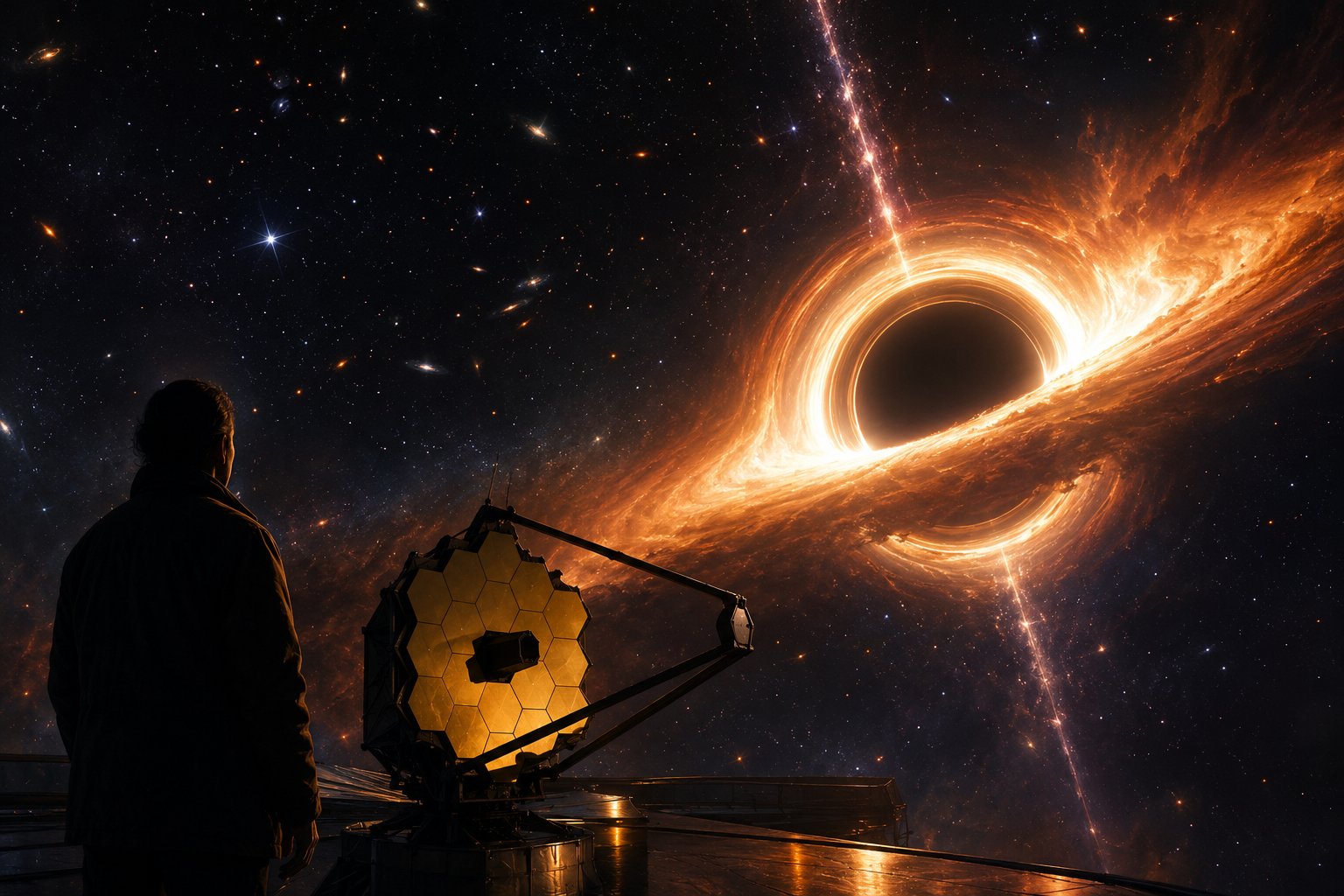
A Black Hole Older Than Its Galaxy? Webb Forces Scientists To Reconsider The Early Universe
The James Webb Telescope May Have Just Upended One Of Astronomy’s Biggest Assumptions
For decades, the standard story seemed straightforward. Massive clouds of gas collapsed into stars, stars gathered into galaxies, and somewhere inside those galaxies black holes slowly emerged and grew over time.
That sequence became one of the foundational ideas of modern astronomy. Galaxies were believed to come first. Black holes were thought to be products of those galaxies, feeding on surrounding material and gradually becoming the supermassive monsters found at the centers of large cosmic structures today.
The problem is that the James Webb Space Telescope keeps finding objects that appear far too large, far too early, and far too difficult to explain using that traditional timeline. Each new observation has added pressure to existing models, but the latest finding may be the most disruptive yet.
Researchers studying an object known as Abell2744-QSO1 have found evidence suggesting that its central black hole may have formed before the surrounding galaxy had fully developed. The black hole appears dramatically oversized compared to its host galaxy, creating a puzzle that existing theories struggle to solve.
The Black Hole That Appears To Have Arrived First
At the heart of the discovery is a surprisingly massive black hole estimated to contain roughly 50 million times the mass of the Sun.
That figure alone would be remarkable in the early universe. What makes the object so extraordinary is the apparent mismatch between the black hole and the galaxy around it. The surrounding galaxy appears relatively small and immature, while the black hole already resembles something far more developed.
Scientists were able to study the object using Webb's unprecedented sensitivity and a natural phenomenon known as gravitational lensing, where massive foreground objects magnify distant regions of space. This allowed researchers to estimate the mass of the black hole directly and compare it with the properties of its host galaxy.
The results point toward a startling possibility. Rather than growing slowly from the collapse of massive stars, this black hole may have been born already enormous. If true, that would represent a fundamentally different route to black hole formation.
Why This Matters Far Beyond One Galaxy
This is not merely a story about a single unusual object located billions of light-years away.
The early universe has become one of Webb's most important testing grounds. Again and again, the telescope has revealed galaxies and black holes appearing sooner, growing faster, and becoming larger than many theoretical models predicted.
The discovery strikes directly at one of the biggest unanswered questions in astronomy: how did supermassive black holes become so large so quickly?
Traditional models often start with relatively small black holes formed from dying stars. Those black holes then grow through mergers and by consuming surrounding matter. The challenge is that the timeline appears impossibly tight. Some black holes seem to have reached enormous sizes only a few hundred million years after the Big Bang.
The new evidence strengthens an alternative idea known as the "heavy seed" or direct-collapse scenario. Instead of beginning as small stellar remnants, certain black holes may have formed directly from the rapid collapse of gigantic primordial gas clouds. That would give them a massive head start.
Could Black Holes Have Helped Build Galaxies?
Perhaps the most fascinating implication is that the relationship between galaxies and black holes may be backwards.
Instead of galaxies creating black holes, some researchers now wonder whether early black holes helped create galaxies.
A sufficiently massive black hole could influence the flow of gas around it, altering how stars form and potentially shaping the development of entire galactic systems. Rather than being passengers inside galaxies, black holes may have acted as architects during the universe's earliest chapters.
This possibility has existed in theoretical discussions for years, but Webb is now producing observations that appear increasingly difficult to ignore. Several studies have identified unusually massive black holes embedded within surprisingly small galaxies, hinting that the pattern may not be unique.
If future observations reveal more examples, astronomers may be forced to revise the sequence that explains how the first cosmic structures emerged from the aftermath of the Big Bang.
The Biggest Unknown Remains The Most Exciting Part
Science advances when reality refuses to cooperate with expectations.
The discovery does not mean current cosmology is wrong. It does not prove that black holes definitely formed before galaxies. Nor does it confirm more exotic ideas such as primordial black holes created moments after the Big Bang.
What it does show is that the early universe was likely more complex than previously believed. The object appears to sit in a region where established models struggle and alternative explanations suddenly become much more interesting.
That is exactly the kind of result scientists hope to find. The greatest breakthroughs often begin with observations that seem impossible under existing assumptions.
A New Era Of Cosmic Discovery
The James Webb Space Telescope was built to look deeper into time than any observatory before it. Its mission is not simply to confirm what astronomers already think they know. It is designed to find the surprises.
This discovery may ultimately turn out to be an outlier. Future observations may reveal a conventional explanation. But if additional examples begin appearing across the early universe, astronomy could be approaching one of its most significant paradigm shifts in decades.
The deeper Webb looks, the stranger the universe appears.
And increasingly, the biggest question is no longer how galaxies created black holes.
It may be whether some black holes helped create galaxies in the first place.
