A Comet From Another Sun Has Revealed A Chemical Secret Scientists Have Never Seen Before
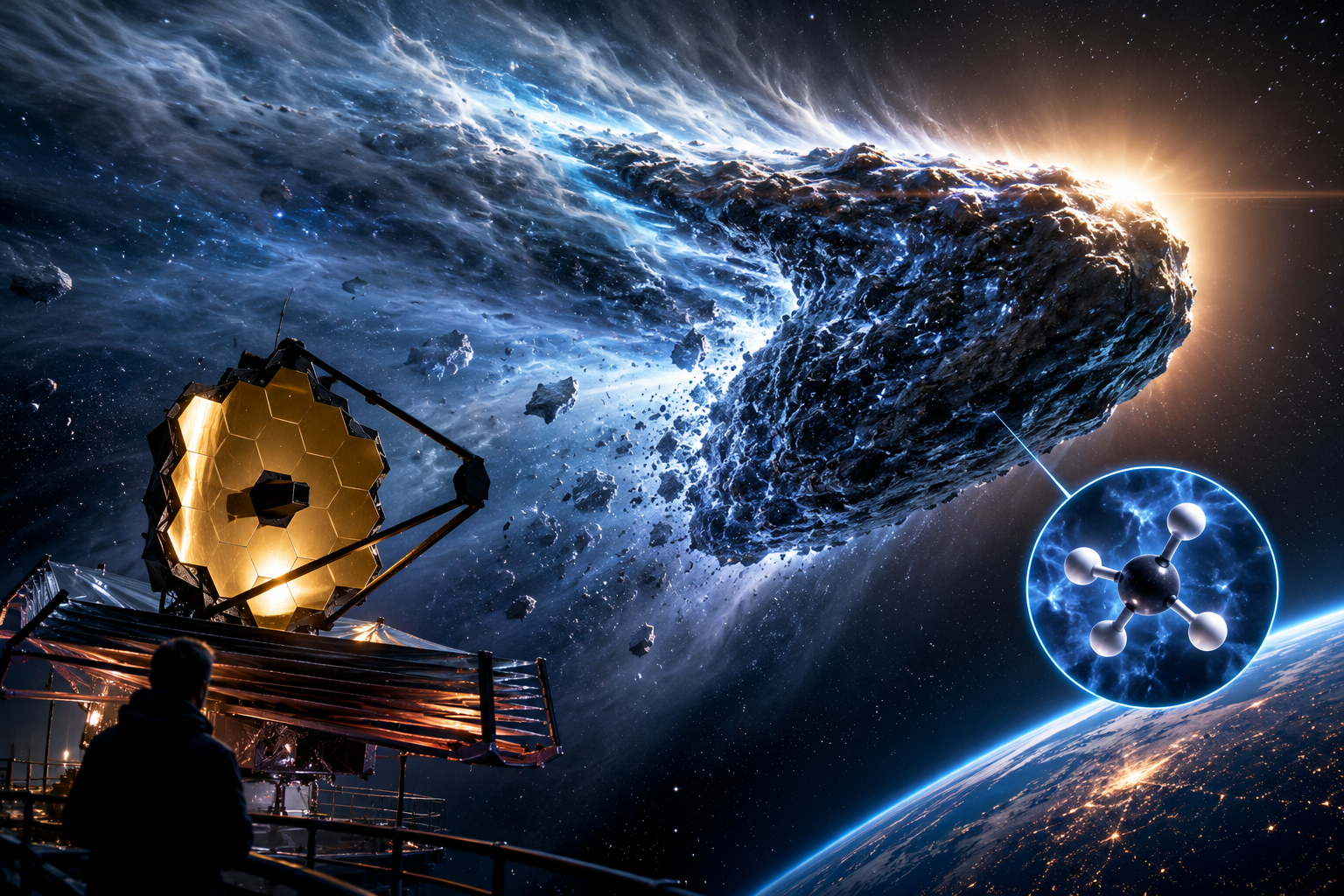
The Interstellar Object That Is Rewriting Space Science
NASA Just Found Methane On A Visitor From Another Star System — And It Could Change How We Think About Planet Formation
Most comets tell scientists about the history of our own Solar System. Interstellar object 3I/ATLAS is different. It formed around another star entirely before being ejected into the vast emptiness between stellar systems and eventually passing through our cosmic neighborhood. That alone makes it exceptionally valuable.
Now the James Webb Space Telescope has delivered a breakthrough. Scientists have detected methane within 3I/ATLAS, marking the first direct detection of methane on an interstellar object. The observation provides the first detailed mid-infrared chemical fingerprint ever collected from such a visitor and offers a rare look at materials that formed far beyond the Sun's influence.
For astronomers, this is not merely another comet story. It is effectively a sample-return mission from another planetary system without ever launching a spacecraft.
Why Methane Matters So Much
Methane might sound mundane. On Earth it is associated with everything from natural gas to biological processes. In space science, however, methane is a crucial clue to the conditions under which an object formed.
Researchers believe the methane inside 3I/ATLAS was hidden beneath the surface and only became visible after solar heating penetrated deeper layers of the comet. That means scientists are seeing material that remained protected for potentially billions of years.
The discovery is particularly significant because previous interstellar visitors failed to reveal methane in comparable observations. Its presence immediately makes 3I/ATLAS chemically distinct and potentially representative of a very different planetary nursery than the one that produced Earth and the other planets orbiting the Sun.
That raises an exciting possibility. If planetary systems across the galaxy produce dramatically different chemical inventories, then the story of planet formation may be far more diverse than scientists previously imagined.
A Chemical Signature From Another Sun
The methane detection is only part of the story. Webb's observations also found unusually high levels of carbon dioxide relative to water, making 3I/ATLAS unlike most comets observed within our own Solar System.
This matters because chemistry acts like a cosmic fingerprint. Different temperatures, radiation environments, and formation locations inside young planetary systems leave distinct chemical signatures behind.
The evidence increasingly suggests that 3I/ATLAS formed in an environment that was fundamentally different from the region where Earth and its neighboring planets emerged. Some studies indicate it may have originated in especially cold conditions rich in unusual isotopic signatures, preserving information about another protoplanetary disk entirely.
In practical terms, scientists are not simply studying a comet. They are studying the history of a distant star system that no telescope could ever directly reconstruct in such detail.
The Bigger Scientific Opportunity
Interstellar objects are extraordinarily rare. Before the discovery of 1I/'Oumuamua in 2017, humanity had never confirmed one. Then came 2I/Borisov. Now 3I/ATLAS has become only the third confirmed interstellar visitor ever identified.
Each one represents a fleeting opportunity. These objects travel through the Solar System once and then disappear forever into interstellar space.
That scarcity makes every observation precious. Unlike exoplanets, which are observed from enormous distances, interstellar objects physically travel through our region of space. Scientists can study their chemistry, behavior, and structure with far greater precision than would otherwise be possible.
It is difficult to overstate the value of that opportunity. Imagine receiving a rock sample from another solar system every few years. That is effectively what astronomers have been handed.
What Scientists Still Do Not Know
As exciting as the discovery is, many questions remain unanswered.
Researchers still do not know exactly where 3I/ATLAS originated. They cannot identify its parent star with certainty, nor can they fully reconstruct the events that launched it into interstellar space. Like a message in a bottle drifting across an ocean, its origin story remains partly hidden.
Scientists are also trying to determine whether its unusual chemistry is common among interstellar objects or whether 3I/ATLAS is an outlier. With only three confirmed examples to study, drawing broad conclusions remains difficult.
Future discoveries will be critical. Every new interstellar visitor expands the sample size and helps astronomers build a clearer picture of how planetary systems form and evolve across the Milky Way.
The Real Story Behind The Discovery
The methane detection is not important because it proves anything exotic. It is important because it gives humanity direct evidence that planetary systems beyond our own can preserve and transport complex chemical material across unimaginable distances.
For decades, scientists have studied distant stars, distant planets, and distant galaxies. What makes 3I/ATLAS special is that it brought part of another solar system to us.
That transforms a seemingly obscure astronomy story into something much larger. The discovery offers a rare glimpse into environments we may never physically visit. It provides new clues about how planets form, how chemistry evolves around other stars, and how common—or uncommon—the conditions that produced Earth might actually be.
In a universe containing hundreds of billions of stars, 3I/ATLAS may be one of the closest things humanity has ever received to a physical postcard from another world.
MAX SEO / SEO MAX
SEO Title: NASA Detects Methane On Interstellar Comet 3I/ATLAS In Major James Webb Discovery
Meta Description: NASA's James Webb Space Telescope has detected methane on interstellar object 3I/ATLAS, revealing rare chemical clues from another star system and offering new insights into planetary formation.
