What Is the Universe Expanding Into? Recent Evidence, Ranked
In the past couple of days, two fresh updates have sharpened a question people never stop asking: what is the universe expanding into?
One update comes from a new round of attention on the final, high-precision maps of the cosmic microwave background from the Atacama Cosmology Telescope. The other is a recent NASA briefing on how the upcoming Roman Space Telescope will use “cosmic voids” to pin down the expansion history with tighter precision.
But here’s the tension. The better our measurements get, the less they support the everyday picture of an explosion pushing outward into empty space. The best-fit picture is stranger and, in a way, simpler: the universe isn’t expanding into something else. Space itself is what’s expanding.
This piece explains what that sentence really means, what the newest data strengthens, and what remains genuinely unknown.
The story turns on whether “expanding into” is a physical question about an outside, or a mental model that the data never required.
Key Points
The strongest evidence supports “metric expansion”: distances grow because the geometry of space-time changes, not because galaxies are flying through a pre-existing emptiness.
The most recent high-impact dataset in this area is the Atacama Cosmology Telescope’s final release, which reinforces the standard early-universe expansion picture while tightening limits on many proposed “fixes” for the Hubble tension.
Upcoming constraints are likely to come from mapping the cosmic web at scale, including “cosmic void” measurements planned for NASA’s Roman Space Telescope.
No observation directly measures an “outside.” The models that match the data do not need an external arena, so cosmology treats “what it’s expanding into” as a category mistake, not a missing piece of the puzzle.
The most active scientific tension is not “into what,” but “how fast,” and “whether dark energy changes with time,” because those shape the universe’s long-run fate.
Some recent debate suggests parts of the acceleration story may be sensitive to how supernova data are corrected; that matters, but it is still about the expansion rate’s history, not an outside space.
Background
When cosmologists say “the universe is expanding,” they mean that on very large scales, the average distance between galaxies increases over time. The key is what counts as “distance.”
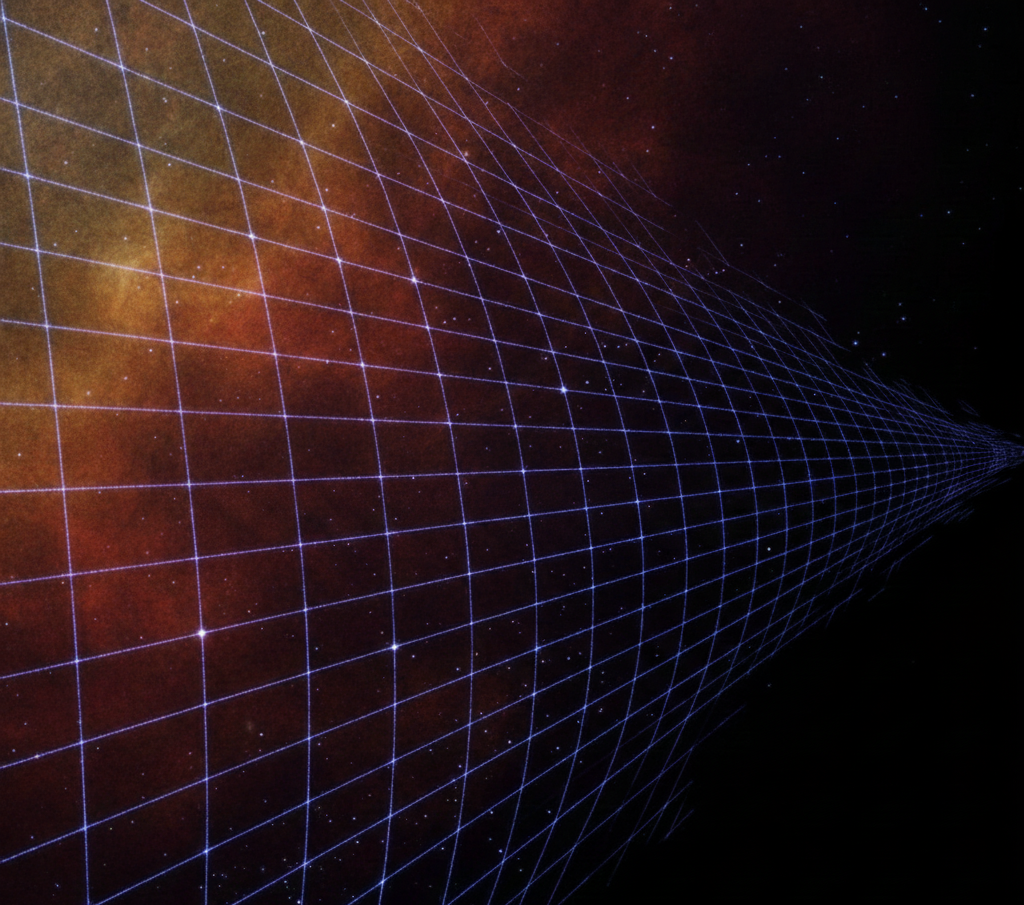
In Einstein’s general relativity, space-time is not a rigid stage where events happen. It is part of the system. You can think of it as a grid that can stretch. If the grid stretches, two dots on it get farther apart even if neither dot is “moving through” the grid.
That’s why “What is it expanding into?” is often treated like asking “What is north of the North Pole?” It assumes there is an edge and an outside direction. In the standard cosmological model, there does not have to be an edge at all.
There is also a common confusion between the universe and the observable universe. The observable universe has a horizon, meaning a limit to what light has had time to reach us from since the early universe. That horizon is not a physical wall. It’s a limit on information.
So the expansion we infer is based on internal relationships: redshifts, patterns in the cosmic microwave background, and the way matter clumps over time. None of those observations point to, or require, an “outside.”
Analysis
Political and Geopolitical Dimensions
The measurements that shape this debate are international by design. Ground-based work depends on long-term access to exceptional sites, cross-border instrument teams, and shared data pipelines. Space missions add another layer: budgets, launch schedules, and institutional priorities shape which questions get answered first.
This matters because the “what’s next” of expansion science is heavily dependent on survey scale. Wide-area mapping is not a philosophical move. It’s a practical response to where the uncertainty lives now: subtle differences between models show up only when you can measure enormous volumes of the cosmos precisely.
Economic and Market Impact
Cosmology does not move markets the way interest rates do, but it does move money in a quieter way: advanced sensors, cryogenics, precision optics, and high-performance computing. The big cost is not just building instruments. It is running them, calibrating them, and storing and reprocessing mountains of data until systematic errors are squeezed down below the signal.
A useful rule of thumb is that “expanding into” is not a spend-driving question. “How fast is it expanding, exactly?” and “Is dark energy constant?” are. Those are the questions that decide which surveys get funded and which analysis methods become standard.
Social and Cultural Fallout
The phrase “the universe is expanding” invites a movie-brain image: a blast wave moving outward, with empty space beyond. That image is sticky because it feels intuitive.
The problem is that intuition is built for local motion, not global geometry. On small scales, space is not “stretching you.” Atoms, people, planets, and even galaxies are held together by forces and gravity in ways that overwhelm cosmic expansion. Expansion shows up cleanly only when you average over huge distances.
So the cultural divide often looks like a scientific disagreement when it is really a picture-versus-definition problem. The science is not hiding the “outside.” It is saying the outside is not part of what the equations need, and not part of what the observations can access.
Technological and Security Implications
The main technology story here is measurement discipline. The reason “expanding into” keeps coming up is that people sense a gap between a simple statement and its implications. Closing that gap takes clearer models, better error accounting, and multiple independent probes.
That is also the trust story. Big claims survive when they endure independent cross-checks. The newest precision datasets matter because they tighten the room for “easy fixes” and force sharper, testable ideas.
What Most Coverage Misses
The overlooked detail is that “expanding into” is not a single question. It bundles three different ideas: whether the universe has an edge, whether there is a larger container, and whether “space” is a substance that needs room.
The newest data touches none of those directly. What it does touch is whether our internal description of the universe is self-consistent across time: the early universe encoded in the cosmic microwave background versus the late universe traced by supernovae, galaxy clustering, and gravitational lensing.
If there’s a genuine crack in the standard story, it is more likely to show up as a mismatch in inferred parameters, not as a signpost pointing to an external space. That is why the live frontier is measurement tension and model flexibility, not a detected boundary.
Why This Matters
In the short term, the people most affected are researchers and institutions building the next generation of surveys, because the expansion history is now a precision problem. Small systematic errors can shift big conclusions.
In the long term, the stakes are conceptual but real. If dark energy is truly constant, the universe’s expansion continues to accelerate in a way that shapes what remains observable in the far future. If dark energy changes with time, or if some of the acceleration evidence is more fragile than believed, the long-run story can look different.
The next milestones are not dramatic “edge of the universe” events. They are data releases and cross-check papers that tighten uncertainties, plus survey results that constrain how dark energy behaves.
Real-World Impact
A detector engineer in the American Southwest spends years chasing noise sources that most people will never hear of. If they win, a tiny improvement in polarization sensitivity can erase whole families of speculative models and force theorists back to the drawing board.
A data scientist working on sky-map pipelines repeatedly reprocesses data as calibration improves. Their daily work decides whether a “tension” is a real crack in physics or a hidden bias in analysis.
A high school physics teacher in London tries to explain why “space expands” but “things don’t get stretched.” The quality of that explanation shapes whether students see science as careful and honest, or as a stack of slogans.
A small optics supplier in Europe wins a contract to produce components that have to behave consistently at extreme temperatures. The economic impact is local, but the payoff is global: better instruments mean tighter constraints on what the universe is doing.
Road Ahead
The cleanest answer to “what is the universe expanding into” is that it isn’t expanding into anything we can define or observe. The expansion is a change in the scale of space-time itself, not a wavefront pushing into a surrounding emptiness.
What has changed recently is not the philosophy. It is the squeeze on alternatives. Better maps and bigger surveys are narrowing the space of plausible explanations for the remaining disagreements about the expansion rate.
The fork in the road is now clearer: either the late-universe measurements converge toward the early-universe prediction as systematics are understood, or the tensions persist and force new physics inside the universe, not outside it.
The signs to watch are straightforward: whether independent late-universe methods move closer together, and whether the next wave of wide-area mapping tightens the allowed behavior of dark energy enough to settle the argument about the expansion’s history.
