Could Advanced Alien Life Live Completely in Water?
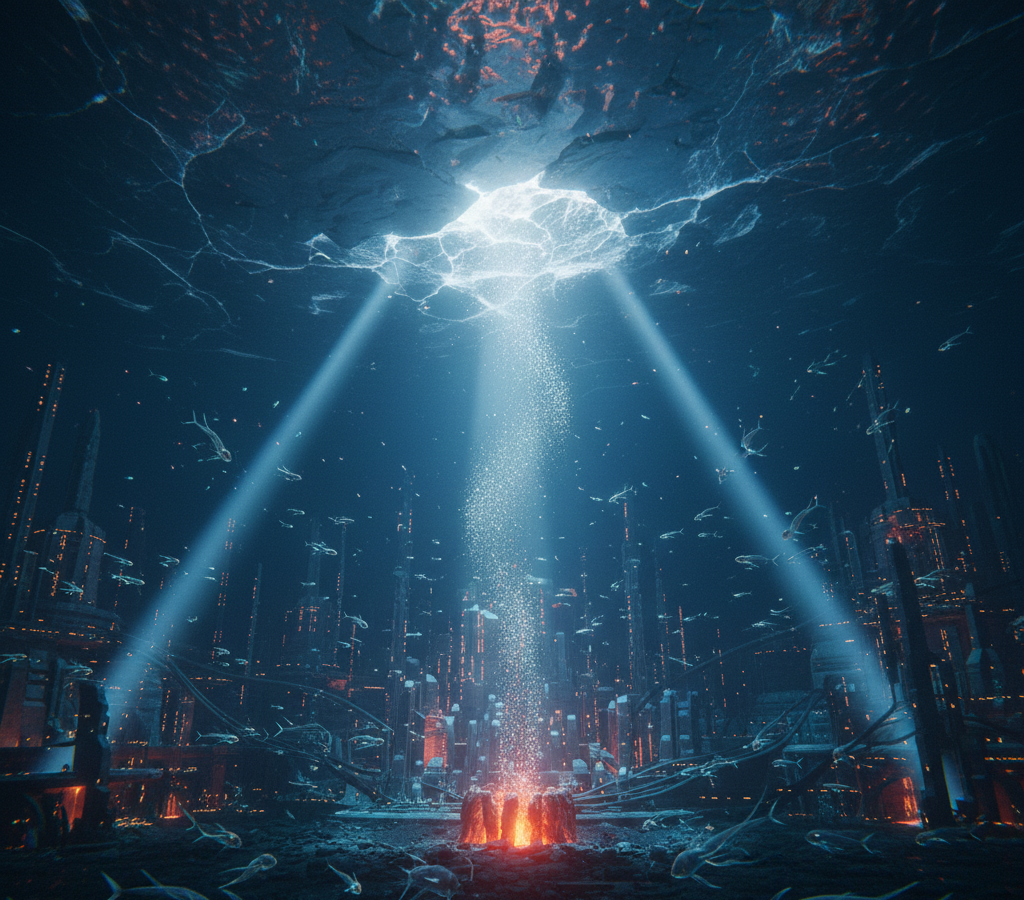
Right now, the hunt for life beyond Earth is drifting toward a simple idea: if you want biology, follow liquids. That’s why “ocean worlds” keep showing up in serious conversations about alien life in water, from planets with global seas to moons that may hide oceans under ice.
The question is not just whether microbes could survive in an alien ocean. It’s whether truly advanced life could exist there, permanently, with no land stage and no surface culture at all. That matters because it shapes what scientists should look for, what signals might reach us, and what “intelligence” could look like when it evolves under pressure, darkness, and salt.
This piece breaks down what an all-water path could support, what it would struggle to do, and the few plausible ways an aquatic civilization might still become “advanced” by its own standards.
The story turns on whether “advanced” requires the kind of technology that usually starts with fire.
Key Points
Advanced alien life in water is plausible in a biological sense, including large, complex animals and high intelligence. The ocean is not a dead end for evolution.
The biggest barrier is not brains. It is industry: controlled fire, metallurgy, and easy manufacturing are far harder underwater.
“Advanced” may need a broader definition. An aquatic species could master biology, chemistry, and information in ways that do not resemble human tech.
Under-ice oceans could support rich ecosystems if they have long-term energy sources like geology and chemical gradients, even without sunlight.
Detecting aquatic intelligence remotely is difficult. Many classic “civilization” signals (smoke, cities, radio leakage) may be absent or muted.
If an aquatic species does reach high capability, it may do so by exploiting coasts, ice interfaces, caves, or controlled air pockets rather than staying in open water forever.
Background: Advanced Alien Life in Water and Ocean Worlds
On Earth, water is not just a habitat. It is the original arena where life began and diversified. Oceans offer stability, chemical richness, and protection from radiation. They also host extreme environments where life can run on chemistry instead of sunlight, like ecosystems built around hydrothermal activity.
But Earth also shows the ocean’s limits. The sea is excellent for evolving bodies and behaviors. It is less friendly for building machines. Fire is difficult underwater, and without fire, many of the shortcuts that humans used to build an industrial civilization disappear. Even basic materials processing becomes a slow, high-effort problem.
So when people ask whether advanced alien life could be completely aquatic, the real issue is what “advanced” means: advanced biology and cognition, or advanced technology with large-scale engineering.
Analysis
Political and Geopolitical Dimensions
If a future discovery hinted at intelligent aquatic life—especially in a nearby ocean world—it would create an immediate contest over interpretation and restraint. The first argument would not be “how do we talk to them,” but “how do we avoid harming them.” Planetary protection rules exist because contamination cuts both ways. An ocean biosphere could be vulnerable to even small amounts of terrestrial microbes, chemicals, or heat.
A second pressure point would be prestige and access. Space exploration is cooperative, but it is also competitive. The first mission to detect a strong biosignature, and the first to test it independently, would carry political weight. Even without any direct contact, the existence of complex alien life would become a diplomatic topic: who sets rules, who pays, who shares data, and who gets the first close look.
Economic and Market Impact
An all-water “advanced” species also changes what industries might emerge around the search. Instruments that can detect subtle chemical cycles, heat flows, and unusual patterning in ice or oceans would matter more than classic “radio SETI” alone. That shifts money toward sensors, drilling, autonomous submarines, and long-duration power systems.
If alien oceans are common, the long-term economic implications are stranger. It would suggest that biology is not a rare accident, which would raise the value of research into origin-of-life chemistry, synthetic biology, and life-detection tools. The biggest near-term market impact would still be indirect: more funding, more missions, and more spin-off engineering rather than any kind of commercial “resource rush.”
Social and Cultural Fallout
Aquatic intelligence forces humans to confront a bias that often goes unspoken: people treat “technology like ours” as the definition of intelligence. But a species can be brilliant without building skyscrapers. Octopuses show complex problem-solving with short lifespans. Dolphins show social learning and communication in an environment that scrambles long-distance visibility. Humans are not the only template for mind.
If strong evidence emerged for a fully aquatic intelligent species, the cultural response would likely split. One camp would emphasize kinship: another thinking being, shaped by evolution, worthy of moral consideration. Another camp would emphasize distance: if they have no cities, no tools we recognize, are they “advanced” at all? That debate would spill into education, religion, ethics, and how societies define personhood.
Technological and Security Implications
For a species living completely underwater, the engineering pathway is narrow but not empty.
The hard part is precision manufacturing. Underwater, you cannot easily sustain high-temperature processes in open space. You can still get heat from geology, but controlling it is tricky. You cannot easily create clean, dry environments for electronics, optics, and high-tolerance parts. And you cannot store and use combustion energy in the usual way.
Still, there are workarounds. An aquatic civilization might build technology in sealed chambers, in natural caves, under ice, or at the boundary where water meets gas. It might exploit electricity directly through bioelectrical organs, electrochemistry, or mineral-based energy storage. It might develop “wet technology” first: polymers, ceramics, composites, and chemistry-heavy engineering that tolerates water rather than fighting it.
From a detection standpoint, an aquatic civilization may be quiet. Radio signals attenuate in seawater. Waste heat disperses. Even large structures could be hidden from distant observation. That means “no signal” would not equal “no intelligence.” It would also mean that if contact ever happened, it might be initiated by humans through probes rather than by alien broadcasts.
What Most Coverage Misses
The most overlooked factor is time. Oceans can be stable for very long periods. A species might have millions of years to refine biology, social structures, memory systems, and communication without ever crossing into industrial tech. That could produce a civilization that is “advanced” in coordination, culture, and knowledge, but not in machines.
The second missed factor is that the ocean is not one environment. Coasts, tidal zones, floating mats, ice ceilings, and submarine caves create “mixed” spaces. Evolution might find tiny interfaces where air exists, even if the broader world is ocean. If so, the idea of being “completely in water” becomes fuzzy. A species could remain aquatic in daily life while still using dry pockets as workshops, libraries, or power stations.
Why This Matters
In the short term, the definition of “advanced alien life in water” changes search strategy. If researchers assume that intelligence always produces obvious surface artifacts, they may miss quieter possibilities. Life detection may need to focus on chemistry, energy flows, and pattern recognition, not just atmospheric gases or radio bursts.
In the long term, it shapes the ethical framework for exploration. If complex ecosystems can exist in sealed oceans, then drilling, melting, or sampling becomes a moral question as well as a scientific one. The most affected sectors would be space agencies, mission contractors, universities, and the international bodies that shape exploration norms.
The next big “watch points” are not dramatic public moments. They are technical milestones: better instruments, cleaner sampling, longer-lived probes, and methods that reduce contamination risk while increasing confidence.
Real-World Impact
A robotics engineer in Seattle works on autonomous navigation for underwater drones. If ocean worlds are a prime target, funding shifts toward machines that can map, sample, and survive for months without human control. That talent pipeline grows fast.
A policy adviser in Brussels drafts guidelines for how international missions share sensitive findings. Even a hint of complex life raises questions about transparency, verification, and restraint, because the stakes are scientific and reputational.
A science teacher in Manila updates lesson plans when students ask a pointed question: if alien life can be intelligent without building cities, what does intelligence really mean? The classroom debate becomes a social debate.
A small-boat fisher on the coast of Portugal watches a documentary about ocean ecosystems and hears the phrase “alien oceans.” It sounds distant, but it nudges public attention back to Earth’s seas, and to how little people understand about life under pressure and darkness.
Conclusion
Advanced alien life could plausibly exist entirely in water, including intelligence, culture, and complex societies. The stronger claim—that a fully aquatic species could build an industrial, spacefaring civilization without ever relying on dry environments—is much harder, but not impossible if it finds stable interfaces, sealed chambers, or alternative engineering routes.
The real fork in the road is not “water versus land.” It is “biology-first advancement versus machine-first advancement.” Both can be sophisticated. They just leave different fingerprints.
If the coming years deliver clearer evidence of ocean habitability elsewhere, the key sign to watch will be whether those worlds show not only chemistry compatible with life, but also persistent, structured patterns that look less like geology and more like choice.
