Why Are Scientists Trying To Achieve Nuclear Fusion — And What Would Success Actually Change?
What Would Cheap Fusion Electricity Really Change?
A Sun On Earth
Fusion could add a powerful source of dependable low-carbon electricity, but a successful reaction must become an affordable, maintainable system before it can change everyday life.
Scientists are not trying to establish whether nuclear fusion can happen. It powers stars, and laboratories have produced fusion reactions for decades. The unfinished task is to build a system that turns those reactions into useful energy reliably enough, and cheaply enough, to operate as a power station.
Success could be consequential. Fusion could provide electricity without burning carbon-based fuel, using small quantities of nuclear fuel and potentially operating independently of the weather. It could strengthen an energy system that must power transport, heating and industry while reducing emissions.
But abundant energy would not mean free energy. The reactor, its materials, its fuel cycle, its maintenance and the network carrying its output would still have costs. The scientific promise is substantial precisely because the practical question can be stated clearly: can the whole system deliver more value than it consumes?
What Happens In A Fusion Reaction?
Atomic nuclei contain protons and, in most cases, neutrons. Fusion occurs when light nuclei combine into a different nuclear arrangement, releasing energy in suitable reactions.
The products can have slightly less rest mass than the original particles. The difference appears as energy, following the relationship expressed by Einstein's equation linking mass and energy.
This is different from nuclear fission, where a heavy nucleus splits into smaller fragments. Both are nuclear processes, but their fuels, reaction products and engineering requirements differ.
The difficulty with fusion begins with electrical repulsion. Nuclei are positively charged, so bringing them close enough for nuclear interactions requires demanding conditions. High temperature gives particles substantial motion, while quantum tunnelling contributes to the probability of fusion.
Heating is not enough on its own. The fuel must also be dense enough, and remain in suitable conditions long enough, for enough reactions to occur.
That combination explains much of the field's engineering. Researchers are trying to manage temperature, density and confinement while limiting the processes that carry energy away.
Why A Reactor Is Not Simply A Small Sun
The Sun fuses hydrogen through reactions that occur under enormous gravitational confinement. Its vast mass creates high pressure and density in the core, where fusion proceeds over astronomical timescales.
A terrestrial machine cannot reproduce the Sun's gravitational confinement. It must use another strategy, and most leading approaches use a different fuel reaction from the Sun's main proton-proton chain.
Deuterium and tritium, two isotopes of hydrogen, are attractive because their reaction is comparatively accessible under laboratory conditions. Deuterium has one neutron in its nucleus; tritium has two.
When they fuse, the main products are a helium nucleus and a neutron. The products share the released energy, with most carried by the neutron.
The required plasma temperatures can exceed those in the Sun's core because the terrestrial confinement conditions are very different. Saying a laboratory is hotter than the Sun therefore does not mean it has already become a successful star-like power source.
The phrase artificial sun communicates ambition, but it can obscure the real problem. A power station must satisfy industrial requirements that a star never has to meet: controlled output, maintainable components, safe fuel handling and an acceptable electricity price.
What A Plasma Is And How Magnets Hold It
At sufficiently high temperatures, electrons are no longer bound into ordinary atoms. The fuel becomes a plasma: a mixture of charged particles that responds collectively to electric and magnetic fields.
A solid container cannot simply hold the hottest plasma against its walls. Contact would cool the fuel and place intense stress on the surrounding material.
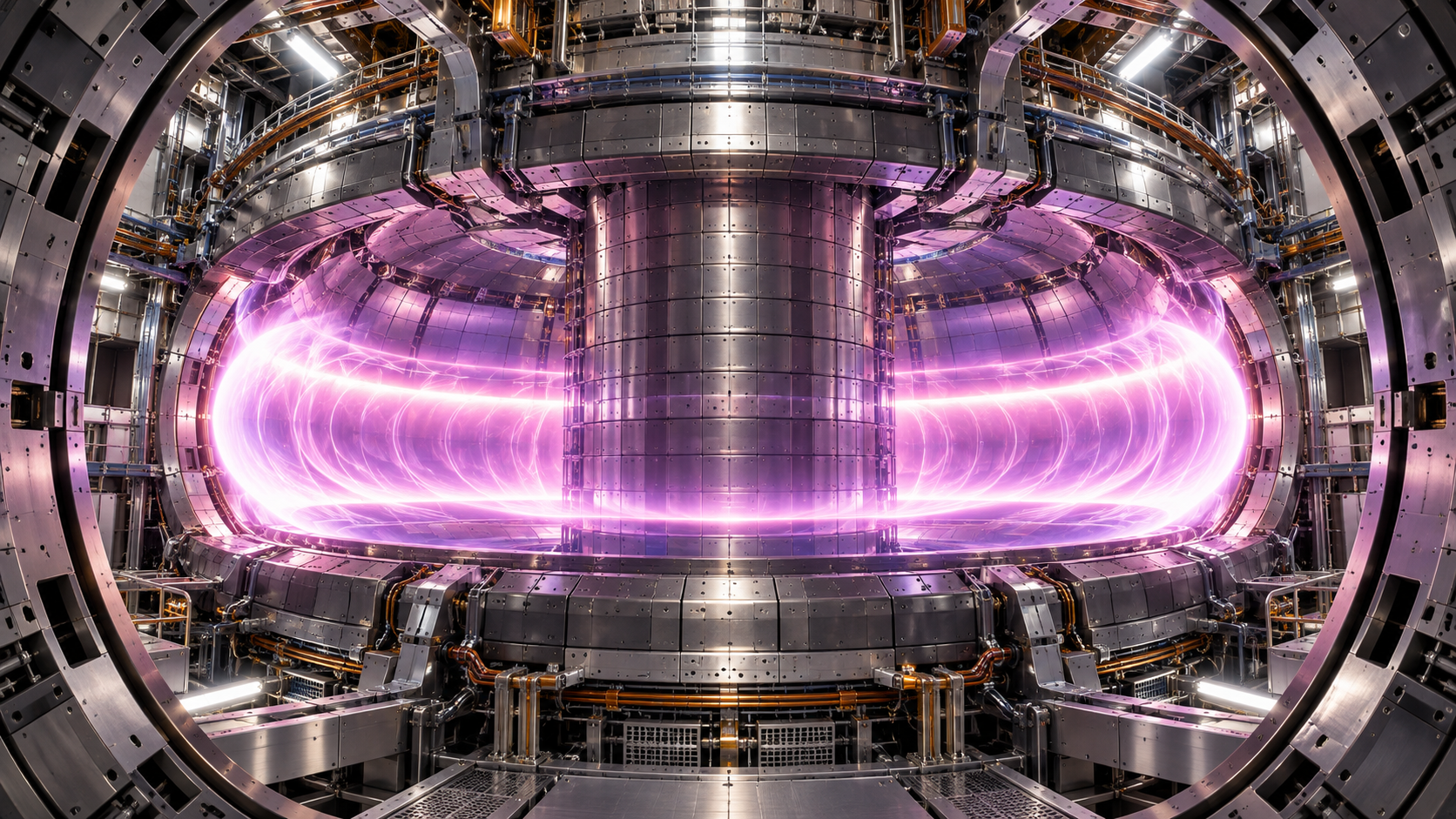
Magnetic confinement uses the motion of charged particles in magnetic fields to keep much of the plasma away from the walls. The arrangement must limit losses and maintain suitable conditions long enough for useful fusion.
Tokamaks use a toroidal, or ring-shaped, configuration with magnetic fields produced by external coils and plasma current. Stellarators use more geometrically complex external magnetic fields and offer different operating advantages and difficulties.
Neither design creates perfect isolation. Particles and heat still escape. Turbulence, instabilities and impurities can affect performance. Exhaust systems must remove heat and unwanted material while protecting the machine.
Strong superconducting magnets can improve the design options, including the possibility of more compact devices. But a stronger magnet does not automatically solve heat exhaust, fuel supply or the lifetime of the reactor's internal surfaces.
These are the linked engineering tasks behind the race to develop practical fusion machines. Plasma performance is essential, but it operates within a much larger system.
How Laser Fusion Takes A Different Route
Inertial confinement attempts to compress a small fuel target rapidly enough that fusion occurs before the material flies apart. Powerful laser systems are one way to drive that compression.
At the US National Ignition Facility, laser energy is delivered to a target arrangement that produces an intense environment around a fuel capsule. The capsule is compressed and heated, creating conditions for a short burst of fusion.
The approach differs fundamentally from maintaining a magnetically confined plasma over a longer period. Instead of holding one hot plasma continuously, a potential power plant based on this route would need repeated, highly controlled events.
That adds requirements beyond an individual successful shot. Targets must be manufactured cheaply and consistently. They must be delivered into position rapidly. The driver must operate efficiently and repeatedly, and the chamber must survive the resulting conditions.
A laboratory machine designed for high-precision experiments does not automatically have those industrial characteristics. Demonstrating the physics can be a major step while leaving the power-plant design unfinished.
The competing approaches should therefore be compared through the questions they have answered and the remaining requirements. A record in one category does not establish that an entire technology has overtaken every other route.
Why The Ignition Results Matter
In December 2022, the National Ignition Facility achieved a widely recognised milestone: a fusion experiment released more energy than the laser energy delivered to its target.
Subsequent experiments improved performance. Lawrence Livermore National Laboratory's fiscal-year 2025 annual report records an April 2025 experiment producing 8.6 megajoules of fusion energy from 2.08 megajoules delivered by the lasers, a target gain of about 4.13.
These results matter because they demonstrate a regime in which fusion reactions contribute substantially to sustaining the conditions for further reactions within the event. Repetition and improvement also provide evidence that researchers can understand and control the process better.
But the comparison concerns energy delivered to the target. It does not include all the electrical energy used by the laser facility and its supporting equipment.
Nor is the fusion output already electricity sent to customers. An industrial system would need to capture useful energy, convert it and run its own equipment before exporting a surplus.
The result is a genuine physics achievement. Describing it accurately protects that achievement from a different claim it did not establish: a complete power station producing net electricity.
There Is More Than One Meaning Of Energy Gain
A fusion headline can become confusing when the boundary around the calculation changes. Energy gain is a ratio, and a ratio only makes sense when its numerator and denominator are specified.
Target gain compares fusion energy with the energy delivered to an inertial-fusion target. Plasma gain in a magnetic-confinement context commonly compares fusion power with external heating power supplied to the plasma.
Neither necessarily includes every electrical demand in the facility. Magnets, cryogenic systems, pumps, heating equipment and control systems can consume energy outside that narrow boundary.
Engineering breakeven concerns a more complete system balance. Net electricity requires the generator's output to exceed the plant's own electrical consumption over the relevant operating cycle.
Commercial success adds further demands. A plant must cover construction, financing, maintenance, fuel-cycle costs and eventual decommissioning while selling useful output.
A simple hypothetical example shows the difference. Suppose a plant generates 500 megawatts of electricity but consumes 200 megawatts in its own systems while operating. Its net export is 300 megawatts before considering outages. Those illustrative numbers describe a system balance, not a forecast for any project.
A machine can therefore demonstrate impressive plasma physics without yet meeting engineering or commercial requirements. The definitions are not pedantry; they tell us which problem has actually been solved.
Why Tritium Is A Serious Fuel Challenge
Deuterium can be obtained from water and is abundant relative to the quantities a fusion industry would require. Tritium is different: it is radioactive, scarce and decays with a half-life of about 12.3 years.
Many proposed deuterium-tritium power plants would breed tritium using lithium in a surrounding blanket. Neutrons from fusion would interact with the blanket, producing fuel that could be recovered and reused.
The idea closes an important loop on paper. Operating it continuously at power-plant scale is an engineering challenge.
The system must produce enough tritium to replace what is burned, compensate for losses and decay, and potentially support the start-up of additional plants. It must also extract and process the fuel efficiently.
Tritium can move through materials and must be contained carefully. Storage, measurement and recovery are part of both safety and economic performance.
Calling fusion a technology powered by seawater skips this essential part of the fuel cycle. Deuterium's abundance is valuable, but the availability of one ingredient does not establish a complete, self-sufficient fuel supply.
Other proposed fuels could avoid some tritium requirements. They generally introduce different and often more demanding plasma conditions. Their appeal must be assessed alongside what has actually been demonstrated.
The Neutrons That Carry Energy Also Damage Materials
In the deuterium-tritium reaction, the uncharged neutron is not confined by the magnetic field in the same way as charged plasma particles. It can travel into surrounding material, transferring energy.
That is useful because a reactor must extract heat. It is also destructive because repeated neutron impacts can alter the structure and composition of materials.
Components may become brittle, swell or change their thermal properties. Nuclear reactions can create helium within materials and contribute to long-term damage. Some components can become radioactive through activation.
The inner structures must therefore survive an environment combining irradiation, heat and mechanical stress. Materials that perform well in a short test may not provide an adequate lifetime under continuous operating conditions.
Replacement is also difficult. Activated components may require remote handling, and the design must allow maintenance without turning every intervention into a lengthy reconstruction project.
This is a central economic issue. If expensive components need frequent replacement and the plant spends too much time offline, excellent plasma performance will not produce cheap electricity.
The reactor must be designed for the conditions after thousands of operating hours, not simply for the moment when a record reaction occurs.
Heat Exhaust May Decide Whether A Design Works
Fusion power has to leave the plasma and eventually reach useful equipment. Along the way, heat can become concentrated on particular surfaces.
In magnetic devices, a divertor helps manage exhaust and impurities. The local heat loads can be severe, making material selection and cooling design critical.
A successful solution must remove energy without contaminating or destabilising the plasma. Material eroded from a surface can enter the fuel and radiate away energy that the reaction needs.
That creates a coupled problem. Improving one component can change conditions elsewhere, so the machine cannot be optimised as a collection of independent parts.
Cooling loops must also work reliably in an irradiated environment. Leaks, corrosion, fatigue and access for repair become part of the design case.
The engineering sounds less dramatic than holding a plasma at an extraordinary temperature. Yet it is exactly the kind of detail that separates an experimental pulse from a dependable generating station.
How Fusion Energy Would Become Electricity
For many leading designs, the route from nuclear energy to electricity remains familiar. Heat is captured in a working fluid and used through a thermal power cycle to drive a generator.
The efficiency of that conversion depends on temperatures, materials and the chosen cycle. Not all heat can become useful electrical work, and the plant must reject the remainder.
Higher operating temperatures can improve the theoretical opportunity, but materials and cooling systems must tolerate them. A gain in one part of the system may impose costs in another.
Some alternative fusion concepts propose direct conversion of charged-particle energy. Those approaches have their own requirements and should not be assumed to apply to every reactor.
The complete plant includes equipment that rarely appears in an image of the plasma chamber: turbines or other conversion machinery, cooling systems, electrical infrastructure, shielding, maintenance spaces and fuel processing.
This is why a compact fusion core does not necessarily imply a tiny overall power station. The balance of plant still needs space, materials and investment.
Would Fusion Be Safer Than Fission?
Fusion has important potential safety advantages. A deuterium-tritium plasma requires demanding conditions to keep producing energy; if those conditions are lost, the fusion reaction rapidly stops.
It does not operate through the same self-sustaining chain reaction as a fission reactor. The small quantity of fuel in the active plasma at one time also limits the energy available from the immediate reaction inventory.
But describing a fusion plant as having no hazards would be wrong. Tritium is radioactive. Neutron activation creates radioactive components, while stored magnetic energy, industrial chemicals and hot coolants introduce additional risks.
Safety therefore depends on design, containment and operation. Engineers must analyse failures in the complete facility, including events outside the plasma chamber.
The waste profile could differ substantially from that of conventional fission, especially with carefully selected materials. However, fusion does not mean zero radioactive waste, and the handling requirements depend on the components and their irradiation history.
The fair comparison is specific: which hazards, how much radioactive inventory, what accident pathways and what waste-management requirements? A general claim of perfect safety cannot substitute for those answers.
What Dependable Low-Carbon Power Could Change
If fusion becomes technically and commercially successful, one major value would be the ability to provide substantial low-carbon output without relying directly on daily weather conditions.
A grid with large amounts of wind and solar must balance supply and demand across changing conditions. Storage, transmission, flexible demand and dependable generation can all contribute.
Fusion could become one option in that mix. Its value would depend on cost, reliability and how flexibly a particular plant could operate.
A plant that is expensive to build but relatively cheap to run may be most economical when used frequently. That affects how it competes with generators whose output has very low marginal cost when the wind blows or the sun shines.
The economic question is therefore broader than whether fusion can produce electricity. It must produce electricity that the system needs, when and where it is useful, at a cost that justifies its role.
A dependable plant could also support long periods of low renewable output or serve areas where other clean resources are constrained. The scale of the benefit would vary with geography and the existing energy system.
A Powerful Reactor Can Still Produce Too Little Useful Energy
Power measures the rate at which energy is produced. Energy measures the accumulated output over time. A plant's peak rating therefore does not tell us how much electricity it will deliver over a year.
A hypothetical one-gigawatt plant operating at full net output for one hour supplies one gigawatt-hour. If it is unavailable during most of the year, its annual contribution will be far smaller than the nameplate rating might suggest.
The capacity factor expresses actual generation relative to what continuous operation at rated output would have produced over the same period. It reflects outages, operating limits and, in some cases, market decisions to reduce output.
For fusion, maintenance requirements could strongly influence this measure. Replacing a damaged internal component may involve cooling, remote handling, inspection and recommissioning before production resumes.
A design with a lower peak output but longer service intervals could therefore produce more valuable electricity than an impressive machine that frequently stops. The comparison depends on annual performance, not a record reached briefly during a test.
Reliability also affects the rest of the grid. Operators need to plan for unexpected loss of a large generator and ensure that other resources can respond. Dependable generation still requires reserves and coordinated system operation.
Would Fusion Remove The Need For Energy Storage?
Not necessarily. Electricity demand changes across hours and seasons, and the most economical operating pattern for a fusion plant may not exactly follow those changes.
If the plant's capital cost is high, keeping it productive can be preferable to reducing output whenever demand falls. Storage or flexible industrial demand could help use that output at times when ordinary consumption is lower.
Thermal storage might also have a role in some designs, separating aspects of heat production from electricity generation. Whether that works depends on temperatures, materials, cost and the operating characteristics of the reactor.
Other grids might use fusion alongside wind and solar, with batteries handling short fluctuations and additional resources covering longer imbalances. The appropriate combination would be a system-design question rather than a property of fusion alone.
Storage has costs and losses, so it should not be assumed to solve every integration issue cheaply. Equally, adding dependable fusion would not make every storage investment redundant.
The useful outcome would be a broader choice of resources whose strengths can be combined. Engineers would still need to match supply, demand and network capacity hour by hour.
Would Electricity Become Cheap Or Free?
Fuel is only one part of the cost of electricity. Even a reactor with inexpensive fuel must repay its construction and financing, employ staff and maintain equipment.
The cost of capital matters because large projects often spend years consuming money before they earn revenue. Delays can increase the eventual price of the electricity, even if the reactor works well once completed.
Maintenance and availability matter just as much. A plant that is theoretically powerful but frequently offline spreads its fixed costs over fewer units of output.
Transmission, distribution and retail services also remain. The bill paid by a household is not simply the fuel cost at the power station.
Fusion could lower some energy costs if it becomes competitive and widely deployed. But neither low fuel mass nor abundant deuterium proves that outcome in advance.
The credible goal is affordable, reliable low-carbon energy. Promising electricity too cheap to matter confuses a possible improvement in one input with the economics of an entire system.
What Fusion Could Do For Heavy Industry
Steelmaking, chemicals, cement and other industries use large amounts of energy. Some processes require electricity, while others need high-temperature heat or chemical feedstocks.
Competitive fusion electricity could support electrification where suitable equipment exists. It could also power electrolysis to produce hydrogen for applications in which hydrogen has a useful role.
But changing an industrial process involves more than replacing its energy bill. Factories may need new equipment, redesigned production lines and reliable supply chains for new inputs.
Some emissions arise from chemistry rather than energy use alone. Cement production, for example, releases carbon dioxide through the processing of carbonate material. Cleaner electricity does not automatically eliminate that source.
Direct heat from a fusion plant might be useful in some settings, but its temperature, distance from the user and reliability would determine whether it fits. Heat is generally harder to transport over long distances than electricity.
Fusion could therefore expand the available decarbonisation options. It would not provide one universal industrial conversion that works identically for every sector.
Could Abundant Energy Ease Water Scarcity?
Desalination turns seawater into fresh water and consumes energy. Lower-cost, dependable electricity could improve its economics in suitable coastal regions.
That could be valuable where water demand is high and freshwater resources are limited. Energy also supports pumping, treatment and recycling within existing water systems.
However, water scarcity has several causes. Inland distribution can require expensive infrastructure, and some locations are far from a suitable source. Storage, leakage and governance can matter as much as the production process.
Desalination also leaves concentrated brine that must be managed responsibly. Intake and discharge can affect marine environments, so more available electricity does not remove the ecological questions.
Agricultural water use adds another complication. Cheap production does not guarantee that water reaches the farms or communities with the greatest need, nor does it automatically change wasteful practices.
Fusion could reduce an important constraint. The result would still depend on pipelines, treatment systems, environmental standards and institutions capable of providing a reliable service.
What About Synthetic Fuels And Carbon Removal?
Abundant low-carbon electricity could help produce hydrogen and synthetic fuels. These may be useful for some activities that are difficult to electrify directly, including parts of aviation and shipping.
The processes involve conversion losses. Using electricity to make a fuel and then converting that fuel back into motion generally consumes more electricity than using an efficient direct electrical route where one is available.
That does not make synthetic fuels pointless. It means their strongest uses are likely to be those where their storage, transport or energy-density advantages justify the additional steps.
Energy could also support carbon dioxide removal. Direct air capture and related processes require equipment, energy and somewhere to put the captured carbon securely.
Cheap energy would improve some calculations without making permanent storage effortless. Monitoring, transport, suitable geology and the overall environmental balance would still matter.
The same principle applies across these applications: a cheaper input can expand what is practical, but every subsequent process retains its own physical and economic constraints.
Would Fusion Change Geopolitics?
An energy source with a different fuel supply could alter the strategic value of some existing resources. Countries dependent on imported fossil fuels might gain another route to reducing that dependence.
Fusion fuel would be needed in small quantities compared with the physical volume of coal, oil or gas used by large energy systems. That could change transport requirements and exposure to some supply disruptions.
Yet energy independence is never only about the fuel. Reactor designs may depend on specialised magnets, manufacturing expertise, control systems, materials and maintenance services.
Those capabilities can become concentrated in particular countries or companies. Intellectual property, export controls and industrial capacity could create new dependencies even as old ones weaken.
States would also differ in their ability to finance and construct plants. A technology does not become globally available merely because its physical fuel ingredients are widespread.
The likely geopolitical effect would be a redistribution of advantages, not the disappearance of strategic competition. The details would depend on who can manufacture, operate and export reliable systems.
Why Fusion Would Not End Environmental Limits
More low-carbon energy could improve living standards and reduce pollution from combustion. It could also make some resource-intensive activities cheaper, increasing demand for materials and land.
Mining, habitat loss and waste do not vanish when electricity becomes cleaner. Manufacturing a large fleet of plants requires industrial inputs, and the wider economy still uses finite resources.
Cooling requirements can affect water use and siting. Waste heat remains part of thermal electricity generation, even when the primary energy source produces no carbon dioxide through combustion.
Demand can also respond to lower prices. If energy becomes cheaper, people and businesses may use more of it. That can deliver benefits, but it means efficiency and environmental policy remain relevant.
Fusion would therefore change the set of constraints rather than remove all constraints. It could make some activities much easier while leaving others limited by ecology, materials, infrastructure or political choices.
A serious account of abundance asks what becomes abundant and for whom. Electricity is an important input to prosperity, but it is not identical to clean water, housing, biodiversity or a well-functioning public service.
Why Climate Action Cannot Wait For Fusion
Even a successful first power plant would be only the beginning of deployment. Designs must be licensed, supply chains expanded, workers trained and construction repeated.
An energy system turns over across years and decades. Replacing a meaningful share of global generation requires many plants, not one convincing demonstration.
The emissions released while waiting still accumulate. A future energy source cannot automatically undo the warming associated with delayed reductions today.
Existing low-carbon options therefore remain necessary: renewable generation, suitable nuclear fission, efficiency, storage, stronger grids and changes in demand all have roles depending on location and evidence.
Fusion research can proceed alongside those efforts. Treating it as a reason to postpone available measures would assign an unproven technology a task it cannot yet perform.
The sensible comparison is between complementary investments and their timing. A longer-term opportunity can be worth pursuing without being a credible substitute for near-term deployment.
Why A Prototype Is Not Yet An Industry
The first successful machine in a new category often uses expensive components, unusually skilled staff and extensive support. Its purpose is to demonstrate that the system can work.
A commercial industry needs repeatable construction and operation. Suppliers must deliver consistent components, maintenance procedures must be predictable and customers must have confidence in the output.
Learning can reduce costs, but it is not automatic. A design may contain components that remain expensive or difficult to manufacture at scale. Changes made to improve production can also affect performance.
Regulators need evidence about the actual hazards and operating conditions. Insurers, lenders and grid operators need information that a short experimental run cannot provide.
The transition therefore involves accumulated operating experience. Reliability is demonstrated through sustained service, inspection and maintenance, not inferred from a single peak output.
The history of major scientific breakthroughs shows that discovery and widespread adoption are different stages. Fusion's industrial significance will depend on completing both.
How To Judge A Fusion Breakthrough Headline
The most useful first question is what was measured. A temperature record, a long plasma duration, a high fusion yield and net electrical output describe different achievements.
Next comes the boundary around the energy calculation. Does the input include only plasma heating or laser energy on target, or the whole facility? Is the output heat, fusion energy or exported electricity?
Then consider duration and repetition. A brief peak may establish valuable physics without showing that the plant can run for commercially useful periods.
Maintenance and fuel-cycle information are also important. A design needs a credible account of component lifetime, tritium supply where relevant and the time required for replacement work.
Finally, distinguish a company's target from an independently demonstrated result. A proposed date can organise a programme without guaranteeing that the required engineering will be complete by then.
These questions allow optimism to remain specific. They identify which risk has fallen and which work remains, making a real advance more useful than a broad declaration that fusion has been solved.
What Success Would Look Like
A convincing fusion power station would repeatedly produce useful net output, manage its fuel and radioactive materials safely, and survive long enough between maintenance periods to make economic sense.
The next level of success would be a design that can be built again, financed and connected where its electricity is needed. At that point, the discussion would move from experimental milestones to construction rates, service performance and the price customers pay.
The decisive demonstration will be an operating system: fuel arriving, power leaving, components lasting and maintenance returning the plant to service. That is the step that could turn fusion from an extraordinary laboratory achievement into a consequential source of energy.
Sources
Lawrence Livermore National Laboratory — National Ignition Facility, Fiscal-Year 2025 Annual Report — The April 2025 fusion yield and target-gain result.
US Department Of Energy — Fusion Nuclear Science And Technology — Materials, heat handling, fuel-cycle and integrated-system challenges.
US Department Of Energy — Deuterium-Tritium Fusion Fuel — Fuel supply, lithium and the constraints surrounding alternative reactions.
Next Reads
Fusion Energy Breakthroughs Push Tokamak Reactors Toward Real Power — Further context on the effort to improve fusion machines.
Ranked: Science’s Most World-Altering Breakthroughs — How scientific capability becomes wider technological change.
