Why Were Gravitational Waves Such A Huge Discovery — And What Could They Allow Us To Discover?
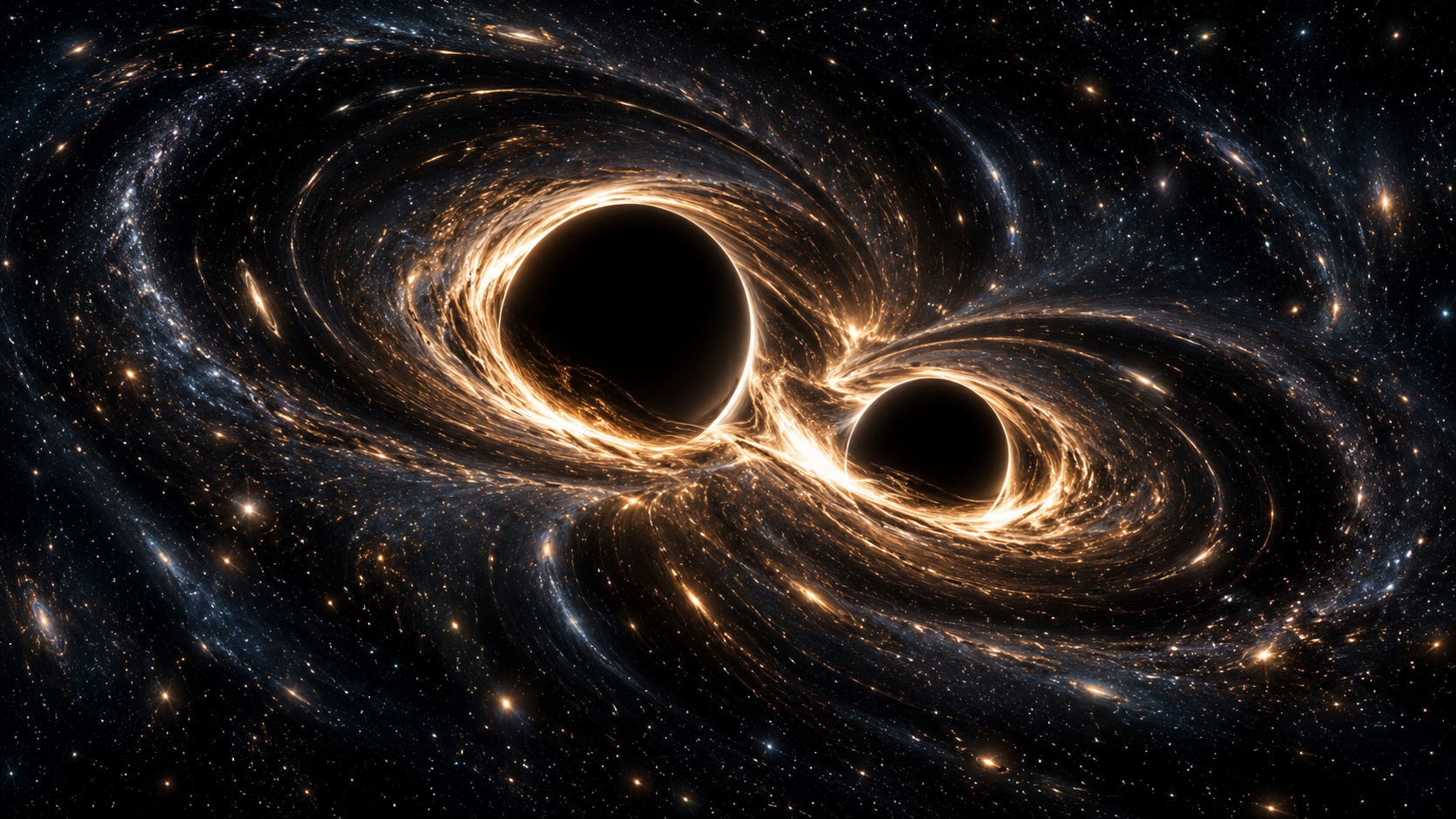
The Cosmic Ripples That Let Scientists Detect Colliding Black Holes
Listening Beyond The Light
Ripples in spacetime let astronomers study violent events through gravity itself, revealing compact objects and physical conditions that light alone cannot fully explain.
On 14 September 2015, two detectors in the United States recorded a brief disturbance. It came from two black holes merging more than a billion light-years away. By the time the signal reached Earth, its effect on the detectors was almost unimaginably small.
The observation, announced in February 2016, was the first direct detection of gravitational waves. It confirmed a major prediction of general relativity and established something equally consequential: astronomers could investigate the universe through changes in spacetime, rather than relying only on the light and particles that distant objects send towards us.
That new channel has its own strengths. Black holes can merge without producing a conspicuous flash. Dense stellar remnants can conceal their internal physics from ordinary telescopes. Gravitational waves provide information about their motion and structure, opening questions that were previously much harder to test.
What A Gravitational Wave Is
Einstein's general relativity describes gravity through the geometry of spacetime. Matter and energy affect that geometry, and objects move within it. When suitable distributions of mass accelerate, changing distortions can propagate outwards as gravitational waves.
The waves are not sound travelling through the air. They do not need a gas or another material medium. They are travelling changes in spacetime geometry, moving at the speed of light in general relativity.
Imagine a small ring of freely floating test objects. A passing wave can alternately stretch the distances between them in one direction and compress them in another. The pattern depends on the wave's polarisation and orientation.
This illustration captures the measurement principle, although real detectors are much more complicated. Scientists look for differential changes in distance, not a visible ripple rolling across a surface.
It is also misleading to picture space as a sheet embedded in a larger room. The familiar rubber-sheet analogy helps introduce curvature, but actual spacetime does not require an external space into which it bends.
Gravitational radiation is produced particularly efficiently by massive, compact objects in rapidly changing arrangements. Two black holes spiralling together provide an extreme example. As they lose energy through waves, their orbit shrinks and the final stages accelerate.
Ordinary moving objects also participate in gravity, but the waves generated by everyday activity are far too weak to detect with current instruments. The astronomical sources are useful because of the enormous masses and accelerations involved.
Why Astronomers Needed More Than Light
Visible light is only a small part of the electromagnetic spectrum. Radio telescopes, infrared instruments, X-ray observatories and gamma-ray detectors have already shown how different the universe looks at different wavelengths.
Each extension reveals processes that other instruments miss. Cool dust glows in the infrared. Hot gas can shine in X-rays. Some cosmic environments block one kind of radiation while allowing another to escape.
Gravitational waves add a more fundamental difference. They are not another colour of light. Their production and interaction with matter follow a different physical channel.
A binary black hole system may have little nearby material to heat and illuminate. Its strongest observable signal can therefore be gravitational. The waves reveal the motion of the black holes even when there is no useful electromagnetic counterpart.
That does not make light obsolete. Light provides chemical information, images, spectra and precise positions that gravitational-wave detectors may struggle to obtain. The two approaches answer overlapping but distinct questions.
Astronomy also uses neutrinos and cosmic rays. Gravitational waves join this broader effort to combine messengers, rather than representing the first time science moved beyond visible light.
The value of an additional messenger is that it can challenge interpretations drawn from the others. If different signals from the same event agree on a physical explanation, that explanation becomes much stronger. If they disagree, the mismatch can identify missing physics or an incorrect assumption.
There Was Strong Evidence Before The First Direct Detection
The 2015 observation did not arrive in a scientific vacuum. Binary pulsars had already supplied strong indirect evidence for gravitational radiation.
By timing pulses from a suitable orbiting system, astronomers could track changes in its orbit. The observed loss of orbital energy agreed with the prediction that the system should radiate gravitational waves.
That was an important test, but it measured the changing source rather than the passing waves themselves. LIGO added a direct measurement of strain at Earth and opened access to systems that were not already known through pulsar observations.
The distinction is similar to inferring that an object is losing energy and separately measuring the radiation carrying that energy away. Both observations matter, but they provide different evidence.
It also explains why the discovery was both confirmation and expansion. The theory already had substantial support; the new instruments made its predicted radiation into an observing tool.
How The First Signal Revealed Two Black Holes
The first detected event was named GW150914 after its observation date. Its waveform increased in frequency and strength before fading, a pattern often described as a chirp.
Researchers compared the signal with calculations of merging compact objects. The best-fitting interpretation involved black holes of roughly 36 and 29 solar masses, leaving a remnant of about 62 solar masses. Approximately three solar masses' worth of energy had been radiated as gravitational waves.
The numbers are estimates with uncertainty, not exact weights taken on cosmic scales. They nevertheless show why the event was so remarkable. A substantial amount of energy left the system during its final moments without appearing as ordinary light.
The waveform supplied evidence for the nature of the objects. Their inferred masses, rapid motion and close separation required extremely compact bodies. Familiar stars could not occupy the same configuration without colliding much earlier.
The signal also matched the expected stages of a black hole merger. First came the inspiral, as the pair orbited closer together. Then came the merger itself, followed by the ringdown as the remnant settled towards a stable rotating state.
This was not a photograph of an event horizon. It was a measurement of dynamical behaviour whose details agreed with black hole predictions. Different observational techniques test different aspects of the same physical picture.
How LIGO Measures Such A Small Change
The Laser Interferometer Gravitational-Wave Observatory, known as LIGO, uses two widely separated American sites. Each detector has two long arms arranged at right angles, with laser light travelling along them and reflecting from carefully isolated mirrors.
When the returning beams are combined, their relative phase contains information about differences in the effective arm lengths. A gravitational wave can change that relationship in a characteristic way.
The arms are four kilometres long. The fractional distortion from an astrophysical signal can be around one part in a thousand billion billion, depending on the event. Multiplying that strain by the arm length gives a change far smaller than the diameter of a proton.
That comparison can sound impossible because atoms themselves move and the ground is never perfectly still. The answer is not that the apparatus freezes every source of motion. It combines isolation, optical design, repeated sampling and analysis to distinguish signals from noise.
The mirrors are suspended through systems that reduce the transmission of vibration. Vacuum tubes prevent air from disturbing the laser paths. Feedback controls hold the instrument near its required operating state.
Light effectively makes repeated journeys through optical cavities, increasing sensitivity to the small changes being measured. The entire instrument is calibrated so researchers can translate its output into an estimate of gravitational-wave strain.
The measurement is an interaction between the passing wave, the mirrors and the light propagation. Saying that everything stretches equally and therefore nothing can be measured misses the time-dependent and differential nature of the experiment.
How Scientists Know A Chirp Is Not A Truck
An exquisitely sensitive detector also notices things scientists do not want to study. Ground motion, equipment activity, thermal effects and brief instrumental disturbances can all enter the data.
A single unusual trace is therefore insufficient. Researchers use environmental monitors and information from the instrument to identify disturbances that could mimic an astronomical event.
The distance between observatories helps. A genuine wave should reach different sites with a delay consistent with travel at light speed, and its shape should be compatible with how each detector is oriented. A local disturbance near one site will not usually produce the corresponding signal at another.
Analysis pipelines compare the data with families of predicted waveforms. This method, called matched filtering, is powerful when the expected signal shape is well understood. Other searches look for coherent disturbances without requiring such a specific template.
Scientists estimate how often noise could produce an event of comparable apparent significance. They can compare data streams with deliberately altered relative timings to study accidental coincidences that could not be the same astrophysical wave.
No single test carries the whole argument. Instrument checks, timing, waveform consistency and statistical analysis work together. Detection is strongest when several methods point to the same event and no plausible environmental explanation survives.
Public candidate alerts can therefore change status after further examination. A preliminary trigger is a request for attention, not necessarily a finished scientific conclusion. That distinction matters when early alerts become headlines.
Why Several Observatories Are Better Than One
A gravitational-wave detector does not usually point at a small patch of sky like an optical telescope. Its sensitivity covers a broad region and varies with direction and polarisation.
With only two sites, the arrival-time difference can leave a large area of possible source locations. Adding another detector helps narrow the geometry. Differences in signal strength and orientation supply further information.
This is why an international network matters. More detectors can improve localisation, increase the chance that instruments are operating together and help separate the properties of a source from the response of a particular observatory.
Localisation is especially important when astronomers hope to identify a flash or afterglow. Telescopes must search the right region quickly enough to catch an event that may be fading.
A stronger network also improves estimates of source orientation. A binary seen nearly face-on can produce a signal that is difficult to distinguish from a differently placed system at another distance. Additional information can help break such degeneracies.
Better data do not remove every ambiguity. They make the uncertainty more manageable, allowing astrophysicists to compare possible explanations with greater discrimination.
The Neutron-Star Merger That Connected The Messengers
On 17 August 2017, the event GW170817 supplied a different kind of opportunity. Gravitational waves indicated the merger of two neutron stars, while electromagnetic observatories detected associated emissions.
A short gamma-ray burst arrived close in time to the merger signal. Optical and infrared observations subsequently followed a fading counterpart in the galaxy NGC 4993. Together, the observations connected a compact-object merger to an evolving electromagnetic event.
Neutron stars are the dense remnants of some massive stars. Unlike black holes, they contain material that can be disrupted and expelled. Their collisions can therefore illuminate their surroundings as well as produce gravitational waves.
The fading optical and infrared emission was consistent with a kilonova, powered by radioactive decay in newly formed material. The event strengthened the evidence that neutron-star mergers make heavy elements through rapid neutron capture.
This is often summarised as discovering the origin of gold. The broader finding is better supported than an exact inventory of every element in a particular event. Identifying individual species and reconstructing their quantities requires detailed spectral analysis and models.
Nor does one merger establish that all heavy elements throughout the universe were made in the same way. Other proposed astrophysical environments remain relevant. The achievement was tying a specific kind of collision to an observed element-producing process.
Looking Inside Matter We Cannot Make On Earth
A neutron star compresses matter to densities far beyond those of ordinary materials. Its interior presents a problem at the intersection of nuclear physics and astrophysics.
Researchers describe the relationship between pressure and density through an equation of state. Different descriptions of dense matter can produce neutron stars with different radii and different responses to tidal forces.
As two neutron stars approach, each distorts the other. That deformation changes the orbital evolution slightly, leaving information in the gravitational waveform. A relatively deformable star affects the signal differently from a more compact, resistant one.
Extracting the effect is difficult because the signal must also reveal the masses, spins and other parameters. Researchers must account for uncertainties in both the observations and the waveform calculations.
Nevertheless, repeated observations can help exclude equations of state that predict incompatible behaviour. Gravitational waves can be combined with other measurements, including estimates of neutron-star masses and radii from electromagnetic observations.
This provides a route towards answering whether exotic phases of matter occur deep inside such objects. Suggestions include forms of matter involving particles or arrangements not present in ordinary nuclei.
A signal does not label the interior with a simple name. The scientific process compares predictions against several kinds of evidence until the permitted descriptions narrow. Even excluding an attractive model would be meaningful progress.
Testing Einstein Where Gravity Is Extreme
General relativity has survived many tests, from planetary motion to precision timing. Merging black holes test it in a regime involving strong, rapidly changing gravity.
The waveform contains several opportunities for comparison. Researchers can ask whether the inspiral behaves as predicted, whether the remnant inferred from the early signal agrees with the late signal and whether the ringdown resembles the expected black hole response.
The ringdown can be compared loosely with a bell settling after a strike. Its characteristic patterns depend on the object. For a standard rotating black hole, the allowed modes are governed by its physical parameters.
If future observations measured several modes accurately, they could test whether the remnant has the relationships predicted by general relativity. A robust inconsistency would be far more interesting than a vague suggestion that the waveform looked unusual.
Other tests examine how gravitational waves propagate across cosmic distances. The near-coincident gravitational and electromagnetic signals from a neutron-star merger place stringent limits on differences in their propagation speeds, with assumptions about their emission times included.
These tests complement laboratory work on gravity and quantum objects. Agreement in one regime does not settle every regime, which is why physicists pursue several approaches.
An anomaly would also require caution. Imperfect modelling, noise or an unexpected ordinary astrophysical effect could mimic new gravity. Extraordinary interpretations need independent checks and repeated evidence.
A New Method For Measuring Cosmic Expansion
The universe's expansion can be described through the relationship between distance and recession. Measuring that relationship accurately is one of modern cosmology's central tasks.
Gravitational waves offer a method known as standard sirens. The changing waveform of an inspiralling binary contains information about its intrinsic dynamics, while the measured amplitude helps estimate its distance.
If astronomers identify the host galaxy, they can obtain a redshift and compare it with the gravitational-wave distance. The method has different sources of uncertainty from the traditional cosmic distance ladder.
This independence is valuable. If two approaches rely on the same calibration, they can share the same hidden mistake. A genuinely different measurement can expose or reduce such dependence.
Standard sirens are not automatically precise. Uncertainty about a binary's inclination affects its distance estimate. Nearby galaxies have motions caused by local gravity as well as the wider cosmic expansion. Detector calibration and source identification also matter.
Events without a visible counterpart can contribute statistically, using information about possible host galaxies. These methods require careful treatment of selection effects and incomplete catalogues.
As observations accumulate, standard sirens could help investigate disagreements among expansion measurements. They will not resolve those disagreements merely by existing; they must reach enough precision and demonstrate control of their own uncertainties.
How Black Hole Populations Tell A History Of Stars
One merger can be remarkable. A population of mergers can reveal how black holes form and find partners.
Some binary black holes may descend from pairs of massive stars that evolved together. Others may meet through interactions in dense stellar environments. These histories can leave different distributions of masses, spins and orbital properties.
A black hole's spin orientation, for example, may carry clues about how orderly or chaotic its formation environment was. But the relationship is probabilistic. A single event rarely provides an unambiguous biography.
Researchers compare whole populations with models. They ask how merger rates change across cosmic time and whether particular mass ranges are more or less common than expected from stellar evolution.
Unusually massive objects can challenge simple formation scenarios. They might reflect previous mergers, unexpected stellar processes or another route that needs testing. Calling every surprising mass a failure of physics would skip the astrophysical work.
Selection effects are crucial. Detectors are better at finding some systems than others. An observed catalogue is therefore not a straightforward census of everything in the universe.
Scientists model what the instruments could have detected before drawing conclusions about the underlying population. Without that correction, the easiest objects to observe could be mistaken for the most common objects that exist.
Why Space-Based Detectors Open A Different Band
Gravitational waves have frequencies, just as light and sound do. Different sources produce their strongest signals in different ranges.
Ground-based instruments are especially useful for relatively rapid events involving stellar-mass compact objects. At much lower frequencies, ground motion and other limitations become formidable obstacles.
The planned Laser Interferometer Space Antenna, or LISA, is designed to address another part of the spectrum. Its concept uses three spacecraft separated by around 2.5 million kilometres, measuring changes between free-floating test masses through laser links.
The enormous separation suits lower-frequency signals. These include mergers of massive black holes and the long inspirals of smaller objects around much larger black holes.
Such observations could help reconstruct how massive black holes grew across cosmic history. They may distinguish different populations of early black-hole seeds or constrain the environments in galactic centres.
Some systems could remain in the observable band for a long time, allowing detailed tracking rather than a brief final chirp. That creates opportunities to test the geometry around a massive compact object.
LISA is a different instrument for a different range of questions, not simply a larger copy of a terrestrial detector. Its capabilities depend on a demanding space-engineering programme and on the sources nature provides.
Pulsars Can Become A Galaxy-Sized Measuring System
At still lower frequencies, astronomers use pulsars: rotating neutron stars whose beams produce highly regular pulses as they sweep past Earth.
The arrival times are not perfectly constant. They must be corrected for numerous effects, including the motion of Earth, the pulsar's own behaviour and the material through which the radio signal travels.
A background of very low-frequency gravitational waves can leave a correlated pattern in the timing residuals across many pulsars. The crucial word is correlated. Random irregularities in individual pulsars are not enough.
This approach is called a pulsar timing array. It turns a collection of distant natural clocks into a detector for waves with periods measured in years rather than fractions of a second.
Supermassive black hole binaries are a leading expected source in this band. Instead of observing a single rapid merger, scientists can investigate a combined background and search for individual contributors.
The method illustrates why there is no universal best gravitational-wave observatory. Different frequencies require different techniques. Taken together, the techniques can examine physical systems that occupy very different scales.
Could We Detect Signals From The Early Universe?
The cosmic microwave background gives us an electromagnetic view of the universe when it became transparent, roughly 380,000 years after the hot Big Bang. Earlier epochs are much harder to observe directly with light.
Gravitational waves interact weakly with matter. In principle, waves produced much earlier could preserve information that electromagnetic radiation cannot deliver in the same way.
Possible sources include violent transitions between physical states in the early universe, hypothetical cosmic strings and processes associated with inflation. Each proposal predicts a different kind of signal, and none should be treated as automatically detectable.
The challenge is both sensitivity and identification. A faint primordial background may be hidden beneath waves from ordinary astrophysical populations. Instrumental noise can also resemble part of a broad background if it is not understood carefully.
Even a real background requires interpretation. Its shape and statistical properties must discriminate between models. Detecting something unexplained is not the same as identifying its origin.
This is one reason gravitational waves feature in discussions of what might be learned about the universe before familiar cosmic history. They could extend the observational reach, but they do not guarantee access to an ultimate beginning or to a time before the Big Bang.
Some information may never be recoverable. Scientific ambition is strongest when the proposed signal and the conditions for recognising it are stated clearly.
Can We Really Hear Black Holes?
The word listening is useful because some detected gravitational-wave frequencies lie in the range human ears can hear when converted into audio. Scientists can turn a changing signal into a sound, making its structure easier to recognise.
But no microphone on Earth heard pressure waves arriving through space from the black hole merger. The sound is a representation of detector data.
This distinction resembles translating an infrared image into visible colours. The representation makes information accessible to human senses without changing what the instrument originally measured.
For some signals, the audio can preserve the original timing and frequency scale. Others may be shifted or processed for demonstration. A dramatic soundtrack should not be confused with an untouched recording of the physical event.
The metaphor remains valuable because the waveform evolves over time. Its changing pitch and strength convey a pattern that a still image cannot easily express. Used carefully, listening describes how we interpret the data rather than a new way for sound to cross a vacuum.
What The Discovery Could Change Outside Astronomy
Gravitational-wave observatories push precision measurement to extremes. Their development involves lasers, optical coatings, vibration isolation, vacuum engineering, control systems and statistical methods.
Those capabilities can influence other research and engineering fields. The connection is most credible when a particular technique is transferred and its performance demonstrated, rather than when every future invention is credited to one discovery.
There is no established gravitational-wave telephone, energy generator or household appliance arising directly from detecting cosmic mergers. Generating a strong, controllable gravitational-wave signal for practical communication would present an extraordinary difficulty.
The waves also do not give engineers a straightforward way to extract the vast energy of a distant collision. A signal can carry substantial total energy across an enormous sphere while interacting only extremely weakly with a small detector on Earth.
The main realised transformation is scientific. We can observe populations and physical conditions that were previously inaccessible through this channel. That is a substantial result even without a consumer product attached.
Research can be assessed on that basis alongside the value of technical development, training and international collaboration. It does not require a promise that an astronomical detector will solve every practical problem.
What A More Sensitive Detector Really Buys
Improved sensitivity can increase the distance over which a particular kind of event is detectable. In a simple nearby-universe approximation, doubling the distance reach increases the accessible volume by about eight times.
That scaling is an illustration, not a universal forecast. At large cosmological distances, the geometry, source evolution and redshift complicate the relationship. Detector duty cycles and source populations also affect event counts.
Sensitivity can improve the quality of nearby signals as well as the number of distant ones. A louder measurement may reveal small waveform features that would otherwise be buried in noise.
Those details can be particularly important for neutron-star deformation, black-hole ringdown and tests of alternative gravitational behaviour. More events and more precise events are both useful, but they are not identical scientific gains.
There are practical limits. Thermal noise, quantum measurement effects and environmental disturbances require different solutions. An improvement in one frequency range may not improve the whole instrument equally.
The case for a new detector should therefore identify the questions its design can answer. A headline about a longer arm is less informative than an explanation of which signals become measurable and which uncertainties become smaller.
The Discovery We Cannot Specify In Advance
Many scientific instruments begin with a list of expected targets and then reveal something their designers did not anticipate. A new observational channel is valuable partly because it widens the range of surprises that can become evidence.
For gravitational waves, the surprise might be an unexpected population, a signal shape that resists existing models or a background with an origin that standard astrophysics cannot explain. None is guaranteed.
The immediate task is more concrete: improve the measurements, connect them with other observations and make the theoretical predictions precise enough to fail. The next major advance will depend on a waveform carrying a distinction that our instruments can finally resolve.
Sources
LIGO Scientific Collaboration — Observation Of Gravitational Waves From A Binary Black Hole Merger — The first direct detection and its black-hole interpretation.
LIGO Scientific Collaboration — The Dawn Of Multi-Messenger Astrophysics — The neutron-star merger and its electromagnetic counterparts.
European Space Agency — LISA Factsheet — The planned space observatory and its scientific objectives.
Next Reads
The Universe Before Time — Why earlier cosmic epochs are difficult to investigate.
Einstein’s Gravity Enters The Quantum World — A complementary approach to testing gravity.
The Biggest Physics Discoveries Of The Next Century: What We’re Most Likely To Find — The wider questions that new observatories could help address.
