What The Uniforms Accomplished
The Men Who Took A Vermeer Entered Through The Staff Door.
In the early hours of 18 March 1990, two men wearing police uniforms rang the intercom of the Isabella Stewart Gardner Museum in Boston. They said they were answering a report of a disturbance. A guard admitted them. Eighty-one minutes later they left behind two restrained guards, a series of empty frames and a collection that could no longer be experienced as its founder had arranged it.
Thirteen objects were missing. They included paintings by Rembrandt and Vermeer, five works by Edgar Degas, a Chinese bronze vessel and an eagle taken from the top of a flagstaff. The question of how the men entered has a documented answer. The question of where those objects went after the thieves' two trips to their vehicle remains open. Between those points lies an unusually detailed record of a crime whose perpetrators have never been publicly established in court.
What The Uniforms Accomplished
The men's story invited the guards to cooperate in protecting the very building that was about to be robbed. A uniform did not physically unlock the entrance. It offered a reason for a person with access to unlock it voluntarily. According to the museum's reconstruction, allowing the visitors through the employee entrance breached protocol. The next instruction was for the first guard to move away from his desk.
That sequence mattered more than any elaborate device for defeating locks. The position from which the guard could assess the claim and respond to an emergency was also the position from which the two men needed him to move. Once inside, they took control of both guards, led them to the basement and restrained them. The people most likely to interrupt the theft could hear or know very little of what was happening in the galleries above.
It is easy to pass from identifying a breach of procedure to imagining an explanation for it. The museum can establish that its procedure was breached. A conclusion that somebody secretly helped plan the crime would require a different body of evidence. The distinction is particularly important when discussing employees who had the misfortune to be on duty. An effective impersonation and an avoidable decision are already sufficient to explain how the door was opened.
The guards remained restrained after the men had gone. Police reached them at about a quarter past eight that morning. By then the building had spent hours in an unusual condition. Its collection had changed, its night staff could do nothing to report the change, and the ordinary morning discovery had yet to take place. The thieves had needed control inside for rather less time than the delay before anyone outside could begin a pursuit.
A Collector Had Already Made The Floor Plan Part Of The Art
Isabella Stewart Gardner opened the museum in 1903. She arranged paintings, furniture, historic objects and architectural details so that encountering one item affected how a visitor saw the next. Visitors were entering a collection with relationships fixed in space. A large picture on a wall and a small object on a table might be quite unlike in age and material and still belong to the same carefully composed room.
This gives the inventory of the theft a meaning beyond valuation. A dealer asked to price a missing painting can consider its rarity, authorship and condition. A curator walking through the building also sees a missing interval in a sequence. The other objects survive, but they now lead the eye towards a place where something ought to be. Someone who had never seen the lost works can still encounter the effect of the crime without reading an account of it.
It also helps explain how investigators know so much about what was taken. There is a known state of the rooms before the theft. The placement and identity of the objects can be compared with what remained when staff regained access. Motion detectors supplied information about movement inside. A sensor can record activity in a particular area; it cannot record the thought that made somebody reach for one work and pass over another.
Six Losses From The Dutch Room
The Dutch Room on the second floor suffered the most famous losses. Rembrandt's Christ in the Storm on the Sea of Galilee is his only known painted seascape. Its vessel and occupants give the large canvas a distinctive composition. Removing it from the wall and carrying away its frame would have been a substantially different physical undertaking from cutting the canvas free. The thieves cut it out, leaving the frame behind.
A second Rembrandt painting, A Lady and Gentleman in Black, was also cut from its frame. A third work by the same artist could almost disappear in a hand by comparison. It was a small self-portrait etching displayed at the side of a chest. The men removed that from its frame too. Describing all three as stolen Rembrandts conceals important differences for a person who might one day encounter them. A print, a large seascape and a painted double portrait are very different objects to look for.
The Concert by Johannes Vermeer was taken from its frame. So few paintings are accepted as Vermeer's work that the removal of one from public view affects the study of the entire surviving group. A viewer who could once compare the physical handling of light and colour directly must rely on photographs and earlier accounts. Reproduction preserves the image in one sense while making any future question about the surface dependent on the recovery of the original.
Landscape with an Obelisk by Govaert Flinck also went missing. So did an ancient Chinese bronze vessel of the type known as a gu. The presence of the latter among European works on paper and canvas prevents the easy assumption that someone arrived simply to collect a short list of Dutch painters. The assortment fits several stories that have been told about the crime. On its own it establishes none of them.
Six items from one room therefore span four artists or artistic traditions, several techniques and a wide range of sizes. A picture-led account tends to reproduce the same two or three absent masterpieces. For an investigator pursuing an object with a different route through the world, the incongruous bronze or the small etching could prove just as important as the painting most people would recognise.
Five Works By Degas And An Eagle
In the second-floor Short Gallery the thieves took five Degas works. These smaller pieces make up a striking proportion of the total. When the museum speaks of thirteen missing works, it is counting objects, not giving each item an equal share of the combined financial estimate. A person seeking a single spectacular Vermeer story can therefore miss almost half the inventory in one room.
The other object taken there came from a flag associated with Napoleon's Imperial Guard. A bronze eagle finial adorned the top of the staff. The thieves took the eagle. A finial separated from its original setting presents a recovery problem quite different from that of a world-famous painting. Someone looking at the bird by itself might not know what it had been attached to or even that it once belonged in an American museum.
The Gardner has offered a separate reward for information leading to the eagle's return. That decision makes a practical distinction between recognising a painting from repeated reproductions and recognising a piece of ornamental metalwork. It also keeps open the possibility of recovering a single object without requiring the finder to know anything about the whereabouts of the others.
The Short Gallery remains a useful caution about reading intent from selection. Portability might help explain why several works on paper were taken. Historical association might appear to explain the eagle. But these are accounts constructed after the fact. No verified shopping list has been produced that tells us why a Degas was wanted or whether the eagle was selected before the men entered the building.
A Manet Downstairs
Édouard Manet's Chez Tortoni was taken from the Blue Room on the first floor. Its frame stayed behind. The work shows a man at a café, a subject and scale far removed from the storm in the Dutch Room. It is also a reminder that a simple upstairs tour of the most celebrated losses will give an incomplete map of the robbery.
An inventory and a movement record answer different questions. If a previously documented painting is missing, its absence can be established even if investigators cannot reconstruct every step taken by the person carrying it. A motion detector can register a movement without identifying which object was in someone's hands. The surviving record is strongest when several independent lines coincide, and weaker when a neat narrated route asks a sensor to function like a camera.
By 2.45am the thieves had departed. They made two trips to carry the stolen property to their vehicle, according to the museum. The figure of eighty-one minutes covers their time in the building. It does not establish how much of it was spent deciding what to take, removing a particular canvas or dealing with a frame. A timetable precise at the entrance and exit can still have gaps in the middle.
Why A Catalogue Can Outlast A Witness
Compare the descriptions that might reach an investigator decades after the event. Someone has seen a picture of men in a boat. Someone else recalls a small bronze vessel. The first description sounds exciting because it calls to mind the missing Rembrandt. It could equally describe a copy, a print or any number of unrelated works. The second sounds less promising until details of the vessel's shape are compared with photographs of the object the museum lost.
An object record allows those possibilities to be tested without asking a witness to remember the night in Boston. This is especially valuable for works on paper, where an artist might return to a subject or produce several versions of a composition. The name of an artist and a broadly familiar subject narrow a search. Format, dimensions and the particular arrangement within a sheet can narrow it much further.
The FBI includes the Gardner works in a file covering stolen art more widely. For the museum, that keeps a practical tool in circulation after general interest in an anniversary or a documentary has faded. Identification can begin with somebody who has never heard of the guards or the uniformed men. What that person needs to recognise is an object, possibly in an entirely unfamiliar setting.
Why Having The World's Attention Can Make Stolen Paintings Hard To Sell
The FBI describes the loss in terms of hundreds of millions of dollars. That is a measure of the property taken, rather than a sum the thieves can be assumed to have received. A legitimate purchaser of a major Vermeer would ask where it had been, who owned it and whether the seller could convey title. Here virtually every person qualified to authenticate the work would also know where it belonged.
This creates an odd problem for a thief. The qualities that make a famous painting desirable make it extraordinarily difficult to circulate openly. They do not make it valueless to every possible holder. Nor do they prove that a wealthy collector commissioned the crime, that the pictures were successfully sold, or that they remain together. Each of those propositions requires evidence about what happened after the objects left Boston.
Condition is a further uncertainty. Canvas cut from a frame needs appropriate handling. A work on paper has other vulnerabilities. A bronze object can fare differently again. Nobody viewing a photograph taken before the theft can establish the condition of the missing item today. The museum's interest in a safe return reflects that practical problem. Recovering an object and conserving it may turn out to be distinct stages of the same task.
Why The Empty Frames Still Hang
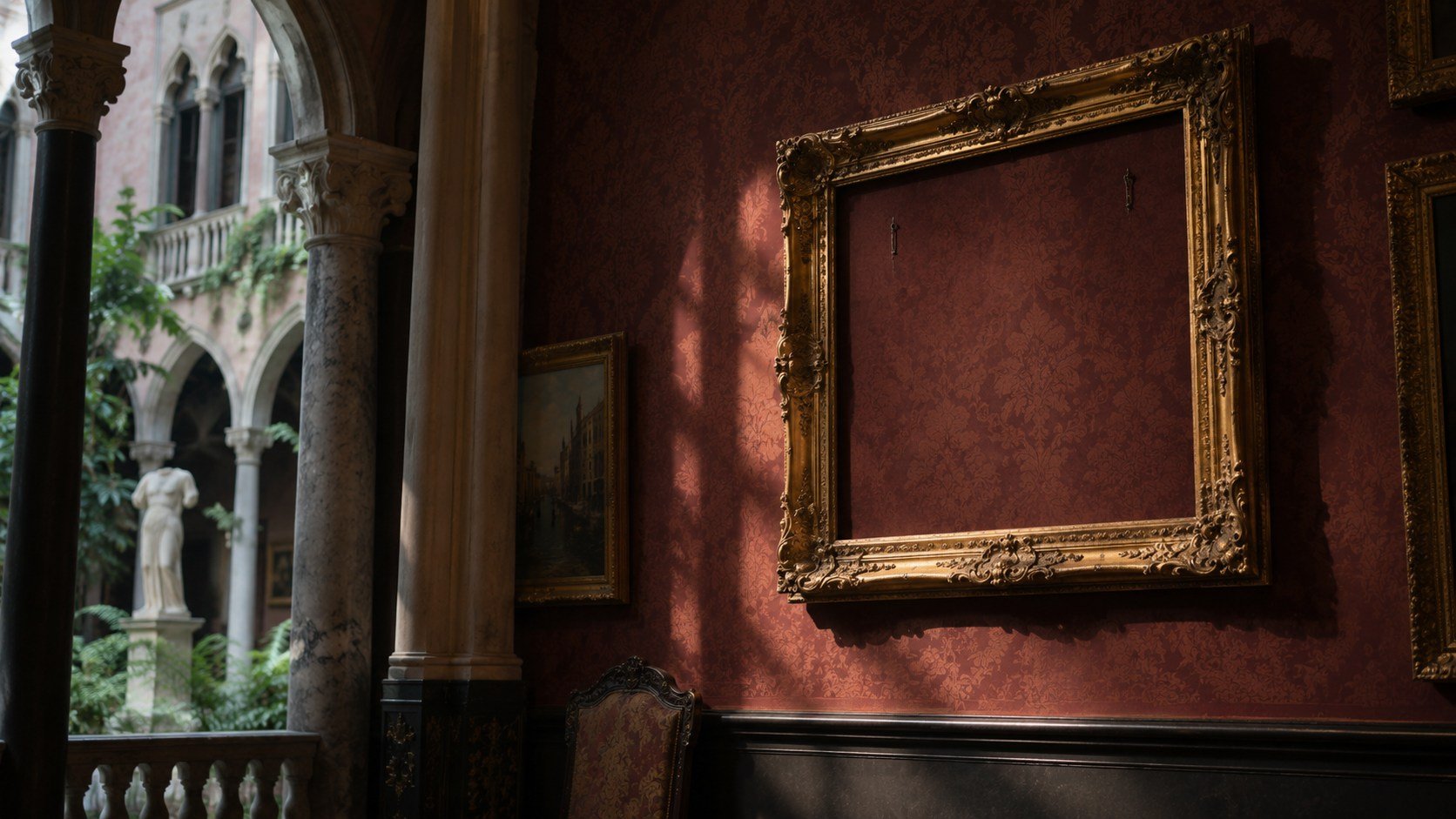
In 1994 the museum chose to display empty frames. Four years had passed since the theft. The decision was an act of interpretation rather than an untouched crime scene left precisely as police found it. It allowed the rooms to communicate absence without filling the space with a substitute. A visitor standing before the empty frame of a large canvas has some immediate idea of the scale of what was carried out of the building.
Gardner's own arrangement made that choice unusually apt. In a conventional chronological exhibition, a museum might close a gap by redistributing works from storage. Here moving another painting into the space could compound the alteration to a room whose arrangement was part of the collection's character. An empty frame acknowledges both the absent work and the founder's decision about where it belonged.
The arrangement can tell visitors something else. A theft remembered chiefly through reproductions of a famous Rembrandt also deprived people of encounters with works they might never otherwise have sought out. A Dutch interior, a French drawing and an ancient bronze once formed parts of the same visit. The crime dispersed that experience as effectively as it removed the physical objects.
What Investigators Can Still Recover
The FBI's Boston office continues to identify the theft as an active investigation, working with the museum and federal prosecutors. The missing objects are documented in the National Stolen Art File. Keeping individual descriptions publicly available allows someone who encounters one piece to check it without possessing a theory about the robbery as a whole. The museum offers a reward of up to ten million dollars in connection with the recovery of the art in good condition, with provision for information leading to the return of individual works.
A person with knowledge of a present location need not be the person who entered the museum. Ownership claims, custody and knowledge can change over decades. That is one reason a continuing appeal makes sense long after the initial witnesses have told police what they saw. Investigators may learn something new from a transaction, a family discovery or a single object that has become separated from the others.
What remains unresolved is substantial. There is no publicly established chain of custody that takes the thirteen works from the staff door to a known destination. A confident identification of a criminal group would still leave the physical recovery of every object outstanding. At the Gardner, the answer that would matter most could be much smaller than a complete solution to the heist. Someone could walk into the Dutch Room carrying one canvas, and an empty frame would again have a purpose beyond explaining a loss.
Sources
Isabella Stewart Gardner Museum Theft | Isabella Stewart Gardner Museum
The Unsolved Heist at the Isabella Stewart Gardner Museum | A&E
