A Family At Uluru
Why Did Finding A Baby’s Jacket Help Free Lindy Chamberlain?
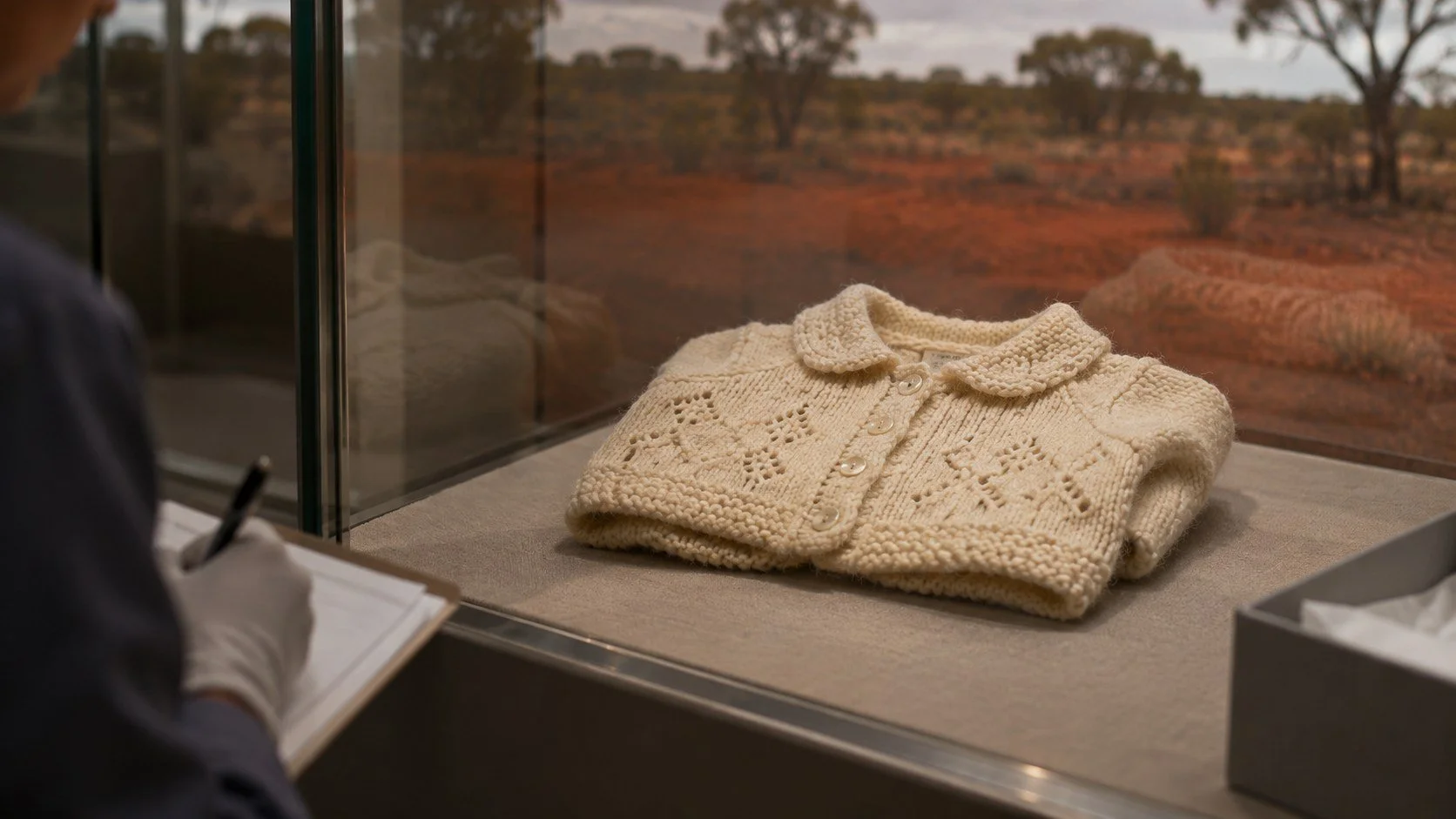
The garment Lindy Chamberlain described to investigators had been missing for more than five years. In February 1986 searchers found it near Uluru, where her nine-week-old daughter Azaria had disappeared from a campsite. It was a small knitted matinee jacket, worn over a baby's clothes. Lindy had consistently said Azaria was wearing one. By the time it was recovered, the absence of that extra layer had been made to count against the mother's account.
Lindy was released from prison within days. Her conviction was quashed in 1988. A coroner formally found in 2012 that a dingo had attacked and taken Azaria. Those dates describe different decisions. The jacket corroborated something the mother had said from the beginning. It undermined assumptions made about the clothing that had been found earlier. It did not, by itself, establish how a baby had died. That conclusion required an investigation far broader than the object that finally brought the prosecution's case back under scrutiny.
A Family At Uluru
On 17 August 1980 Lindy and Michael Chamberlain were camping with their children at the site then widely known as Ayers Rock. Other campers were nearby. Azaria had been put down in the family tent. Lindy's account was that she saw a dingo emerging from the tent and discovered her daughter was gone. A search began in a place where tracks, clothing and the behaviour of animals could all become evidence.
Searchers never recovered Azaria's body. That single fact profoundly affected every later investigation. There was no direct examination from which a pathologist could establish injuries to the child and test a proposed cause of death. Specialists instead considered bloodstaining, marks on fabric, damage to the baby's clothes and the conditions around the campsite. Each was a legitimate field of inquiry. None was an adequate substitute for having the complete physical record.
The experience of people familiar with local dingoes also mattered. A question framed in the abstract can sound preposterous to somebody who has never spent time near the animals. People who knew the area could speak to behaviour, movements and tracks in a way far more useful than a national audience's impression of what a dingo would ordinarily do. The family's account required examination in the place it had happened.
Pieces of Azaria's clothing were subsequently found away from the tent. The jumpsuit became especially important because investigators could study a garment the baby had occupied even though they could not examine her body. It was possible to inspect where blood had reached cloth and where cloth had been torn or cut. It was much more difficult to work backwards from those observations to a unique series of movements by an animal or a human hand.
Why An Outer Layer Changed The Questions
Imagine trying to reconstruct damage to a shirt on the assumption that it was the outermost garment. A mark might seem surprising if direct contact were expected at that point. The same mark might appear far less remarkable if another layer had intervened. The second garment might have absorbed blood, moved relative to the first or received damage that would otherwise have appeared on the shirt. Finding the extra layer changes the conditions under which the question must be asked.
Lindy said she had dressed Azaria in a matinee jacket over the other clothing. Before its discovery, there were at least two possible reasons why nobody could produce it. Her description might be wrong or the garment might simply be missing. In the case built against her, its absence invited suspicion about her account. Yet clothing carried across open country is precisely the sort of evidence a search might fail to recover in its entirety.
Recovering one piece of clothing had never guaranteed that the searchers had found every piece. Nevertheless, the very availability of the jumpsuit encouraged increasingly detailed interpretations. The questions became about the precise way an animal would have had to grip or move a child to leave some areas marked and others relatively clean. A missing garment had acquired an extraordinary role in an argument constructed from a garment everybody could see.
The first inquest accepted that a dingo had taken Azaria. A second inquest followed and proceedings eventually took Lindy and Michael to a criminal trial. These were different institutions asking different questions. An inquest seeks to establish what happened to someone who died. A criminal court determines whether an accused person committed an offence to the required standard. The history matters because accounts that begin only at the murder trial can leave the impression that the animal explanation was a late alternative. It was present from the first night.
What The Jury Heard About The Car
The prosecution alleged that Lindy had killed Azaria and that the account of a dingo concealed a human act. The family car became a proposed location for the killing. Material in it was interpreted as evidence of infant blood. If scientifically sound, such a finding would give the prosecution a physical connection between a suggested crime scene and a baby who had supposedly disappeared from a tent. That gave the testing exceptional importance.
A test can be sensitive to a substance without being sufficiently specific to identify it in every environment. In a laboratory the distinction can be examined by asking what other material could produce a similar response. In a vehicle, manufacturing substances, dust and other residues can complicate the picture. Later examination of the Chamberlain evidence exposed serious problems with the interpretation of material from the car, including the part played by sound-deadening material. A confident claim about foetal blood had outrun what the testing could support.
The consequences extended beyond the individual test. If the car contained persuasive evidence of a killing, blood on a jumpsuit might be interpreted as the aftermath of that act. If that support disappeared, the marks on the clothing had to stand on their own. A source of apparent corroboration could turn out to depend on the same unproven reconstruction it was being used to strengthen.
At the 1982 trial Lindy was convicted of murder and sentenced to life imprisonment. Michael was convicted as an accessory after the fact. It is especially important in recounting this part of their history to state the outcome that followed. Both convictions were overturned. The intense attention paid to how the parents appeared in public produced no scientific evidence about the contents of a vehicle or the actions of a dingo at the tent.
A Mother's Manner Became A Public Argument
The Chamberlains were Seventh-day Adventists. Their faith and Lindy's manner under questioning became objects of fascination. Observers formed opinions about the way a grieving mother ought to speak, the feelings they expected her to display and the meaning of a composure they saw only through limited public appearances. Such interpretations were easy to repeat because they required neither access to exhibits nor expertise in forensic testing.
Their weakness is equally obvious once a specific claim is examined. A mother who speaks steadily can be grieving. A mother who cannot speak can also be grieving. A stranger who has observed either briefly has no reliable scale on which to convert demeanour into evidence of a particular act. The question in the Chamberlain case was what happened to Azaria. No member of the television audience could answer it by comparing Lindy's face with an imagined portrait of an innocent woman.
Public opinion moved in more than one direction. People examined the scientific inconsistencies, campaigned for the family and questioned what had happened at trial. John Bryson's 1985 book Evil Angels brought substantial attention to the evidential disputes. By the time the jacket was recovered, there were already reasons to review the convictions. The discovery was decisive in accelerating change because it made one disputed proposition visible and testable in a way that public argument could not.
Two Garments Acquired Quite Different Public Lives
The National Museum of Australia holds another piece of Azaria's clothing, a little black dress with matching items. It is easy to see why the museum regards it as a historical object. The colour of the dress encouraged speculation about Lindy and about whether black was an appropriate colour in which to dress a baby. It tells us a great deal about the assumptions some observers brought to the case and very little about how Azaria disappeared.
Place the dress beside the jacket in an account of the evidence and the difference is instructive. The dress existed and attracted interpretations about the character of the mother who chose it. There was no sound route from that choice of colour to a conclusion about a criminal act. The jacket served an entirely different function because Lindy had described it as part of the child's clothing on the night in question. Finding it allowed a specific statement about observable fact to be checked.
The dress also illustrates a danger in retelling the case through pictures. A photograph of Azaria wearing something, an exhibit associated with the family and a garment recovered during the search are quite different historical records. A caption that merely calls an item “Azaria's clothes” can give a reader the impression it was recovered near the campsite. The evidential meaning of any piece depends on where it came from, what the child had been wearing and what proposition is being tested.
This is why collections and inquest records complement one another. An institution preserving a family's belongings can show how the public assigned meaning to things. A court must decide whether that meaning can withstand a particular challenge. A black dress could become famous without ever providing evidence against its owner. A small jacket could matter enormously because the person describing it had supplied information before it was found. One illustrates the history of suspicion. The other helped establish what was wrong with it.
What Searchers Found In 1986
The jacket was discovered during a search arising from the death of a British climber. The location was in the area around Uluru associated with dingo activity. Its recovery did two things at once. Investigators could compare a real garment with Lindy's description, and they could reconsider how far separated items of clothing might be found in the surrounding country. An object previously treated as an absence now had a location and physical characteristics of its own.
The finding did not supply a witness to the original incident. A garment recovered years after a disappearance cannot identify everything that touched it, establish who last held the baby or date every change to the cloth. What it did establish was devastating to a particular line of reasoning. The mother had described an outer garment when no one could produce it. Those who used its absence to undermine her reliability now had to explain why her account had anticipated the discovery.
The Northern Territory authorities released Lindy in February 1986. Release from custody mattered immediately to her and her family. It did not in itself erase either parent's conviction. Someone unfamiliar with the legal sequence could reasonably imagine a court had issued a final finding about a dingo within days of the recovery. The remaining proceedings show how far that impression would be from what the jacket had actually accomplished.
How The Royal Commission Re-examined The Evidence
Justice Trevor Morling headed the royal commission into the convictions. Its task required more than finding a fresh expert willing to disagree with an earlier one. The evidence behind the prosecution's reconstruction had to be examined piece by piece, with the competing account given a fair test. The commission considered what the blood and clothing could show, what they could not show and which assumptions had made earlier claims appear stronger than they were.
Consider the dispute about how much blood should have been found in the tent. One line of reasoning was that a dingo attack capable of producing blood on the jumpsuit should have produced much more blood in the bedding or left a clearer trail. Its apparent force depended on several prior matters. When did the bleeding occur? Did the animal have to kill the baby inside the tent? Was the blood deposited at the moment and in the place the reconstruction assumed?
If the evidence did not establish those conditions, the expected trail could not simply be read backwards as proof against the dingo account. A useful expert question is what would be expected under a specified sequence. A much riskier one is what must have happened because a sequence selected by the investigator failed to fit. The commission's examination of the tent and the clothing illustrates that difference with painful precision.
Morling concluded that the evidence gave considerable support to the possibility that a dingo had taken Azaria and that the convictions could not safely stand. The parents were formally exonerated in 1988. The immediate criminal issue had come to an end. Their daughter still lacked an official account of her death that reflected what her parents had reported from the campsite.
Why Another Inquest Was Needed
A third inquest in 1995 left the cause of death open. That position was compatible with having quashed the murder convictions. A court can conclude that there was no sound basis for convicting a person without establishing a single positive account of how a death occurred. The difference can look semantic to an outsider. It was anything but semantic to parents who had spent years explaining why their daughter was missing.
Over time, further evidence became available about dingo attacks, including attacks on children. Such evidence does not establish what any particular animal did in August 1980. It can, however, test a premise that had influenced the reception of the original account: whether a dingo could attack or take a child in the relevant circumstances. Evidence from other incidents can change an assessment of possibility without becoming an eyewitness to the event under investigation.
At the fourth inquest in 2012, Northern Territory coroner Elizabeth Morris found that Azaria had died as a result of being attacked and taken by a dingo. Thirty-two years separated that finding from the night at the campsite. It placed an affirmative cause of death on the public record. Lindy and Michael had long since ceased to be convicted people; now they had an official finding concerning the child at the centre of the case.
For anyone following the case through newspaper cuttings, the order of those decisions matters. A release from prison answered the immediate question of whether Lindy would go home. Clearing the convictions altered what could properly be said about both parents. Recording how Azaria died required a further public finding. A family could live through each of those events and still have to wait for the next.
The jacket's place in the story is therefore both smaller and greater than legend suggests. It did not perform the work of the royal commission, reverse the convictions by its own force or make the coroner's final decision unnecessary. Its power came from the specificity of what Lindy had said. She had remembered how she dressed her daughter on the last evening of her life. Years later, in country where it had always been possible for a search to miss something small, somebody found the garment she had described.
