A Canoe Goes Missing At Seaton Carew
The Photograph In Panama Answered A Different Question From The Man In The Police Station.
On 1 December 2007 a man walked into a London police station and identified himself as a missing person. John Darwin had last been seen setting out in a canoe from the north-east coast of England in March 2002. A death certificate had been issued. His sons had spent more than five years believing their father had drowned. His appearance settled the most urgent question immediately. It did very little to explain where he had been.
Four days later a photograph introduced an altogether different problem. Darwin appeared in it alongside his wife, Anne, at a property agent's office in Panama. It had been taken on 14 July 2006. Whatever else had happened during the missing years, the couple had been together abroad well before the reunion that the public had been invited to imagine. Anyone seeking to explain the photograph now had to account for Anne's knowledge as well as John's survival.
A Canoe Goes Missing At Seaton Carew
John and Anne Darwin owned property at The Cliff in Seaton Carew, near Hartlepool. John worked as a prison officer. The couple had invested in property and owed substantial sums. At Anne's eventual trial, prosecutors placed those financial pressures close to the origin of the plan. A rise in their loan payments threatened to expose a position they could no longer sustain. To friends and family they appeared to have assets. Keeping the property and keeping up the repayments were different things.
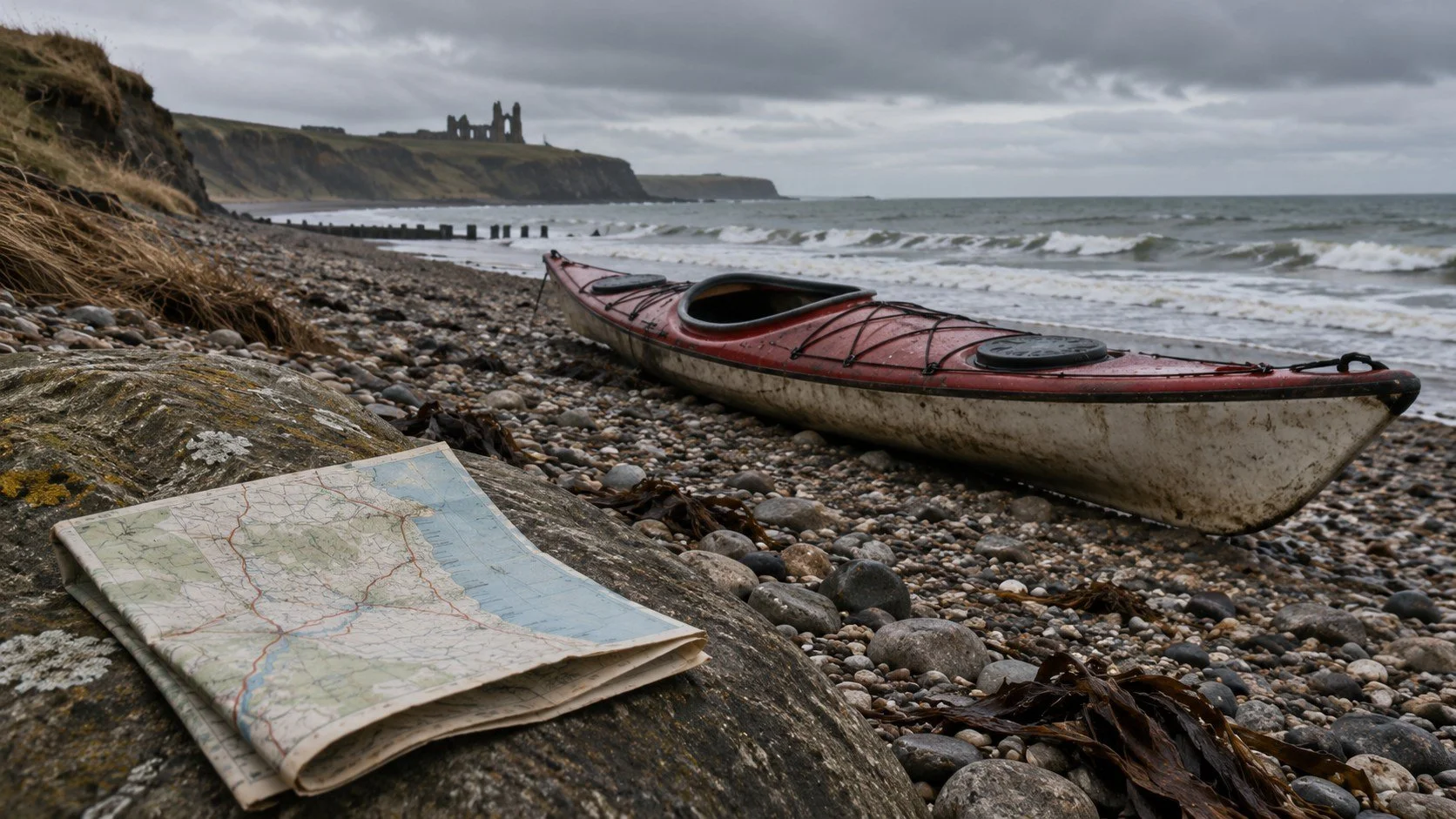
On 21 March 2002 Anne reported that John had gone out in his canoe and failed to return. The sea supplied a credible reason why even an extensive search might never recover him. Emergency services had to act while there might still be a person to save. A report that subsequently proves fraudulent presents exactly the same immediate demand on a rescue crew as one that proves true. There was no sensible way to postpone the search until somebody had examined the family finances.
What remained of the canoe helped the disappearance acquire the shape of an accident. The discovery of damaged equipment is consistent with a person being lost at sea. It establishes considerably less about where its owner went once the equipment was in the water. In March 2002, however, a family waiting for somebody to return had little reason to insist upon that distinction. The sons, Mark and Anthony, were among the people entitled to take their mother's account at face value.
An Inquest Opens The Way To A Claim
On 10 April 2003 the Hartlepool coroner recorded an open verdict. A death certificate was issued. The word “open” is important here. The public process did not establish a precise sequence of events out at sea. It did provide a document that could be used in subsequent transactions. For institutions dealing with life cover and financial arrangements, a certificate carried a weight that a report of an overdue canoe could never have carried on its own.
Money obtained after John's disappearance became the subject of criminal charges. In court the prosecution described a fraud worth around a quarter of a million pounds. Figures in accounts of the case can differ according to whether they include insurance, pension payments or other financial consequences. The essential feature of the transactions was common to them all. Money changed hands because people with a duty to decide claims had been given reason to believe John was dead.
There were consequently two deceptions to sustain. One had a balance sheet. Institutions could trace what had been claimed and paid, and on what representation. The other involved people who had little reason to keep a written record of what they were being told. For the sons, their father's death was a fact around which other parts of life had to be rearranged. There would be no corresponding entry on a financial statement for having allowed a child to grieve for a living parent.
Why The House Next Door Mattered
John had returned to Seaton Carew within weeks. Anne's trial heard that he had contacted her in distress before coming back. The couple owned adjoining property. Part of the accommodation beside the family home could be used to conceal him. That arrangement answered the most obvious practical difficulty facing someone who intended to be dead on paper while continuing to depend on the person who had reported him missing.
The concealment is sometimes remembered chiefly for its ingenuity. Its greater significance at trial was the length of time for which it could be maintained. Seeing a missing husband once in unexpected circumstances and helping sustain his hidden life over years are very different propositions. A room in the adjoining property made continued contact possible on a scale that the outside world had no way of observing.
It also created a remarkable inequality of information inside a single family. A son visiting his mother had every reason to interpret the house as a place marked by absence. Anne and John knew the physical distance between father and son might be very small indeed. There is no need to imagine a particular visit, overheard conversation or brush with discovery to understand what that meant. The premises made it possible for the parents to keep sharing a life while depriving their sons of the same choice.
Concealment at home was only part of the solution. A person presumed dead could scarcely apply for travel documents under his own name without exposing the contradiction. In October 2003 John obtained a passport in the name of John Jones. The identity allowed him to travel while the British records of his own death continued to serve their purpose. The false passport later accounted for a criminal charge separate from obtaining the money.
A Business Photograph Becomes A Dated Record
Property transactions took the Darwins to Panama. The photograph that survived from July 2006 was in one respect entirely ordinary. Property agents have commercial reasons to show prospective customers that other people have visited their offices. A customer who might be careful about correspondence with an insurer could still appear in a picture intended for a completely different audience. The circumstances that made the image dangerous arose much later, when the faces in it became recognisable.
The date puts the photograph more than a year before John's return to the police and more than four years after the reported canoeing accident. The location adds something that a picture from the family home could not. Anne and John had travelled beyond the immediate circumstances of his disappearance. They were together in a setting connected to plans for property overseas. Anne went on to sell the family home and moved to Panama in October 2007.
A photograph records less than its reputation sometimes suggests. It cannot tell an observer what one spouse said to another before they entered the office. It does not document which insurance form either signed. Even an apparently relaxed expression is a poor guide to how freely a person acted across several years. The picture's power came from the narrowness of the question it could answer well. Were Anne and John together in Panama on a date when other people understood him to be dead? Yes.
Why The Order Of Discovery Matters
John came forward first. The identification of the photograph followed public attention to his return. That order is easy to reverse in retrospect because the picture is the detail most people remember. No officer needed an overseas property website to tell them, after 1 December, that John was alive. What investigators needed was evidence capable of testing an account that depended heavily on gaps in his recollection.
He presented himself as unable to remember a period of years. Loss of memory is a claim about an individual's present capacity to remember. Seeing a picture of someone in another country does not medically establish what that individual can recall of the journey. Investigators could, however, assemble an external history that stood independently of anything John chose or was able to remember. The photograph supplied one firmly placed episode in that history. The passport and financial transactions supplied others.
For Anne, the chronology created an immediate difficulty of its own. A spouse learning astonishing news in December 2007 might reasonably be unsure what to say or how to react. Surprise in the present could not explain away joint activity recorded the previous July. Once the Panama image had surfaced, the central question became how far her involvement extended and what responsibility she bore for it. Those were matters for evidence and eventually a jury.
How A Reader Located The Photograph
The trail to Panama ran through an ordinary internet search. A member of the public looked online after following the reporting and found the picture on the website of a business called Move to Panama. Contemporary coverage in the Guardian traced the discovery to that reader. The significance of the search lay in combining two pieces of information that had previously lived in separate places: the increasingly familiar face in British news reports and a company's account of its overseas customers.
Finding a similar-looking couple online would initially have been a lead. A journalist or investigator still needed to ask where the photograph came from, when it was taken and whether the people had been identified correctly. Anne acknowledged that the image was genuine. That acknowledgement gave the discussion a much firmer basis than resemblance alone. The remaining argument concerned what the occasion established about her knowledge. It is a distinction worth keeping when the photograph is reproduced today, usually without the business page that explained why anyone had taken it.
What Anne Darwin Asked The Jury To Believe
John admitted deception and passport offences in March 2008. His admissions narrowed what remained to be tried. By then Anne could not realistically dispute that the disappearance had become a fraud. Her defence at Teesside Crown Court concerned the circumstances in which she had taken part. She relied on marital coercion, a defence then available under English law. The jury had to consider her account of the pressure John exerted alongside evidence of her conduct throughout the scheme.
That distinction is easily lost when the photograph is used to sum up the entire prosecution. A person can know something and still claim to have acted under pressure. Proof of knowledge does not, without more, dispose of a defence about coercion. By the same token, evidence of an unequal relationship does not by itself answer the legal question raised by particular transactions. The trial required a closer examination of who did what and under what circumstances.
The prosecution invited jurors to consider repeated acts over time. There had been a report to authorities, concealment in the adjoining property, claims on the strength of a death, overseas travel and dealings connected with a new life abroad. An explanation that might account for a single decision in a crisis had to be assessed across very different settings. It was the accumulation that made the couple's history consequential. The estate agent's picture allowed the public to grasp one part of it in an instant.
Anne's account of pressure did not succeed. The jury convicted her of six counts of obtaining money by deception and nine of money laundering. The latter offences concerned dealings with the proceeds. It would be misleading to convert the number of charges into fifteen separate discoveries that John was alive. The law had divided a long course of conduct according to identifiable acts, allowing the prosecution to present evidence and seek a verdict on each.
What The Sentences Settled
On 23 July 2008 Anne received six and a half years in prison. John was sentenced to six years and three months. The difference between their sentences is sometimes treated as a verdict on which spouse invented the scheme. That is too much to extract from two numbers. John had pleaded guilty. Anne had contested the charges. Sentences follow the offences before the court and the circumstances of the individual defendants, including the way their cases were resolved.
The sons had been left outside both halves of the undertaking. They had received a false explanation for their father's disappearance and had been allowed to act on it while their parents planned a future together. The fraud had worked partly because the public conduct of genuinely bereaved relatives was entirely compatible with the story being told to the authorities. Their mistaken belief helped the deception appear plausible without making them participants in it.
There is a final irony in where the best-known piece of evidence came from. Insurers had an obvious interest in the truth about John. A property agency in Panama had no apparent reason to investigate a British death certificate. Its ordinary record survived precisely because the event it depicted seemed unremarkable to its intended audience. The journey from an unremarkable property visit to evidence in a British fraud case required someone to recognise the couple and understand the date.
The police station established life. The certificate explained how money could be obtained. The adjoining room showed how a family could be kept apart under the appearance of ordinary domestic life. The photograph did something none of those records could do quite so economically. It placed the two people who knew the truth together in a particular office on a particular day, nearly seventeen months before their sons were permitted to learn it.
