Rex Heuermann And The Gilgo Beach Case: The Road That Hid A Pattern
How A Cold Case Finally Narrowed
The Pizza Crust, The Phones, And The Road
The road looked empty because that was the point.
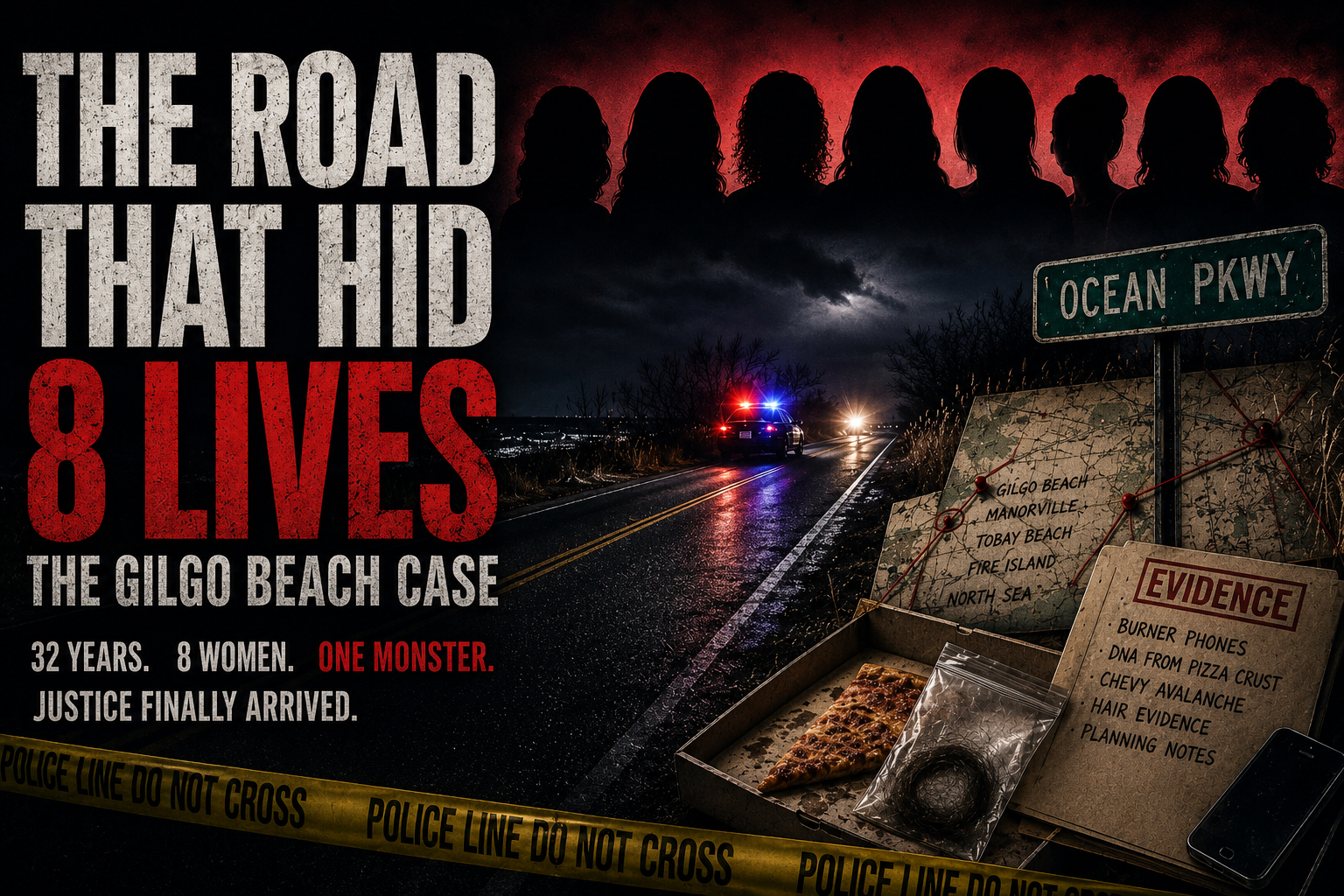
Ocean Parkway runs along the barrier beaches of Long Island, a hard strip of asphalt between water, reeds, scrub, sand, and sky. At night, it can feel less like a road than a corridor. Cars pass. Headlights cut through blackness. Then the dark closes again.
For years, the Gilgo Beach case was not one mystery. It was several mysteries placed beside one another: missing women, unidentified remains, old phone records, partial DNA, family grief, police embarrassment, media obsession, and a stretch of roadside brush that kept giving up the dead.
Latest Confirmed Status: As Of June 17, 2026, Rex Heuermann Had Been Sentenced In Suffolk County To Three Consecutive Life Terms Without Parole Plus An Additional 100 Years To Life After Pleading Guilty To Seven Charged Murders And Admitting To The Killing Of An Eighth Woman. Suffolk County prosecutors announced the sentence as three consecutive life sentences plus 100 years, while AP reporting described the sentence as life without parole for his admitted crimes.
The public shorthand is simple now: Rex Heuermann, the Gilgo Beach serial killer. The record took much longer to get there. It moved through a missing-person search, a cold-case task force, a witness memory of a vehicle, phone data, DNA from degraded hair, a discarded pizza crust, seized electronics, a disputed forensic fight, and finally a courtroom admission.
This is the story of how a place became a case, how a case became a pattern, and how a pattern finally became a legal outcome.
The Life Before The Case
Before their names were attached to court filings, timelines, documentaries, and headlines, the women in the Gilgo Beach case had ordinary lives with ordinary pressures. They were daughters, mothers, sisters, friends, and women trying to survive within systems that often noticed them too late.
The eight women Heuermann admitted killing were Sandra Costilla, Karen Vergata, Valerie Mack, Jessica Taylor, Maureen Brainard-Barnes, Melissa Barthelemy, Megan Waterman, and Amber Lynn Costello. Some were living in or around New York. Some had come from other states. Several were doing sex work, which prosecutors later said Heuermann targeted as part of his method. Reuters reported that Heuermann admitted in court to killing eight women in attacks dating back to the 1990s.
That detail matters, but it should not be allowed to shrink them. Sex work was part of the risk environment around the case. It was not a substitute for identity. Megan Waterman was a young mother from Maine. Maureen Brainard-Barnes had children in Connecticut. Jessica Taylor was remembered by relatives as fierce, kind, compassionate, and intelligent. Karen Vergata was survived by two sons.
A cruel feature of the case is that public attention often arrived only after the women were gone. Their families had already been living inside the silence before the wider world saw a pattern. The road did not create the case. It exposed how many private searches had already failed to become public urgency.
That is why the case cannot be understood only through the man who later pleaded guilty. It begins with the people whose absences were first treated as fragments.
The People Around Them
The supporting cast was large because the timeline was long. Families called police. Friends repeated last conversations. Detectives worked old files. Prosecutors later built a case from records that had sat for years beside newer forensic tools.
The first search that opened the wider Gilgo Beach investigation began with Shannan Gilbert, a 23-year-old woman who disappeared in May 2010 after leaving a client’s home in Oak Beach. Her disappearance led police to search near Ocean Parkway, where they found remains that did not belong to her. The Guardian reported that the Gilgo Beach murder investigation began after police found four sets of remains in 2010 while searching for another missing woman, Shannan Gilbert.
That distinction is essential. The public story often folds every Long Island discovery into one single narrative. The legal record is narrower. Heuermann pleaded guilty to seven charged murders and admitted responsibility for an eighth. Other remains found in the broader area have separate investigative histories and should not be casually assigned to him.
The police figures changed over time, too. The early investigation drew years of criticism. Then a renewed task force formed in 2022, bringing together Suffolk County police, prosecutors, the FBI, state police, and other agencies. CBS reported that in January 2022, federal, state, and local investigators launched the Gilgo Beach Homicide Investigation Task Force and began a comprehensive evidence review.
The people around the victims kept the case alive before the system caught up. The people around the evidence later had to prove that old clues could still speak.
The First Cracks
The first crack was not a dramatic arrest. It was a pattern that looked too similar to ignore.
In December 2010, while searching for Gilbert, investigators found the remains of Melissa Barthelemy, Maureen Brainard-Barnes, Megan Waterman, and Amber Lynn Costello near Gilgo Beach. They became known as the Gilgo Four. Their remains were found close together along Ocean Parkway, and all had been missing after contact connected to sex work. CBS reported that Barthelemy, Waterman, Costello, and Brainard-Barnes were found in close proximity in 2010 and became known as the Gilgo Beach Four.
The pattern was frightening, but patterns do not solve cases by themselves. Investigators still needed identity, time, movement, contact, opportunity, and evidence tying a suspect to specific victims. The earliest public understanding was broad: a serial killer might be using the beach road as a disposal site. That was not the same as knowing who, how, or when.
There were other cracks in the case’s first public version. More remains were found in 2011. Some belonged to victims whose identities were not confirmed until much later. Some had been found in more than one location, including Manorville and other Long Island sites. The map widened. The timeline stretched backward.
The road had made the case visible, but it had also distorted it. Gilgo Beach became the name. The actual geography reached beyond the beach.
The Last Ordinary Movements
The last ordinary movements differed for each woman, but the prosecution later described a recurring structure: online contact, phone communication, meetings arranged through sex-work advertisements, and disappearances at times when Heuermann’s family was allegedly away from home.
Court filings said the killer used burner phones to contact the Gilgo Four. Investigators focused early on cellphone use because the victims advertised online and used their phones to connect with clients. Separate burner phones allegedly used by the killer created one of the first digital trails.
Phone evidence did not place a camera inside the crimes. It narrowed the corridor of contact. Investigators looked at where calls were made, which devices interacted, and where those patterns overlapped with Massapequa Park and Midtown Manhattan, where Heuermann lived and worked.
Amber Lynn Costello’s case became central because a witness had described a dark green Chevrolet Avalanche connected to the time around her disappearance. Years later, the renewed task force revisited that vehicle clue. CBS reported that detectives linked Heuermann to a first-generation Chevrolet Avalanche registered to him at the time of the murders, similar to a vehicle reported by a witness when Costello disappeared in 2010.
The strongest old clues were not spectacular. They were ordinary things: a vehicle, a phone, a location, a repeated absence from the home. Each looked limited alone. Together, they began to make the timeline smaller.
The First Alarm
The first alarm in the public case came from a search that was looking for someone else.
On December 11, 2010, the search for Shannan Gilbert led to the discovery of remains later identified as Melissa Barthelemy. Additional remains were found nearby soon after, and the search expanded. What began as one missing-person inquiry had exposed multiple deaths along the same stretch of barrier beach.
That discovery changed the emotional weight of every unanswered call. It also changed the official problem. Police were no longer dealing only with a disappearance. They were looking at possible serial homicide, possible repeated disposal, and a victim group whose lives had not always received urgent institutional attention.
Melissa Barthelemy’s family had already endured something especially cruel. Authorities said her sister received taunting calls after Barthelemy disappeared, calls believed to have come from the killer. The wider significance was not only emotional. Those calls allegedly created location and timing clues that later mattered to investigators.
The phone became more than a device. It became proof of presence after disappearance, a weapon of psychological harm, and a timeline marker. But even that did not identify the caller immediately.
The case had alarm. It did not yet have a name.
The Search For An Explanation
The early explanation was broad and uneasy: someone was killing women and using Long Island’s remote edges to hide them.
That explanation was correct in outline, but incomplete in detail. It did not explain why some remains were found at Gilgo Beach while others were found in Manorville, Fire Island, Tobay Beach, North Sea, or other locations. It did not explain whether every victim belonged to one offender, more than one offender, or overlapping cases grouped together by geography.
One common misunderstanding is that every body associated with the broader Long Island serial killer investigation was legally resolved by Heuermann’s plea. That is not what happened. Heuermann pleaded guilty to seven charged murders and admitted one additional killing. Other deaths and remains connected to the broader search history have separate legal status. ABC7 reported that Heuermann admitted killing Karen Vergata even though he was not formally charged in her death.
The official story also changed as identities were restored. Karen Vergata had been known publicly as a Jane Doe before her identification was announced in 2023. Valerie Mack had been unidentified for years after her remains were found in separate locations. The case was not one clean file moving forward; it was a stack of partial files being joined slowly.
The explanation that survived was not simply “Gilgo Beach.” It was mobility, concealment, digital contact, victim vulnerability, and repeated opportunity over many years.
The Evidence That Did Not Fit
The renewed task force found power in older evidence because the old evidence had not been useless. It had been waiting for context.
The Chevrolet Avalanche was one example. A witness had described a vehicle at the time of Amber Costello’s disappearance. When investigators in 2022 connected a first-generation dark green Chevrolet Avalanche to Heuermann, the clue no longer sat alone. It fit with his residence, his work location, and phone-pattern analysis.
Then came DNA. Detectives surveilling Heuermann recovered a discarded pizza box from a Manhattan trash can. CBS reported that DNA from a pizza crust in that box was compared with hair evidence, and a forensic lab found the profiles were the same in a way that excluded 99.96% of the North American population as matches to the hair.
DNA did not work here like television forensics. Much of the evidence involved degraded hair, mitochondrial DNA, nuclear DNA, family profiles, and advanced testing. The defence challenged the science before the plea. The prosecution argued that newer DNA work could connect Heuermann to evidence recovered in old cases.
The prosecution also pointed to digital evidence. Reporting and court filings described searches about victims, their relatives, the investigation, and violent material, as well as alleged counter-surveillance and the use of fictitious identities, burner phones, and email accounts.
The case did not turn on one clue. It narrowed because separate clues kept meeting in the same place.
Evidence At A Glance
The Chevrolet Avalanche mattered because a witness vehicle description from 2010 became meaningful when investigators connected a similar vehicle to Heuermann. It was not proof by itself, but it gave the renewed task force a concrete lead to test against phone, address, and timeline records.
The burner phones mattered because prosecutors said they were used to contact victims and helped map links between Midtown Manhattan, Massapequa Park, and the victims’ phones. Digital evidence did not show every movement, but it narrowed the field of contact.
The pizza crust DNA mattered because surveillance officers recovered discarded food from Manhattan and investigators compared that DNA with preserved hair evidence. The strength of that clue came from comparison, not from the pizza box alone.
The rootless hair testing mattered because the case involved old and degraded biological material. The prosecution’s ability to use advanced DNA analysis became one of the major pretrial fights.
The family travel records mattered because prosecutors said Heuermann’s wife and children were out of state during charged homicides, creating alleged opportunity. Opportunity did not equal guilt, but it became more important when placed beside contact evidence and forensic evidence.
The digital searches and devices mattered because investigators described online activity connected to victims, the investigation, and violent material. Search history can suggest interest, preparation, or consciousness of guilt, but it must be handled carefully because it does not directly record private intent.
The alleged planning document mattered because prosecutors described it as a record of reconnaissance, post-event steps, body preparation, and avoiding detection. Its force depended on whether it could be tied to the wider evidence pattern rather than read as an isolated document.
The Event At The Center Of The Case
The central event was not one night. It was a series of killings over years.
Heuermann admitted in court that he killed eight women between 1993 and 2010. Reuters reported that he admitted to attacks dating to the 1990s, and AP-linked reporting described him as having admitted killing eight women before receiving life without parole.
The earliest admitted killing was Sandra Costilla in 1993. Her remains were found in North Sea, Long Island. Authorities initially suspected a different killer, but prosecutors later said advanced DNA evidence linked Heuermann to the case.
Karen Vergata disappeared in 1996. Some of her remains were found on Fire Island that year, and more were recovered years later near Gilgo Beach. Heuermann was not formally charged with her death, but he admitted killing her as part of the plea agreement. ABC7 reported that distinction directly.
Valerie Mack was killed in 2000, and Jessica Taylor went missing in 2003. Both cases involved remains found in separate places at different times. Court filings described injuries and disposal methods that prosecutors argued were intended to inhibit identification. Similar legal caution applies here: before the plea, that was the prosecution’s allegation; after the plea, Heuermann’s admission supplied the legal resolution for the charged murders.
The Gilgo Four came later: Maureen Brainard-Barnes disappeared in 2007, Melissa Barthelemy in 2009, and Megan Waterman and Amber Lynn Costello in 2010. Their remains were found near one another along Ocean Parkway in December 2010. CBS described the four women as having been found in close proximity in 2010.
The prosecution’s reconstruction was built around luring, restraint, killing, transport, concealment, and repeated attempts to avoid detection. Reuters reported that Heuermann admitted to strangling the women and dismembering some of them before discarding their bodies wrapped in burlap. The necessary detail is grim, but the legal point is narrower: the admissions connected the method to the man in a way the trial no longer had to test before a jury.
The road had once hidden the pattern. The plea made the pattern official.
When The Story Broke Open
The story first broke open publicly in 2010 and 2011, when the discoveries along Ocean Parkway turned a missing-person search into a suspected serial murder investigation. It broke open again in July 2023, when Heuermann was arrested outside his Manhattan office and charged in three killings.
The arrest changed the case’s shape because the suspect did not fit the public’s simplest imagination of a roadside killer. He was a Long Island architect. He lived in Massapequa Park. He worked in Manhattan. He had a family home. The alleged pattern was no longer only tied to dunes and brush; it was tied to commutes, office life, phone records, and household trash.
Media attention expanded fast. Documentaries revisited old police criticism. True-crime audiences re-examined victim timelines. Families who had been carrying the case for years were asked to relive the story in public. That public attention helped keep the victims’ names visible, but it also risked making the case about the killer’s double life rather than the women he killed.
One of the strongest public-interest lessons is that the case exposed how vulnerability can distort investigative urgency. Women who did sex work were easier for systems and strangers to misread, dismiss, or morally categorize. The later court outcome did not erase that earlier failure.
The story broke open because a suspect was arrested. It stayed open because the public had to confront why it took so long.
The Case Built From Fragments
Before the guilty plea, the prosecution case was a circumstantial architecture. That does not mean weak. It means the evidence was built from separate strands that gained force when aligned.
A jury would not have been asked whether Heuermann seemed disturbing. It would have been asked whether prosecutors proved specific charges beyond a reasonable doubt. That distinction mattered because much of the case involved inference: phone contact, vehicle identification, DNA probability, travel records, digital searches, and alleged planning notes.
The defence challenged the DNA evidence, particularly the use of whole genome sequencing on rootless hairs. The Guardian reported that before changing his plea, Heuermann had been scheduled for trial after his defence team lost a bid to exclude DNA evidence extracted from hairs found on victims’ bodies.
The prosecution also relied on a document found on Heuermann’s computer, described in filings as a planning document. The document allegedly contained categories prosecutors interpreted as reconnaissance, pickup, post-event tasks, body preparation, and avoiding detection.
What the evidence could not prove, by itself, was private thought in the moment of each killing. Phone data could show contact patterns and locations. DNA could show genetic links or exclusions. Searches could show conduct and interest. Travel records could show opportunity. None of those alone was a full confession.
The plea changed that. It converted a case that would have asked a jury to decide whether the fragments proved guilt into a case where Heuermann admitted responsibility in court.
Mini Timeline: How The Case Narrowed
1993: Sandra Costilla was killed. Her case later became part of the charged murder case against Heuermann, extending the official timeline back to the early 1990s.
1996: Karen Vergata disappeared. Heuermann later admitted killing her, although ABC7 reported that he was not formally charged in her death.
2000–2003: Valerie Mack and Jessica Taylor were killed. Their remains were found in separate locations across years, complicating the geography of the case.
2007–2010: Maureen Brainard-Barnes, Melissa Barthelemy, Megan Waterman, and Amber Lynn Costello disappeared across a three-year period.
December 2010: The search for Shannan Gilbert led investigators to remains near Ocean Parkway. The Guardian reported that the investigation began when police found four sets of remains during that search.
January 2022: A renewed task force began reviewing evidence. CBS reported that federal, state, and local investigators joined forces and launched a comprehensive review.
March 2022: Detectives linked Heuermann to a Chevrolet Avalanche similar to one reported by a witness in connection with Amber Costello’s disappearance.
January 2023: Surveillance officers recovered a discarded pizza box in Manhattan. CBS reported that DNA from the pizza crust was later compared with preserved hair evidence.
July 2023: Heuermann was arrested and initially charged in three murders. At that time, he pleaded not guilty.
April 8, 2026: Heuermann pleaded guilty to seven charged murders and admitted killing an eighth woman. Reuters reported that the guilty plea ended a case that had stymied investigators until DNA evidence helped lead to his 2023 arrest.
June 17, 2026: Heuermann was sentenced to life without parole. AP-linked reporting described relatives addressing him in court before the sentence was imposed.
The Outcome That Did Not End The Story
On April 8, 2026, Heuermann stood in Suffolk County Court and pleaded guilty. Reuters reported that he had been charged with seven murders and admitted an eighth killing that was not among the charges.
The legal result was severe. Suffolk County prosecutors said Heuermann was sentenced to three consecutive life sentences plus 100 years for murdering eight women. AP-linked reporting described the sentence as life in prison without parole for his admitted crimes.
The plea had a practical effect beyond punishment. It spared families a long trial filled with forensic argument, autopsy evidence, digital records, and repeated references to the women’s final hours. It also prevented a jury from testing the prosecution’s case in public, which means much of what would have become trial testimony remained filtered through filings, plea admissions, and reporting.
That is not a weakness in the legal outcome. A guilty plea is a legal admission. But it does change the public record. The courtroom did not produce weeks of cross-examination. It produced admission, sentence, and victim impact.
The law reached its answer. The families still had to live with the years before it arrived.
The Aftermath People Still Argue About
The aftermath is not only punishment. It is the question of why this case remained unresolved for so long.
Families of the victims had spent years pressing for attention. AP-linked reporting described relatives confronting Heuermann at sentencing after decades of waiting for justice. It also reported that he was sentenced to life in prison without parole for his admitted crimes.
That request matters. Serial-killer cases often drift toward the offender: the house, the job, the family, the hidden life, the searches, the documents, the psychology. This case has all of those elements. But every minute spent turning the offender into a dark celebrity risks repeating one of the earliest failures: treating the women as secondary.
There are also unresolved investigative questions beyond the eight admitted killings. Authorities and lawyers have discussed possible links to other cases, but possibility is not proof. The correct standard is narrow: Heuermann is legally responsible for the killings he admitted and the charges to which he pleaded guilty. Other suspected links require evidence, not atmosphere.
The case also leaves a forensic legacy. The DNA fight over rootless hair and advanced testing was important before the plea because it tested how far courts may allow newer DNA science in old cases with degraded evidence. The Guardian reported that Heuermann’s defence had lost a bid to exclude DNA evidence from hairs found on victims’ bodies before he changed his plea.
The outcome ended the trial risk. It did not end the debate about cold-case policing, forensic evolution, or how long certain victims have to wait before the system treats them as urgent.
The Review, Appeal, Or Unanswered Question
Heuermann’s plea resolved the central criminal case, but it did not answer every public question.
The most important unresolved question is not whether he was legally responsible for the eight admitted killings. He said he was, and the court sentenced him accordingly. The remaining questions are about scope, delay, and prevention: whether other unsolved cases can be connected; what earlier investigators missed; whether advanced forensic techniques could have narrowed the case sooner; and why victim vulnerability slowed public urgency.
There is also the question of evidence limits. DNA can connect a person to material. Phone records can narrow contact and geography. A vehicle description can identify a lead. A planning document can show preparation or intent when tied to other proof. None of those tools should be described as magic. They mattered because they converged.
The public version often misses that convergence. It says “pizza crust solved the case.” That is too simple. The pizza crust mattered because it gave investigators a usable DNA reference. It gained power only when compared with hair evidence, vehicle records, phone data, witness accounts, and the broader timeline. CBS reported the DNA comparison details and also noted that prosecutors tied Heuermann to other evidence including burner phones and the vehicle clue.
The same is true of the road. Ocean Parkway did not solve the case. It revealed a pattern that investigators spent years failing, revisiting, and finally rebuilding.
The uncomfortable lesson is that evidence can wait longer than families should ever have to.
Why The Road Still Matters
Ocean Parkway remains the case’s central image because it holds the contradiction.
It was public enough for traffic and hidden enough for disposal. It was close enough to ordinary life that commuters used it and remote enough that remains could sit in the brush. It became the visual symbol of a case that was never only about one place.
By the end, the legal record named eight women: Sandra Costilla, Karen Vergata, Valerie Mack, Jessica Taylor, Maureen Brainard-Barnes, Melissa Barthelemy, Megan Waterman, and Amber Lynn Costello. Their lives did not begin at the roadside. Their stories did not end with the man who admitted killing them.
The case matters because it shows what cold cases require: preserved evidence, family pressure, institutional humility, forensic caution, and investigators willing to look again at old assumptions. It also shows what true crime often gets wrong. The most searchable name is usually the offender’s. The most important names are usually the victims’.
Rex Heuermann will spend the rest of his life in prison. That is the legal ending.
The human ending is harder. It belongs to the families who kept saying the names, to the women whose absences were ignored for too long, and to a road that no longer looks empty once you understand what it was hiding.
