True Crime: D4vd And Celeste Rivas Hernandez: The Tesla, The Tow Yard, And The Timeline That Would Not Stay Quiet
The Phone, The Car, And The Unanswered Timeline
D4vd And Celeste Rivas Hernandez: The Timeline Inside The Tesla Case
A car can sit on a Los Angeles street long enough to become part of the scenery.
In late summer 2025, a Tesla registered to the singer known as D4vd was parked near the Hollywood Hills. It did not look, at first glance, like the center of a criminal case. It looked like an expensive vehicle left too long in a neighborhood where people eventually started to notice what did not belong.
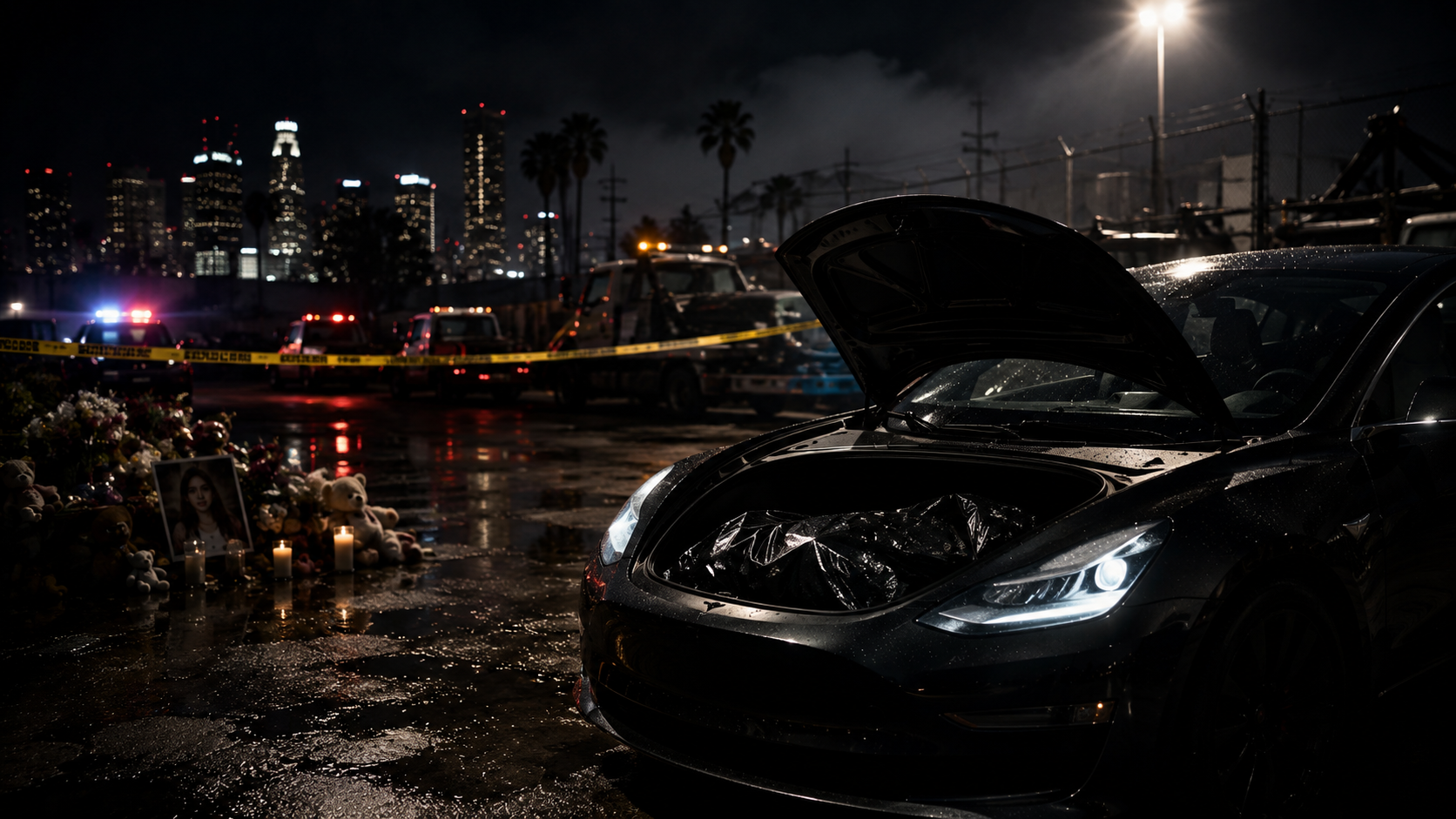
The first witness was not a detective, a prosecutor, or a fan scanning old posts. It was the car itself: abandoned, impounded, and then impossible to ignore. At a tow yard, workers reported a strong odor. Police opened the front storage compartment. What they found would pull a missing teenager, a rising musician, a family’s private fear, and a public internet storm into the same file.
This case is not only about the horror of a discovery. It is about the gap between what people thought was happening and what investigators later alleged had been happening for months. By the end, the question is not simply what happened to Celeste Rivas Hernandez. It is how a child could become visible to police, disappear again, and still remain outside the public’s full understanding until a car forced the story into the open.
The Life Before The Case
Celeste Rivas Hernandez was from Lake Elsinore, a Southern California city far from the version of Los Angeles that exists in music videos and industry parties. Her family later described her as a girl who loved singing, dancing, and Friday movie nights. Those details matter because they place her back in a home, a family rhythm, and a life that was not built to become evidence.
The public record has often introduced Celeste through the way her remains were found. That is the fastest route into the case, but it is also the least human one. Before she was a case name, she was a child whose family searched, worried, and tried to bring her home after missing-person reports in 2024.
Reports describe Celeste as a seventh grader when her family first reported her missing. Prosecutors later said those reports mattered because they brought David Anthony Burke, known professionally as D4vd, into contact with law enforcement before the homicide charge ever existed. The first official concern, then, was not a body in a car. It was a missing child and a phone record.
That is where the story begins to narrow. A young girl’s ordinary life had already started to overlap with an adult musician’s private world, and the people trying to find her were still working from the outside.
The People Around Them
David Anthony Burke was 21 when he was charged in April 2026. As D4vd, he had become a fast-rising alt-pop singer with a large TikTok following, viral songs, and a career that had moved from online gaming culture into mainstream music. Reuters reported that he gained wide attention after songs recorded for gaming videos went viral, with “Romantic Homicide” helping him build a major profile.
Celeste’s family occupied a very different part of the story. They were not public figures. They entered the record through missing-person reports, later through grief, and then through a statement thanking investigators and asking for justice. The family said Celeste loved to sing and dance and that Friday nights were for movies.
The official relationship between Burke and Celeste is now a matter of allegation, not conviction. Prosecutors say they met in January 2022, when she was 11. They allege a sexual relationship began in November 2023, when she was 13 and he was 18. Burke has pleaded not guilty, and his attorneys have said the evidence will show he did not murder Celeste and was not the cause of her death.
That legal distinction is essential. The prosecution has built a theory; the defense has rejected it. The case now sits between those positions, with a court still to decide whether the evidence moves forward to trial.
The First Cracks
The first documented crack came through a missing-person investigation. Prosecutors say Celeste was reported missing in February 2024 and that Riverside County authorities contacted Burke after identifying his phone number in her records. According to the prosecution’s preliminary-hearing brief, Burke told authorities he was unaware Celeste was a minor or had been reported missing.
That did not end the concern. Prosecutors allege Los Angeles sheriff’s deputies later went to Burke’s home for a welfare check and told him Celeste was 13 and a runaway. The brief says Celeste returned home two days later. Her parents, according to prosecutors, then took away her phone.
What prosecutors allege happened next is one of the case’s key early warning signs. They claim Burke drove to Lake Elsinore and paid a junior high school student $1,000 to give Celeste a cellphone he had purchased so they could continue communicating. That allegation, if proved, would matter because it would show not confusion but persistence after official notice of her age and status.
At the time, the outside version could still look like a runaway case. The prosecution’s version says it was already something more controlled, more hidden, and more dangerous.
The Last Ordinary Movements
By April 2025, prosecutors say Celeste and Burke were still communicating. The prosecution’s filing describes a lengthy argument by text on April 22, 2025, and alleges Celeste threatened to disclose damaging information about their relationship. That allegation now forms part of the state’s claimed motive, but motive remains an allegation until tested in court.
The next night, April 23, is the date prosecutors identify as the likely date of Celeste’s death. They allege Burke sent an Uber to pick her up from her Lake Elsinore home at about 8:40 p.m. and bring her to his Hollywood Hills residence, where she arrived around 10:10 p.m.
A few minutes later, according to the prosecution, messages were sent from Burke to Celeste asking where she was. Prosecutors argue those messages were not real concern but cover, sent after they believe she was already dead. The defense disputes the murder allegation and has not accepted the prosecution’s reconstruction.
The ordinary object here is the phone. In a missing-child case, a phone can be a lifeline. In this case, prosecutors say it became a timeline, a contradiction, and eventually part of the state’s argument about staging.
The First Alarm
The first alarm after April 23 did not immediately become a public homicide case. Celeste had already been reported missing before. Authorities and family members were operating within the difficult category of a teenager who had run away, returned, and disappeared again. That context can shape how urgent a disappearance appears from the outside, even when the family’s fear is real.
Prosecutors say Celeste was never heard from again after going to Burke’s Hollywood Hills home. The Los Angeles County District Attorney’s Office later stated that Burke invited Celeste to the home on April 23, 2025, and that she was not seen again afterward.
The public would not learn the shape of the case for months. Burke released his debut album, “Withered,” in April 2025 and later went on tour. Prosecutors allege his career context mattered because they claim Celeste’s threatened disclosure created a financial and reputational motive. Burke’s defense has rejected the allegation that he killed her.
The gap between April and September is one of the case’s most disturbing features. It was not only a gap in public knowledge. It was a gap between a family’s search and a physical reality prosecutors say had already been concealed.
The Search For An Explanation
Before charges, the case was surrounded by partial explanations. Celeste had a history of being reported missing. The vehicle was registered to a famous young musician. The body was badly decomposed, and early medical information was limited. At first, even the public record could not answer whether there was criminal culpability beyond concealment of the body.
The Medical Examiner initially had to work under severe limits. Reuters reported that the autopsy examination was affected by extensive postmortem changes, and the time of death was listed as unknown. Those limitations matter because forensic science can establish some facts while leaving others unresolved.
The investigation also moved under court-ordered secrecy. The Los Angeles County Medical Examiner later said a court order initiated by LAPD had prevented release of its findings until April 2026. That delay fed public speculation, but the official reason was preservation of the investigation.
One common misunderstanding is that unanswered questions mean investigators have nothing. They can also mean investigators are holding back facts while they test records, devices, purchases, witness accounts, and forensic findings. In this case, the silence did not last.
The Evidence That Did Not Fit
The discovery happened on September 8, 2025. The Los Angeles County Medical Examiner said Celeste was found at 11:00 a.m. in the front trunk of a vehicle in a Los Angeles tow yard, and death was pronounced by an LAPD detective. Prosecutors later said the vehicle had been towed three days earlier after sitting near Burke’s Hollywood Hills home.
The prosecution’s preliminary-hearing brief says the Tesla had been parked about 400 feet from Burke’s residence and that surveillance video and other evidence confirmed he was the last person to drive it on July 29, before leaving Los Angeles on tour. That is a prosecution claim, not a trial finding, but it is central to the state’s theory.
On September 16, 2025, the Medical Examiner identified the remains through dental records, according to the prosecution’s brief and later reporting. Police searched Burke’s Hollywood Hills residence the next day. Prosecutors say investigators found evidence in the garage consistent with postmortem mutilation, including blood samples that DNA analysis linked to Celeste’s genetic profile.
The case narrowed through objects: a vehicle, a garage, bags, digital records, purchase histories, and a phone. None of those objects, standing alone, tells the whole story. Together, prosecutors say, they created a sequence.
The Event At The Center Of The Case
The official medical finding is narrower than the prosecution’s full narrative. The Los Angeles County Department of Medical Examiner determined Celeste’s cause of death as multiple penetrating injuries caused by objects, and the manner of death as homicide. Reuters reported that the medical examiner found two penetrating wounds to the torso, possibly sharp-force injuries, while the report did not specify the murder weapon and noted that decomposition limited the examination.
The prosecution alleges a more detailed reconstruction. According to the preliminary-hearing brief, Celeste arrived at Burke’s Hollywood Hills home at about 10:10 p.m. on April 23, 2025. Prosecutors contend that by around 10:30 p.m., when Burke allegedly texted asking where she was, she was already dead. They allege those messages were part of a premeditated cover story.
Prosecutors allege Burke stabbed Celeste multiple times soon after she arrived, did not call 911, and drove later that night toward Santa Barbara County while continuing to contact her phone. That is the state’s version. Burke’s defense has said the actual evidence will show he did not murder Celeste and was not the cause of her death.
The immediate aftermath is where the prosecution’s case becomes heavily documentary. Prosecutors allege Burke ordered a shovel on April 24, two chainsaws on May 1, and a body bag, heavy-duty bags, and an inflatable pool on May 5. They also allege some purchases were made under a fake name.
The prosecution says Celeste’s remains were later placed in two bags and left in the Tesla’s front trunk. It also alleges Burke returned more than once to an isolated area near SR-154 in Santa Barbara County, where Celeste’s passport card was later found. Those claims matter because they move the case beyond a single alleged act and into alleged concealment, staging, and disposal of evidence.
This is not yet a jury’s finding. It is the prosecution’s map of what it intends to prove. The central legal question is whether that map can survive scrutiny.
When The Story Broke Open
The case became public in stages. First came the discovery in September 2025. Then came identification. Then came the search of the home, the canceled tour dates, and months of online attention around the connection between Celeste and D4vd. Washington Post reporting in April 2026 noted that internet users had already been scouring Burke’s content for possible links to Celeste before charges were filed.
The arrest came on April 16, 2026. LAPD arrested Burke on suspicion of murder, and the case was presented to prosecutors. Four days later, the Los Angeles County District Attorney’s Office announced charges in case 26CJCF02399: murder, continuous sexual abuse of a child under 14, and unlawful mutilation of human remains.
The complaint includes special circumstance allegations of murder of a witness, murder for financial gain, and lying in wait. It also alleges Burke personally used a deadly and dangerous weapon, described as a sharp instrument. If convicted as charged, he faces death or life without parole, though prosecutors said a decision on whether to seek the death penalty would come later.
The public story had changed. What began as a vehicle discovery had become a capital murder case, an alleged child sexual abuse case, and a test of how much the court would allow the public to see before trial.
The Case Built From Fragments
The prosecution’s case is built from categories of evidence rather than one single public confession or one visible eyewitness. The preliminary-hearing brief lists text messages, iCloud data, cellular activity, Tesla records, surveillance video, DNA evidence, purchase records, Uber records, and proof of Burke’s music career as evidence prosecutors intend to present.
That structure matters. Digital records can show time, contact, movement, transactions, and device activity. They cannot automatically prove intent without interpretation. DNA can connect a person to a place or object. It does not, by itself, explain every act that occurred there. A jury, if the case reaches trial, would have to weigh the pattern.
The prosecution says the pattern points to premeditation, concealment, and motive. The defense says Burke did not kill Celeste and was not the cause of her death. Reuters reported that a not guilty plea was entered, Burke remains in custody without bail, and defense attorney Blair Berk pushed back directly against the murder allegation.
The court’s task at the preliminary stage is not the same as a trial verdict. A preliminary hearing determines whether there is enough evidence for the case to proceed. It is not a final finding of guilt. That distinction is where true-crime coverage often fails: suspicion, charge, and conviction are not the same thing.
The Outcome That Did Not End The Story
The formal outcome so far is not a conviction. It is a charged case. Burke has pleaded not guilty to first-degree murder and other charges. He remains presumed innocent unless and until proven guilty in court, a point the District Attorney’s Office included in its own charging announcement.
The legal process has already been contested. In April 2026, lawyers for Burke sought to force prosecutors to present evidence publicly, and a judge set a hearing for that purpose. PBS, citing the Associated Press, reported that Burke appeared in court exactly one year after prosecutors say Celeste was last known to be alive.
The Medical Examiner’s findings also became public in April 2026 after months of restriction. The office said its cause-and-manner determination had been made in December 2025 but was previously withheld because of a court order initiated by LAPD. That release gave the public an official answer on cause and manner of death, but it did not resolve who a jury may ultimately hold responsible.
For Celeste’s family, the legal filing was not closure. Their public statement asked for justice. The case had moved from secrecy into court, but it had not reached judgment.
The Aftermath People Still Argue About
The aftermath has unfolded in two arenas: court and public interpretation. In court, prosecutors have framed the case as a capital murder prosecution tied to alleged abuse, witness silencing, and financial motive. Outside court, the case has become a magnet for social media sleuthing, music-industry questions, and arguments about whether warning signs were missed.
One of the strongest public misunderstandings concerns what is known versus what is alleged. It is known that Celeste’s remains were found in a vehicle registered to Burke, that the Medical Examiner ruled the manner of death homicide, and that Burke was charged. It is alleged that Burke killed her, mutilated her remains, and did so to protect his career. Those allegations have not yet been proven at trial.
Another misunderstanding concerns forensic certainty. The Medical Examiner identified multiple penetrating injuries and homicide as the manner of death, but Reuters reported that the examination was limited by decomposition and did not specify the weapon. That does not erase the homicide finding. It limits how precisely the medical evidence can answer timing and mechanism questions.
The digital record may become the public’s next fixation. The more technical the evidence, the easier it is to overread it. Phone data, rideshare records, purchase histories, and surveillance may create a timeline, but the court still has to decide what that timeline proves beyond allegation.
The Review, Appeal, Or Unanswered Question
As of the latest confirmed court update found in reliable reporting, the case had not gone to trial. ABC7 reported on June 17, 2026, that Judge Charlaine Olmedo reset July 21 as the start of a multi-day hearing to determine whether there is enough evidence to require Burke to stand trial. A status conference was also set before that hearing.
That makes the central unanswered question legal as much as factual. Prosecutors have laid out a detailed theory. The defense has denied the core allegation. The preliminary hearing is the next major threshold because it decides whether the state’s evidence is sufficient to push the case toward trial.
There are also unanswered public-interest questions. How did earlier missing-person reports shape the response? What could law enforcement know, prove, or act on when Celeste first returned home? How should digital records involving a missing minor and an adult celebrity be assessed without letting internet rumor outrun verified evidence?
The case is not finished. It is still moving through the machinery that separates allegation from proof.
Why This Case Matters
The D4vd and Celeste Rivas Hernandez case matters because it sits at the intersection of youth safety, celebrity access, digital evidence, and the legal limits of public certainty. It is a case where a phone number, a missing-person report, a car, a tow yard, a garage, purchase records, and family grief all became part of the same record.
It also matters because Celeste was a child before she was a headline. The family detail that stays with the case is not the Tesla, the charge sheet, or the tour schedule. It is the Friday movie night: an ordinary ritual that says more about what was interrupted than any courtroom phrase can.
The legal system still has to test the prosecution’s allegations. Burke remains charged, not convicted. The defense has denied that he killed Celeste. The court will decide what evidence moves forward, and if the case reaches trial, a jury will decide whether the state has proved its case beyond a reasonable doubt.
For now, the most honest ending is not certainty. It is the image of an ordinary object changed forever: a front trunk that became a crime scene, a phone that became a timeline, and a missing girl whose life must not be reduced to the vehicle where the world finally found her.
