True Crime: Erin Patterson And The Mushroom Lunch That Turned A Family Table Into Evidence
The Beef Wellington, The Death Caps, And The Question That Would Not Go Away
How A Table Became A Crime Scene
The dish was ordinary enough to make the story harder to understand.
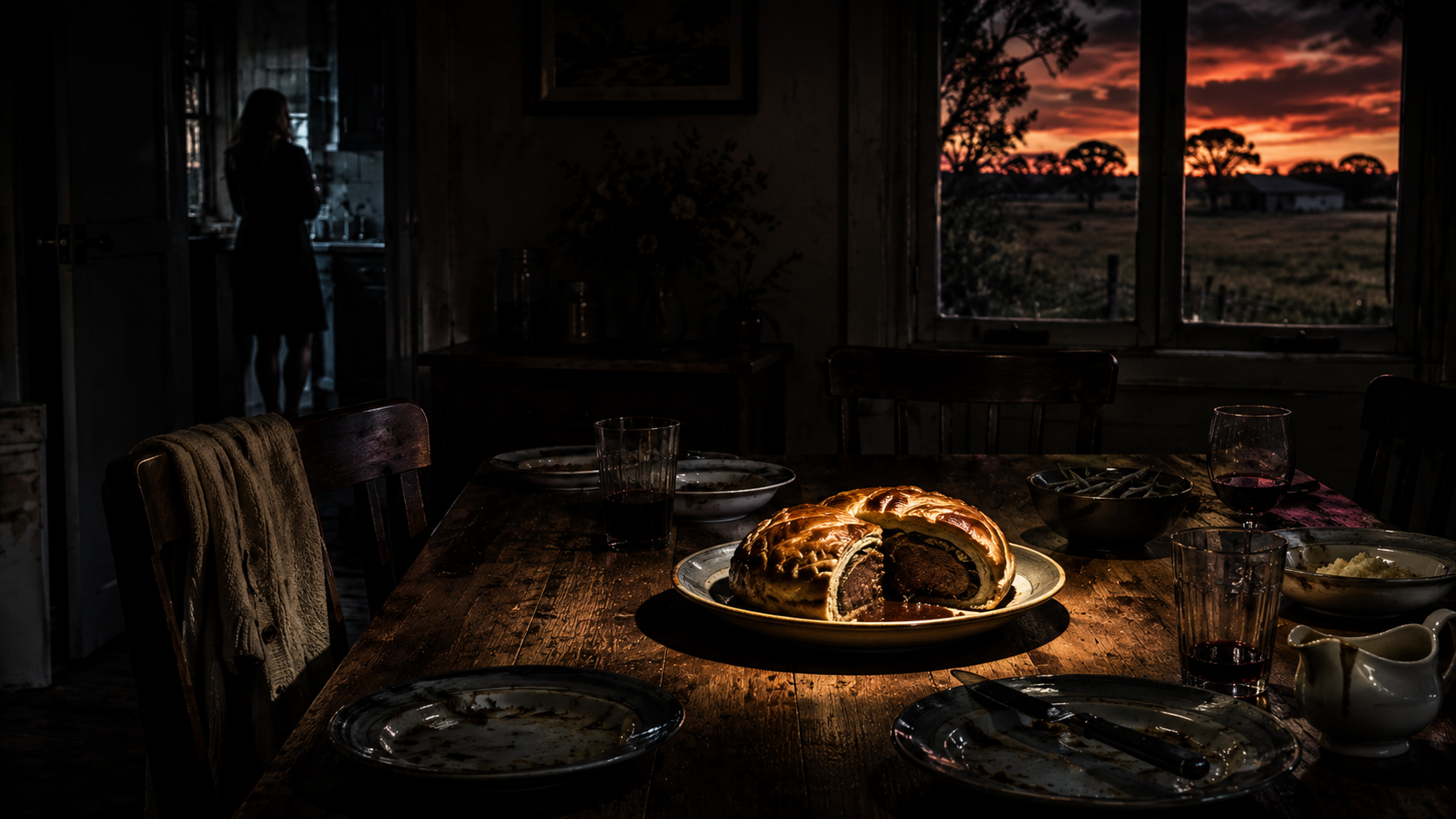
Beef Wellington sat at the center of the table in Leongatha, a small town in South Gippsland, Victoria. There were mashed potatoes, green beans, packet gravy, cake, fruit, and the quiet ritual of relatives gathering for lunch. The people invited were not strangers. They were connected by marriage, church, children, old affection, and years of family history.
What made the lunch dangerous was not visible on the plate. Death cap mushrooms do not announce themselves. Victorian health authorities warn that symptoms can begin hours after eating, sometimes with stomach pain, vomiting, nausea, and diarrhea, before a deceptive pause gives way to serious internal damage, especially to the liver.
For a while, the explanation seemed almost too awful to be criminal: a terrible mistake with wild mushrooms. That was the first version. It would not survive the evidence.
By the time the case reached trial, the question was no longer whether the meal contained death caps. Erin Patterson accepted that it did. The question became whether the poison entered the food by accident, as she claimed, or by design, as prosecutors argued and a jury later found.
As of July 4, 2026, the legal story is not fully finished. Patterson is serving life imprisonment with a 33-year non-parole period, but her conviction appeal and the prosecution’s appeal against the sentence are listed to be heard on August 19 and 20, 2026.
The Life Before The Case
Before the world knew Leongatha as the place of the mushroom lunch, it was just a town in regional Victoria where families lived with the rhythms of work, church, school, errands, and long relationships. Don and Gail Patterson had settled in nearby Korumburra in 1984. They had married in 1973 and raised four children there. Don had been a high school teacher. Gail, the court heard, had faced health struggles after encephalitis.
Heather Wilkinson, Gail’s younger sister, was married to Ian Wilkinson. They had four children. Heather helped at a local school as a teacher’s aide, while Ian had served as pastor at Korumburra Baptist Church since 1999.
Those details matter because they keep the case from becoming only a strange headline about food. The people at the lunch had histories, marriages, routines, communities, and roles that long predated the crime label later attached to the case.
Erin Patterson was part of that family structure through her marriage to Simon Patterson, Don and Gail’s son. She and Simon were separated, but they remained legally married and shared two children. ABC’s court coverage reported that Simon described Erin as intelligent and witty, and that the trial heard she had been financially stable for many years.
The ordinary fact at the center of the story is that the lunch was not supposed to look like danger. It was framed as a family meal, prepared inside a home, with relatives who believed they were gathering to talk, support, and perhaps repair something.
The People Around Them
The supporting cast was small, which made the case feel more intimate and more claustrophobic.
Simon Patterson was the estranged husband who did not attend. The court heard that he had been invited to the July 29, 2023 lunch but messaged Erin the day before to say he felt too uncomfortable to come. He said he was willing to discuss her health and its implications at another time.
Erin replied that she had spent many hours preparing the meal and wanted everyone there for conversations she needed to have. The message mattered because it showed the lunch was not casual in her own description. It had been planned, expensive, and emotionally loaded.
Don and Gail Patterson were Simon’s parents. Heather and Ian Wilkinson were Gail’s sister and brother-in-law. The four guests were older relatives, connected by family and faith, and they arrived at a house where the conversation was expected to include Erin’s health.
Ian later told the court that he and Heather had been excited by the invitation because they thought it might improve their relationship with Erin. That detail gives the lunch its human force. To at least some of the guests, the table represented repair, not risk.
The social world around the case also included Erin’s online friendships. The trial heard that she had connected with women through a Keli Lane true crime Facebook group, which developed into a private group chat where members discussed personal lives, recipes, and cooking.
The family table and the online chat would later collide in court. One showed what Erin presented to relatives. The other showed what prosecutors argued she had been saying, buying, and preparing before the lunch.
The First Cracks
The first cracks did not look like a murder plot in real time. They looked like family tension, health anxiety, foraging, online messages, and the kind of domestic friction that many separated families recognize.
The trial heard that Erin and Simon’s relationship had deteriorated in late 2022 over issues including child support and schooling. ABC reported that their children gave evidence through pre-recorded police interviews, and that parenting disputes formed part of the trial background. Those details required care because the children were not the story’s spectacle; they were part of the family system disrupted by it.
In Erin’s Facebook group chat, witnesses said she discussed recipes, a dehydrator, and drying mushrooms. Friends told the court that she had posted about buying and using a dehydrator in the months before the lunch.
There was also the health story. The prosecution said Erin had used a false cancer claim as part of the reason for the lunch. Erin disputed the prosecution’s framing but admitted she did not have cancer and told the court she had lied about possible future treatment because she was embarrassed about private plans connected to gastric-bypass surgery.
The important legal distinction is narrow but crucial. A lie about health was not, by itself, proof of murder. Prosecutors had to show how that lie fit with other evidence: the invitation, the food, the source of the mushrooms, the plates, the symptoms, the phones, and the discarded dehydrator.
What began as family discomfort became a question of planning.
The Last Ordinary Movements
The timeline tightened in the months before the lunch.
On April 18, 2023, a user on iNaturalist recorded death cap mushrooms in the Loch area. On May 21, another iNaturalist user posted a photo and exact location of death caps growing in Outtrim. Prosecutors alleged Erin’s mobile phone data placed her in those areas soon after death cap sightings were posted, though the defense challenged the accuracy and interpretation of the tower evidence.
The phone evidence did not operate like a GPS dot on a map. It suggested connections to towers and areas, which prosecutors used to build an inference. The defense’s job was to remind jurors that inferred location evidence can be less precise than public summaries make it sound.
On July 16, Erin attended a service at Korumburra Baptist Church and invited Don, Gail, Simon, Ian, and Heather to lunch on July 29. On July 28, Simon messaged to say he would not attend. The following day, the four older relatives came to Erin’s Leongatha home.
The meal, according to court coverage, consisted of individual beef Wellingtons with mashed potato, green beans, and packet gravy. Heather and Gail brought cake and fruit. Erin said she had used a RecipeTin Eats cookbook and made deviations to the recipe.
That ordinary menu became a legal map. The pastry held mushroom paste. The plates became disputed. The leftovers became forensic material. The food was no longer food. It was evidence.
The First Alarm
The first alarm came through illness.
On July 30, Don and Gail phoned Simon complaining of serious sickness. They traveled by ambulance to Dandenong Hospital. Simon picked up Heather and Ian and took them first to Korumburra Hospital, then to Leongatha Hospital.
At that early stage, one simple explanation still had room to exist. People can become violently ill after food. Mistakes happen. Wild mushrooms can be misidentified. Death caps can resemble edible mushrooms, and official warnings make clear that poisoning symptoms may be delayed, then briefly appear to improve before severe liver damage becomes apparent.
But this illness did not behave like ordinary food poisoning. Doctors at Leongatha and Dandenong conferred about the cases, and all four guests were transferred to Austin Hospital in Melbourne. Erin also presented to hospital, but ABC reported that she declined a full examination at Leongatha and later appeared clinically well at Monash, with vital signs within normal limits.
The medical gap became one of the case’s pressure points. The guests showed signs consistent with death cap poisoning. Erin said she felt unwell too, but doctors did not see the same markers in her testing as they saw in the four guests.
The first fear was that something in the meal had gone terribly wrong. The next question was whether anyone had made it go wrong.
The Search For An Explanation
Erin’s early explanation centered on mushrooms she said she had bought and used without knowing they were deadly.
She maintained that she used mushrooms from Woolworths and an Asian grocer. She said the mushrooms may have become mixed with dehydrated wild mushrooms in a plastic container in her pantry. The defense position was that the poisoning was a tragedy and a terrible accident, not a deliberate act.
That explanation created an urgent public health question. If death caps had entered a commercial food supply, other people might have been at risk. Health officials and council workers tried to trace the alleged store-bought mushrooms, checking Asian-style grocery stores in Melbourne’s south-east. They did not find a product matching Erin’s description.
The prosecution said the grocer story was not confusion but cover. Erin rejected that claim. The jury would later have to decide whether the shifting suburbs, the lack of a matching product, and the wider evidence showed panic after an accident or concealment after an intentional poisoning.
Another theory involved foraging. Erin told the court she had begun foraging during the COVID-19 lockdowns, and AP reported that she accepted the lunch contained death caps but said most of the mushrooms came from local stores.
The record did not need jurors to believe death caps were impossible to mistake. It required them to decide whether this mistake, in this meal, with this preparation and this aftermath, was credible.
The Evidence That Did Not Fit
The dehydrator became the ordinary object that refused to stay ordinary.
Police said they found a Sunbeam FoodLab dehydrator with Erin Patterson’s fingerprints on it at the Koonwarra tip soon after the lunch. Her defense said she admitted panicking and lying, including initially saying she had never owned a dehydrator. A forensic expert told the court that residue in the dehydrator trays tested positive for death cap mushrooms.
That object connected several strands: foraging, drying mushrooms, online messages, the Koonwarra trip, and the prosecution claim that the death caps had been prepared in advance.
The phones added a second strand. The court heard that Erin factory reset a phone multiple times after the lunch. She said one reset was linked to a broken phone issue involving her son, another occurred because she knew the phone contained photos of mushrooms and dehydrators that would make her look guilty, and a later remote reset after police took the phone was, in her own word, “really stupid.”
The prosecution alleged she had used two phones and two SIM cards in the weeks before and after the lunch, and that one phone was never recovered. Again, the legal meaning depended on inference. Multiple phones and resets can look suspicious, but suspicion alone is not proof. The Crown had to connect behavior to intent.
Then there were the plates. Ian Wilkinson told the court that guests ate from grey plates while Erin ate from a smaller orange-colored plate. Erin disputed that account and said she did not own grey plates. Heather had reportedly noticed the plate difference before her death.
Each piece could be argued separately. Together, prosecutors said, they made accident harder to believe.
The Event At The Center Of The Case
The lunch itself was not a violent scene in the ordinary true-crime sense. There was no weapon visible on the table, no struggle, no alarm at the moment of serving. That is what made the central event so chilling in court: the prosecution case depended on poison hidden inside hospitality.
The guests were served individual beef Wellingtons. The court heard the meal included mushroom paste, mashed potato, green beans, and packet gravy. Leftovers recovered from Erin’s bin tested positive for toxins found in death cap mushrooms. According to testimony from Ian Wilkinson and Erin Patterson, Ian and Heather ate all of their portions; Don ate his portion and half of Gail’s. Erin said she ate about a third of hers.
The prosecution argued that Erin deliberately served the poisoned portions to her guests while avoiding a lethal dose herself. The defense argued that the death caps were accidentally included and that differences in plates or portions could be explained innocently.
Medical evidence narrowed what happened after the meal. The four guests became seriously ill. Heather Wilkinson died at 2:50am on August 4. Gail Patterson died at 5:55pm the same day. Don Patterson died at 11:30pm on August 5. Ian Wilkinson survived after a prolonged hospitalization and later rehabilitation.
The toxicology picture was not simplistic. ABC reported that both prosecution and defense agreed medical testing showed death cap mushrooms caused the deaths. Samples from Don Patterson and Ian Wilkinson contained death cap toxins, while samples from Heather Wilkinson and Gail Patterson did not; samples from Erin Patterson and her children showed no evidence of those toxins.
That did not mean Heather and Gail had not been poisoned. It meant the forensic picture required expert interpretation, clinical context, and caution. Death cap cases are not solved by one dramatic test result. They are built through symptoms, timing, toxicology, food evidence, medical deterioration, and the physical source of the toxin.
The jury ultimately accepted the Crown’s construction. The meal was not an accident in law. It was deliberate poisoning.
When The Story Broke Open
The story became public before the trial could give it legal shape.
In August 2023, the deaths of three people after a mushroom lunch drew intense attention because the details sounded almost fictional: a regional town, a family meal, a rare poison, a surviving host, and relatives who had gathered for what appeared to be a private conversation. By November 2, 2023, police had arrested Erin Patterson and charged her with three counts of murder and multiple attempted murder counts.
The early media version was powerful because it was simple. A woman cooked lunch. Three people died. One survived. Her estranged husband had been invited but did not attend. That version was accurate as far as it went, but it flattened the legal complexity.
At trial, some allegations changed shape. The jury was told that Patterson was no longer accused of attempting to murder Simon Patterson, and Justice Christopher Beale directed jurors to put those discontinued charges out of their minds.
That distinction matters. Public memory often keeps old allegations alive after the court has narrowed the case. The trial that began in Morwell in April 2025 was not about every rumor, every suspicion, or every earlier charge. It was about three murder counts and one attempted murder count connected to the July 29 lunch.
The case could no longer be contained by the first headline, but the courtroom demanded something the internet rarely does: proof, sequence, and admissible evidence.
The Case Built From Fragments
The courtroom conflict was not whether the guests ate death caps. It was whether Erin Patterson meant that to happen.
Justice Beale told jurors that Patterson did not have to prove anything, and that the prosecution had to prove the charges beyond reasonable doubt. For murder, he explained, the prosecution needed to prove causation, a conscious and deliberate act, intent to kill or cause really serious injury, and absence of lawful justification or excuse.
The prosecution’s case was a pattern case. It pointed to the alleged false health story, the invitation, iNaturalist sightings, phone data, the dehydrator purchase and disposal, the toxic residue, the different plate evidence, the absence of matching commercial mushrooms, the hospital behavior, and the phone resets.
The defense pushed back against certainty. It said the poisoning was accidental, challenged the interpretation of phone location evidence, emphasized the risks of misidentifying wild mushrooms, and argued that panic and lying after a catastrophe did not prove murder.
One common misunderstanding is that circumstantial evidence is weak evidence. It can be weak, but it can also be powerful when many independent fragments point in the same direction. The question for jurors was not whether any single item proved everything. It was whether the total pattern excluded reasonable doubt.
The prosecution did not need to prove a clear motive. AP reported that the motive remained a mystery, and that prosecutors did not offer one definitive explanation for why Patterson would do it.
That is one of the case’s lasting discomforts. The law can convict without answering the human question that haunts the public most.
The Outcome That Did Not End The Story
On July 7, 2025, a Supreme Court jury found Erin Patterson guilty of murdering Don Patterson, Gail Patterson, and Heather Wilkinson, and guilty of attempting to murder Ian Wilkinson. Patterson had pleaded not guilty and maintained that the poisonings were accidental.
The verdict settled the legal question at trial level. It did not make the case emotionally complete.
On September 8, 2025, Justice Christopher Beale sentenced Patterson to life imprisonment with a non-parole period of 33 years. The Supreme Court of Victoria’s sentence summary states that she was convicted of deliberately serving a meal containing death cap mushrooms and that she had already served 676 days in pre-sentence detention.
ABC reported that Justice Beale imposed three life sentences for the murders and 25 years for the attempted murder, with the 33-year non-parole period meaning Patterson could be eligible for release in 2056, when she would be 82.
The sentence was also unusual in public form. The Supreme Court said it was livestreamed and televised, with Justice Beale allowing broadcast to increase public understanding of the court’s work.
A verdict can answer what a jury found. It cannot restore the lunch table, the church community, the marriages, the children’s grandparents, or the years of ordinary family life removed from the people left behind.
The Aftermath People Still Argue About
The aftermath has two competing centers: punishment and meaning.
Prosecutors had argued for life without parole. Patterson’s defense accepted that life imprisonment was appropriate but sought a non-parole period. Justice Beale set 33 years, citing the seriousness of the crimes while also taking into account the harsh custodial conditions Patterson faced because of her notoriety and likely protection needs.
The Victorian Director of Public Prosecutions later appealed the sentence, arguing it was manifestly inadequate. AP reported that prosecutors wanted a longer guaranteed prison term and had argued she should never be eligible for parole.
For the families, the public argument about punishment sat beside private grief. Ian Wilkinson’s victim impact statement drew attention because he offered forgiveness for the harms done to him while making clear he could not forgive harms done to others.
That response became part of the case’s public memory because it resisted the obvious script. He had lost his wife, endured severe poisoning, and lived through a trial watched far beyond South Gippsland. Yet his words moved toward faith, discipline, and moral separation: his own injury was his to forgive; the deaths of others were not.
The internet often treats the case as a puzzle about Erin Patterson. The aftermath shows it is also a story about those who refused to let her become the only subject.
The Review, Appeal, Or Unanswered Question
The next legal question is not whether the public thinks the verdict feels right. It is whether appeal judges find legal error.
ABC reported that Patterson’s appeal against her conviction is scheduled for August 19 and 20, 2026, and that she lodged documents claiming there had been a “substantial miscarriage of justice” during the trial. The Director of Public Prosecutions will also appeal against the sentence, arguing the non-parole period was inadequate.
An appeal is not a second documentary, a social-media poll, or a complete re-run of every emotional detail. It asks legal questions about the trial, the verdict’s safety, the sentence, or the reasoning that led to it.
That matters because the case has always lived in two worlds. In one world, people remember the dish, the town, the mushrooms, and the family table. In the other, lawyers examine jury directions, evidentiary rulings, sentencing principles, and whether the law was properly applied.
The unresolved question for the public is motive. The unresolved question for the appeal court is legal safety. Those are not the same thing.
If the conviction stands, Patterson remains a convicted triple murderer serving life. If the sentence appeal succeeds, the parole position could change. As of July 4, 2026, the final appellate answer has not yet been delivered.
The uncomfortable lesson is that a case can be legally strong and still leave one human question unanswered.
Why This Case Matters
The Mushroom Murders matter because they turned the safest-looking setting into the hardest kind of evidence.
A family lunch is supposed to be legible. People understand invitations, recipes, plates, leftovers, errands, church conversations, and messages between separated spouses. That is why this case traveled so far beyond Leongatha. It placed extreme violence inside ordinary domestic form.
It also exposed how easily public attention can outrun legal clarity. The case involved death caps, foraging culture, online maps, phone tower data, digital resets, disputed plates, toxicology limits, family messages, and a motive gap. Simplified summaries often reduce all of that to one gothic image: poisonous mushrooms in pastry.
The stronger version is more disturbing because it is more precise. The jury found Erin Patterson deliberately served a meal containing death cap mushrooms to four relatives. Three died. One survived. The court sentenced her to life imprisonment with a 33-year non-parole period. An appeal is pending.
What remains is the table itself. The cake and fruit brought by guests. Don’s love of knowledge. Gail and Heather’s sisterhood. Ian’s survival and forgiveness. A meal prepared as if it were care, then examined as if every plate, phone, mushroom, and lie could speak.
The Mushroom Murders still matter because the case proved that the most ordinary object in a room can become the one that tells the truth.
