True Crime: D.B. Cooper - The Hijacking, The Evidence And The Best Theories Ranked
The Clues Behind The Mystery
What was D.B. Cooper's real name?
On the afternoon of November twenty-fourth, nineteen seventy-one, a man walked into Portland International Airport carrying an attaché case. He paid cash for a one-way ticket to Seattle and gave his name as Dan Cooper. The ticket cost twenty dollars. His destination was barely half an hour away.
Nothing about him demanded attention. Witnesses generally placed him in his forties, around six feet tall, with dark hair. He wore a dark business suit, a white shirt, a black tie and loafers. Once aboard Northwest Orient Flight 305, he sat near the back of the Boeing 727 and ordered a bourbon and soda.
Then he handed flight attendant Florence Schaffner a note.
She initially assumed it was the sort of message a male passenger might slip to a young flight attendant and put it away. The passenger quietly told her that she should read it. The note indicated that he had a bomb and instructed her to sit beside him. Cooper opened his case enough for her to see wires and red-coloured cylindrical objects.
His demands were remarkably specific: two hundred thousand dollars in twenty-dollar notes, four parachutes and cooperation from the crew.
What followed created one of the most durable mysteries in American criminal history. The important question is not simply who D.B. Cooper was. It is how much the surviving evidence really tells us about the man who boarded Flight 305 — and how much of the familiar Cooper legend was constructed afterwards.
The Passenger Who Called Himself Dan Cooper
The name itself is the first misconception.
The hijacker did not introduce himself as D.B. Cooper. He bought his ticket under the name Dan Cooper. The initials that became famous appear to have originated from an early reporting error after investigators questioned another possible suspect whose initials were D.B. The mistake stuck so completely that the incorrect name became more recognisable than the alias actually used during the crime.
The real Dan Cooper boarded Flight 305 in Portland shortly before Thanksgiving. Thirty-six passengers were aboard the short service to Seattle. There were no airport security procedures remotely comparable with those familiar today. A passenger could buy a ticket with cash, walk aboard and carry luggage without passing through the layers of screening that modern travellers take for granted.
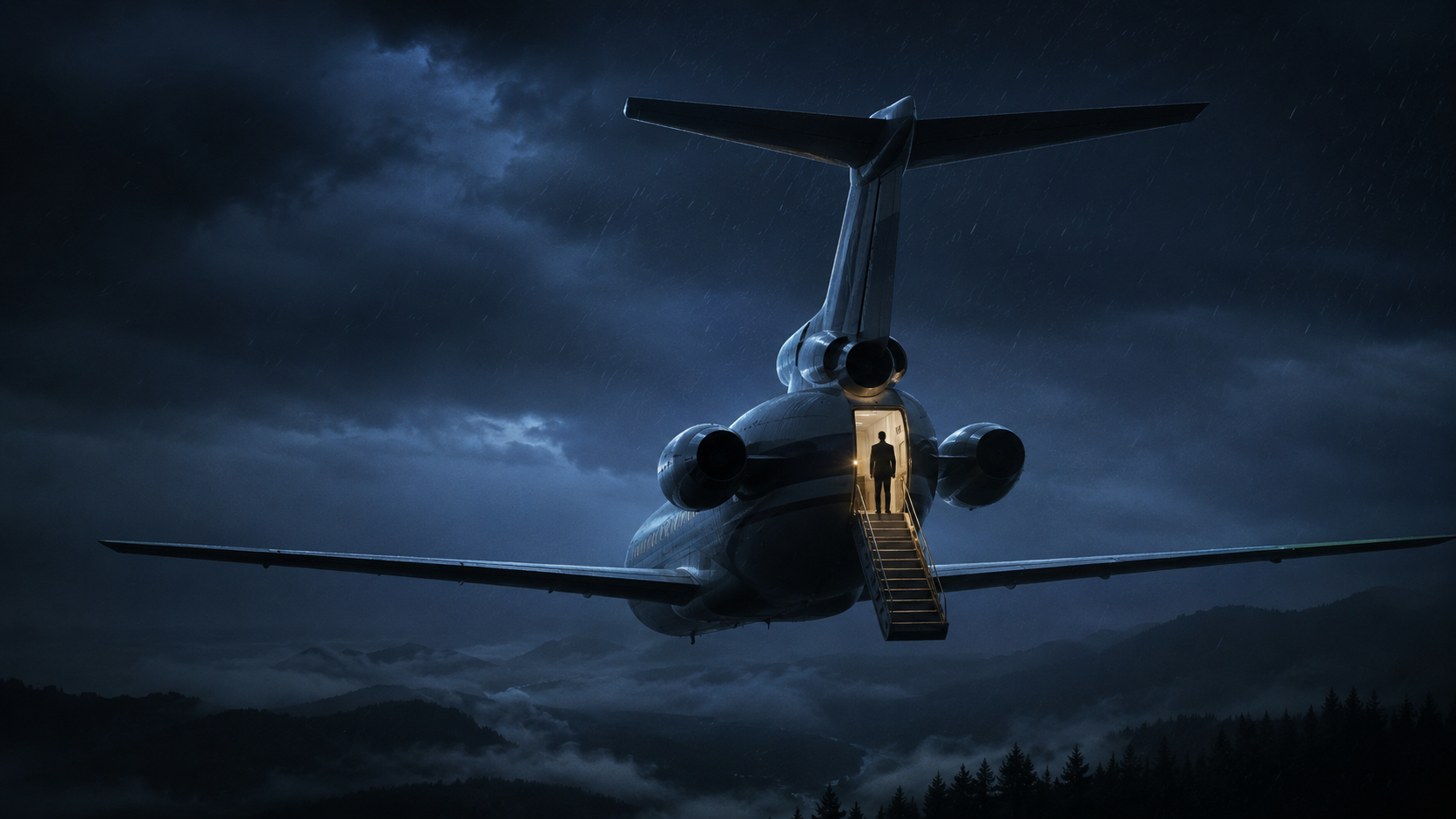
Cooper chose a seat in the rear section of the cabin. That position mattered. The Boeing 727 had a distinctive aft staircase beneath its tail. Instead of relying only on conventional side doors, passengers could enter or leave through stairs that lowered directly from the rear fuselage.
The aircraft was therefore unusually suited to what Cooper appeared to have in mind.
His behaviour was controlled rather than theatrical. He did not run through the cabin waving a weapon. He communicated through flight attendants and delivered instructions. Witness descriptions portrayed a man who was polite enough to use conventional forms of address even while threatening an aircraft with what he claimed was a bomb.
That contrast helped build the later mythology of Cooper as a gentleman outlaw. It should not obscure the underlying fact: passengers and crew had no way of knowing whether the device was genuine, and they had to treat the threat as real.
The Demand That Changed Flight 305
Once Schaffner understood the situation, Cooper dictated what he wanted.
The ransom was two hundred thousand dollars in twenty-dollar notes. He also demanded four parachutes. The request for multiple parachutes immediately complicated the response because authorities could not confidently assume that Cooper planned to jump alone. Supplying defective equipment risked killing a hostage if he forced someone to accompany him.
The aircraft remained airborne while arrangements were made in Seattle.
Passengers were not initially told that the flight had been hijacked. A mechanical problem provided the public explanation for the delay while the aircraft circled and officials assembled the money and parachutes.
The ransom itself would become unusually valuable evidence. Investigators recorded the serial numbers of the bills before they were delivered, creating a huge financial fingerprint. If Cooper spent substantial quantities of the money through ordinary channels, investigators theoretically had a way of detecting it.
At Seattle-Tacoma Airport, the exchange took place.
The passengers were released. Some crew members were permitted to leave. Cooper retained a smaller flight crew and received the money and parachutes he had requested.
What mattered next was the way he wanted the aircraft configured.
Cooper directed the crew towards Mexico City, although the Boeing would require refuelling before reaching it. He wanted the aircraft kept low, no higher than approximately ten thousand feet. He demanded a slow speed, landing gear down and flaps set at a specific angle. Most importantly, he intended to use the rear staircase.
These were not random requests.
The Boeing 727 Question
The aft stairs are one of the strongest clues to Cooper's background.
The Boeing 727 was a tri-jet designed with a staircase beneath the tail. Cooper apparently understood that the stairs could provide an exit from the aircraft while it was flying, and he constructed the second phase of the hijacking around that possibility.
There is evidence that he specifically checked that the Portland-to-Seattle service used a Boeing 727 before purchasing his ticket. During negotiations he demonstrated enough familiarity with the aircraft to discuss its configuration and knew the location of equipment aboard it. Contemporary accounts also describe airline personnel seeking technical advice about whether the aircraft could safely fly with the stairs lowered.
The knowledge has produced decades of speculation about military aviation, Boeing, parachuting and covert operations.
It is tempting to convert that familiarity into certainty that Cooper was an aviation professional. The evidence does not justify going that far.
An intelligent person planning a hijacking could research an aircraft. Someone who worked around aviation could acquire practical knowledge without being a pilot. Military service could explain it. Airline employment could explain it. Aircraft manufacturing could explain it.
What can reasonably be said is narrower: Cooper appears to have chosen an aircraft whose physical characteristics were important to his escape plan. That makes the Boeing 727 itself part of the evidence rather than simply the setting.
The Second Flight
Flight 305 left Seattle again with Cooper and four crew members aboard.
Two military fighter aircraft were sent to follow it, although maintaining useful visual contact with a slow-moving passenger jet in poor conditions was difficult. Cooper remained in the passenger cabin while the flight crew stayed forward.
The weather was bad. It was dark. The aircraft was deliberately flying low and slowly.
Cooper began working with the parachutes and ransom.
One of the reserve parachutes supplied to him was actually a non-functional training unit whose canopy had been sewn shut. Cooper did not select it as his primary parachute. He cut cord from another parachute and apparently used it to secure the money.
At approximately seven forty-two p.m., the cockpit received an indication that the aft stairs had been activated. When the crew contacted Cooper to offer assistance, he declined.
The last known exchanges were brief.
Soon afterwards, the pilots felt a noticeable movement or oscillation in the aircraft. Later testing using the same Boeing configuration and a heavy object pushed from the aft stairs reproduced a similar reaction, supporting the conclusion that the movement corresponded with Cooper leaving the aircraft.
When Flight 305 eventually landed in Reno, Nevada, the aft stairs were down.
Cooper was gone.
So was the ransom.
The Search For A Man Somewhere Below
Investigators now faced an extraordinary geographical problem.
They knew approximately where the aircraft had been when the pressure change and oscillation occurred, but they did not know Cooper's precise exit moment, how long he remained in freefall, how the wind affected him, exactly where the aircraft was within the estimated flight corridor or where he landed.
Searchers concentrated heavily on southwestern Washington.
Aircraft, helicopters, ground teams and law-enforcement personnel searched rugged country around the presumed drop zone. Lakes and surrounding areas were examined. Farms and properties were checked. The terrain was heavily wooded and in places extremely difficult to search comprehensively.
Nothing conclusive appeared.
There was no body.
There was no confirmed parachute.
There was no intact ransom bag.
There was no cache containing the missing money.
Most importantly, there was no individual investigators could prove was Dan Cooper.
The FBI investigation became known as NORJAK, from Northwest Hijacking. Hundreds of people were interviewed and thousands of leads accumulated. By around the fifth anniversary, investigators had already considered more than eight hundred suspects.
The absence of a discovery created two competing narratives almost immediately.
One was romantic: Cooper had survived, recovered the money and vanished.
The other was more brutal: there was nothing mysterious about his disappearance because he had died somewhere in the wilderness shortly after leaving the plane.
Both remain possible.
Neither explains everything.
What Cooper Left Behind
Although the hijacker disappeared, he did not leave Flight 305 completely clean.
Investigators recovered a black clip-on Towncraft tie associated with J.C. Penney and a tie clip. An FBI evidence inventory also recorded cigarette butts from Raleigh filter-tipped cigarettes and hair recovered around his seat.
The cigarette evidence later became especially frustrating because the butts were not preserved in a way that allowed modern investigators to exploit them as investigators today might hope to exploit biological evidence.
The tie survived.
That matters enormously.
Modern analysis turned an inexpensive piece of clothing into something resembling an environmental archive. Microscopic particles embedded in the fabric may reflect the places in which its owner worked or spent time.
A major forensic reanalysis published in twenty twenty-six examined approximately one hundred and eighty thousand particles sampled from the tie using scanning electron microscopy and energy-dispersive X-ray spectroscopy. The researchers identified materials associated with speciality metals and industrial processes, including particles involving titanium, gold-palladium, mercury-silver and tungsten-cobalt, alongside industrial mineral material.
Importantly, the study also weakened one earlier line of interpretation. Some particles previously thought to contain a distinctive titanium-antimony combination were not confirmed by the more detailed reanalysis. That is exactly why Cooper evidence must be handled carefully: a fascinating microscopic clue is not the same thing as an occupational identification.
The tie suggests an industrial environment.
It does not print Cooper's name.
The Money That Came Back
For years the ransom appeared to have vanished as completely as the hijacker.
Then, in February nineteen eighty, a child named Brian Ingram was with his family on a Columbia River beach known as Tina or Tena Bar, northwest of Vancouver, Washington. While clearing sand, he uncovered badly deteriorated bundles of twenty-dollar notes.
Investigators checked the serial numbers.
They were Cooper's ransom money.
The recovered total was approximately five thousand eight hundred dollars.
The discovery should have simplified the mystery.
Instead, it made it harder.
Tena Bar was not conveniently located inside the classic search narrative. How the money reached the Columbia River bank became a problem in hydrology, geology, flight-path reconstruction and decomposition.
Perhaps Cooper or the ransom entered a water system and part of the money travelled downstream.
Perhaps the money arrived at the beach through flooding.
Perhaps river dredging and later sediment movement affected its position.
Perhaps somebody deliberately buried it.
Every explanation creates another question.
Why were only several bundles present?
Why did essentially none of the remaining ransom appear in circulation?
How did bundled notes remain associated long enough to arrive together?
And if Cooper deliberately planted the money, why sacrifice marked ransom cash years after an apparently successful escape?
Tena Bar is arguably the most important discovery in the case because it is unquestionably connected to the hijacking and unquestionably outside the aircraft.
It is also one of the least cooperative clues.
Why The Missing Ransom Matters
The vast majority of the two hundred thousand dollars has never been publicly recovered.
That fact is routinely used to support the theory that Cooper died.
If he survived specifically to obtain money, why did the serial-numbered ransom apparently never flood into banks, casinos, businesses or other traceable channels?
There are several answers.
The serial-number system was far from perfect. Identifying individual twenty-dollar notes in ordinary commerce was not the same as electronically searching modern transactions. Cooper could have moved cautiously, exchanged bills indirectly, taken the money abroad, lost some of it, destroyed it or simply avoided spending conspicuously.
But the silence is still significant.
A man takes an enormous physical and criminal risk for money. Decades pass. Apart from the Tena Bar bundles, the money does not reliably reappear.
That does not prove death.
It is nevertheless evidence that any survival theory has to explain.
Was Cooper An Expert Parachutist?
One of the most persistent versions of Cooper imagines a highly trained paratrooper executing an almost military-perfect escape.
The FBI eventually moved away from that interpretation.
Experienced parachutists normally try to control risk. Cooper jumped at night, in poor weather, wearing a business suit and loafers, carrying a heavy ransom package and using a parachute that was not steerable in the way modern equipment might be. The landing terrain could include forest, water and rough ground. Former investigators therefore argued that his decisions were inconsistent with what a genuinely expert skydiver would deliberately choose.
There is an important distinction, however, between being an expert and having experience.
Cooper clearly knew enough to attempt the operation. His aircraft instructions were purposeful. He understood parachute equipment to some degree. He managed the cabin preparations without apparently abandoning the plan.
The strongest interpretation may therefore lie between the extremes.
He was probably not a clueless amateur who invented the scheme that afternoon.
But the surviving record does not require him to have been an elite military parachutist either.
What His Behaviour Tells Us
Documented Behaviour
Cooper selected a Boeing 727, sat near its rear, demanded parachutes and ransom money, controlled communications through flight attendants and gave flight parameters compatible with his intended exit. He reclaimed the original hijacking note, prepared the ransom for the jump and operated the aft stairs himself.
At the same time, he accepted extraordinary physical risks. He did not insist on ideal weather. He did not demand specialist clothing. He used equipment supplied by others and jumped into darkness without an obvious ground support operation established in the known record.
What Qualified Experts Said
Investigators originally entertained the possibility that Cooper was an experienced jumper or former paratrooper. Later FBI assessment became more sceptical. Special Agent Larry Carr argued that a skilled parachutist would have recognised how dangerous the combination of darkness, weather, clothing and equipment made the jump.
That assessment is evidence-based professional interpretation rather than proof of Cooper's training history.
What Can Reasonably Be Inferred
The behaviour is consistent with preparation combined with overconfidence.
Cooper may have known aircraft systems better than he understood the risks of the actual descent. Alternatively, he may have possessed enough parachuting experience to believe the jump was survivable despite conditions that later investigators considered reckless.
His restrained behaviour aboard the aircraft may suggest planning and self-control, but it does not establish personality type, motive or mental condition.
What Cannot Be Known
No credible psychological diagnosis can be constructed from the surviving evidence.
We cannot know whether Cooper was frightened, exhilarated, desperate or entirely confident when he reached the rear stairs. Nor can we determine from his demeanour whether the bomb was real.
The evidence records what he did.
It cannot reconstruct everything he thought.
The Best D.B. Cooper Theories Ranked
Any ranking must begin with an uncomfortable fact: no named suspect has been proved to be Cooper.
The strongest theory is therefore not necessarily the most colourful one. It is the explanation requiring the fewest unsupported assumptions while remaining consistent with the physical and eyewitness evidence.
Number One: Cooper Survived, But His Identity Has Never Been Publicly Established
This is marginally the strongest overall theory, although confidence should remain limited.
The central argument is simple: a parachute jump from a Boeing 727 was dangerous but not automatically fatal. Searchers failed to find Cooper's body, parachute or other personal equipment despite extensive efforts. No later discovery has established his death.
His preparations also suggest that he expected the jump to work. He chose the aircraft, demanded parachutes, specified flight conditions and manipulated the rear staircase. These actions look more like an escape plan than an improvised suicide mission.
The biggest objection is the money. Almost all of it disappeared from the known record, and several thousand dollars emerged years later on a Columbia River bank.
Still, absence from the banking system is not proof that Cooper never reached the ground alive.
If Cooper survived and immediately recognised how intensely authorities were searching for marked ransom notes, keeping or slowly disposing of the money may have been safer than spending it.
Verdict: Most plausible overall, but only narrowly.
Number Two: Cooper Died During Or Shortly After The Jump
The FBI itself has repeatedly regarded this as a serious possibility.
The conditions were dreadful. Cooper jumped into darkness and bad weather wearing unsuitable clothes and shoes. He carried a cumbersome money package. The parachute he used offered limited manoeuvrability. His exact landing area was uncertain and could have contained forest, rugged terrain or water.
The Tena Bar money can also be made compatible with a fatal jump if Cooper or his ransom entered water and part of the cash travelled through the river system.
The problem is physical absence.
More than half a century of searching, logging, recreation and human activity has not produced a confirmed parachute, skeleton, clothing, ransom container or other equipment from a fatal landing.
Bodies can disappear in wilderness. Parachutes can remain hidden. Search areas can be wrong.
But the complete absence of a crash-site equivalent is meaningful.
Verdict: Extremely plausible and almost inseparable from the survival theory on present evidence.
Number Three: Richard Floyd McCoy Jr. Was D.B. Cooper
No named suspect matches the mechanics of the crime as dramatically as Richard Floyd McCoy Jr.
On April seventh, nineteen seventy-two — less than five months after the Cooper hijacking — McCoy hijacked another Boeing 727. He demanded money and four parachutes, released passengers, ordered the aircraft along a specified route and escaped by parachute. Investigators identified him through evidence including handwriting and fingerprints.
The similarities are extraordinary.
McCoy had military and aviation experience, including parachuting. If one were constructing a suspect purely from behavioural similarity, he would be difficult to ignore.
The FBI did not ignore him. It investigated him and ultimately rejected him as Cooper. Among the problems was eyewitness identification: flight attendants who spent considerable time around Cooper did not accept McCoy as matching the hijacker they remembered. The ages and aspects of the descriptions were problematic as well.
Recent claims have renewed interest. Material said to include a parachute rig and jump records connected with McCoy's family has been presented publicly, and investigators reportedly showed interest in examining physical evidence. Those claims are intriguing, but public assertions that the equipment belonged to Cooper have not been established by an official forensic identification. They should therefore remain claims, not conclusions.
McCoy is the strongest named suspect.
That is different from saying he was Cooper.
Verdict: Best named-suspect theory, but the eyewitness conflict remains a major obstacle.
Number Four: Cooper Worked In Aerospace Or Specialised Heavy Industry
This theory does not give Cooper a name, but modern forensic science has made it increasingly interesting.
Particles preserved on his clip-on tie include materials associated with speciality metals and industrial environments. The twenty twenty-six forensic study identified particles involving titanium, tungsten-cobalt, gold-palladium and mercury-silver, alongside industrial mineral material.
Combined with Cooper's apparent familiarity with the Boeing 727, this raises a plausible occupational profile: someone who worked in aircraft production, specialist metallurgy, engineering, manufacturing or an associated industrial environment.
There are important limitations.
A tie collects particles from workplaces, vehicles, homes and other environments. Some contamination may occur over time, although the concentration and diversity of material remains scientifically interesting. Researchers themselves present the particles as investigative associations rather than proof of employment at one specific company.
The theory therefore works better as a filter than an identification.
Verdict: One of the strongest modern clues to Cooper's background, but not his name.
Number Five: Cooper Had A Canadian Or European Connection
The name Dan Cooper may itself contain information.
A French-language comic series called The Adventures Of Dan Cooper featured a Canadian military test pilot. The comics circulated in continental Europe and French-speaking Canada and included aviation and parachuting themes.
The FBI publicly explored the possibility that the hijacker encountered the character overseas or in Canada and adopted the name.
If deliberate, this is potentially revealing. A man choosing a false identity for an aviation crime happened to select the name of a fictional military aviator.
Coincidence is also entirely possible.
There is no evidence Cooper ever owned or read one of the comics. The name could have been invented independently. Efforts to turn the comic connection into a specific nationality have therefore gone much further than the evidence allows.
Verdict: A clever clue worth keeping, but far weaker than physical evidence.
Number Six: One Of The Other Famous Named Suspects Was Cooper
Numerous men have been proposed over the decades, including military veterans, pilots, parachutists, criminals and individuals identified through alleged confessions or family stories.
The fundamental problem repeats itself.
A resemblance to the composite sketch is not enough.
A mysterious absence over Thanksgiving is not enough.
A relative recalling unusual behaviour is not enough.
Military parachuting experience is not enough.
A deathbed confession is not enough.
The FBI accumulated enormous numbers of tips precisely because thousands of middle-aged men could be made to fit fragments of the Cooper profile. The agency eventually stated that none of the tips or applications of investigative technology produced evidence sufficient to establish the hijacker's identity.
This is why individually compelling suspect stories often weaken under scrutiny. They start with the candidate and work backwards.
A convincing solution must work in the opposite direction: evidence first, identity second.
Verdict: Possible in individual cases, but collectively much weaker than their popular reputations suggest.
The Clue That May Matter Most Today
The black tie may ultimately prove more useful than the famous composite sketch.
Eyewitness memory deteriorates. Suspect stories accumulate folklore. Family recollections are vulnerable to reinterpretation. The tie is different because at least some of the material embedded within it existed before the hijacking entered popular culture.
The twenty twenty-six particle analysis is therefore one of the most meaningful scientific developments in the modern Cooper story.
Researchers examined roughly one hundred and eighty thousand particles and emphasised that ties can function as unusually effective collectors of workplace and environmental material because they are rarely washed. Their results supported associations with speciality metals and industrial environments while correcting some earlier assumptions about specific particles.
This could eventually allow researchers to compare Cooper's environmental signature with industrial processes, locations or employment histories.
It may also lead nowhere.
Trace particles rarely identify one human being without another piece of evidence connecting the material to a specific person.
But after decades dominated by suspects, confessions and facial comparisons, the tie offers something different: evidence that does not care who anyone wants Cooper to be.
What The Record Cannot Prove
The Cooper case contains far more uncertainty than popular retellings sometimes admit.
There is no confirmed identity.
There is no verified post-hijacking sighting.
There is no confirmed recovery of Cooper's main parachute.
There is no established explanation for the location of the Tena Bar money.
There is no proof that the bomb was genuine.
There is no reliable public evidence showing what happened to most of the ransom.
And there is no scientific result currently linking the tie particles to a single identified suspect.
The absence of answers is not a blank space into which any theory can be inserted.
A suspect must still fit the witnesses, chronology, aircraft knowledge, physical evidence and known movements. A survival theory must address the ransom. A death theory must address the absence of remains. A river theory must explain the cash. An industrial theory must explain the particles without pretending that environmental trace evidence is a name tag.
That tension is why the mystery persists.
Every serious theory solves one part of the case by creating difficulty somewhere else.
Why The FBI Stopped Actively Investigating
The investigation did not end because Cooper was identified.
In July twenty sixteen, the FBI announced that resources dedicated to the case were being redirected to other priorities. The agency explained that decades of tips and technological examination had not produced evidence capable of proving the hijacker's identity.
The distinction matters.
The case was effectively moved out of active investigation, not solved.
The FBI also left an important door open. It said specific physical evidence connected to the parachutes or ransom money should still be brought forward.
That is a sensible threshold after decades of false confessions and suspect theories.
Another story about a mysterious uncle may add little.
A parachute demonstrably linked to the equipment supplied in Seattle could change the case.
Previously unknown ransom notes with matching serial numbers could change it.
Biological material unquestionably connected to Cooper could change it.
A scientifically defensible match between trace evidence and a particular suspect could change it.
The mystery probably does not need another theory.
It needs another object.
Why D.B. Cooper Still Matters
Cooper occupies a peculiar place in American folklore because the story ends at exactly the point most criminal investigations are supposed to begin narrowing.
The aircraft landed.
The passengers survived.
Investigators knew what the hijacker looked like.
They had physical evidence.
They had serial numbers for the ransom.
They knew approximately where he left the aircraft.
Yet the central figure vanished.
The case also belongs to a vanished era of aviation. Hijackings helped accelerate changes in airport security, passenger screening and aircraft design. The Cooper incident and the copycat crimes that followed demonstrated just how vulnerable commercial aviation could be when almost anyone could board an aircraft with minimal examination.
But folklore has softened the crime over time. Cooper is often imagined as an elegant outlaw who embarrassed the authorities and disappeared with corporate money.
That interpretation forgets the people aboard Flight 305 who had to believe the bomb might be real.
The enduring mystery is not evidence that the hijacking was victimless. It is evidence that uncertainty can transform a criminal into a legend.
More than half a century after the flight, the strongest answer remains frustratingly incomplete.
The man who boarded in Portland probably planned the operation carefully. He understood something important about the Boeing 727. His tie suggests exposure to specialised industrial environments. He left the aircraft somewhere over southwestern Washington with approximately two hundred thousand dollars. Several bundles of that money eventually reached a Columbia River beach.
Beyond those boundaries, certainty collapses.
Perhaps he landed, walked away and spent the rest of his life guarding one extraordinary secret.
Perhaps the wilderness ended his escape within minutes.
Perhaps Richard McCoy really did perform essentially the same crime twice.
Perhaps Cooper's real name has never appeared on any serious suspect list.
The black clip-on tie remains.
An ordinary, inexpensive object removed somewhere between Portland and the rear staircase of Flight 305, it may contain more reliable information about D.B. Cooper than decades of confessions, photographs and speculation.
The legend asks who vanished into the darkness.
The evidence asks a harder question: what can actually be proved?
