True Crime: Jonestown Explained – Jim Jones, The Peoples Temple And The Road To Mass Death
How Control Escalated
Why Did Peoples Temple Move To Jonestown?
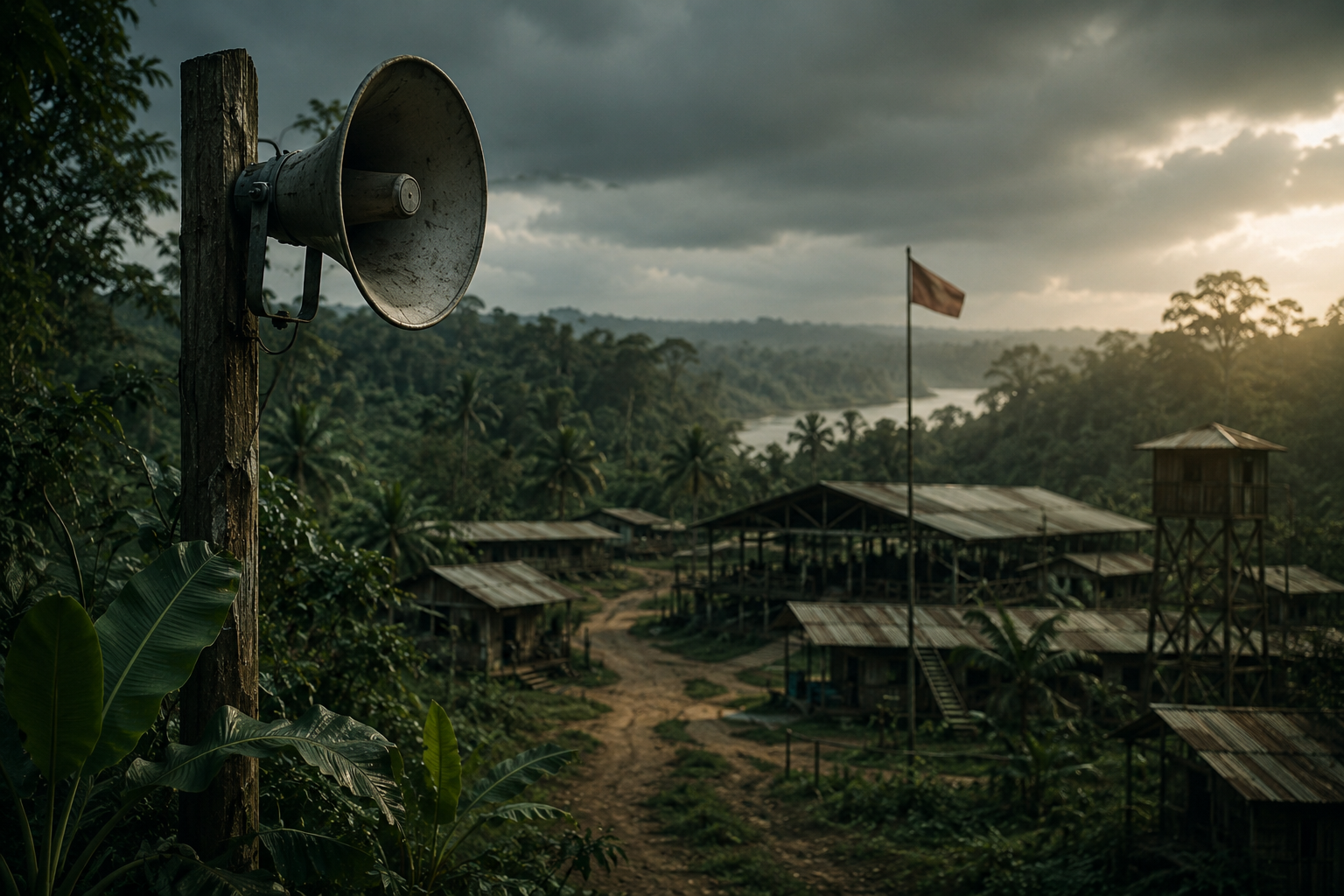
In the remote northwestern interior of Guyana, a loudspeaker was almost impossible to escape. It carried announcements across a settlement surrounded by dense jungle, summoning residents to meetings, broadcasting news, relaying instructions and carrying the voice of one man into homes and communal spaces. The settlement had a school, crops, workshops, a medical clinic and hundreds of people who had travelled thousands of miles believing they were helping to build something better.
Its name was Jonestown.
To outsiders who were allowed to visit, it could appear industrious and strangely impressive. To many of the people living there, it represented an experiment in racial equality, communal ownership and protection from a United States they believed was becoming increasingly hostile. Yet former members and worried relatives were presenting a radically different description: isolation, punishment, armed security, restrictions on leaving and increasingly ominous discussions about collective death. American diplomatic officials made several visits but reported that they had obtained no clear proof of the most serious allegations.
By the autumn of nineteen seventy-eight, the contradiction had become impossible to ignore. How could a church that had attracted followers through racial integration, welfare programmes and social justice end up in a Guyanese jungle where former insiders were warning that hundreds of lives might be in danger?
The answer was not one sudden act of madness. Jonestown was the end point of a much longer transformation: a movement that offered belonging, a leader who accumulated extraordinary authority, a community that increasingly separated itself from outside correction, and a series of loyalty demands that gradually changed what members were expected to accept.
Jim Jones Before Jonestown
James Warren Jones emerged as a preacher in Indiana during the nineteen fifties. His early ministry contained something that made Peoples Temple more complicated than the caricature it later became. Jones publicly supported racial integration at a time when doing so could provoke serious hostility, and his congregation deliberately welcomed Black and white worshippers together.
The organisation that developed into Peoples Temple took shape in Indianapolis in the mid-nineteen fifties. Jones combined Pentecostal-style preaching and supposed healings with a strong social message. Racial equality, support for poor people, communal responsibility and criticism of economic inequality became central to the movement's appeal. Peoples Temple eventually became affiliated with the Christian Church, Disciples of Christ.
That history matters because many people who joined Peoples Temple were not searching for an obviously destructive organisation. Some were drawn to causes that were progressive and tangible. They saw interracial families, food assistance, care for elderly people, communal living and members willing to devote enormous amounts of time to helping others.
Jones could therefore offer two things at once: an ideological mission and an intensely personal form of belonging.
The distinction is crucial. Understanding why intelligent people entered Peoples Temple does not require assuming that they were foolish, gullible or psychologically defective. A group capable of becoming coercive can still initially satisfy genuine human needs. Indeed, those positive experiences can make later warning signs harder to interpret because leaving does not merely mean rejecting a leader. It can mean abandoning friendships, family, housing, purpose and a moral identity.
California And The Expansion Of Peoples Temple
In nineteen sixty-five, Jones and roughly one hundred and fifty followers relocated to northern California, establishing themselves around Redwood Valley near Ukiah. Membership grew, and by the early nineteen seventies Peoples Temple had expanded into San Francisco and Los Angeles. It operated residential facilities and other social programmes while campaigning around civil rights and political causes.
San Francisco transformed the scale of Jones's influence.
Peoples Temple could mobilise large numbers of disciplined volunteers. Members attended demonstrations, campaigned for political causes and became a visible constituency. The movement's interracial membership and social programmes gave Jones access to prominent civic and political figures who saw Peoples Temple as an organised progressive force.
In October nineteen seventy-six, San Francisco Mayor George Moscone appointed Jones to the San Francisco Housing Authority. Jones subsequently became its chairman. The position gave a preacher who already exercised considerable authority within his congregation the legitimacy of public office.
This external recognition mattered inside the Temple as much as outside it. Every politician willing to appear alongside Jones could be presented to followers as evidence that their leader was important and respected. Every compliment strengthened the perception that attacks on Jones came from enemies rather than legitimate critics.
The public face of Peoples Temple consequently became one of its strongest defences.
A politician visiting a service could see a multiracial congregation and enthusiastic supporters. A vulnerable person could see practical assistance. An activist could see disciplined organisation. A member who knew about harsher internal practices encountered a different institution.
Those realities could coexist.
The System Behind The Public Image
As Peoples Temple expanded, Jones increasingly occupied the centre of a highly organised hierarchy. Senior members and administrators helped operate a movement whose demands extended far beyond attending church on Sunday.
Members could surrender property, income and enormous quantities of labour. Relationships increasingly became subject to collective scrutiny. Meetings could involve public criticism and humiliating disciplinary rituals. Defectors later described pressure, fear and an environment in which Jones's authority reached deep into private life.
Not every person experienced Peoples Temple in precisely the same way, and the historical record contains memories from former members who continued to value some of the movement's early social work. That complexity should not be erased. Peoples Temple was capable of doing things its members considered genuinely good while simultaneously creating structures that made resistance increasingly costly.
Jones's position was strengthened by another technique: portraying the outside world as dangerous.
Criticism could be interpreted as persecution. Former members could become traitors. Journalists, relatives, government agencies and political opponents could be folded into a broad narrative in which hostile forces were supposedly trying to destroy the Temple.
Once that worldview became powerful enough, scrutiny no longer necessarily weakened Jones. It could strengthen his argument.
He was telling followers that enemies were coming.
Then enemies appeared.
Why Guyana Appeared To Offer An Escape
Peoples Temple began developing an agricultural project in Guyana during the nineteen seventies. The country offered several advantages from the movement's perspective. It was English-speaking, governed by a leadership pursuing socialist policies, geographically distant from California and interested in developing its sparsely populated interior.
Temple representatives secured land in Guyana's northwest. The settlement gradually developed before the large migration that made it famous. Government records show that Guyanese officials initially regarded the community reasonably favourably. It appeared to fit the country's objective of promoting agriculture and settlement in the interior.
Jones increasingly described relocation as protection.
Followers were encouraged to believe that racial persecution, authoritarianism or even catastrophic violence could engulf the United States. Guyana could therefore be presented not as retreat but as liberation: a place where the Temple could finally practise communal socialism without hostile interference.
The image had enormous emotional power.
Members were not simply moving to a farm. They were being told they were participating in the construction of a better society.
Yet the physical geography that offered refuge also created extraordinary dependence.
Jonestown was remote. Travel required difficult journeys through Guyana. Communications were limited. Residents depended heavily on the organisation for food, housing, work, transport, medical treatment and information from the outside world.
The farther Peoples Temple travelled from its critics, the more Jones controlled the environment in which criticism could be interpreted.
The Migration That Changed Jonestown
During nineteen seventy-seven, hundreds of Temple members moved rapidly from the United States to Guyana. What had been a comparatively small agricultural project suddenly had to accommodate a much larger population.
The transition intensified practical problems. Feeding hundreds of people, providing sanitation, maintaining medical services and expanding housing in an isolated tropical environment required constant labour.
Residents worked agricultural and construction jobs. Children attended school. Loudspeakers provided information and Jones frequently addressed the population. The settlement operated according to detailed schedules and collective demands.
Former resident Deborah Layton described a far darker reality after leaving Jonestown in May nineteen seventy-eight. In a sworn affidavit, she alleged inadequate food, severe restrictions on personal freedom, armed guards, rehearsed responses before official visits and a climate in which members feared openly contradicting Jones. Most significantly, she warned that Jones was discussing mass death and that residents' lives were in danger.
Her account was not simply retrospective interpretation produced after Jonestown became infamous.
It existed months before the final events.
That makes it one of the most important documents in the entire history of Peoples Temple.
The Child Custody Fight That Intensified The Siege Mentality
At the same time, one dispute acquired enormous significance: the custody battle involving John Victor Stoen.
John had been born in California in January nineteen seventy-two to Grace and Timothy Stoen. His birth certificate named Grace and Timothy as his parents. Less than two weeks after the birth, Timothy signed an extraordinary affidavit stating that Jim Jones was the biological father. That document became central to years of conflict over the boy.
Grace left Peoples Temple. Timothy eventually did too. They sought custody of John, who was in Guyana with the Temple.
A California court granted custody to Grace and Timothy in November nineteen seventy-seven. Legal proceedings also unfolded in Guyana as attempts were made to compel Jones to produce the child.
For Jones, the dispute became more than a custody case.
It threatened the principle that Jonestown could remain beyond the effective reach of defectors and their families. If outside courts could force the return of one child, other relatives might intensify attempts to remove people from the settlement.
Inside Jonestown, the conflict was incorporated into Jones's broader story of persecution.
Legal pressure became existential pressure.
That transformation was dangerous because ordinary outside intervention could increasingly be interpreted not as a dispute to be resolved but as proof that the entire community faced destruction.
The White Nights
Perhaps the clearest indication of where that thinking was heading came through what residents called White Nights.
During crisis meetings, Jones presented scenarios in which enemies were supposedly approaching Jonestown. Members debated or rehearsed responses ranging from resistance to collective death.
Layton described one particularly disturbing loyalty test. Residents, including children, were ordered to drink a red liquid and told that it contained poison. They complied. After waiting for the expected effects, Jones revealed that the drink was harmless and said the exercise had tested their loyalty.
That rehearsal reveals something more important than the mechanics of what occurred.
It altered the psychological boundary of what could be discussed collectively.
An idea that would normally have been unthinkable had become a meeting agenda. Then a hypothetical response. Then a rehearsal. Then a loyalty test.
Repeated exposure does not prove that every resident accepted collective suicide. It demonstrates that the leadership had normalised the discussion sufficiently for hundreds of people to participate in exercises built around it.
The distinction between believing an idea and becoming accustomed to hearing it is important.
People do not necessarily need to embrace an extreme proposition for repeated exposure to make it easier for an authority figure to introduce the next escalation.
The Growth Of Control
Documented Behaviour
The strongest behavioural evidence concerning Jones comes not from diagnosing him but from examining what he repeatedly did.
He concentrated organisational authority around himself. Former insiders described members being pressured to sacrifice money, privacy and independent relationships. Critics and defectors were reframed as enemies. Jonestown became physically isolated. Residents received information through systems controlled by Temple leadership. Official visitors were announced in advance, and Layton stated that residents were coached on how to respond.
Jones also repeatedly invoked catastrophic external threats.
Political fascism, racism, government intervention, hostile relatives and supposed conspiracies were woven together into a worldview in which the Temple existed under permanent siege.
The White Night rehearsals pushed that process further by connecting loyalty to willingness to die.
What Can Reasonably Be Inferred
Those patterns are consistent with a system in which dependence increased while alternative sources of authority weakened.
The most useful question is therefore not simply why people believed Jones. Many may have believed different parts of his message to different degrees. What mattered was that dissent became progressively more expensive while obedience became embedded in daily life.
Physical isolation reinforced social isolation. Social isolation reinforced informational control. Informational control made Jones's claims harder to test. The perception of persecution then made outside criticism easier to dismiss.
An alternative explanation must also be acknowledged. Some members remained committed to socialism and communal life on ideological grounds and did not understand themselves simply as passive followers. Genuine political belief existed inside Peoples Temple.
But ideological commitment and coercion are not mutually exclusive.
A person can sincerely believe in a cause while simultaneously living inside a system that constrains meaningful choice.
What Cannot Be Known
The surviving record cannot tell us exactly what every Jonestown resident believed.
It cannot reliably divide the population into true believers, frightened conformists, reluctant participants, people intending to leave and people whose position changed from one day to another.
Nor can historical observation responsibly diagnose Jones with a psychiatric disorder from his speeches, drug use, paranoia or violence alone.
What can be established is behaviour: increasingly concentrated authority, escalating siege rhetoric, rehearsals involving collective death and mechanisms that made resistance more difficult.
Explanation is not excuse, and psychological speculation is unnecessary when the documented conduct is already so revealing.
The Concerned Relatives And The Pressure From Outside
Former Temple members and relatives eventually organised publicly as the Concerned Relatives.
They sought government intervention, information about family members and opportunities for people who wanted to leave Jonestown to do so. The Stoen custody dispute became one of their most visible campaigns.
From outside Jonestown, their demands could look straightforward: access, communication and legal accountability.
Inside Jones's narrative, the same activity could be portrayed as an organised assault.
American officials were caught between competing claims. Temple representatives insisted that residents were living voluntarily in Guyana and complained of harassment. Critics alleged coercion and abuse.
Diplomatic records show that United States consular officials visited Jonestown several times beginning in nineteen seventy-seven. They did not obtain clear evidence confirming the worst accusations, although officials knew about allegations of physical abuse, weapons and suicide rehearsals.
There was an obvious structural problem.
An announced visit to an isolated community did not necessarily reveal what happened when officials were absent.
Layton explicitly warned of that weakness. She claimed members were prepared for inspections and feared retaliation if they spoke openly.
By late nineteen seventy-eight, Congressman Leo Ryan decided to see Jonestown himself.
Leo Ryan Goes To Guyana
Ryan represented a California congressional district containing relatives of Peoples Temple members. After receiving allegations about conditions in Guyana, he organised a fact-finding visit.
The delegation travelled to Guyana in November nineteen seventy-eight. Ryan was accompanied by staff members, concerned relatives and journalists.
Reaching Jonestown itself was complicated because Peoples Temple controlled access to its property. After negotiations, the party eventually arrived at the settlement on November seventeenth.
That evening, residents staged musical entertainment. Ryan spoke publicly and said that, from conversations he had held, many people appeared to believe Jonestown was the best thing that had happened to them.
The statement was greeted enthusiastically.
For a moment, Jones appeared to have the validation he wanted.
But another conversation was already changing the visit.
A resident quietly passed a message to a member of Ryan's party.
People wanted to leave.
The Defections That Changed The Visit
Ryan agreed that anyone wishing to return with him could do so.
The following day, several residents identified themselves as defectors. The Parks family and others prepared to leave.
Their decision presented Jones with the exact scenario his system had been built to resist: members standing inside Jonestown, in front of outsiders, and openly choosing the outside world.
Jones's composure deteriorated during interviews.
The congressional visit had transformed from an inspection into an extraction.
As the departing party prepared to leave, resident Don Sly attacked Ryan with a knife. Ryan was not seriously injured. Despite the assault, the group continued toward the nearby Port Kaituma airstrip.
A second aircraft was needed because of the additional defectors.
One man who said he also wanted to leave was Larry Layton.
Others were suspicious of him.
They had reason to be.
The Port Kaituma Airstrip
The Ryan party reached Port Kaituma and began preparing to depart aboard two small aircraft.
Layton boarded one of them.
Then a Temple vehicle approached carrying armed men.
Gunfire erupted.
At the airstrip, Congressman Leo Ryan, Temple defector Patricia Parks, photographer Greg Robinson, cameraman Bob Brown and reporter Don Harris were killed. Nine others were wounded. Jackie Speier, then a member of Ryan's congressional staff, survived multiple gunshot wounds.
Layton opened fire inside one aircraft but was restrained.
The ambush removed any remaining possibility that Jones could portray the crisis as merely a disagreement between a private community and intrusive relatives.
A sitting United States congressman had been murdered while performing his official duties.
Back at Jonestown, Jones called residents together.
The loudspeaker that had helped organise daily life now summoned the community for its final gathering.
The Last Meeting In Jonestown
An audio recording recovered after the events preserves much of what followed.
Jones told the assembled residents that the situation had become hopeless. He presented death not as defeat but as what he called revolutionary suicide.
At least one resident, Christine Miller, openly challenged him.
She argued that the community could seek another solution and raised the possibility of going to the Soviet Union. Her objections are historically crucial because they destroy the idea that the gathering reflected effortless unanimity.
There was dissent.
Jones answered it.
Other members spoke in support of his position.
The meeting moved from argument to implementation.
A mixture containing cyanide was prepared with a flavoured drink. Children were among the first to receive it. Eyewitness testimony and later investigations established that syringes without needles were used to place the liquid into the mouths of babies and small children.
Once children began dying, the language of collective suicide becomes morally inadequate.
Children could not meaningfully consent.
Adults faced a setting shaped by armed security, years of escalating loyalty demands, prior rehearsals, intense group pressure, physical isolation and the immediate deaths of their own children.
Some adults may have willingly accepted Jones's ideology of revolutionary suicide.
Others may not have.
The evidence cannot reconstruct each person's final degree of consent.
That is why describing Jonestown simply as the largest mass suicide in modern history creates a false sense of certainty.
Mass murder-suicide or mass death better captures what the evidence allows us to say.
Nine Hundred And Nine People At Jonestown
By the time Guyanese authorities entered the settlement, practically the entire Jonestown population had died.
The final established figure was nine hundred and nine deaths at Jonestown itself. Combined with the five people murdered at Port Kaituma and four additional Temple deaths in Georgetown, the overall total connected to the events of November eighteenth was nine hundred and eighteen.
More than two hundred of those who died at Jonestown were children.
Jones was found dead with a gunshot wound to the head.
The scale initially confused investigators. Early counts dramatically underestimated the number of bodies because people were lying closely together and, in places, on top of one another. The remoteness, tropical conditions and speed of decomposition complicated recovery and identification.
Medical examination confirmed cyanide poisoning as the principal mechanism of the mass deaths. A later United States pathology review examined only a small sample of bodies, an important limitation that prevents forensic certainty about the precise circumstances of every individual death.
That limitation matters.
Jonestown produced an enormous crime scene but comparatively poor individual forensic resolution.
The broad event is clear.
The final choice available to every person is not.
Why Jonestown Was Not Simply A Mass Suicide
The phrase mass suicide survives because Jones explicitly used the language of suicide and because some adults apparently participated without visible physical resistance.
But consent cannot be evaluated in isolation from circumstances.
Hundreds of residents lived thousands of miles from their former homes. The settlement was controlled by the organisation. Armed personnel were present. Escape through surrounding jungle was difficult. Children were killed. Prior loyalty tests had rehearsed the very scenario now unfolding.
The fact that some adults believed in revolutionary suicide does not prove that all did.
Likewise, the existence of coercion does not require imagining that every adult was physically held down.
Coercive systems rarely operate through a single mechanism.
They can rely on fear, dependence, exhaustion, surveillance, ideological commitment, group pressure, isolation, threats and the progressive destruction of alternatives.
Academic analysis of Jonestown consequently tends to treat the event as more complex than either an entirely voluntary mass suicide or a simplistic scenario in which every resident was forcibly poisoned. Evidence indicates that Temple leadership had developed collective-death planning in advance, while the degree of consent among individual adults remains impossible to establish.
For the children, the issue is clearer.
They were killed.
What The Record Cannot Prove
Jonestown generated thousands of surviving documents and hundreds of audio recordings. Peoples Temple kept unusually extensive records, many of which were recovered after the deaths and entered government archives.
Yet enormous documentation does not produce perfect knowledge.
We cannot know how many adults would have refused had they believed refusal was safely possible.
We cannot reconstruct every private conversation during the final hours.
We cannot determine the exact intentions of every armed guard.
We cannot establish whether each adult ingestion was voluntary, coerced or somewhere between those categories.
We should also be cautious about theories claiming that an outside intelligence operation secretly orchestrated the deaths. Jonestown has generated decades of conspiracy claims, but the surviving evidence already provides a substantial internally generated explanation: Temple leaders discussed collective death before November eighteenth, rehearsed it, prepared for it and implemented it during the final crisis.
The historical uncertainties are real.
They do not make the entire event mysterious.
Larry Layton And The Legal Aftermath
Larry Layton survived the shootings at Port Kaituma.
His legal process became the major American criminal prosecution connected directly to Jonestown because the other suspected participants in the airstrip attack died.
After proceedings in Guyana and eventual extradition, Layton was convicted in the United States on federal charges connected with the conspiracy to murder Congressman Ryan and the attempted murder of an internationally protected person.
He received a life sentence.
Layton ultimately spent about eighteen years in prison before being released.
The broader investigation was enormous. The FBI investigation was code-named RYMUR, for Ryan Murder. Agents interviewed survivors and former Temple members, processed records, examined recovered tapes and assisted with identification. The resulting material became one of the principal documentary archives through which Jonestown can now be reconstructed.
Peoples Temple itself effectively ceased to exist.
Families were left to confront losses almost impossible to comprehend.
The People Lost Behind The Word Jonestown
One of the lasting problems with discussing Jonestown is that Jim Jones can overwhelm everyone else in the story.
Nine hundred and eighteen deaths become a statistic.
That distorts what disappeared.
The people who entered Peoples Temple had families, professions, political beliefs, disagreements and different reasons for joining. Some wanted racial equality. Some wanted religious community. Some wanted economic security. Some valued the Temple's social programmes. Some followed relatives. Some were children and never chose membership at all.
Many of the older Black women who formed an important part of the congregation had lived through decades of American racial discrimination. Peoples Temple offered interracial worship, communal care and a language of dignity at a time when those promises had genuine meaning.
Recognising that does not rehabilitate Jones.
It exposes the scale of his betrayal.
He did not create every ideal that attracted people to Peoples Temple. He positioned himself at the centre of those ideals until loyalty to the cause became increasingly difficult to distinguish from loyalty to him.
That is one reason the word cult, although understandable, can sometimes stop analysis too early.
Calling Peoples Temple a cult tells us that it became coercive.
It does not explain how.
The Myth Of Drinking The Kool-Aid
Jonestown also entered popular language through the expression drinking the Kool-Aid, meaning unquestioningly accepting an idea or following a group.
The phrase trivialises the history in two ways.
First, the flavoured drink used at Jonestown is generally identified in surviving evidence as Flavor Aid rather than Kool-Aid, although other drink packets were also reportedly present at the settlement.
More importantly, the expression turns hundreds of coerced and murdered people, including children, into a joke about gullibility.
They did not all perform one identical voluntary act.
The historical lesson is precisely that choice had been progressively distorted.
Reducing Jonestown to unquestioning followers drinking something because Jones told them to ignores the years required to create the conditions in which the final gathering could occur at all.
Why The Warning Signs Failed To Stop It
Jonestown raises a disturbing institutional question.
Warnings existed.
Former members described abuse.
Relatives organised.
The Stoen custody case moved through courts.
Deborah Layton provided a sworn warning about mass suicide months before November eighteenth.
Diplomatic officials knew allegations included physical abuse, firearms and suicide rehearsals.
Yet intervention was complicated.
Most Jonestown residents were adult American citizens living in another sovereign country. Religious freedom, freedom of movement and limits on consular authority mattered. Officials could not simply assume that relatives who disliked Peoples Temple spoke for adults who claimed they wanted to remain.
Consular visits also produced conflicting information. Officials saw residents who publicly defended the settlement and did not obtain clear evidence of widespread coercion.
In retrospect, those visits appear inadequate to penetrate an organisation capable of preparing members for outside inspection.
But retrospect must be used carefully.
The lesson is not that authorities should automatically dismantle unconventional communities whenever relatives object.
It is that systems designed to evaluate individual consent can fail when access to individuals is mediated by the very organisation accused of controlling them.
What Jonestown Actually Teaches
Jonestown is sometimes treated as a story about charisma.
That is only part of it.
Jim Jones could not have created Jonestown through charisma alone.
He required an organisation.
Administrators managed finances. Loyalists enforced discipline. Political allies provided legitimacy. Members worked relentlessly. Communications systems reinforced the internal worldview. Geographic isolation increased dependence. Critics were turned into proof of persecution. Loyalty tests shifted behavioural boundaries.
The important pattern is cumulative.
No single step explains the destination.
A socially progressive church does not automatically become a coercive community.
Communal property does not automatically lead to violence.
Political activism does not produce mass death.
Moving abroad does not make an organisation dangerous.
Strong leadership alone is not enough.
The danger emerged from the interaction between those elements and something more fundamental: the gradual removal of meaningful limits on Jones's authority.
When a leader becomes the principal interpreter of reality, the principal source of protection, the judge of loyalty and the person who defines every challenge as persecution, correction becomes increasingly difficult.
Jonestown demonstrates what can happen when that process reaches an extreme.
The Loudspeaker At The End
The loudspeaker system that carried Jim Jones's voice around Jonestown had once performed ordinary functions.
It announced work.
It delivered news.
It organised meetings.
It connected hundreds of people living in an isolated settlement.
But by November eighteenth, nineteen seventy-eight, its meaning had changed.
The community built to escape an allegedly dangerous outside world had become a place in which the greatest danger came from the authority at its centre.
Nine hundred and eighteen people died in Guyana that day and in the connected events surrounding Jonestown. The youngest never chose the movement at all. Among the adults, degrees of belief, coercion and resistance remain impossible to divide neatly.
That uncertainty does not weaken the lesson.
It sharpens it.
Jonestown was not created in a single moment when hundreds of people suddenly stopped thinking for themselves. It was constructed over years, as genuine ideals became attached to one man's authority, external criticism became evidence of conspiracy, dependence replaced alternatives and previously unthinkable demands were rehearsed until they became discussable.
The road to Jonestown did not begin with poison.
It began when one voice became harder and harder to escape.
