

True Crime: The Salem Witch Trials Explained - How Fear Turned A Town Against Itself
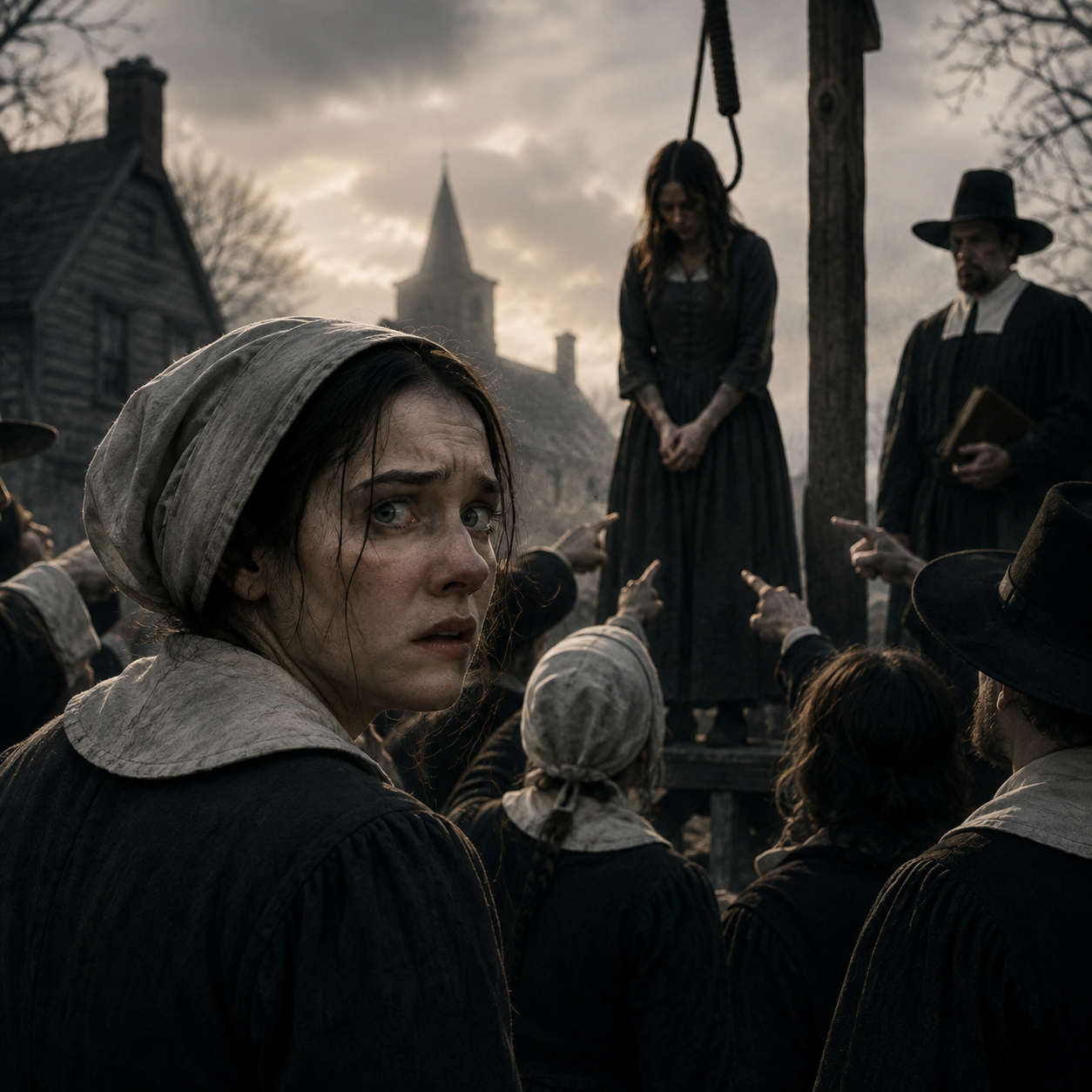
How fear, religion, local conflict and spectral evidence turned suspicion into a deadly crisis.
From Accusations To Crisis
In the winter of sixteen ninety-two, something was wrong inside the home of the Reverend Samuel Parris. His nine-year-old daughter, Betty, and his twelve-year-old niece, Abigail Williams, began suffering strange episodes. Their bodies twisted into unusual positions. They cried out. They appeared frightened by things nobody else could see. Prayer did not stop it. Fasting did not explain it. A doctor reportedly concluded that an “Evil Hand” might be responsible.
To people living in Salem Village, this was not automatically an absurd conclusion. The Devil was not a metaphor in their world. Witchcraft was a crime recognised by law, supernatural interference was accepted as possible, and stories of witches attacking ordinary Christian families already circulated throughout New England.
Then came a question with consequences nobody in the village could control: if invisible forces were tormenting these children, who was sending them?
Names began to emerge.
And once Salem accepted the premise that an invisible crime was taking place, almost anything could become evidence of it.
A Village Already Divided
The popular image of the Salem Witch Trials is deceptively simple: frightened Puritans became superstitious, children made accusations, and innocent people were executed. Every part contains some truth. Together, however, they miss the conditions that allowed the accusations to spread.
Salem Village was not the modern city of Salem. The rural settlement, now largely within Danvers, existed alongside the more prosperous commercial centre of Salem Town. Long-running disagreements divided residents over land, money, church organisation, local authority and the degree of independence the village should have from the town. By the sixteen seventies, tensions between the agricultural village and wealthier town were already pronounced.
Religion added another fault line. Salem Village struggled to keep ministers. Several had left during the preceding years, and the arrival of Samuel Parris in sixteen eighty-nine did not produce lasting unity.
Disputes developed around Parris himself, including his salary and the parsonage. By sixteen ninety-two, a new village committee opposed to him had been elected, his salary had gone unpaid for months, and even the supply of firewood to his household became contentious. The community in which the first accusations appeared was therefore not socially calm before witchcraft entered the conversation.
Nor was Massachusetts politically secure.
The colony had recently endured years of uncertainty over its charter and relationship with England. A new royal charter was issued in sixteen ninety-one, altering the colony's political structure and increasing royal control. Governor William Phips did not arrive with the new charter until May sixteen ninety-two, meaning the witchcraft crisis began during an awkward transition in legal authority.
Beyond Salem, warfare added another layer of insecurity. Conflict involving English colonists, the French and Indigenous peoples along the northern frontier had displaced families and exposed communities to violence. Some people involved in the Salem crisis had direct experience of that frontier world.
There had also been smallpox, severe weather and economic disruption.
None of these conditions alone caused the Salem Witch Trials. Together, they created something more dangerous: a community in which uncertainty already felt normal.
The World Salem Believed In
To understand what happened next, it is essential not to impose a twenty-first-century worldview on people living in the seventeenth century.
Many New England Puritans sincerely believed Satan operated in the physical world. A witch was not simply someone practising folk magic. In the theological understanding relevant to the trials, witchcraft could involve entering a covenant with the Devil and using supernatural power against other people.
English law also criminalised witchcraft. Massachusetts had treated witchcraft as a capital offence long before sixteen ninety-two, drawing partly on English legal traditions that allowed death as a punishment for serious acts associated with witchcraft.
This mattered because Salem did not begin with people pretending to investigate something they privately knew was impossible. Many participants operated inside a worldview in which the underlying crime could genuinely exist.
The crucial failure came later.
Believing that witchcraft was possible did not logically prove that a particular neighbour was a witch. Salem gradually destroyed that distinction.
Three Women Enter The Story
As Betty Parris and Abigail Williams continued behaving strangely, other young people began reporting similar afflictions.
Attention turned towards possible human causes.
On February twenty-ninth, sixteen ninety-two, formal complaints were made against three women: Tituba, Sarah Good and Sarah Osborn. Warrants followed, and examinations began on March first.
The choices were revealing.
Tituba was enslaved in the Parris household and described in surviving records as an “Indian” woman. Her precise early life remains uncertain, although modern historical work places her background in the Caribbean and probably among Indigenous peoples connected to the region around present-day Venezuela. She occupied an exceptionally vulnerable position within Puritan Massachusetts: enslaved, female, culturally different and dependent upon Samuel Parris.
Sarah Good was poor and socially marginalised. She had relied on charity and sometimes moved from household to household asking for assistance. Sarah Osborn was older, unwell and already involved in local social tensions.
All three could be imagined as outsiders.
That did not mean every accusation in Salem simply followed class prejudice. Respectable church members and eventually men, ministers and prosperous residents were also accused. But the first targets demonstrate how suspicion often begins where social protection is weakest.
During questioning, Sarah Good denied witchcraft.
The surviving examination record shows magistrates repeatedly asking why she hurt the children and who she employed to do it. Good insisted she had not harmed them. When the afflicted girls looked at her, however, their apparent suffering was treated as evidence connected to her presence.
A process was taking shape in which denial could struggle to prove anything.
Then Tituba changed the scale of the crisis.
Tituba Gives Salem A Conspiracy
At first, Tituba denied harming the children.
Questioning continued.
The surviving examination records show investigators asking about the Devil, supernatural shapes, other women and supposed commands to hurt the children. Tituba eventually described extraordinary scenes involving supernatural creatures, a mysterious man, Sarah Good, Sarah Osborn and additional unidentified witches.
She described being threatened. She spoke of a devilish figure demanding service. She said other people were involved.
This was the turning point.
The original mystery could have remained limited: several children appeared afflicted and three women stood accused.
Tituba's account offered something much larger.
If there were unidentified witches operating alongside those already named, Salem was not investigating three suspicious neighbours. It was hunting a network.
Her confession also demonstrated a devastating feature of the emerging system. Confession could make an accused person useful to the authorities. Denial could make someone appear stubborn, deceptive or aligned with Satan.
Tituba survived the crisis.
Sarah Good and Sarah Osborn maintained their innocence.
The incentive structure was becoming dangerously inverted.
Why The Accusations Spread
Once authorities accepted that a hidden conspiracy might exist, the absence of visible evidence stopped being reassuring.
It could itself fit the theory.
A supposed witch did not need to attack someone physically. According to spectral claims accepted during the crisis, a person's apparition or spectre could appear to an afflicted person while the accused individual was somewhere else entirely.
That created an almost impossible evidential problem.
Imagine being accused of entering someone's bedroom at night. You could potentially produce witnesses showing you were several miles away.
But if the accusation was that your invisible spectre entered the bedroom, being elsewhere no longer cleared you.
The allegation had been designed in a form that ordinary reality could not easily disprove.
As more residents reported attacks, visions and strange sensations, more names appeared. Accusations moved beyond Tituba, Sarah Good and Sarah Osborn to people whose reputations seemed much harder to reconcile with the stereotypical image of a witch.
Rebecca Nurse was one of them.
Nurse was elderly, respected and a church member. Her accusation disturbed some neighbours enough that dozens signed a petition defending her character. Her sisters Mary Esty and Sarah Cloyce also became targets.
The widening social range of the accused should have created doubt.
Instead, it could be interpreted as proof that Satan's conspiracy was more sophisticated than anyone realised.
This is one of the most important mechanisms in the entire Salem story. Every failed prediction could be absorbed into the theory rather than weakening it.
If only outsiders were accused, the Devil recruited outsiders.
If respectable people were accused, the Devil had successfully concealed his agents inside respectable society.
If an accused person confessed, the confession proved witchcraft.
If an accused person denied everything, the refusal could be treated as deceit.
The theory became increasingly difficult to falsify.
Fear Became Evidence
Modern descriptions sometimes use the term “mass hysteria” as though Salem experienced a temporary collective insanity.
That explanation is too easy.
People did not all behave identically, and there was never one single motive shared by every accuser, magistrate, minister, witness or neighbour.
Some probably believed the accusations completely.
Some may have interpreted ordinary illnesses through a supernatural framework.
Existing resentments almost certainly influenced some accusations.
Children and teenagers operated within intense social pressure.
Adults reinforced the proceedings.
Confessing suspects learned that identifying additional witches could improve their own immediate position.
And magistrates repeatedly asked questions based upon the assumption that witchcraft was already occurring.
The result was a feedback system.
Affliction produced accusations.
Accusations produced examinations.
Examinations produced more supernatural claims.
Those claims identified additional suspects.
The arrival of additional suspects appeared to confirm the original theory that a conspiracy existed.
The community was therefore not merely experiencing fear. It was building institutions that transformed fear into apparently accumulating evidence.
The Court That Made The Crisis Deadly
Massachusetts still needed a mechanism for trying the growing number of prisoners.
Governor William Phips arrived in May and created a special Court of Oyer and Terminer, meaning a court empowered to “hear and determine” cases. William Stoughton served as chief justice.
The first person brought before it for trial was Bridget Bishop.
Bishop had previously faced allegations of witchcraft years earlier. In sixteen ninety-two, multiple witnesses attributed supernatural attacks and strange events to her.
The case relied heavily on evidence that would be regarded as fundamentally unreliable today.
Most importantly, the court permitted spectral evidence: testimony that an accused person's spectre had appeared and attacked someone even though no ordinary observer could verify the event. Massachusetts' own modern judicial history describes the court's acceptance of such evidence as one of the central procedural failures of Salem.
Bridget Bishop was convicted.
On June tenth, sixteen ninety-two, she was hanged.
The machinery Salem had created was no longer merely imprisoning people.
It was killing them.
The Executions Accelerate
The executions continued through the summer.
On July nineteenth, Sarah Good, Rebecca Nurse, Susannah Martin, Elizabeth How and Sarah Wilds were hanged.
Rebecca Nurse's case became particularly revealing.
The jury initially found her not guilty. Yet her accusers reacted dramatically, and the court asked the jury to reconsider. A disputed response Nurse had given to a question became significant. She was elderly and reportedly hard of hearing.
The jury reversed itself.
She was convicted and executed.
The fact that a jury could reach acquittal and then be prompted back into deliberation captures how difficult it had become for ordinary safeguards to operate against the momentum of the hunt.
On August nineteenth, another group was hanged: George Burroughs, Martha Carrier, George Jacobs Senior, John Proctor and John Willard.
Burroughs posed another problem for the idea of a stereotypical witch.
He was a former minister of Salem Village.
At the execution site, he reportedly recited the Lord's Prayer successfully, something contemporary folklore sometimes suggested a witch could not properly accomplish. Even developments that ought to have encouraged doubt were not enough to halt the proceedings.
The executions continued.
Giles Corey Refuses The Court
Giles Corey presented the authorities with a different problem.
When his case reached the point where he was expected to enter a plea, he refused.
Under the legal practice being applied, the court could not proceed to an ordinary jury trial without one.
Authorities subjected him to peine forte et dure, pressing him beneath increasingly heavy stones in an effort to force a plea.
He did not give one.
On September nineteenth, Giles Corey died under the weight.
His death was exceptional even within the Salem crisis: he was not hanged following a witchcraft conviction but killed through the coercive procedure used to obtain his participation in the legal process.
Three days later, on September twenty-second, eight more people were hanged: Martha Corey, Mary Esty, Alice Parker, Mary Parker, Ann Pudeator, Wilmot Redd, Margaret Scott and Samuel Wardwell.
They were the final group executed at Salem.
By then, the system was beginning to consume its own credibility.
Why Salem Finally Began To Doubt
Witchcraft belief did not suddenly disappear in the autumn of sixteen ninety-two.
Instead, confidence in the method of identifying witches began to collapse.
The pool of accused people had grown enormous. More than two hundred people would ultimately be accused or implicated across Salem and surrounding Massachusetts communities. Suspicion had spread well beyond a few socially marginalised figures.
The logic of spectral evidence was also facing increasing criticism.
If Satan could assume the appearance of an innocent person, then seeing someone's spectre could not reliably prove that the real person had authorised the apparition.
This was not merely a modern objection.
Religious figures of the period struggled with precisely that theological problem.
Once this possibility was admitted, the foundations of numerous accusations weakened.
Governor Phips eventually intervened.
On October twenty-ninth, sixteen ninety-two, he dissolved the Court of Oyer and Terminer.
The prosecutions were not instantly finished. Prisoners remained in custody, and witchcraft remained a recognised offence.
But the legal environment had changed.
What Happened When Spectral Evidence Lost Its Power
A new Superior Court of Judicature began hearing remaining cases in January sixteen ninety-three.
This court did not treat spectral evidence in the same way.
The consequences were dramatic.
According to Massachusetts' judicial history, the new court heard the cases of twenty-six people accused of witchcraft. Twenty-three were found not guilty, while the remaining three were later pardoned by the governor.
The contrast is extraordinary.
The population had not suddenly become immune to superstition.
The Devil had not disappeared from Puritan theology.
What changed was the evidential threshold.
That difference exposes one of Salem's most important lessons.
Fear became catastrophic when institutions converted accusations that could not be independently tested into legally persuasive evidence.
Once that mechanism weakened, convictions became much harder to obtain.
The Human Cost
Nineteen people were hanged during the crisis.
Giles Corey died under pressing.
Others died in prison.
The wider number of deaths associated with imprisonment and the crisis reaches twenty-five when those who died in custody, including an infant, are counted.
The damage extended beyond the dead.
Families lost parents, spouses and property. Children experienced imprisonment. Accused people spent months confined in harsh conditions. Prisoners could be chained and were charged expenses associated with their confinement.
Four-year-old Dorothy Good, Sarah Good's daughter, was imprisoned after accusations reached her. She was eventually released on bail in sixteen ninety-three.
Tituba remained imprisoned long after her confession had helped expand the original investigation. A grand jury ultimately rejected the case against her in May sixteen ninety-three. Her jail fees were then paid by another enslaver, and she disappeared from the surviving historical record.
There was no clean moment when everyone simply returned home and Salem moved on.
The consequences followed families for generations.
What Was Happening To The Accusers?
This remains one of the most tempting parts of the story to over-explain.
Why did Betty Parris, Abigail Williams, Ann Putnam Junior and others apparently behave as they did?
There is no diagnosis that can be established from surviving seventeenth-century records.
One famous modern theory suggested ergot poisoning from fungus-contaminated rye might have produced hallucinations, convulsions and other symptoms. The hypothesis became popular because some symptoms of ergotism can superficially resemble descriptions from Salem.
It has not produced a convincing single explanation for the crisis. Modern historical interpretation generally treats Salem as the product of interacting social, political, religious and legal forces rather than contaminated bread suddenly causing an entire witch hunt.
That does not require assuming every afflicted person consciously invented every symptom.
Humans can experience genuine physical symptoms influenced by psychological stress, expectation, social reinforcement and cultural interpretation. But retrospectively diagnosing specific individuals would go far beyond what the evidence allows.
The safer conclusion is more powerful anyway.
The precise medical explanation for every fit was not what made Salem lethal.
The legal and social interpretation of those fits did.
How The Accusation System Changed Behaviour
The documented behaviour of the crisis shows a recurring incentive.
A person who denied witchcraft faced enormous difficulty proving innocence against claims involving invisible activity.
A person who confessed could become a source of information.
Tituba's confession widened the alleged conspiracy. Other accused people also confessed and supplied additional names. Massachusetts' own legal history notes that confessing, repenting and blaming other people could help an accused person avoid execution.
That structure may reasonably be expected to distort testimony even without assuming every participant was calculating cynically.
An accused person faced imprisonment, frightening interrogation, religious pressure and potentially death. Agreeing with investigators could provide an apparent route towards survival.
The system therefore selected for stories that confirmed the system.
Denials added little new information.
Confessions produced names.
Names produced arrests.
Arrests produced new examinations.
New examinations produced further accusations.
The feedback loop kept feeding itself.
Family Feuds, Property And The Danger Of One-Cause Explanations
Another popular explanation says Salem was essentially a land dispute disguised as witchcraft.
There were certainly property disputes, factional divisions and family rivalries in Salem Village. The Putnam family, for example, played a prominent role in the accusations and stood within one side of long-running village tensions.
But reducing the entire crisis to a calculated property grab creates another false simplicity.
Accusations spread across numerous communities and eventually reached people whose cases cannot convincingly be explained by one local land conflict. Religious fear, legal procedure, political uncertainty, individual grievances, social status, war trauma and interpersonal relationships all mattered in different combinations.
There was no single switch that transformed Salem.
There was a sequence of reinforcing failures.
That is precisely why the crisis remains useful to study.
What The Record Cannot Prove
The surviving documents are unusually rich for a seventeenth-century event, but they do not give access to private motives.
We cannot know which accusers genuinely believed they saw spectres.
We cannot identify with certainty which symptoms were involuntary.
We cannot determine how many accusations were shaped by personal resentment.
We cannot reconstruct every conversation that happened outside official proceedings.
And we cannot responsibly diagnose the children or adults from descriptions written more than three centuries ago.
The historical record can establish what people said, what authorities recorded, how courts acted and what consequences followed.
It cannot give us a single psychological key that unlocks every participant.
Salem Begins To Admit What Happened
Regret emerged relatively quickly.
In January sixteen ninety-seven, Massachusetts observed a public day of fasting connected to the crisis.
Samuel Sewall, who had served as one of the judges, publicly acknowledged blame for his role. Unlike many officials involved, he continued expressing remorse afterwards.
Legal rehabilitation came more slowly.
In seventeen eleven, Massachusetts reversed the convictions of a number of people after petitions from their families and provided compensation in some cases.
The historical correction nevertheless remained incomplete for centuries.
In July twenty twenty-two, Massachusetts formally exonerated Elizabeth Johnson Junior, who had been convicted during the wider witchcraft prosecutions but escaped execution. Her case had remained outside earlier legislative efforts to clear the accused.
More than three centuries after the crisis, the legal record was still being repaired.
Why The Salem Witch Trials Still Matter
Salem is frequently invoked whenever people believe society is experiencing a “witch hunt.”
The analogy is often used too casually.
The actual trials were not simply a period when unpopular people faced criticism. Citizens were arrested by legal authority, imprisoned under brutal conditions, tried using deeply unreliable evidence and executed by the state for an offence that modern institutions recognise was never proved.
Calling every political controversy a Salem-style witch hunt can flatten what happened to the real people of sixteen ninety-two.
The deeper lesson is not that accusations are always false.
It is that fear can corrupt the process used to determine whether accusations are true.
A society may begin with a legitimate concern and still reach illegitimate conclusions.
Authorities may sincerely believe they are protecting people and still construct procedures that punish innocence.
Witnesses may sincerely report experiences and still be mistaken about their cause.
Confessions may sound persuasive while being shaped by coercion or powerful incentives.
Consensus may grow while becoming less reliable rather than more reliable.
Salem demonstrates how these failures can reinforce one another.
How Fear Turned A Community Against Itself
There was no morning when everyone in Salem Village collectively decided to persecute innocent neighbours.
That is what makes the story unsettling.
The process happened incrementally.
Children appeared to suffer.
Adults searched for an explanation.
A familiar religious framework supplied one.
The first vulnerable suspects were identified.
One confessed.
Her confession suggested more witches existed.
Authorities treated additional accusations as corroboration.
Spectral evidence made the allegations difficult to disprove.
Court proceedings gave the accusations institutional legitimacy.
Executions made retreat psychologically and politically harder because admitting error now meant admitting innocent people had already died.
And as the boundaries of suspicion expanded, an accusation against almost anyone could be made to fit the underlying theory.
Fear did not merely make Salem irrational.
Fear changed what Salem considered rational.
That distinction matters.
The Real Lesson Of Salem
The Salem Witch Trials are remembered because of witches.
They should probably be remembered because of evidence.
When Betty Parris and Abigail Williams first began behaving strangely inside Samuel Parris's parsonage, the community faced a genuine mystery. Something appeared to be happening to the children. People wanted an answer.
The catastrophe began when uncertainty became intolerable.
Instead of preserving the difference between suspicion and proof, Salem gradually collapsed it. An invisible attack could be evidence. A fit could be evidence. A dream could be evidence. Denial could appear suspicious. Confession could validate the theory. Another accusation could validate the previous accusation.
Eventually, the system produced its own certainty.
When spectral evidence lost its authority, that certainty collapsed with remarkable speed.
The parsonage where the crisis began therefore represents more than the origin of an old American ghost story. It marks the beginning of a chain in which frightened people, existing divisions and flawed institutions repeatedly reinforced one another until ordinary neighbours could look across a courtroom and believe they were confronting agents of Satan.
No witches had to exist for the consequences to become real.
That is why Salem has lasted.
The most disturbing part of the story is not that people in sixteen ninety-two believed something modern readers reject.
It is how quickly a community can build an apparently logical system around a false premise once fear, authority and confirmation begin working in the same direction.
And how difficult it becomes to stop that system after it starts punishing anyone who challenges it.
