What Really Happened?
Why The Nine Hikers Left Their Tent
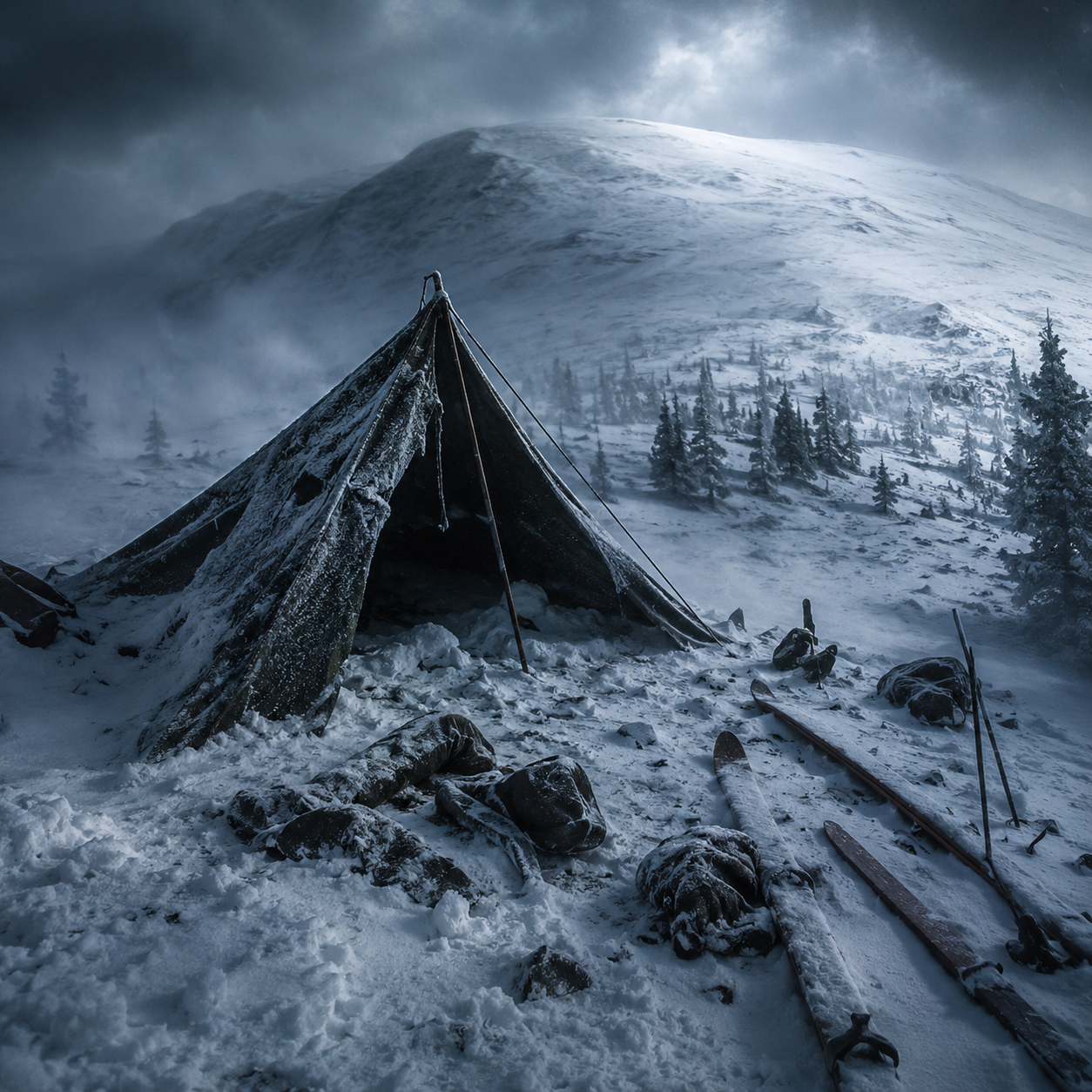
On the eastern slope of Kholat Syakhl in the northern Ural Mountains, a long canvas tent stands against a landscape with almost nothing to protect it. There are no trees immediately around the campsite, no building, and no easy shelter from the wind. Inside are nine experienced Soviet hikers, their skis, boots, food, clothing, cameras and equipment arranged for another night in one of the most unforgiving environments they have encountered.
The group has deliberately camped on the exposed slope rather than descending into the forest below. It is February, nineteen fifty-nine. Temperatures are far below freezing, wind is driving snow across the mountain, and darkness has removed almost every useful landmark.
Nothing recorded in the hikers’ surviving photographs or diaries indicates that they believe themselves to be in extraordinary danger. They have travelled through difficult winter conditions before. Their leader, Igor Dyatlov, is experienced enough to organise an expedition classified at the highest level of difficulty then recognised for Soviet ski tours.
Yet something happens after the group settles into the tent. Something serious enough for them to abandon their principal shelter in extreme cold. The question that has transformed Dyatlov Pass into one of the twentieth century’s most enduring mysteries is deceptively simple: what could make nine experienced hikers believe that leaving that tent was safer than staying inside it?
More than six decades of rumours have produced explanations involving secret weapons, UFOs, murder, radiation, indigenous attackers, unknown animals, infrasound and government conspiracy. But the surviving physical evidence points towards a far less supernatural sequence — and modern research has made one natural explanation considerably more plausible than it once appeared.
The Expedition Into The Northern Urals
The expedition begins as an ambitious sporting challenge rather than a journey into the unknown. The group is associated with the Ural Polytechnical Institute in Sverdlovsk, now Yekaterinburg, and most of its members are experienced hikers accustomed to demanding winter expeditions.
Igor Dyatlov leads the party. The group that eventually reaches the mountains also includes Zinaida Kolmogorova, Lyudmila Dubinina, Rustem Slobodin, Yuri Doroshenko, Georgiy Krivonischenko, Aleksander Kolevatov, Nikolai Thibeaux-Brignolle and Semyon Zolotaryov. Yuri Yudin initially travels with them, making ten expedition members at the start of the journey.
They are not poorly prepared tourists wandering casually into dangerous terrain. Their planned route is demanding and winter travel in the northern Urals carries obvious hazards, but the participants have equipment, experience and an organised itinerary. That matters because many popular retellings implicitly depend on the group behaving irrationally from the beginning. The historical record does not support that picture.
The expedition travels by train, road and finally ski towards increasingly remote country. Photographs recovered afterwards document an energetic group moving through deep snow, repairing equipment, joking and carrying the substantial loads required for a prolonged winter journey.
At the abandoned mining settlement known as Second Northern, Yuri Yudin develops health problems and decides he cannot continue. On January twenty-eighth, nineteen fifty-nine, he turns back. It is an apparently disappointing but ordinary decision that makes him the only member of the original expedition to return home.
Nine people continue into the mountains.
The Last Recorded Days Of The Group
The surviving diaries and photographs provide an unusual window into the expedition because they preserve the journey almost until its final camp. They show deteriorating weather, difficult navigation and considerable physical effort, but not evidence that the group is being followed or threatened.
On February first, the hikers move towards Kholat Syakhl. The name is often dramatically translated as “Dead Mountain”, although the cultural and linguistic history of the name is more complicated than the ominous English version implies. Its later association with the incident has given the landscape a sinister reputation it did not possess for the hikers themselves.
Conditions worsen. Strong winds and drifting snow make navigation difficult. Instead of following their intended route precisely, the group moves onto the eastern slope of Kholat Syakhl.
At some point that afternoon, Dyatlov decides to establish camp on the exposed mountainside.
That decision has been debated ever since. Descending towards the forest would have offered some protection and access to firewood, but it would also mean losing altitude and repeating part of the climb the following morning. Experienced expedition groups sometimes deliberately practised exposed winter camping, and there is no reason to assume that simply pitching the tent there demonstrates incompetence.
The hikers level part of the snowpack and erect their long, modified tent. Photographs taken during the process show substantial wind and blowing snow. Their stove apparently remains packed rather than being set up, consistent with camping above the tree line where convenient firewood is unavailable.
The important point is that they have created a fragile pocket of shelter in an exposed environment. Their boots and much of their outer clothing are inside. Whatever happens next begins there.
The Message That Never Arrived
The hikers are expected to communicate after completing the difficult part of their route. Delays on expeditions are not automatically alarming, and the expected return date was never precise enough for an immediate emergency response.
As more time passes without a telegram, however, relatives and people connected to the expedition become increasingly concerned. Pressure grows for a search.
Search parties are organised using students, experienced hikers, aircraft and eventually military assistance. The terrain is immense. Finding a small tent or a group of people in winter conditions across the northern Urals is exceptionally difficult.
Then searchers locate a ski trail.
On February twenty-sixth, nineteen fifty-nine, a search party reaches the eastern slope of Kholat Syakhl and finds the group’s tent. Searcher Boris Slobtsov recognises it. The discovery does not immediately explain where the hikers are.
Instead, it creates the mystery.
The Tent That Changed The Investigation
The tent is damaged and partially covered by snow. Inside remain equipment, food, clothing and footwear that would be essential for surviving the conditions outside. The group has not simply packed up and moved somewhere else.
Most importantly, investigators determine that sections of the tent have been cut from the inside.
The original case material describes cuts allowing people to exit through the side rather than use the normal entrance. That is one of the strongest pieces of evidence in the entire Dyatlov case because it establishes urgency without telling us what produced that urgency.
Footprints descend away from the campsite towards the forest.
The tracks are equally important because they undermine some of the more dramatic interpretations of what happened. The surviving prints were described as belonging to approximately eight or nine people travelling close together. Some individuals appear to have been wearing socks, one shoe or inadequate footwear.
Yet the tracks are not generally evidence of nine people sprinting chaotically in different directions. They suggest a group moving down the slope together.
That distinction changes the psychology of the event. Whatever persuaded the hikers to leave, they appear to have retained at least some degree of organisation afterwards. A disciplined emergency evacuation fits the evidence more comfortably than nine independent people simultaneously losing their minds.
The tracks continue towards the tree line roughly one and a half kilometres away.
Searchers follow them.
What Searchers Found At The Cedar
At the edge of the forest stands a large cedar tree. Beneath it are the remains of a small fire.
Nearby, searchers find Yuri Doroshenko and Georgiy Krivonischenko.
Both are dead.
Their clothing is grossly inadequate for the conditions, and neither has proper footwear. The discovery confirms that whatever happened at the tent has become a survival emergency. Medical examination concludes that both men died from exposure to low temperatures.
Broken branches high on the cedar suggest that someone climbed or pulled at the tree. One possibility is that members of the group were attempting to see the tent through the darkness and blowing snow. Another is that they were gathering fuel. The precise reason cannot be established.
The fire nevertheless shows deliberate survival behaviour. The hikers have reached the shelter of the forest, attempted to create warmth and remained together long enough to gather wood.
They have not simply fled aimlessly.
Three more discoveries reinforce that interpretation.
Between the cedar and the abandoned tent, searchers locate Igor Dyatlov, Zinaida Kolmogorova and later Rustem Slobodin. Their positions lie broadly along the route back towards the campsite, leading to the longstanding interpretation that at least part of the group attempted to return uphill.
Their equipment is still waiting there. Their heavier clothes, footwear and supplies could mean survival.
None reaches it.
Dyatlov and Kolmogorova are found to have died from hypothermia. Slobodin has a skull fracture, but the forensic examination nevertheless attributes his death to freezing rather than the head injury.
Five hikers have now been accounted for.
Four remain missing.
The Four Hikers Beneath The Snow
The search continues into spring.
On May fourth, approximately seventy-five metres beyond the cedar, searchers find the remaining members of the expedition in a ravine beneath several metres of accumulated snow. They are Lyudmila Dubinina, Semyon Zolotaryov, Nikolai Thibeaux-Brignolle and Aleksander Kolevatov.
Their situation differs significantly from the first group.
Some are substantially better dressed because clothing appears to have been removed from those who died earlier and redistributed. Far from suggesting something sinister, this is exactly the sort of survival decision experienced people might make once companions could no longer use their clothing.
There is also evidence that members of the group had attempted to create additional shelter around the ravine area.
The medical examinations, however, reveal the evidence that sends the Dyatlov case into an entirely different category.
Kolevatov is classified as having died from the effects of cold. Dubinina, Zolotaryov and Thibeaux-Brignolle have severe traumatic injuries.
Dubinina has extensive rib fractures and internal haemorrhaging. Zolotaryov also has major chest injuries. Thibeaux-Brignolle has a catastrophic skull fracture. These are not superficial injuries caused by stumbling through the forest. They require a substantial physical force.
The combination becomes the foundation for decades of speculation: hikers leaving a tent through cuts in its side, almost barefoot in bitter cold, followed by hypothermia, devastating internal trauma and strange post-mortem changes.
The mystery now seems almost designed to produce conspiracy theories.
But several of its most famous details sound considerably stranger when removed from their forensic context.
The Missing Tongue, Eyes And Other Famous Details
Lyudmila Dubinina is found without her tongue and with significant soft-tissue loss around her mouth. Some of the ravine bodies also have missing eyes or other exposed soft tissue.
These details have frequently been presented as evidence of torture, ritual mutilation or attack.
There is no convincing forensic evidence supporting those conclusions.
The four hikers had remained for months in a ravine containing snow and running or melting water. Soft tissues exposed to moisture, decomposition and scavenging deteriorate much faster than protected tissue. Eyes, lips and the tongue are particularly vulnerable.
The absence of those tissues does not require someone to have removed them deliberately.
This distinction is essential. The condition of a body when recovered is not automatically evidence of the condition in which the person died. Months of environmental exposure separate the two.
The unusual appearance of the hikers’ skin has similarly been transformed into claims that the bodies were unnaturally orange or brown. Post-mortem change, cold exposure and prolonged environmental conditions provide far less extraordinary explanations.
The Dyatlov mystery becomes harder to solve when genuine anomalies and ordinary post-mortem processes are treated as equivalent.
What About The Radiation?
Another genuine but heavily exaggerated finding involves radioactive contamination.
Testing detected elevated beta radiation on some items of clothing. The presence of radiation is real; the conclusion that radiation caused the disaster is not.
The later Russian review considered contamination connected with the East Ural radioactive trace following the nineteen fifty-seven Mayak nuclear accident as a plausible explanation. Some expedition members had backgrounds that could have exposed clothing to contaminated environments. The testing did not establish a lethal radiation event at Dyatlov Pass.
This is a good example of how the case accumulated mythology.
“Radioactivity was detected” is accurate.
“The hikers were killed by radiation” is not supported by the evidence.
Nor does contamination on selected garments explain why the entire group abandoned the tent together.
The Original Investigation Reaches No Clear Answer
Soviet investigators examine the campsite, witnesses, bodies and equipment. There is no persuasive evidence of robbery. Valuables remain with the expedition. Nor is there convincing physical evidence that another group attacked the hikers at the tent.
The criminal case is closed in May nineteen fifty-nine.
Its famous conclusion does not identify a monster, murderer, avalanche or military experiment. Investigator Lev Ivanov attributes the disaster to an overwhelming or compelling natural force that the hikers were unable to overcome. The exact English rendering varies, but the important point is the same: the investigation does not identify a specific mechanism.
That vagueness becomes extraordinarily important.
Had investigators established a clearly documented avalanche, the Dyatlov Pass incident might have remained a relatively obscure mountaineering disaster. Instead, the official record provides a conclusion that sounds almost deliberately mysterious.
Against the secrecy of the Soviet state, every unexplained detail acquires additional significance.
The mystery expands.
Why The Avalanche Theory Was Originally Rejected
Avalanches were considered from the early stages but encountered serious objections.
Searchers did not encounter the huge field of avalanche debris people expected. The tent remained visible and was not carried hundreds of metres downhill. Equipment remained inside. Footprints survived below the campsite.
The mountain also appeared too gentle.
Conventional avalanche guidance often focuses on slopes of roughly thirty degrees or more, while the campsite has frequently been described as being on a slope closer to the low twenties.
If a large avalanche had swept through the campsite, why was the tent still there? Why could the hikers walk away? Why could searchers still identify footprints?
These are legitimate questions.
For decades they made “avalanche” sound less like an explanation and more like an attempt to force an ordinary answer onto extraordinary evidence.
Modern research, however, changed the question.
The relevant mechanism does not require a gigantic avalanche roaring down the entire mountain.
It requires a comparatively small slab of compacted snow.
The Slab Avalanche Explanation
In two thousand and nineteen, Russian prosecutors reopened their examination of the case, focusing on natural explanations rather than criminal conspiracy. Their subsequent reconstruction concluded that an avalanche, followed by disorientation and exposure, best explained the disaster.
Independent scientific work then examined whether the mechanics were actually possible.
Researchers Johan Gaume and Alexander Puzrin developed analytical and numerical models exploring how the campsite could have produced a delayed slab avalanche. Their research was published in Communications Earth & Environment in two thousand and twenty-one.
The proposed sequence begins when the hikers cut into the slope to create a flat platform for the tent.
That excavation can weaken a snow layer.
Above them, strong winds continue transporting snow onto the slope. Wind loading matters because a seemingly stable snowpack can gradually accumulate additional weight without fresh snowfall directly overhead.
The researchers identified local terrain and snow conditions under which a relatively small slab could release hours after the tent was erected.
This delay solves one apparent problem with the avalanche hypothesis. Critics had reasonably asked why an avalanche triggered by pitching the tent would wait until after the hikers settled down. Wind-driven accumulation provides a mechanism through which stress increases gradually until the weakened slab fails.
The model also addresses the slope question. The broad visible slope does not tell the entire story. Local topography beneath the snow can create steeper sections capable of supporting a slab release even where the mountain as a whole appears unusually shallow for avalanche terrain.
Perhaps most importantly, the avalanche does not have to obliterate the campsite.
A compact slab striking or partially collapsing onto the tent could injure people and make remaining inside appear dangerous while leaving much of the tent and surrounding snowfield intact.
The researchers did not claim that their calculations recreate every second of the night or prove the exact event beyond doubt. Their conclusion is more precise: a slab avalanche under the documented conditions is physically plausible and can produce injuries consistent with those recorded.
That is a much stronger claim than merely saying “maybe there was an avalanche.”
A Plausible Reconstruction Of The Night
No witness survived the night, so any reconstruction must distinguish between evidence and inference.
The strongest natural explanation begins with instability near the tent.
A slab of wind-loaded snow releases above the campsite and impacts the tent. It may partially bury or deform the structure rather than sweep it away. People inside perceive an immediate danger that the snowpack could move again.
The normal entrance is difficult or too slow to reach, so the hikers cut through the tent.
Some have almost no time to dress properly.
They move downhill together.
The footprints matter here. Rather than displaying uncontrolled panic, the group appears organised enough to stay broadly together as it heads towards the obvious survival resource below: the forest.
Trees mean wind protection.
Trees mean firewood.
The hikers may also believe the evacuation is temporary. If the immediate danger passes, they can return to the tent for equipment.
At the cedar, they light a fire.
The group then appears to divide its survival strategy. Some remain near the fire. Others move into the ravine, where deeper snow and terrain provide greater protection from the wind. Some attempt to return to the tent.
At some stage, the ravine group suffers catastrophic trauma.
Here the reconstruction is less certain. Their injuries could have occurred during the initial slab event, during a fall into the ravine, or through a combination of snow pressure and terrain. The scientific avalanche model demonstrates that snow impact could generate severe thoracic injuries, but it does not prove precisely where each fracture occurred.
Meanwhile, temperatures and wind rapidly punish every mistake.
People without boots lose heat through their feet. Wet clothing becomes dangerous. Fatigue increases. Fine motor control deteriorates. Judgment worsens as hypothermia progresses.
A kilometre and a half that appears manageable on a map becomes an enormous distance when travelling uphill, in darkness, through snow, against wind, without adequate footwear and while already hypothermic.
The tent remains close enough to represent salvation yet far enough to become unreachable.
That may be the central reality behind Dyatlov Pass.
The group did not need to make one inexplicable decision. They needed to make one understandable emergency decision that placed them in an environment where every subsequent option became worse.
Could Extreme Wind Explain It Instead?
A significant alternative natural theory focuses on katabatic winds.
Katabatic winds occur when dense cold air accelerates downhill and can produce extraordinarily severe conditions in mountain environments. A Swedish-Russian expedition examining Dyatlov Pass proposed that an intense downslope wind could have made the campsite temporarily untenable.
This explanation has advantages.
The hikers’ diaries document powerful wind. A sudden escalation could explain why they sought the protection of the forest and why returning uphill became difficult or impossible.
It also requires no conspiracy and fits the broader meteorological environment.
Its weakness is the traumatic injuries.
Extreme wind alone does not naturally explain multiple crushing chest and skull injuries. Additional events — such as a ravine collapse, falling snow shelter or impact with terrain — must be added.
Katabatic wind therefore remains plausible as part of the disaster, particularly as a factor worsening conditions, without matching the explanatory reach of the slab-avalanche reconstruction.
Why Infrasound Is Less Convincing
Another famous theory proposes that wind moving around Kholat Syakhl generated a Kármán vortex capable of producing low-frequency infrasound.
Infrasound can cause discomfort or unease under some circumstances. The Dyatlov version suggests that it generated such extreme psychological distress that the hikers abandoned the tent.
The attraction of the theory is obvious: it offers an invisible trigger for behaviour that otherwise seems irrational.
The evidence is much weaker.
There is no direct evidence establishing the necessary infrasound conditions at the campsite that night, and the hypothesis struggles to explain why all nine people would respond with the same extreme behaviour.
More importantly, infrasound does not explain the physical forces responsible for the severe injuries.
The theory replaces one mystery with another.
The Military Weapons Theory
The Soviet Union’s secrecy made military explanations almost inevitable.
Unusual lights were reportedly seen in the wider region around the period of the incident. Some clothing showed radioactive contamination. Several hikers suffered internal injuries without the degree of external trauma that casual observers expected.
Those facts have been connected to theories involving parachute mines, missiles, bombs, secret weapons and covert military exercises.
No persuasive evidence has established a weapons test at the campsite on the relevant night.
The radiation levels do not demonstrate that the group encountered a nuclear device. The tracks do not show an obvious military intervention. The tent does not provide evidence of an explosion powerful enough to account for the entire incident.
The later prosecutorial review explicitly rejected government involvement and focused on natural causes.
Soviet secrecy unquestionably contributed to public suspicion. But a government capable of concealing information does not automatically mean that every unexplained event was created by the government.
A theory still needs evidence.
Was The Group Attacked?
The possibility of homicide has also been repeatedly proposed.
Early suspicion sometimes fell on local Mansi people, an indigenous community with deep knowledge of the region. The theory has no credible evidential foundation and reflects assumptions that should not be repeated as fact.
There were no persuasive signs of outsiders attacking the campsite. Valuable belongings were left behind. The surviving footprints were associated with the hikers rather than an armed group approaching and leaving.
Nor do the injuries form a convincing pattern of interpersonal violence. Severe chest compression and skull trauma can appear dramatic without indicating assault.
An attacker theory must also explain why nine experienced people apparently descend the mountain together without clear evidence of restraint, pursuit or fighting.
Natural danger does this with fewer unsupported assumptions.
Why The Dyatlov Pass Incident Became So Mysterious
Dyatlov Pass has survived because it contains several individually explainable facts that become extraordinary when placed beside one another.
The tent really was cut.
The hikers really did leave much of their footwear and clothing behind.
Some really did die from hypothermia.
Others really did have massive traumatic injuries.
Some clothing really did show radioactive contamination.
Some bodies really were missing soft tissue.
The original investigation really did end with an unspecific reference to an overwhelming natural force.
None of those details needs to be invented.
The problem is what happens when each fact is interpreted through the most dramatic possible explanation and then combined into one story.
Radiation becomes a nuclear weapon.
Decomposition becomes mutilation.
Trauma becomes assault.
A cut tent becomes evidence of terror.
Unexplained lights become military aircraft or UFOs.
Soviet bureaucracy becomes proof of a cover-up.
Once those interpretations accumulate, any ordinary explanation appears incapable of explaining the mythology, even when it can explain the underlying evidence.
What The Record Cannot Prove
A slab avalanche is now the strongest single explanation, but that does not mean every detail of the night has been solved.
There is no surviving eyewitness account.
No instrument recorded the snowpack at the campsite as it failed.
We cannot know the exact moment the hikers decided to cut the tent, the words they exchanged, which injuries happened first, or how the group divided once it reached the forest.
The scientific model demonstrates possibility rather than providing a video recording of the event. Its authors have been clear that questions remain.
That distinction matters because two equally misleading positions dominate Dyatlov discussions.
One says the mystery is completely inexplicable and therefore requires something extraordinary.
The other says science has proved every moment of the night.
Neither is justified.
The evidence supports a natural-disaster reconstruction considerably better today than it did when Soviet investigators closed the file, but parts of the sequence remain inferential.
So What Really Happened At Dyatlov Pass?
The most evidence-based answer is that the hikers probably encountered a dangerous combination of unstable snow, extreme wind, darkness, terrain and catastrophic cold.
A small slab avalanche is currently the most convincing trigger.
Modern modelling shows how the hikers could have weakened the snowpack while preparing the campsite, how wind could have loaded additional snow above them, how failure could have been delayed, and how a relatively compact slab could threaten the tent without producing the giant avalanche field critics expected.
Faced with what they believed was an immediate threat, the hikers evacuated rapidly through cuts in the tent.
They descended together towards the forest.
There they attempted several rational survival strategies: make a fire, use the trees for shelter, create a snow refuge, redistribute clothing and return towards the tent.
The environment defeated those attempts.
Some succumbed to hypothermia. Others suffered severe trauma either from the snow event, the ravine environment or both. Russian prosecutors concluded in two thousand and twenty that avalanche conditions, poor visibility and exposure provided the most convincing explanation.
That answer is less exotic than UFOs or secret Soviet weapons, but it is arguably more disturbing.
The hikers did not have to behave foolishly.
They did not have to become irrational.
They did not have to encounter an unknown attacker.
They may simply have faced a sequence in which the first sensible decision — escape the immediate danger — removed them from their most important protection.
The tent on Kholat Syakhl therefore remains the defining object of the case.
When searchers first found it, its cut fabric looked like evidence of inexplicable terror.
Seen through the modern reconstruction, those same cuts may represent something entirely different: nine experienced people responding quickly to a danger they believed was real, leaving their shelter with every intention of surviving long enough to return.
They never managed to do so.
And that narrow distance between rational survival decisions and irreversible disaster is probably the real explanation for why Dyatlov Pass has remained haunting for so long.
