True Crime: Alex Murdaugh and the Kennel Video That Changed Everything
Alex Murdaugh, Moselle, and the Minutes That Mattered
The Family That Seemed Built to Last
The Murdaugh name carried institutional force across South Carolina’s Fourteenth Judicial Circuit. Three generations of the family held the solicitor’s office across most of the twentieth century, and even after that formal reign ended, the name remained tied to law, influence, and a sense that the family stood unusually close to the machinery of local power. Alex Murdaugh lived inside that inheritance. He was a lawyer. He carried a badge for volunteer assistant solicitors. He moved through a world in which family history was not background; it was currency.
But by June 2021, that world was under strain. Paul Murdaugh was still living under the shadow of the 2019 boat crash that killed Mallory Beach, a case that had already pulled the family into public anger and legal exposure. At the same time, Alex’s finances were beginning to tighten around him. Later prosecutors argued that he was facing mounting pressure from thefts inside his law practice, including missing fees that had become an issue on the very day Maggie and Paul were killed. His father, Randolph Murdaugh III, was also gravely ill and had been taken to the hospital that same day. The image of family continuity was still visible. Underneath it, almost everything was slipping.
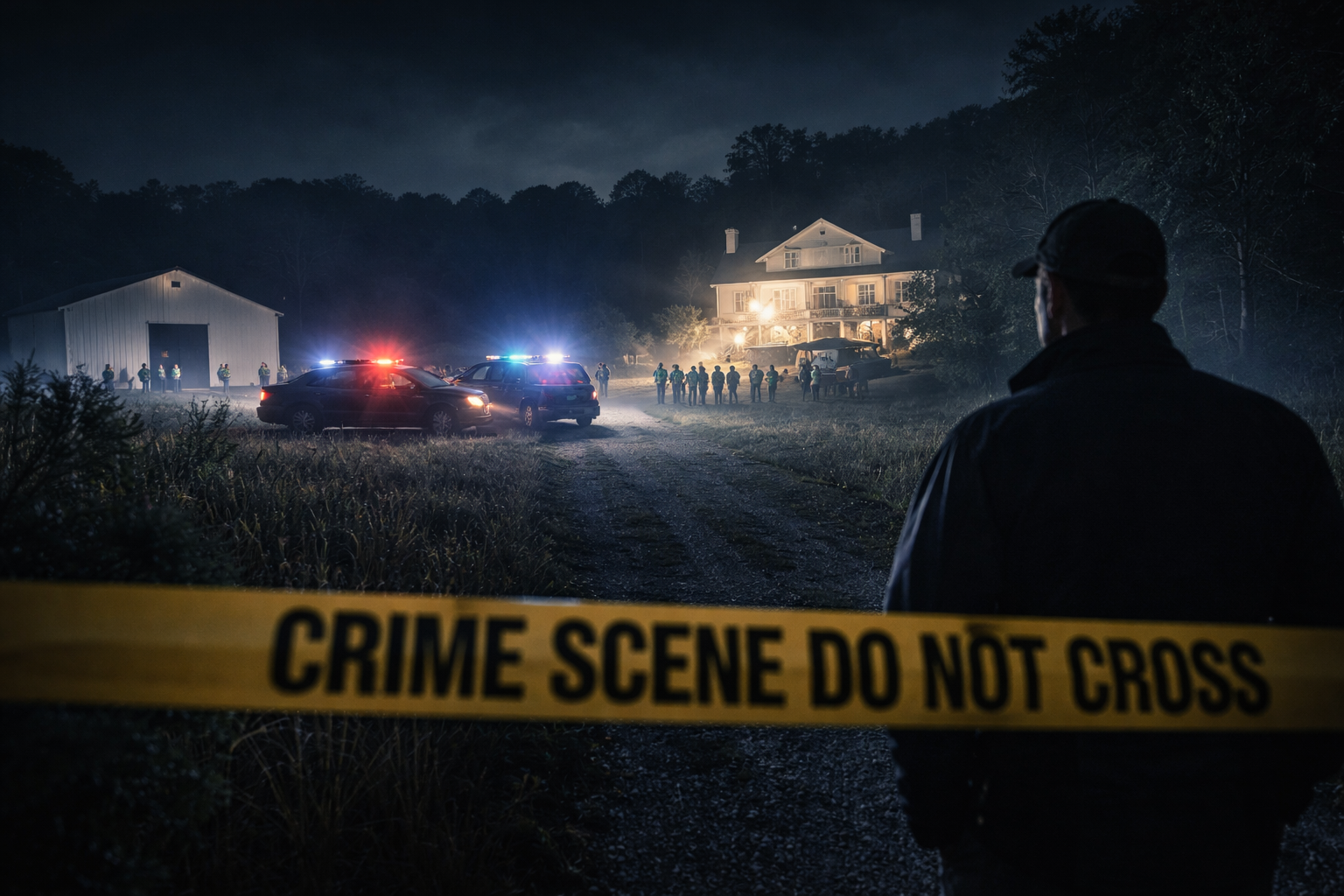
Moselle itself mattered to the story. It was not just a home. It was a large, isolated property, more than 1,700 acres, with distance built into it: the house, the kennels, the roads, and the tree lines. On land like that, movement can disappear quickly. Sound can travel strangely. Ordinary routines can look harmless right up until they are not.
The Last Ordinary Hour at Moselle
Some of the final ordinary moments of that evening survived because of phones. A Snapchat video recorded around 7:39 p.m. showed Alex in a blue button-down shirt, khaki pants, and brown shoes. It looked mundane at the time, one more fragment of family life on a large rural property. In hindsight, it became a marker, fixing how he appeared earlier in the night before the later scramble over clothes, movement, and timing.
The more important recording came later. Between 8:44:49 and 8:45:47 p.m., Paul captured a short kennel video on his phone. Maggie was there. Paul was there. Alex’s voice was there too. For months, Alex would deny being at the kennels with them shortly before the killings. That denial held until investigators recovered the video in 2022. Once they did, one of the case’s central factual questions changed shape. The issue was no longer whether he had been there. The issue became what happened in the minutes after that recording ended.
The state later argued that the murders happened only a few minutes after that clip. Phone activity formed the backbone of that theory. Paul’s phone locked at 8:49:01 p.m. Maggie’s phone appeared to lock about thirty seconds later. They did not use either of them meaningfully again. That left a narrow and brutal window between the kennel video and silence. It also meant the entire case would turn on minutes rather than hours.
The Call That Changed the Case
At 10:06:14 p.m., Alex Murdaugh called 911. The timing mattered. Prosecutors later emphasized that the call came less than twenty seconds after he arrived at the kennels, suggesting a rapid transition from arrival to discovery. During the call, Alex reported that his wife and son had been shot. Afterward, he went back toward the house, retrieved a gun, and then began calling relatives and others close to the family. The scene opened as a family emergency. It hardened quickly into something far more unstable.
From the start, competing narratives were born almost side by side. One was the grief-stricken husband and father who had come upon a slaughter. The other, still unproven but increasingly present, centered on the man who seemed to have already started shaping time: where he had been, when he had left, how long he had visited his mother, and why details kept shifting. A case like this does not become national because bodies are found. It becomes national when the first explanation begins to look too carefully arranged.
The early hours also carried a deeper structural problem. Alex was not an ordinary witness inside an ordinary county. He was part of a family long intertwined with the local justice system. That did not prove guilt. It did guarantee scrutiny. Every investigative decision after that would be read through the question of whether power had slowed the truth, protected it, or simply failed to understand how terrible the truth already was.
The Fatal Encounter, Second by Second
No eyewitness saw the killings. No full video recorded them. What the jury received instead was a reconstruction built from forensic testimony, ballistic evidence, phone data, and the state’s theory of sequence. That reconstruction was detailed, but not total. Some parts were strongly supported. Others remained inferential.
Paul appears to have been shot first, near the feed room at the kennels. Trial evidence indicated a first shotgun blast struck his left chest and arm but did not immediately kill him. Stippling suggested that the shot came from only a few feet away. He then suffered a second, catastrophic birdshot wound to the left shoulder, neck, and face. He collapsed outside the feed room, lying face down. The medical evidence described no defensive wounds. The violence was fast, close, and intimate in the most literal sense: the shooter was near enough for the first shot to leave marks of proximity.
Maggie was killed with a different weapon, a .300 Blackout rifle. Shell casings were found around her body. The wounds suggested movement and sequence rather than a single static moment. She suffered a wound to the wrist and a devastating abdominal or torso injury before the final shots. One fatal shot traveled upward through her body into her face and head. Another entered near the back of the head, close to the base of the skull, passing through the brainstem. Trial testimony described those injuries as unsurvivable. Like Paul, she showed no defensive wounds. Prosecutors argued she was moving away from the feed room area, then bent or dropped in pain before the final shots were fired.
Ballistics and scene evidence supported the use of two firearms: a 12-gauge shotgun for Paul and a .300 Blackout rifle for Maggie. Investigators also tied the ammunition and weapon types to firearms used by the family, including two weapons of the matching type that were no longer available after the murders. Neither murder weapon was ever recovered. That absence became part of the state’s case and part of the defense response: prosecutors said it showed planning and concealment; the defense stressed that the state still could not produce the actual weapons or direct physical proof placing them in Alex’s hands at the moment of killing.
The phone evidence narrowed the window even further. Paul’s phone locked at 8:49:01. Maggie appeared to go quiet about half a minute later. Alex’s phone, by contrast, showed little activity from 8:09 until just after 9:02 p.m., when it suddenly registered 283 steps in roughly four minutes. He then called Maggie repeatedly at 9:04, 9:06:14, and 9:06:52 p.m. Her phone changed orientation moments before one of those calls, and it was later found along a roadside roughly half a mile from Moselle. Prosecutors contended that those calls constituted an alibi constructed after the murders. The defense argued that step counts and orientation changes could not establish murder. Both claims were true in different ways. The data did not show a trigger being pulled. It did show a man moving urgently in the minutes after his wife and son seem to have stopped using their phones forever.
The Days After, and the First Break in the Story
Three days after the murders, Randolph Murdaugh III died. The family’s patriarch was buried while the homicide investigation was still young and unstable. In those same days, prosecutors later said, Alex was already doing more than grieving. He was managing witnesses and trying to shape timelines. Shelley Smith, who cared for his mother, later testified that Alex asked her to tell others he had stayed at the family home in Almeda for thirty to forty minutes on the night of the killings. She said he had really been there only fifteen to twenty.
That mattered because Alex’s trip to Almeda had become one of the key spans of time in the case. Phone and vehicle data later placed him arriving there at 9:22:49 p.m., parking behind the house near woods and a shed, moving around again, and then leaving at 9:43:18 p.m. The state treated those movements as suspicious. The defense characterized their behavior as grief, panic, and normal human disorder during a family crisis. But one thing had changed. The story was no longer clean. Witnesses were beginning to describe not just sorrow, but adjustment.
Another detail darkened the picture. Shelley Smith also described an unusual early-morning visit, after Randolph’s funeral, in which Alex carried a blue object she thought looked like a tarp or rain gear. Later litigation over a raincoat or tarp with gunshot residue became part of the prosecution’s broader theory of concealment, though that evidence was contested and never functioned as a single decisive proof. However, by that time, the case had reached a significant milestone: the aftermath had transformed into evidence.
How a Double Murder Became a National Fixation
This case did not stay local because the facts were grisly. It grew because the murders sat at the center of several American obsessions at once: dynasty, privilege, legal influence, financial fraud, and the spectacle of public collapse. The boat crash involving Mallory Beach had already pulled the family into national view. The murders then posed their own irresistible question: what happens when a family that seemed to stand near the law becomes its object?
As investigators moved forward, the public learned more about Alex’s finances. Prosecutors later built motive partly around that unraveling, arguing that exposure inside his law practice was accelerating and that the murders bought him time and redirected scrutiny. That theory was not simply about greed. It was about compression: lawsuits, missing money, a son facing legal peril, a dying father, and a family image cracking all at once. Whether the murders truly sprang from that pileup became the central interpretive question of the trial. But as a narrative, it was devastatingly clear. The walls were closing in before the first shot was fired.
The kennel video then gave the public a single, unforgettable pivot point. It was mundane and deadly at the same time. No confession. No dramatic threat. It was just a voice where it was not supposed to be. In high-profile murder cases, the detail that changes everything is often small. Here, it was a few seconds of ordinary speech before silence.
The Arrest That Took More Than a Year
Alex Murdaugh was indicted and charged with the murders in July 2022, more than a year after Maggie and Paul were killed. The delay became part of the case’s emotional structure. For some observers, it suggested caution and the burden of building a circumstantial prosecution. For others, it suggested a family name that had long received deference. Either way, the arrest did not settle the story. It sharpened it. A murder charge answered one question and raised another: could prosecutors actually prove a case without eyewitnesses, without the murder weapons, and without direct physical evidence tying Alex to the trigger pulls?
The indictment alleged that Maggie was killed with a rifle and Paul with a shotgun. That dual-weapon structure had always made the case unusually complex. It required jurors to think not just about intent but also about sequence, speed, and access. It also helped the defense argue that the state was asking the jury to accept a chain of inferences rather than a clean physical demonstration. The prosecution’s answer was simple: killers do not get acquitted because they were efficient at getting rid of the weapons.
A Trial Built on Pressure, Phones, and Circumstance
At trial, prosecutors argued that Alex’s motive lay in financial collapse and the exposure gathering around him. They introduced evidence of thefts and deception to show a man under crushing pressure who needed sympathy, confusion, and delay more than he needed anything else. The defense fought hard to keep that financial material from overwhelming the homicide case and later argued on appeal that it made the trial unfairly prejudicial.
The state’s core case, though, did not depend on motive alone. It rested on movement. The kennel video put Alex with Maggie and Paul minutes before their phones went silent. His repeated denial of being there stood until the recording surfaced. On the stand, he admitted he had lied about that point and had misled investigators. The defense said that made him a liar, not a murderer. Prosecutors said the lie was the doorway through which the entire case had to be understood.
There were limits to the state’s evidence, and the defense pressed them hard. No blood-covered clothing from the murders was recovered. No murder weapons were produced. The defense criticized the investigation, the handling of the scene, and the leap from suspicious behavior to murder beyond a reasonable doubt. Even now, those arguments remain at the center of the appeal. The case was never about certainty in every detail. It was about whether the combined weight of lies, timing, movement, and circumstance crossed the legal line.
The Verdict That Did Not End the Story
On March 2, 2023, Alex Murdaugh was found guilty of the murders of Maggie and Paul. The next day he was sentenced to life in prison without parole. In formal legal terms, that was the resolution of the homicide case. In cultural terms, it was only the point at which the meaning of the case widened again. A once-dominant local family had not merely fallen. It had been broken in public, under fluorescent courtroom light, by a prosecution built largely from digital traces and human contradiction.
The verdict satisfied many people because it seemed to match the moral shape of the evidence. Others remained uneasy, not necessarily because they believed Alex innocent, but because circumstantial cases of this scale always leave a residue of argument behind. The trial had produced a powerful story. It had not eliminated every doubt a citizen could imagine. That gap between legal conviction and lingering public debate is one reason the case refused to die after sentencing.
Alex Murdaugh Did Not Vanish After Conviction
After the murder conviction, Alex Murdaugh remained at the center of other criminal proceedings. In September 2023, he pleaded guilty in federal court to 22 financial crimes. On April 1, 2024, he was sentenced to 40 years in federal prison for those offenses. Whatever remained to be argued about motive in the murder case, the wider portrait of theft, fraud, and deception had by then moved beyond allegation and into formal conviction.
That mattered because the murders never existed in isolation. Public memory of Moselle is inseparable from the collapse surrounding it: the missing money, the false explanations, the law-firm betrayal, and the spectacle of a man once insulated by reputation now defined by serial deceit. In that sense, Alex’s later criminal sentencing did not distract from the murder case. It deepened the frame through which the murders were understood.
Appeals, Becky Hill, and the Problem of a Dirty Record
The post-verdict fight turned next to jury integrity. Defense lawyers alleged that Colleton County Clerk of Court Becky Hill had improperly influenced jurors and helped taint the trial. The issue became serious enough that South Carolina’s attorney general said state investigators were asked to look into the claims. In January 2024, former Chief Justice Jean Toal denied Murdaugh a new trial, concluding that although Hill had made improper comments and had pursued attention around the case, jurors said those comments did not directly influence their verdict. Toal described the remarks as “fleeting and foolish,” not enough to overturn the conviction.
But the Becky Hill story did not disappear. In December 2025, Hill pleaded guilty to misconduct in office, obstruction, and perjury-related charges tied to misuse of her position and improper access issues involving sealed exhibits. She was sentenced to probation. Those later pleas gave the defense new rhetorical force, because they confirmed serious misconduct around a case already famous for distrust. Yet even then, the legal question stayed narrow: not whether Hill behaved badly, but whether her conduct had prejudiced the murder verdict enough to require a new trial. Those are not the same question, and the difference matters.
On February 11, 2026, the South Carolina Supreme Court heard oral arguments in Murdaugh’s appeal. As of that hearing, no immediate decision had been announced. Even if he were to win relief in the murder case, he would still face the federal 40-year sentence already imposed for financial crimes. The homicide case remains the center of his public identity. Legally, though, it is now also an appellate problem about prejudice, evidence, and whether a verdict can stand when parts of the process around it were undeniably contaminated.
Why the Murdaugh Murders Still Matter
This case still matters because it is not only a double-murder case. It is a case about how power decays. It is about the strange intimacy of family violence, the importance of digital evidence, and the way modern prosecutions can be built from phones, timestamps, and lies rather than a single theatrical piece of proof. It is also about regional authority in America: how a family can seem welded to a justice system for generations, then become the symbol of its failure in a matter of months.
It still matters because Maggie and Paul were reduced for too long to functions inside someone else’s collapse. The trial corrected part of that by forcing attention back onto the last minutes of their lives: where they stood, what they heard, when their phones went still, how quickly the violence moved, and how completely it rearranged every story the family had told about itself.
And it still matters because Moselle left behind a distinctly modern terror. Not the fear that a killer vanished without leaving anything behind, but the opposite. He may have left too much: voice, steps, calls, movement, panic, and timing. In the end, the case was not built on one perfect piece of evidence. It was built on accumulation. A dynasty collapsed the same way. Not all at once, but detail by detail, until the story it had always told about itself could no longer survive the record.
