True Crime: The Menendez Brothers and the Night Beverly Hills Shattered
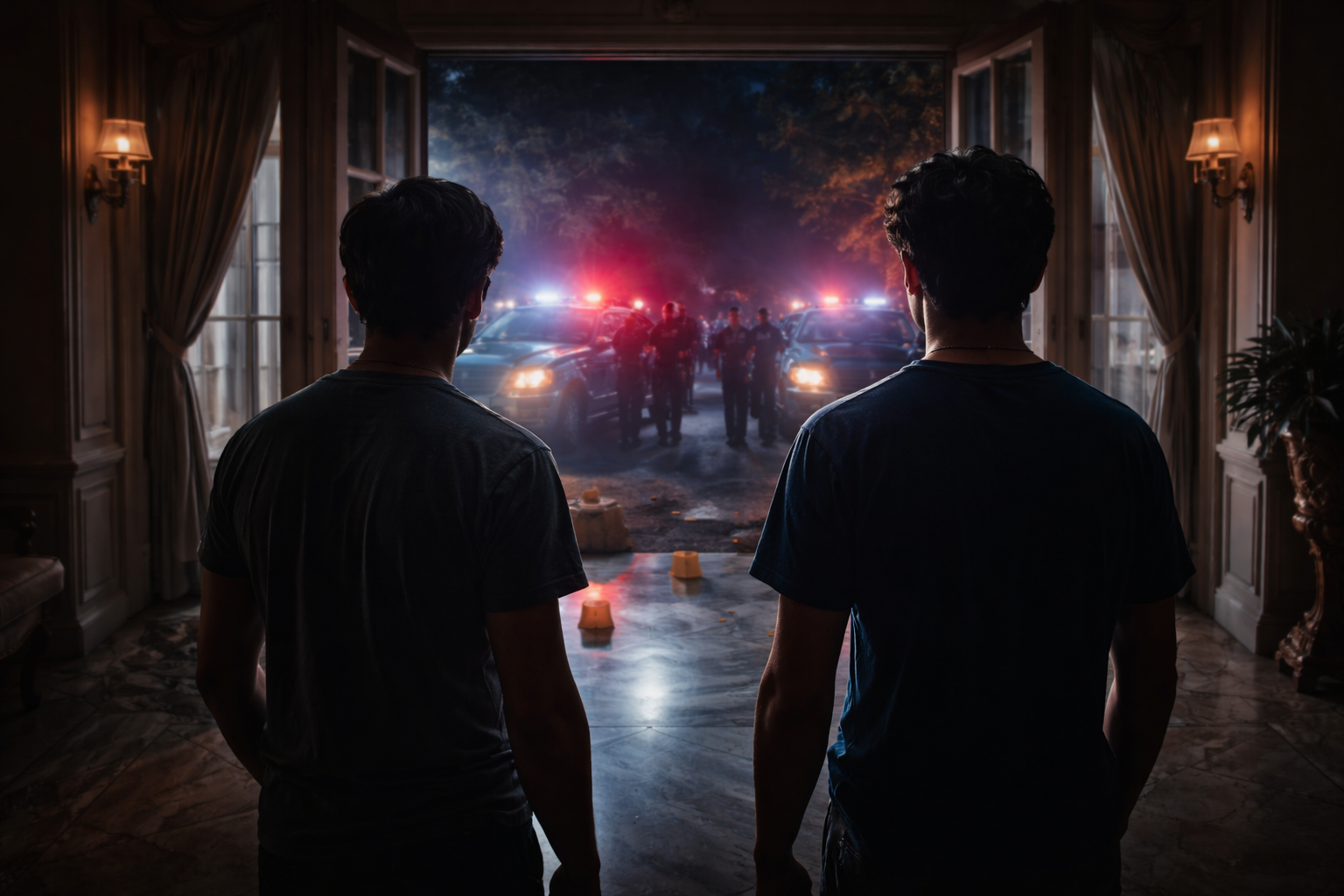
The Night the Menendez Family Collapsed
The House on Elm Drive
The Menendez family projected a very specific American success story. José Menendez was a powerful entertainment executive with a compensation package worth about $1.3 million a year, and the family’s assets included the Beverly Hills home, Calabasas property, and millions in stock. On paper, it looked like arrival. Inside the house, it looked like order, discipline, competition, and money.
Lyle was 21, a Princeton student. Erik was 18 and preparing for college in California. On the night of the murders, José and Kitty were unarmed in the den, watching television and eating. That detail matters because so much of the later legal battle turned on it. The prosecution built from that image outward: two parents at home, unarmed, in a room inside their own house.
But the defense would build a different house around the same room. At trial, the brothers described a family structure ruled by control, fear, humiliation, and sexual abuse, especially by José. They said Kitty knew more than she admitted and failed to protect them. Witnesses and experts offered testimony that supported parts of that account, though prosecutors challenged its reliability and later courts concluded that even evidence tending to corroborate abuse did not erase the proof of planning that surrounded the killings.
The Menendez case became so enduring because both versions of the family were plausible enough to survive contact with the public. One looked like greed under privilege. The other looked like terror under luxury. The jury had to decide which story the evidence actually carried.
Fear, Secrecy, and the Weekend Before
According to the brothers’ later testimony, the final days before the killings were not random. They were crowded with disclosures, confrontations, and fear. Erik said that on August 15 he told Lyle about ongoing sexual abuse by their father. Lyle said he would confront José. What followed, in the defense account later summarized by the court, was a rapid escalation: threats, panic, and a sense that disclosure had made the situation lethal.
On August 17, José returned from a business trip. Erik stayed away from the family home until nearly midnight because he did not want to be there for Lyle’s confrontation with their father. When he came back, he said he was confronted again, spoke to his mother, and was told she knew what had been happening. In the brothers’ telling, that was the moment fear hardened into something more immediate. Erik later said he believed they would both die because Lyle had challenged José.
The next day, August 18, the brothers drove to San Diego and bought two Mossberg shotguns for $200 each, using false identification. On August 19, they tried to practice, bought buckshot after being told birdshot was poor at stopping a person, and spent part of the day avoiding a fishing trip they said they feared could become deadly. These details cut two ways. For the defense, they showed mounting terror. For the prosecution, they showed procurement, preparation, and a plan taking shape before a single shot was fired.
That is the essential tension in the Menendez case. The same timeline can be read as fear-driven arming or as premeditated staging. The law did not have to decide whether the household was healthy. It had to decide what kind of homicide this was.
The Hours Before 10:30
On the afternoon of August 20, Lyle called Perry Berman and discussed meeting that evening. Berman planned to go to the “Taste of L.A.” festival after a movie, and he waited for the brothers to show up. They never did. That detail, tucked into the court record, matters because it placed another thread in the timeline: an outside plan that would later become part alibi, part excuse, part unraveling.
The brothers’ later account of the final hours was full of closed doors and rising dread. Erik said he returned around 9:30 p.m. and spoke to Lyle in the guest house. The brothers decided to go out, but their parents stopped them. José told Erik to go upstairs. Lyle told his father not to touch Erik. Lyle asked Kitty whether she was going to let it happen. According to the defense version summarized in court, she answered, “You ruined this family.” José and Kitty then went into the den and closed the doors behind them.
At about the same time Berman was leaving the festival, a neighbor, Avrille Krom, heard a series of 10 to 12 popping sounds, a pause, and then another series. Her son considered calling 911, but she believed the sounds were firecrackers. That was one of the last ordinary misunderstandings in the case. By the time anyone understood what those noises really were, Beverly Hills had already crossed into a different story.
The Den, Second by Second
This is the part of the case that has to be handled with precision, because everything legal and moral turns on sequence.
According to the brothers’ own account in the appellate record, Erik ran to his room, took a shotgun from the closet, went outside to the car, ejected the birdshot shells, and loaded buckshot instead. Lyle came to the car and loaded his own shotgun. They then entered the main house together, each carrying a loaded weapon.
They burst through the closed doors to the den. The lights were off. The room was lit mainly by the flickering television. Erik later said his parents were standing. On direct examination, he said he began firing only after his father started moving toward them. On cross-examination, however, he said he had no idea whether José even took a step in their direction and acknowledged that he started firing as soon as he saw his parents. That inconsistency mattered because self-defense law depends on immediacy, not generalized fear.
The physical record was devastating. Investigators recovered shotgun components and pellets and estimated that 13 to 15 blasts were fired in the den. No ammunition was found inside the residence, and no weapons were found in the den. José suffered four buckshot wounds. Kitty suffered seven buckshot wounds and two birdshot wounds. The wounds to José’s legs occurred after death. According to the appellate record, Lyle shot his father in the back of the head. After both brothers ran out of ammunition, they went back outside to reload. Lyle then returned to the den; Erik said he heard one more shot and saw him leave.
That reloading sequence is one of the most important facts in the whole case. It is one reason prosecutors argued this was not a spontaneous defensive eruption but a sustained attack. Later proceedings also emphasized that an accident-reconstruction expert in the second trial placed José and Kitty sitting down when they were shot, contradicting the brothers’ account from the first trial that José had been standing and moving toward them. Later courts repeatedly returned to those facts when rejecting attempts to recast the killings as a legally lesser crime.
None of that automatically proves there was no abuse. It does explain why the jury, and then later courts, treated the murders as planned and deliberate. In 2025, when a judge revisited the case through a habeas petition, he wrote that even evidence tending to corroborate abuse did not overcome the strength of the proof of premeditation, deliberation, and lying in wait. That is the hard legal center of the Menendez case: the abuse question and the homicide question were never perfectly the same question.
“Somebody Killed My Parents”
After the gunfire stopped, the brothers did not call immediately. According to the court record, they picked up shells because they believed their fingerprints might be on them. When police did not arrive, they left the house, drove to a movie theater, and bought tickets for the 10:30 showing of Batman in an apparent attempt to create an alibi. But the tickets were time-stamped. They threw them away. On the way to meet Berman, they stopped at a car wash and discarded shells, bloody pants, and shoes with blood spatter. Only then did they return home and “discover” the bodies.
At 11:47 p.m., Lyle called 911. He said someone had killed his parents. When officers arrived, both brothers ran from the house toward them, screaming. Those first minutes became famous because they seemed to offer grief in real time. But they also became evidentiary material, because investigators would soon place the call not at the beginning of the event but at the end of a sequence that included cleanup, disposal, and attempted staging.
Even before the investigation fully tightened, the outline of an alternative narrative had started to form. During early interviews, Lyle raised the possibility that the killings were “business-related.” By the next day, that idea had a more specific shape: mafia, cartel, dangerous men, and retaliation aimed at José rather than the family. The crime was not just being reported. It was being interpreted.
The Money, the Will, and the Mafia Story
The morning after the murders, attention moved fast toward property, paperwork, and control. Family attorney Randolph Wright spoke to the brothers. Erik mentioned a mafia killing and the possibility of probate. Lyle talked about whether José might have changed his will and about entries on the family computer that could relate to a new one. The safe was located and opened in private. The 1981 will was eventually found, and under its terms, Lyle and Erik were the sole remaining beneficiaries.
That concern about money became one of the prosecution’s strongest narrative tools because it was quickly followed by spending. The brothers each received life-insurance proceeds from their father’s death. Within days, there were shopping sprees. Lyle bought Rolex watches and expensive accessories. The brothers purchased cars, homes, businesses, clothing, and costly tennis-related services. The image of traumatized sons living in fear collided with the image of young men moving aggressively through new wealth.
They also continued to feed the organized-crime story. Lyle hired security. Both brothers repeated claims that the murders were tied to business enemies. A computer expert was called in to erase information on the family disk. All of that behavior, laid out in court, did not merely suggest panic. To prosecutors, it suggested consciousness of guilt and an evolving effort to protect a false account.
This is where public sympathy began to split. Money does not disprove trauma. But lavish post-homicide behavior can transform how jurors read fear. In the Menendez case, it helped convert suspicion into a prosecutable theory.
The Therapist, the Tape, and the Arrests
The case might have remained a rich-family massacre with competing theories for much longer if not for one of the most consequential relationships in the record: the brothers’ connection to their therapist, Dr. Jerome Oziel. On December 11, 1989, Erik and Lyle made taped statements to Oziel. According to the appellate opinion, the brothers discussed their relationship with their parents and the reasons they killed them. The opinion summarized the tape this way: they said they hated their father and that killing their mother was a “mercy killing.”
The tapes mattered even more because they did not stand entirely alone. The appellate record also said Erik’s statements were corroborated by comments to his friend Craig Cignarelli, whom he walked through the den and told where his parents had been when the shootings happened. That kind of detail gave prosecutors something more durable than speculation. It gave them admissions.
In March 1990, Lyle was arrested. Erik surrendered days later. They were charged with first-degree murder. From that point on, the case became not just a homicide prosecution but a national referendum on class, family violence, media, and the credibility of sons accusing a powerful father of sexual abuse.
The Trial America Could ’t Stop Watching
The first Menendez trial began in 1993 with separate juries for each brother. It was televised, widely consumed, and unusually intimate. The defense did not deny the killings. Instead, it tried to move the center of gravity from the act to the state of mind behind it. The brothers testified about years of sexual, physical, and emotional abuse. Witnesses described bruises, beatings, secrecy around bedrooms, and earlier disclosures. Experts for the defense diagnosed trauma-related conditions and described panic, learned helplessness, and the psychology of a battered person.
The prosecution pressed the other side just as hard. It argued that abuse allegations had been exaggerated or fabricated, that the murders were about inheritance and freedom, and that the evidence showed planning, not imminent peril. Rebuttal experts challenged the defense’s psychological framing. The jurors were left with a problem that is still recognizable now: the possibility that abuse may have happened without that possibility legally excusing a preplanned killing.
In January 1994, both juries deadlocked. That result preserved the case in amber. It meant neither narrative had fully defeated the other. America had watched the Menendez brothers cry, describe sexual abuse, and admit killing their parents, and still the law had not produced a final answer. But the uncertainty would not last.
The Second Trial and the Verdict
The retrial began in October 1995 before a single jury. By then, the climate around the case had changed. The second trial was not televised in the same way, and much of the defense evidence about alleged sexual abuse was limited compared with the first trial, though later court rulings stressed that abuse evidence remained. Jurors still heard substantial testimony about José's and Kitty’s parenting, behavior, and abuse allegations.
The prosecution’s advantage in the second trial was not simply exclusion. It was coherence. The timeline of gun purchases, the buckshot, the false identification, the closed den doors, the reloading, the lack of weapons in the room, the immediate staging, the concern over the will, and the spending afterward all fed a single theory of deliberate murder. Later courts would say plainly that jurors could have credited abuse evidence and still concluded the killings were premeditated. That was the legal hinge.
In March 1996, the jury convicted both brothers of first-degree murder. In July 1996, they were sentenced to life without the possibility of parole. Appeals followed and failed. The convictions were upheld. By the end of the 1990s, the legal system had spoken with far more certainty than the culture ever would.
The Case That Would Not Stay Buried
Most cases harden after conviction. The Menendez case did not. It kept circulating through documentaries, books, television dramatizations, and arguments over what the first trial meant. Part of that is obvious: wealth, family murder, and courtroom emotion create durable public fascination. But part of it is more specific. The case sits directly on a changing American vocabulary around trauma, coercion, family violence, and the credibility granted to male victims of sexual abuse.
That shift became unmistakable in 2023 and 2024. In 2023, the brothers’ lawyers asked a court to revisit the convictions based on two pieces of claimed new evidence: an undated letter Erik reportedly wrote to his cousin Andy Cano before the murders, describing ongoing abuse, and a declaration from former Menudo member Roy Rosselló alleging that José Menendez had sexually assaulted him in the 1980s. In 2024, multiple family members publicly called for the brothers’ release, arguing that the original era had not been prepared to hear boys describe rape and long-term sexual abuse.
Those developments did not erase the convictions. They reopened the emotional argument. If the first half of the Menendez story was about whether the brothers lied, the second half became partly about whether the culture that first judged them had been capable of hearing the full shape of abuse at all.
Resentencing, Parole, and the Law’s Hard Edge
In late 2024, Los Angeles County District Attorney George Gascón said he would seek resentencing. He pointed to new evidence and to the possibility that a modern jury might have seen the case differently. But after Nathan Hochman took office, the official posture changed. Hochman argued that the brothers had never fully admitted that their self-defense account was false and said the record still showed calculated murder, lies, and efforts to manufacture supporting testimony.
Then came the split that defines the current stage of the case. In May 2025, Judge Michael Jesic resentenced both brothers from life without parole to 50 years to life, making them eligible for parole because they were under 26 at the time of the murders. Jesic called the crime horrific but also said their rehabilitation in prison was extraordinary. That ruling did not declare them innocent, nor did it erase the convictions. It acknowledged time served, age at the time of the murders, and post-conviction change.
But the release path narrowed again almost immediately. In August 2025, California’s Board of Parole Hearings denied parole for both Erik and Lyle for three years. A month later, Judge William Ryan denied the brothers’ habeas petition. His ruling said the newer evidence might slightly corroborate abuse allegations, but it still supported the findings of premeditation, deliberation, and lying in wait, and it was strong enough to prevent reasonable doubt in the mind of at least one juror. That is the law’s sharp edge in this case: rehabilitation may matter for the sentence. It does not rewrite what the courts concluded happened in the den.
Why the Menendez Brothers Still Matter
The Menendez brothers still matter because the case refuses to stay simple. It is about wealth and performance, but also about the difficulty of reading violence inside a family that looks successful from the street. It is about premeditation, but also about what juries and the public do with trauma that may be real yet still fall short of a legal defense. It is about two murdered parents, two surviving sons, and a country that still cannot quite decide whether this story is chiefly about greed, terror, or both.
It also endures because it arrived at the intersection of law and spectacle. The first trial turned private family allegations into national viewing. Later generations returned to the case through streaming, podcasts, and a modern language for abuse that barely existed in the same public form when the brothers were first judged. That has not changed the core fact that two unarmed people were shot to death in their den. It has changed how millions of people think about the story around that fact.
And maybe that is the truest ending available. The law concluded that the Menendez brothers planned and carried out the murders of José and Kitty Menendez. The culture kept asking what kind of fear, damage, calculation, and history could coexist inside that conclusion. More than three decades later, the case still lives in that gap.
