True Crime: Gabby Petito And The Road Trip That Stopped Making Sense
The Van-Life Trip That Fell Apart
The Timeline America Tried To Decode
At first, nothing about the road looked unusual.
There was a white van, a young couple, a long trip west, and the kind of photographs that made distance look clean and simple. Desert roads. National parks. Small meals cooked outside. A life edited into sunlight.
But the warning signs were not hidden in darkness. Some of them happened in public. Some were recorded. Some were spoken aloud and then misunderstood.
By the time Gabby Petito’s family began asking urgent questions in September 2021, the trip had already become something different from what it appeared to be online.
The first version sounded simple: two people traveling across America in a converted van. It would not stay that way.
The Life Before the Case
Gabrielle “Gabby” Petito grew up in New York and was 22 when the road trip that would define public memory of her began. To the world that later searched for her name, she became a symbol almost instantly. But before the case machinery took over, she was a daughter, a friend, a young woman trying to build a life that felt larger than the one immediately around her.
She was drawn to travel, art, video, and the carefully assembled freedom of the van-life world. The idea was simple enough to understand: take a van, convert it, leave familiar routines behind, and document the country as it opened around you.
Brian Laundrie was part of that plan. He and Gabby had known each other through overlapping circles, later became romantically involved, and eventually planned a cross-country trip together. The public version of that journey looked aspirational. Their posts showed scenic landscapes, smiling images, and the grammar of adventure.
But online life has always been selective. It compresses days into moments and tension into silence. Later reporting and documentary material would describe concerns from people close to Gabby about the relationship, including possessiveness and anger. Those concerns did not yet amount to an official case. They were fragments, held privately, before the public had a reason to examine them.
What mattered later was the gap between the image and the pattern.
The Last Ordinary Movements
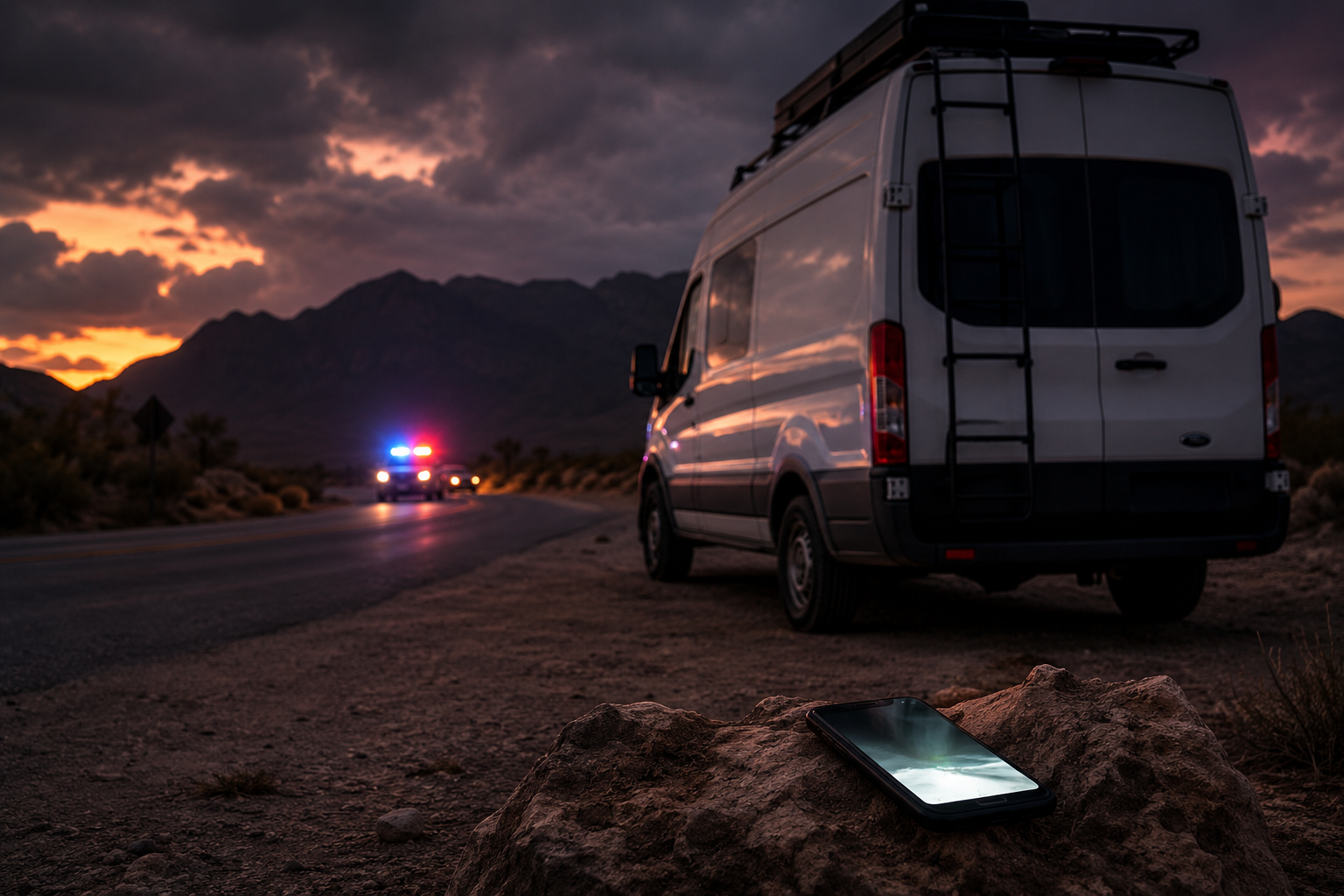
By the summer of 2021, Gabby and Brian were moving through the American West in a white Ford Transit van. The vehicle was not just transport. It was shelter, studio, storage space, bedroom, and public symbol.
The route took them through landscapes built for photographs: deserts, parks, campgrounds, highways, and towns where tourists pass through without leaving much behind. Their trip was part vacation, part content project, part personal experiment.
Then came Moab, Utah.
On August 12, 2021, the couple was in the area near the Moonflower Community Cooperative. A 911 call reported a domestic dispute. According to the later independent review of the police response, the caller described seeing a man “slapping the girl,” said the two ran up and down the sidewalk, and reported that the man appeared to hit her before they drove away. Dispatch then alerted law enforcement to a report of a male hitting a female and a van leaving northbound from the location.
Soon after, an officer stopped the van near the turnoff road into Arches National Park after observing driving behavior that included crossing the double yellow line and hitting a curb. From that point, Gabby and Brian were separated while officers spoke with them.
It was still not a national story. It was a roadside stop in Utah. But the road had changed.
The First Alarm
The traffic stop became one of the most scrutinized moments in the entire Gabby Petito case.
Body-camera footage showed Gabby visibly distressed. Officers spoke with both her and Brian. The independent review later examined officer reports, dispatch notes, audio, witness statements, and body-worn camera video. Its purpose was not to retry the entire relationship from hindsight, but to assess how the August 12 incident had been handled.
The review found that the responding officers made “several unintentional mistakes,” including issues connected to how the incident was classified and handled under domestic violence law. It also recommended additional domestic violence investigation training, legal training, policy review, software review, and stronger review processes for reports.
That conclusion mattered because the roadside stop produced competing interpretations. Was this a mutual argument? A mental health crisis? A domestic violence incident? A warning sign of coercive control? Officers on scene had to decide in real time. Later, the public would examine every sentence with the knowledge of what came after.
The review also noted that a statement was never obtained from the original 911 caller and recommended that it be added to complete the incident report.
The alarm had sounded. The question was whether anyone had heard it clearly enough.
The Event at the Center of the Case
After Moab, the trip continued.
The public record narrows sharply in late August. The most important space in the case is not a dramatic courtroom scene, because there was no trial. It is a remote area near Grand Teton National Park and Bridger-Teton National Forest, where the ordinary timeline began to break apart.
The FBI later stated that Gabby’s remains were found on September 19, 2021, at the Spread Creek Dispersed Camping Area, near where she and Brian had been seen together. The agency also said she was found approximately three weeks after her last known communication.
The coroner’s conclusion gave the case its medical center: Gabby died from “blunt-force injuries to the head and neck, with manual strangulation.” The manner of death was treated as homicide. The FBI investigation then focused quickly on Brian, described by the agency as the last person believed to have seen her alive.
Because Brian was never tried, the exact minute-by-minute sequence was never tested in court. That matters. There was no cross-examined reconstruction in front of a jury. There was no defense case arguing an alternative version under oath. There was no verdict weighing criminal proof.
What investigators did have was the physical finding, the location, the timeline, the last-known association, the van, the digital trail, and Brian’s later written statements. The FBI said that after Gabby’s death, several text messages were identified between Brian’s phone and Gabby’s phone, and that the timing and content indicated an attempt to make it appear she was still alive. The agency also said Brian used Gabby’s debit card without authorization between August 30 and September 1 while driving back to Florida from Wyoming.
The central event, then, was reconstructed from evidence rather than testimony: a remote campsite, a fatal assault involving head and neck injuries and manual strangulation, later communications that appeared deceptive, and a return journey in which Brian drove back without Gabby.
The evidence answered the largest question. It left smaller ones permanently beyond reach.
The Morning After
When Brian returned to Florida, the white van came back with him.
Gabby did not.
That single fact changed the emotional temperature of the case. For her family, the silence was no longer the ordinary silence of a traveler out west. It became a problem with shape and direction. Calls, messages, timing, and explanations began to matter.
The FBI opened its investigation into Gabby’s disappearance on September 12, 2021, after reports from her family that she was missing. Federal, state, and local law enforcement then organized searches in remote areas around Grand Teton National Park and Bridger-Teton National Forest.
The search was not happening in a vacuum. Gabby had left behind a digital footprint. She had social media posts, video, public-facing content, and an audience that could be drawn into the timeline. The van was recognizable. The trip route could be studied. People who had crossed paths with the couple began looking back at photos, sightings, and memories.
But for the family, this was not a puzzle. It was a daughter who was not answering.
The official process moved through reports and searches. The private fear moved faster.
When the Story Broke Open
The Gabby Petito case became public in a way few missing-person cases do.
Part of that was the digital trail. Part of it was the visual clarity of the story: the van, the national parks, the young couple, the edited travel images, the sudden silence. Part of it was the way online communities could participate in real time, comparing locations, studying posts, and pushing sightings into public view.
The case also exposed a difficult truth about attention. Many missing people never receive comparable coverage. Gabby’s case drew enormous interest, and that interest helped generate tips. It also raised questions about whose disappearances become national stories and whose do not.
Netflix later released American Murder: Gabby Petito, a three-episode documentary series in 2025. The platform described the series as examining the final days of Gabby’s life through loved ones, text messages, video footage, and personal journals.
But even before later documentary treatment, the case had already become a public investigation. People were not merely watching. They were searching, analyzing, sharing, and arguing.
That attention intensified pressure on law enforcement. It also compressed grief into spectacle.
The Investigation Narrows
By mid-September 2021, investigators were no longer only asking where Gabby was. They were asking what Brian knew.
The FBI’s final investigative update states that law enforcement worked through logical leads but quickly focused on Brian as the last person believed to have seen Gabby alive. The agency identified post-death messages between the phones and unauthorized use of Gabby’s debit card during Brian’s return to Florida.
On September 15, Brian’s Ford Mustang was recovered from the T. Mabry Carlton Jr. Memorial Reserve and Myakkahatchee Creek Park in North Port, Florida. On September 17, his parents reported him missing after law enforcement had conducted a welfare check at their residence. The next day, authorities began an extensive search of the park where the vehicle had been parked. The FBI later said the area where Brian’s remains were eventually found had been part of that initial search area, but was submerged because of recent flooding.
On September 22, a federal arrest warrant was issued for Brian. The warrant was not for homicide. It was tied to alleged unauthorized use of an access device, connected to activity after Gabby’s death. That distinction matters. Suspicion is not a charge. A charge is not a conviction. The criminal process was still forming around available evidence.
The investigation had narrowed, but the law still needed proof that could survive court.
The Case Built from Fragments
Because Brian Laundrie died before any homicide trial could take place, the Gabby Petito case never became a courtroom contest in the way many true crime stories do.
There was no jury hearing a prosecution theory and a defense theory side by side. There was no public cross-examination of forensic experts. There was no formal verdict that moved from accusation to conviction.
Instead, the official case was built from fragments: the Moab stop, the remote campsite, the recovery of Gabby’s remains, the coroner’s findings, the van’s return to Florida, the phone messages, the debit card use, the search for Brian, and the notebook later found near his remains.
The FBI’s final statement said a review of the notebook revealed written statements by Brian claiming responsibility for Gabby’s death. It also stated that all logical investigative steps had been concluded and that the investigation did not identify anyone other than Brian directly involved in Gabby’s death.
That official conclusion carried great weight. But it did not provide the same public architecture as a trial. There were no days of testimony. No evidentiary rulings. No sentencing hearing. No allocution. No final moment in which the legal system spoke through a jury.
The result was unusual: a case with a strong official answer, but without the catharsis of a courtroom ending.
The Outcome That Did Not End the Story
The formal criminal case ended without a trial.
Brian’s remains were found in Florida after the search of the reserve area. The FBI later said the notebook recovered near him contained statements claiming responsibility for Gabby’s death. The agency closed the investigation in January 2022, saying its work had not identified anyone other than Brian directly involved.
For many members of the public, that was the answer.
For Gabby’s family, it was not the end.
There were still questions about the Moab stop. There were questions about what Brian’s parents knew and when they knew it. There were questions about whether earlier intervention could have changed the outcome. There were questions about the relationship between domestic violence warning signs and law enforcement response.
Civil litigation followed. Gabby’s parents reached a confidential settlement in 2024 with Brian Laundrie’s parents and their attorney in a Florida civil suit that accused them of causing emotional distress by misleading the family about Gabby’s whereabouts before her remains were found. The Laundries denied knowing her fate before the discovery.
A formal ending had arrived in one sense.
In every other sense, the case kept moving.
The Aftermath People Still Argue About
The aftermath split into two tracks: accountability and prevention.
The accountability track focused heavily on Moab. Gabby’s family sued the city and its police department, alleging that officers failed to protect her after the August 12 encounter. In November 2024, a Utah judge dismissed the wrongful death lawsuit against Moab and its police department, citing state law.
That dismissal did not erase the independent review’s findings. The review had already concluded that mistakes were made and recommended domestic violence training, legal training, policy review, report review improvements, and related reforms.
The prevention track became Gabby’s family’s public work. The Gabby Petito Foundation partnered with the National Domestic Violence Hotline, including a $100,000 donation to support expanded capacity for survivors. The Hotline described the foundation as created by Gabby’s family to support organizations assisting victims of domestic violence through education, awareness, and prevention.
That is where the case becomes larger than its timeline. The Moab stop is still debated because it represents a recognizable failure point: a moment where visible distress, witness information, and police discretion converged.
The argument is not only about what officers did.
It is about what systems are trained to see.
The Review, Appeal, or Unanswered Question
The hardest question in the Gabby Petito case is not whether the FBI reached an official conclusion. It did.
The harder question is whether the warning signs before that conclusion were understood when they still mattered.
The independent Moab review is central because it does not rely on hindsight alone. It examined the materials available from the day itself: reports, dispatch notes, audio, witness statements, and body-worn camera footage. It found mistakes and recommended changes.
One issue was the missing statement from the original 911 caller. Another was how officers interpreted what they saw and heard. The review also recorded later concerns about whether certain statements had been accurately attributed or inferred, including questions around report details and what was actually heard on body-camera footage.
This is where public conviction and legal accountability separate.
The public can look at the case and see a chain. A court must apply statutes, causation standards, immunity rules, and evidentiary burdens. That gap is one reason the case still frustrates people. The moral pattern feels clear to many observers. The legal route is narrower.
The unanswered question is not simply what happened.
It is what should have happened sooner.
Why This Case Still Matters
Gabby Petito’s case still matters because it sits at the intersection of intimacy, image, policing, social media, and public attention.
It showed how a relationship can look curated from the outside while carrying danger behind the frame. It showed how a missing-person case can become a national fixation when the internet has enough images to study and enough silence to fill. It showed how domestic violence response depends not only on laws, but on interpretation, training, and whether warning signs are treated as pieces of a pattern.
It also showed the limits of true crime attention. Public pressure can help locate evidence. It can also turn grief into content, encourage speculation, and flatten real people into symbols.
Gabby was not only the young woman in the van. She was not only the face from the footage. She was not only the name attached to a documentary, a foundation, or a police review.
She was a person with plans, family, creative energy, and a future that should not have needed public reconstruction to be understood.
The road trip began as a search for freedom.
It ended by forcing a country to ask how many warnings it had already learned to ignore.
