True Crime: The Fake Tinder Profile That Turned A Front Door Into A Trap
The App That Became A Nightmare
The Tinder Plot That Shocked Detectives
It arrived through an app.
A profile. A photograph. A message that looked like consent to men who had never met the woman whose name and image were being used. Then came the doorbell. Then another. Then another.
In Northwich, Cheshire, a woman began facing men at her home who believed they had been invited there through Tinder. Some said they had been given her address. Some said they had been told to enter. One was told the front door was stiff and should be shoved. What the woman knew, and what the men did not, was that she had not sent those messages.
The profile was not hers. The invitation was not hers. The danger, however, was real.
The Life Before The Case
Before the police file, the court case, and the national headlines, there was a woman trying to live an ordinary life with her children.
Her name has not been made public, and that matters. This case is not about exposing her identity. It is about understanding how quickly a private life can be invaded when another person turns technology into a weapon.
In April 2024, she began seeing a man who contacted her on social media under the name “Mick Renney.” He was not using his real identity. Police later said the man was Asad Hussain, also known as Ash Hussain, from Heald Green, Cheadle. He was 36.
The relationship was brief, but police said it became controlling. One incident became an early warning sign: he went to her home because she had a male friend there and repeatedly rang her doorbell for two hours, leaving only after a neighbor called police.
What looked at first like possessiveness was beginning to look like surveillance.
The Last Ordinary Movements
On May 6, 2024, the relationship reached its breaking point.
The woman woke to find that Hussain had taken her mobile phone and read through messages to male colleagues and friends. According to Cheshire Police, he bombarded her with questions about whether she was seeing other men.
He later returned the phone. But when she tried to go to the bathroom, he objected to her having the device without him present. Police said he forced his way in, pushed her, caused her to fall, and took the phone again.
That was the last time she saw the man she knew as “Mick Renney.”
The name still mattered. She did not yet know who he really was. Police would later say Hussain had hidden behind false identities, separate phones, and attempts to conceal his movements. But in that moment, the woman was left with a more immediate problem: a man who had crossed from jealousy into physical control.
The relationship was over. The campaign was not.
The First Alarm
After the split, Hussain contacted the woman’s daughter and friends, accusing her of cheating and trying to restart the relationship. She refused.
Then, in late July 2024, men began appearing at her address.
They said they had matched with her on Tinder. They said she had invited them round. They had her phone number. They had her address. Some had been given instructions about what to do when they arrived.
The first version sounded absurd enough to be mistaken for misunderstanding. A fake profile. A stranger at the door. A dating app message that could be explained away as a prank, a scam, or a mistake.
But then the pattern repeated.
On one night in August 2024, four men came to the house one after another. They described almost identical messages.
This was no longer a misunderstanding. It was a system.
The Event At The Center Of The Case
The central horror of the case was not only that a fake profile existed. It was how precisely it was used.
Police said Hussain created multiple fake Tinder accounts pretending to be the woman. The men who attended her home told police they believed they had matched with her. They were quickly invited to the address and given her phone number. Before arriving, some were asked what cars were parked outside. Then they were told she was waiting in the conservatory and instructed to enter.
The messages described violent sexual fantasies. Men were led to believe she wanted to be “roughed up.” They were also told that if she said “no,” it meant she wanted it more.
That detail sits at the center of the case because it attempted to erase consent before the woman even opened the door.
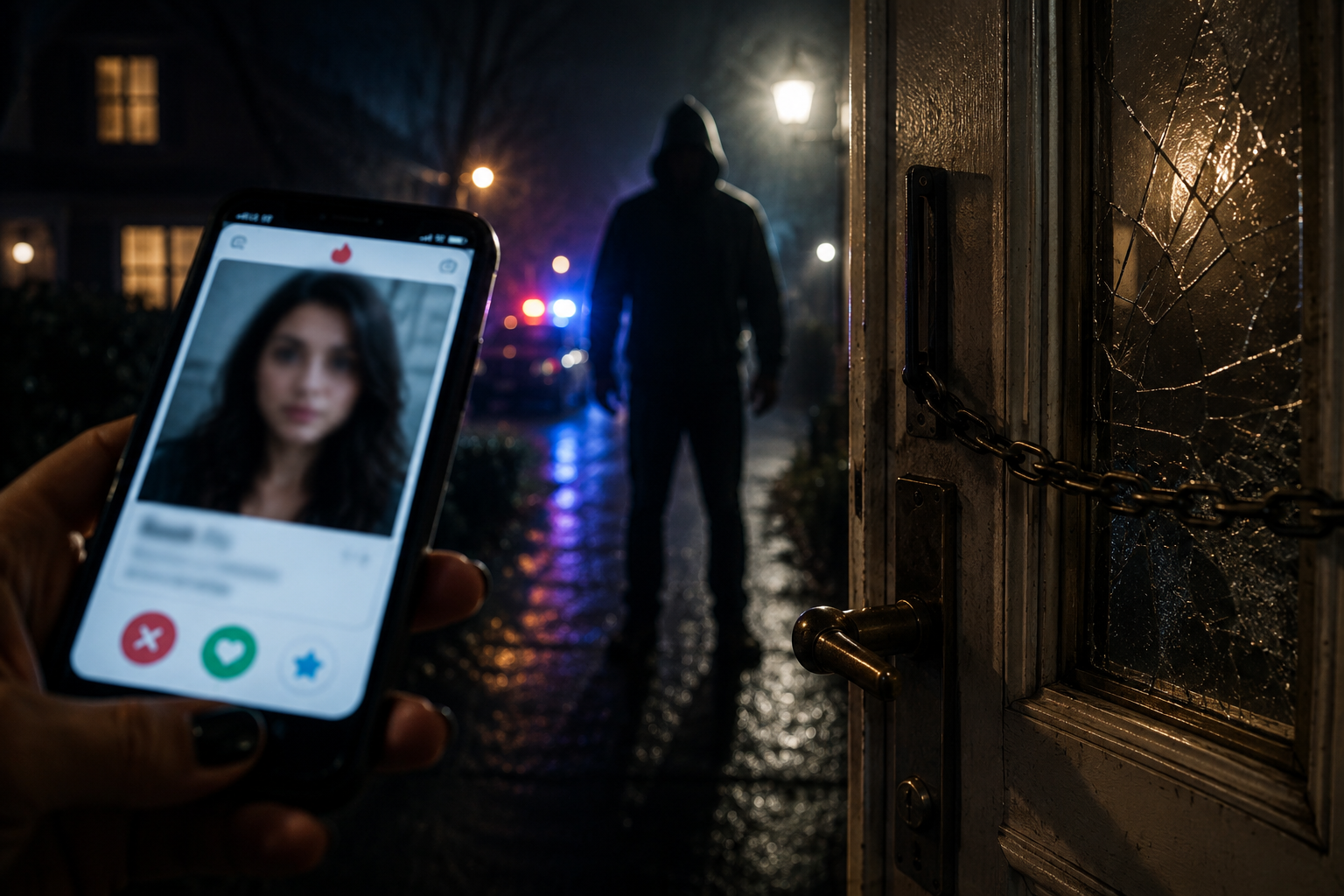
In September 2024, the danger became physical. The woman went to answer the door after the bell rang. As she approached, a man shoved the door, smashing a glass panel. When she explained what was happening, he showed her messages from the fake account saying the front door was open and that he should give it a shove because it was stiff.
Later that day, while the woman was at work, another man entered the house while her teenage daughter was upstairs alone. Police said he remained inside for several minutes before leaving without incident.
At least 18 men are believed to have been deceived into going to the address. Police said the true number remains unknown.
That uncertainty is part of the damage. The woman could count some of the men who came to the door. She could not know how many had been contacted, how many had her address, or how many more might arrive.
The Morning After
The investigation began with a problem that should have made the case harder: “Mick Renney” did not appear to exist.
When the woman contacted police, officers from Northwich Local Policing Unit reviewed her video doorbell footage. That footage gave them a lead. The car used by “Renney” was registered to Asad Hussain and insured to his business.
The case then moved to Cheshire Police’s Harm Reduction Unit, a specialist stalking investigation and risk management team.
The investigation was now looking at two linked identities: the man the woman had known, and the real person police believed was behind him.
That difference mattered legally. Hussain would later deny being “Mick Renney.” He would deny knowing the victim. He would deny ever going to her address. But the doorbell footage, vehicle records, telecommunications data, CCTV, and ANPR evidence began to build a different picture.
A hidden identity was becoming traceable.
When The Story Broke Open
This case became public because it exposed a form of stalking that felt both old and new.
The old pattern was control after separation: jealousy, accusations, unwanted contact, attempts to pull the victim back into the relationship.
The new mechanism was digital impersonation. A dating app profile could make strangers believe they had consent, permission, and instructions. The victim did not need to be physically followed every hour for her home to become unsafe. Her image, address, and phone number could be deployed remotely.
Sky News reported on June 29, 2026, that police described it as an “absolute miracle” the victim was not harmed. Their report said Hussain was being sentenced after creating a fake Tinder profile in his former girlfriend’s name and encouraging men to break into her home and rape her.
The phrase “absolute miracle” was not dramatic padding. It was a factual measure of risk.
The men had gone to the address. A door panel had been smashed. A child had been inside the house. The messages had reframed refusal as permission. The case had moved beyond harassment into the attempted orchestration of real-world sexual violence.
The Investigation Narrows
Police said Hussain had taken steps to avoid detection.
He changed his car registration. He used separate dedicated phones for the “Mick Renney” identity and the fake Tinder account. After learning police were interested in him, he discarded phones and factory reset personal devices. He also attempted to have his details removed from Companies House records for his business.
On October 6, 2024, Hussain was arrested after Cumbria Police officers spotted his van on the M6.
In interview, he denied being “Mick Renney,” denied knowing the woman, denied visiting her address, and denied using dating apps or social media. He claimed the Audi R8 seen in the woman’s video doorbell footage was part of a classic car rental service linked to his plumbing and gas business. Police said he could not name anyone who had leased it.
Investigators used CCTV, ANPR, and telecommunications data to challenge that account. They said every time the Tinder accounts were active, Hussain had traveled from Cheadle to the Northwich area, staying at an industrial unit he rented or parking in a lay-by on the A556 about two miles from the victim’s home while operating the fake accounts for hours.
The digital trail was becoming the map.
The Case Built From Fragments
The case against Hussain was built from fragments that reinforced each other.
There were the men who attended the address and described similar Tinder exchanges. There was the video doorbell footage. There were vehicle links. There were phone and telecommunications records. There was ANPR evidence. There was the timing of the fake profile activity and Hussain’s repeated travel toward Northwich.
There was also the question of devices.
After his arrest, police seized a mobile phone and an iPad from Hussain’s van. He told officers neither device held data relating to the victim or the offences, but he repeatedly refused to provide passcodes. In June 2025, officers served a Section 49 notice under the Regulation of Investigatory Powers Act 2000, legally requiring disclosure of passcodes.
Hussain provided the phone password but said the iPad belonged to a client. Police said inquiries showed the device was linked to his personal phone number and business email address and had connected to the internet at a family member’s address on the morning of his arrest.
The prosecution did not need the case to rest on one message, one witness, or one moment. It became a pattern case.
The Outcome That Did Not End The Story
After a nine-day trial at Chester Crown Court beginning on April 20, 2026, Hussain was found guilty of stalking involving serious alarm or distress, assault by beating, and failure to comply with a Section 49 RIPA notice.
On June 29, 2026, reporting from Hits Radio Manchester said Hussain had been jailed for eight years.
The sentence brought the criminal case to a formal point of closure. It did not undo the fear created at the woman’s front door.
PC Keith Terrill of Cheshire Police called it one of the most disturbing stalking cases the force had investigated. He said Hussain’s objective was to cause maximum harm to the victim and her children, including by inciting others to break into her home and sexually assault her.
That is why the case cannot be understood as simply a fake profile story.
It was a stalking case. A coercive-control case. A digital impersonation case. A case about consent being counterfeited and exported to strangers.
The Aftermath People Still Argue About
The aftermath of cases like this often turns into a debate about platforms, policing, and personal safety.
But the first issue is simpler: the victim did nothing to invite this. Her photos, identity, phone number, and address were used against her. Men were manipulated into becoming instruments of fear. Her home, which should have been private, became the endpoint of a lie.
The second issue is harder: how should police, courts, and technology platforms respond when online impersonation creates immediate physical danger?
Fake accounts are not always low-level nuisance behavior. In this case, the court heard they were used to send men to a real address with instructions that placed a woman and her child at risk. Police said the true number of men deceived remains unknown.
That uncertainty is what makes the case linger.
A sentence can punish what was proved. It cannot fully measure every night the victim may have listened for the doorbell.
The Review, Appeal, Or Unanswered Question
The major unanswered question is not whether Hussain was legally responsible. A jury convicted him, and the court sentenced him.
The harder question is how close this came to a catastrophic failure.
A man smashed a glass panel after being told to shove the door. Another entered the house while a teenage girl was upstairs. Multiple men arrived in one night. The messages attempted to instruct strangers to treat refusal as part of the fantasy.
Police called the victim’s survival an “absolute miracle” because the chain of risk depended on strangers pausing, listening, and eventually realizing something was wrong.
That is not a safety system.
It is luck intersecting with hesitation.
Why This Case Still Matters
The Asad Hussain Tinder stalking case matters because it shows how stalking can move through modern systems without losing its old purpose.
Control. Fear. Humiliation. Isolation. Punishment after rejection.
The method was digital. The threat was physical. The target was a woman’s ordinary life: her phone, her family, her home, her door.
In older stalking cases, danger often had a visible shape. A person waiting outside. A car following. Repeated calls. Letters. Threats. Here, the danger arrived wearing other men’s faces.
That is what makes the case so disturbing. The fake profile did not remain online. It crossed the threshold.
And by the time the court reached sentence, one fact was impossible to ignore: the difference between survival and disaster had been far thinner than anyone should have to live with.
