True Crime: Bryan Kohberger And The Idaho Students—The House, The Knife Sheath, And The Question That Would Not Answer Itself
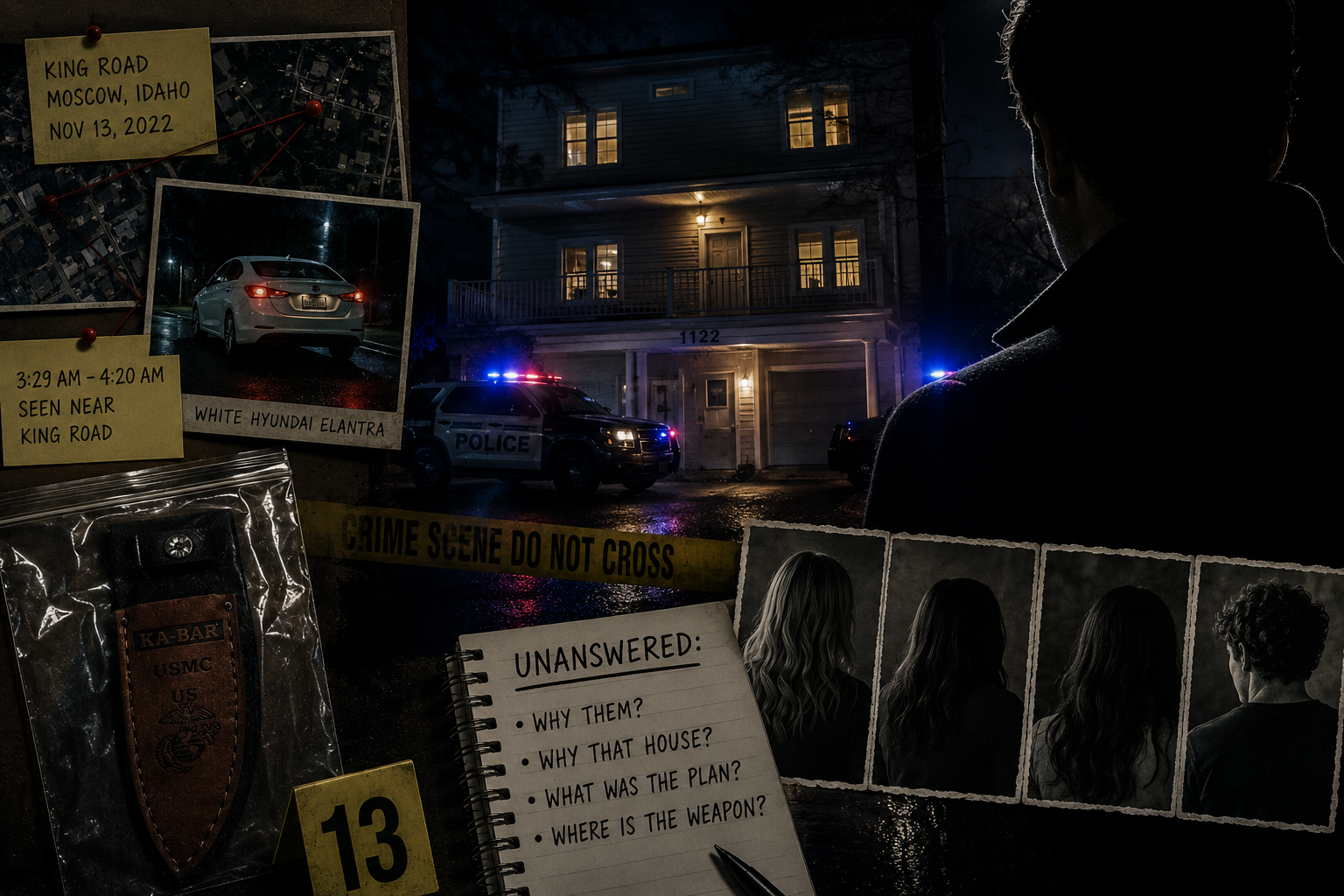
The House That Hid The Truth Until It Didn't
The Idaho Four: The House, The Car, And The Missing Why
The house sat just off the University of Idaho campus, close enough to student life that its noise and traffic could blend into the ordinary rhythm of a college weekend.
There were bedrooms on different floors, a sliding glass door, cars moving through the neighborhood, phones lighting up in the early hours, and a dog somewhere upstairs. Nothing about those details, by themselves, explained why 1122 King Road would become a national crime scene.
By noon on November 13, 2022, the private world inside that house had become something else: a locked-down scene, a university in fear, and the start of an investigation that would stretch across Idaho, Washington, Pennsylvania, forensic genealogy, courtroom strategy, and a question the legal system could answer only in part. Four University of Idaho students — Madison Mogen, Kaylee Goncalves, Xana Kernodle, and Ethan Chapin — were killed in their off-campus home in Moscow, Idaho.
The first explanation was not enough. Not for the families, not for the town, not for the investigators trying to work backward from a silent house and a missing weapon. The case would eventually identify Bryan Kohberger, a Washington State University criminology doctoral student, but the deeper question stayed harder: how did an ordinary college night become a case built around a knife sheath, a white Hyundai Elantra, and a motive that still has not been publicly explained?
The Life Before The Case
Before the case became shorthand for fear, the four students were not evidence markers. They were undergraduates inside a specific campus world, with friendships, Greek life, family routines, and plans that still seemed open.
Madison Mogen and Kaylee Goncalves were both 21. Xana Kernodle and Ethan Chapin were both 20. Mogen, Goncalves, and Kernodle lived at the King Road house with other roommates, while Chapin, Kernodle’s boyfriend, was there as a guest that night.
The human details matter because the public version of this case can harden into objects: the house, the car, the sheath, the sliding door. But the university later created the Vandal Healing Garden and Memorial, designed and built by students, with a memorial sculpture specifically honoring Xana, Ethan, Kaylee, and Maddie.
Ethan’s family also turned grief into scholarships and the Ethan’s Smile Foundation. His mother described the work as a way to “move forward” and create something good, while friends remembered him as someone who joked, showed up, and could be counted on.
That is the part a case file cannot hold well. These were not public figures. They were students inside a small college ecosystem where a late night out, a fraternity party, a food truck, and a DoorDash order could still look like nothing more than weekend life.
The People Around Them
The house on King Road was not empty around the four victims. Two surviving roommates, identified in court documents by initials, were inside the residence at the time. One bedroom was on the first floor; another roommate was on the second floor.
The social circle around the victims mattered because the first public instinct was to look inward. Who had been with them? Who had driven them home? Who had been seen near them at the food truck? Who had been called in the middle of the night?
The early record showed a more ordinary pattern. Chapin and Kernodle had been seen at the Sigma Chi house on the University of Idaho campus between about 9 p.m. on November 12 and 1:45 a.m. on November 13, while Goncalves and Mogen had been at the Corner Club and later at the Grub Truck in downtown Moscow. A private party reported driving Goncalves and Mogen back to King Road at about 1:56 a.m.
Kohberger belonged to a different orbit. He was a Ph.D. student in criminology at Washington State University in Pullman, Washington, about 10 miles from Moscow. Court records later noted his academic background in psychology, cloud-based forensics, and criminal justice, including an interest in helping rural law enforcement collect and analyze technological data.
That contrast became one of the case’s most disturbing facts. The victims’ world and the suspect’s world were geographically close, but the public record has not established a personal relationship that explains why those four students were selected.
The First Cracks
The first crack was not a dramatic warning. It was the absence of one. The night still looked like a college night.
By around 2 a.m., according to the probable cause affidavit, the housemates were home or in their rooms. The exception was Kernodle, whose phone activity and delivery record would later become important because they showed she was likely still awake close to the time of the attack. A DoorDash driver reported making a delivery to the residence at approximately 4 a.m., and forensic review of Kernodle’s phone showed TikTok activity at about 4:12 a.m.
This mattered because early assumptions about the case often treated all four victims as asleep. The record is narrower. Prosecutors later said Kernodle was awake when the violence began upstairs and that she was encountered as Kohberger came down or moved through the house.
Another crack came from sound. One surviving roommate told investigators she heard what she thought was someone upstairs playing with a dog, then heard a voice say something like “there’s someone here.” The affidavit says that voice could have been Goncalves or Kernodle, given Kernodle’s phone activity.
At the time, those sounds did not come with a clear explanation. Inside a student rental, noise did not automatically mean danger. Only later would every small sound be placed back onto a timeline.
The Last Ordinary Movements
The final ordinary movements are traceable because so many parts of modern life leave records. There were bar cameras, food truck video, phone downloads, DoorDash data, neighborhood cameras, and campus surveillance footage.
Goncalves and Mogen were seen at the Corner Club between about 10 p.m. and 1:30 a.m., then at the Grub Truck at about 1:30 a.m. They were reportedly driven from downtown Moscow to the King Road house at about 1:56 a.m.
Chapin and Kernodle’s path was different. They had been at Sigma Chi, then returned to the residence around 1:45 a.m., according to the affidavit. Chapin did not live in the house; he was there because he was dating Kernodle.
The vehicle timeline moved in parallel. Surveillance footage later showed a white sedan traveling near Moscow before dawn. It was seen westbound on Indian Hills Drive at about 3:26 a.m., on Styner Avenue at about 3:28 a.m., and in the King Road neighborhood multiple times between 3:29 a.m. and 4:20 a.m.
What looked ordinary from the inside of the house was already narrowing from the outside. A car was circling. Phones were recording movement. The neighborhood was quiet enough that repeated passes mattered.
The First Alarm
The official alarm did not begin at 4 a.m. It began hours later.
Moscow police and emergency responders were called to the King Road house close to midday on November 13. The probable cause affidavit says Corporal Brett Payne responded around 4 p.m. to assist with scene security and processing after four homicides had been discovered.
The scene split across floors. On the second floor, Payne described entering Kernodle’s room and seeing Kernodle and Chapin deceased. On the third floor, he described finding Goncalves and Mogen in Mogen’s bedroom, where a tan leather knife sheath lay near Mogen’s right side. The sheath bore Ka-Bar, USMC, and Marine Corps insignia markings, and the Idaho State Lab later found a single-source male DNA profile on the button snap.
That sheath became the object the case could not leave behind. A weapon was missing, but part of the weapon’s carrying system was not. It connected the room to a later forensic trail.
The first alarm, then, contained two opposite facts. The attack was already over. The investigation had just found one of the few physical objects capable of speaking.
The Search For An Explanation
Early public explanations moved faster than evidence. In the absence of an arrest, people tried to make the case smaller and more understandable: an ex-boyfriend, a food truck encounter, a roommate, a local argument, a stalker, a random predator.
Investigators had to work differently. They conducted interviews, processed the house, reviewed phone downloads, and began a video canvass of the area around King Road. The affidavit describes that canvass as an effort to locate suspects or suspect vehicles traveling to or leaving the residence in the early hours of November 13.
The white sedan became the first public hinge. Camera footage showed the vehicle passing the house several times, then entering again at about 4:04 a.m., apparently attempting to park or turn around, completing a three-point turn, and later leaving the area at about 4:20 a.m. at a high rate of speed.
FBI vehicle examiners first assessed the vehicle as a 2011–2013 Hyundai Elantra, then widened the possible range to 2011–2016. Investigators began reviewing people connected to white Hyundai Elantras, and Washington State University police soon identified a 2015 white Hyundai Elantra registered to Bryan Kohberger.
The first simple explanation — that the killer had vanished without a trace — began to fail. The trace was not one thing. It was a car, a sheath, a phone, and a route.
The Evidence That Did Not Fit
The evidence tightened because different strands pointed in the same direction.
The affidavit said Kohberger’s white Hyundai Elantra was located by WSU officers on November 29, 2022, at his Pullman apartment complex. Officers also connected his physical description, including height and eyebrows, to the surviving roommate’s description of a masked male she saw inside the house.
Phone data added another layer. Investigators tied Kohberger to a phone ending in 8458, then obtained historical records. The phone was using cellular resources near his Pullman residence at about 2:42 a.m., moved away from that area, and stopped reporting to the network at about 2:47 a.m. It did not report again until about 4:48 a.m., when it used resources south of Moscow.
That gap did not prove the phone was inside the house. It proved something narrower and still important: the phone stopped reporting during the critical window and resumed afterward in a location consistent with a return route. Investigators described the phone’s travel as consistent with the white Elantra’s movements.
The longer historical records were also significant. The affidavit said the same phone had used cellular resources providing coverage to the area of 1122 King Road on at least 12 occasions before November 13, mostly in late evening or early morning hours.
The DNA evidence gave the case its strongest forensic center. Trash recovered from Kohberger’s family residence in Pennsylvania produced a DNA profile that the Idaho lab said was consistent with a biological father of the suspect profile from the sheath, with at least 99.9998% of the male population expected to be excluded from that relationship.
The Event At The Center Of The Case
The central event, as later described by prosecutors at Kohberger’s plea hearing, began with a planned approach, not a spontaneous fight. Prosecutor Bill Thompson said Kohberger left his Pullman apartment, drove to Moscow in his white Hyundai Elantra, circled the neighborhood, and entered the King Road house just after 4 a.m. through the kitchen sliding door.
The prosecution’s sequence placed the first killings on the third floor. Thompson said Kohberger went upstairs and killed Madison Mogen and Kaylee Goncalves. In the room where they were found, investigators had recovered the tan leather knife sheath with the single-source male DNA profile on its snap.
Kernodle was likely awake. The DoorDash order and TikTok activity made her timeline different from the assumption that the house was fully asleep. Prosecutors said that as Kohberger came down the stairs or was leaving, he encountered Kernodle and killed her with a large knife. Thompson said Ethan Chapin was asleep in Kernodle’s bedroom and was also killed there.
The affidavit placed key sounds around that same window. At about 4:17 a.m., a nearby security camera picked up distorted audio of voices or a whimper, followed by a loud thud, and a dog barking. The camera was less than 50 feet from the west wall of Kernodle’s bedroom.
One surviving roommate opened her door multiple times. She saw a masked figure in black clothing walk toward her, then past her, toward the sliding glass door. The affidavit says she locked herself in her room afterward and did not state that she recognized him.
The evidence does not make the event less horrifying, but it does make it less vague. The house had floors, rooms, a path of travel, an entry point, a likely exit, a witness description, a vehicle movement, phone silence, and a physical object left behind. That is how the event became prosecutable.
When The Story Broke Open
The story broke open in two stages: first as fear, then as identification.
In the weeks after the killings, Moscow became the center of national attention. Idaho officials later described local agencies, the county, and the university as overwhelmed by the gravity of the case and the attention surrounding it. Idaho Governor Brad Little directed $1 million in emergency funds to help the investigation, while Idaho State Police and FBI personnel assisted local law enforcement.
The public layer created its own damage. Social media speculation attached suspicion to people who had not been charged, and established reporting described online sleuthing as disruptive and rumor-driven.
On December 30, 2022, Kohberger was arrested in Pennsylvania. Idaho State Police later summarized the case plainly: he was arrested that day, charged with four counts of first-degree murder and one count of burglary, and the case was fully adjudicated after his conviction on July 23, 2025.
The arrest did not end the story. It changed its shape. The question was no longer whether investigators could identify a suspect. It became whether prosecutors could carry a death-penalty case through trial, whether the defense could create reasonable doubt, and whether the families would ever hear an explanation that made sense.
The Case Built From Fragments
The legal case was built from fragments that reinforced one another. No single fragment explained everything.
The prosecution had DNA on the sheath, surveillance video of a white Hyundai Elantra, phone records, the surviving roommate’s description, evidence of prior phone connections near the King Road area, and later courtroom claims about Kohberger’s online purchase history. Reuters reported that Thompson said Kohberger had purchased the knife online about eight months before the killings, that the sheath was recovered, and that the weapon itself was never found.
The defense, before the plea, challenged key evidence and explored alternative explanations. AP reported in 2025 that prosecutors said the defense intended to argue that someone else could have planted the sheath with Kohberger’s DNA, while not contesting that the DNA on the sheath belonged to him.
That was the legal battleground: not whether the case was emotionally convincing, but whether the prosecution could prove every count beyond a reasonable doubt to a jury. A trial would have tested the DNA handling, vehicle identification, phone interpretation, timing, witness reliability, and whether circumstantial evidence formed one coherent story.
It never reached a jury. On July 2, 2025, Kohberger pleaded guilty to all five counts. In court, Judge Steven Hippler asked him how he pleaded to each murder count, naming the victims, and Kohberger answered “guilty” each time. He also said he was pleading guilty because he was guilty.
The case built from fragments became a case resolved by admission. But admission is not the same as explanation.
The Outcome That Did Not End The Story
The plea agreement removed the death penalty. It called for four consecutive life sentences for the murder counts, the maximum 10-year sentence for burglary, and a waiver of Kohberger’s right to appeal.
On July 23, 2025, Kohberger was sentenced in Boise. Reuters reported that he received four consecutive life terms without the possibility of parole or appeal under the deal, after pleading guilty to four counts of first-degree murder. CBS reported that he also received 10 years on the burglary charge.
The courtroom did not become a place of answers. When given the opportunity to speak, Kohberger declined. Judge Hippler said the court was now certain who committed the crimes, but did not know and might never know why.
The families were not united on the plea. ABC reported that the Chapin family supported the plea bargain and that Madison Mogen’s family supported the agreement as the best possible outcome, while Kaylee Goncalves’ father publicly criticized the deal and said the family had sought a fuller confession and the location of the weapon.
That split is part of the aftermath. One family can see finality where another sees silence. The law can impose punishment without giving every victim’s family the same sense of justice.
The Aftermath People Still Argue About
The first argument is motive. Kohberger admitted guilt, but he did not publicly explain why he entered that house or why those victims were killed.
Reuters reported that authorities had not offered a motive and that the plea agreement did not require Kohberger to provide one. Prosecutor Thompson also stated there was no evidence of sexual assault or a sexual component to the killings, closing off one area of speculation without answering the broader question.
The second argument is the plea itself. For prosecutors, avoiding a capital trial meant avoiding years of litigation, appeals, and uncertainty. For some relatives, it meant losing the public trial they wanted and the chance to force more evidence into view.
The third argument is institutional. In 2026, families of the four victims sued Washington State University, where Kohberger had studied, alleging that the university failed to act on warning signs before the murders. A June 2026 report said a trial in that civil case was set for September 13, 2027. These are civil allegations, not criminal findings, and WSU’s liability has not been established.
The final argument is attention. Judge Hippler warned against giving Kohberger continued relevance by centering the unanswered “why.” That warning sits uneasily beside public curiosity, because true crime often turns motive into the prize. Here, the motive may be the least reliable thing the case can offer.
The Review, Appeal, Or Unanswered Question
The criminal case is adjudicated, but the unanswered question remains structurally important. It is not simply curiosity. It shapes how people interpret risk.
If Kohberger had no established personal connection to the victims, the crime feels more random. If he had focused on the house, the residence becomes the target. If he had focused on one person, the attack takes on a different meaning. The public record has not resolved that distinction with confidence.
The evidence does show repeated prior phone connections to the King Road area, mostly late at night or early in the morning. It also shows the vehicle circling the neighborhood shortly before the killings. Those facts support planning and surveillance, but they do not prove motive by themselves.
The appeal question is narrower. Kohberger waived appeal rights as part of the plea agreement, though CBS noted that the judge said he could still file a notice of appeal even if doing so might violate the agreement.
The civil case against WSU may become the next formal arena where people argue about warning signs, institutional responsibility, and foreseeability. But even that lawsuit cannot necessarily answer what Kohberger refused to explain.
The uncomfortable lesson is that a case can be solved, prosecuted, and punished while still withholding the one answer people most want.
Why This Case Still Matters
The Idaho student murders still matter because they sit at the intersection of ordinary life and modern evidence. A student house became a crime scene. A sheath became a forensic anchor. A car became a moving timestamp. A phone’s silence became part of the story.
The case also matters because it showed the power and limits of digital-era investigation. Cameras, phone data, DNA, and interagency work helped identify Kohberger, yet none of those tools could produce a motive that satisfied the families or the public.
It matters because online suspicion can damage innocent people before evidence catches up. The internet flattened the case into theories; the record narrowed it into proof.
Most of all, it matters because Madison, Kaylee, Xana, and Ethan were not abstractions. Their university built a healing garden. Their families created scholarships. Their names are attached not only to a criminal case but to attempts to make memory useful.
The house is gone from daily life, but the case remains because the final silence was not legal. It was human.
