True Crime: Karen Read and the Snowbank That Split America
The Case That Made Millions Believe Police Hid the Truth
The Trial Where Every Piece of Evidence Started a War
The road outside 34 Fairview Road in Canton, Massachusetts, looked ordinary until it did not.
It was a residential street in a Boston suburb, dark in the early hours of a winter storm, with snow falling hard enough to blur distance and flatten landmarks. Cars had moved in and out. People had gone from bars to a house. Phones had registered calls, steps, missed messages, and gaps that would later be pulled apart in court.
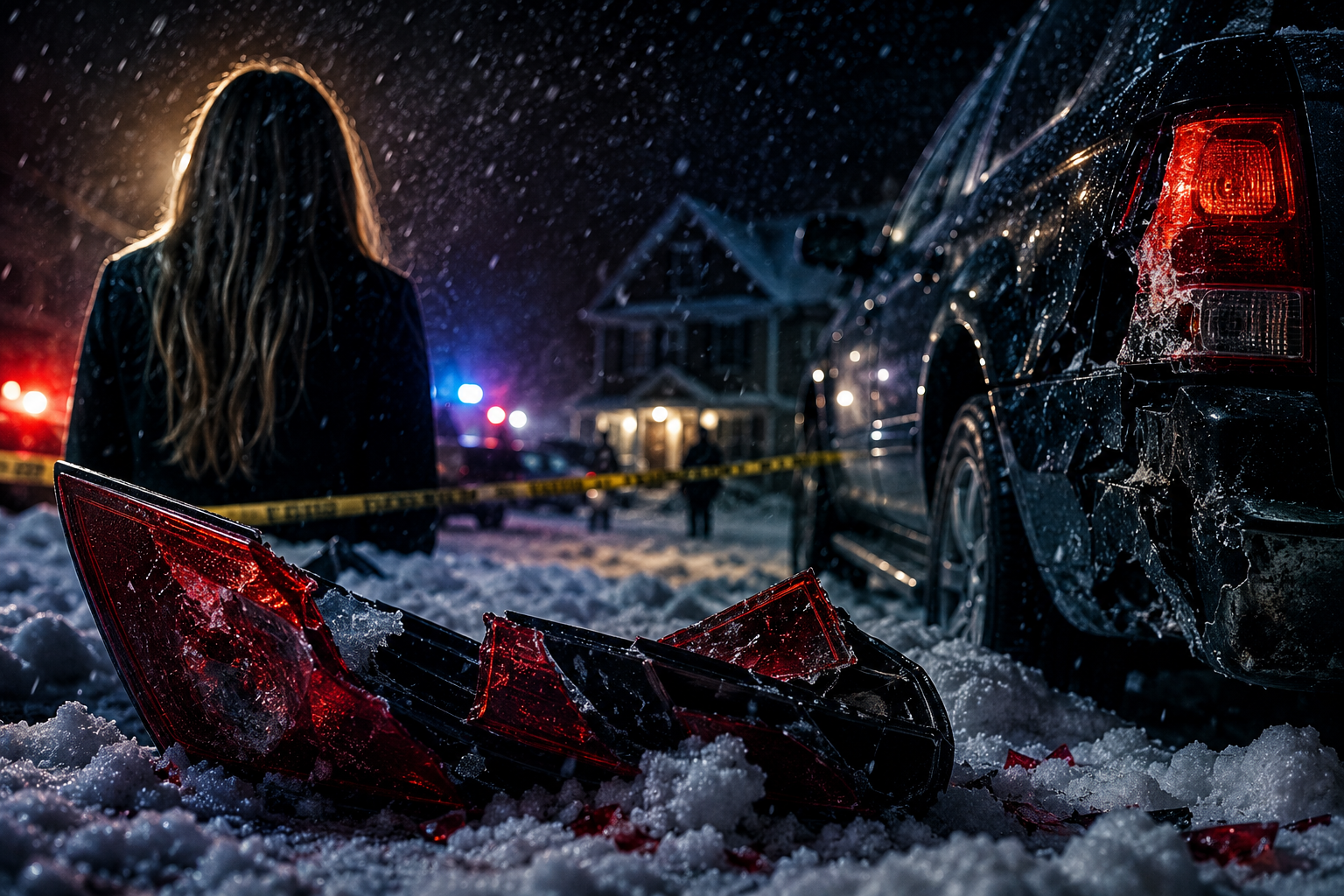
One object would become almost impossible to separate from the story: a broken taillight.
At first, it sounded like the kind of terrible early-morning confusion that police, families, and emergency responders sometimes meet in winter. A man was missing. A girlfriend was frantic. A storm had made every ordinary explanation seem possible.
Then the questions began to multiply. Had John O’Keefe ever entered the house? Had Karen Read’s Lexus struck him outside? Did a damaged taillight explain the injuries, or did the injuries make the taillight theory harder to accept? And why would a local death investigation become a national argument about police power, reasonable doubt, and what the public does when it stops trusting the official story?
This is the Karen Read case: not just a murder trial, but a collision between grief, law enforcement culture, digital evidence, forensic disagreement, and an online audience that decided the courtroom was only one battlefield.
The Life Before the Case
Before the snowbank, the testimony, and the slogans outside court, John O’Keefe was a Boston police officer with a household that already carried more loss than most families are asked to absorb.
O’Keefe’s niece testified in the 2025 retrial that her mother, John’s sister Kristen, died of a brain tumor in 2013, and that her father died shortly afterward of a heart attack. John then became legal guardian to his niece and nephew and moved in with them in Canton, Massachusetts.
That detail matters because it makes the house at the center of John’s life more than an address. It was not simply where he slept between police shifts. It was where two children had already rebuilt a life around an uncle who had stepped into a parental role.
O’Keefe’s friends and relatives described him as loyal, generous, and dedicated, while reporting summarized his career as more than 15 years with the Boston Police Department, including work in Hyde Park, downtown Boston, Dorchester, and the sex offender unit.
Karen Read entered that world not as a stranger but as someone close enough to help with ordinary family life. She had worked in finance and had served as an adjunct finance instructor at Bentley University. She and O’Keefe had known each other earlier in life, reconnected later, and became a couple in a home where dating also meant navigating children, routines, and grief.
The human part of this case begins there, in the ordinary difficulty of an adult relationship folded into a family structure that was already fragile. What later became evidence first looked like the strain of real life.
The People Around Them
The names around John O’Keefe and Karen Read would eventually become familiar to anyone who followed the case: Jennifer McCabe, Brian Albert, Nicole Albert, Brian Higgins, Kerry Roberts, Michael Proctor, and others pulled into the orbit of one winter night.
At the center were Read and O’Keefe, dating but not married, connected but not fully settled. Court TV’s case summary described them as a couple of about two years who did not live together, though Read spent many nights at O’Keefe’s Canton home and became involved with his niece and nephew.
Around them was a social circle that included people with law enforcement connections. Brian Albert, whose home at 34 Fairview Road became the physical center of the case, was a fellow Boston police officer. Jennifer McCabe was connected to that circle and became one of the most scrutinized witnesses because she was with Read on the morning O’Keefe was found.
That network is part of why the case became so combustible. In many criminal cases, the question is whether police correctly identified a suspect. Here, the defense argued that the people around the scene were too close to law enforcement, too connected to one another, and too protected by early assumptions.
The prosecution saw the same social circle differently. Its theory was narrower: Read drove O’Keefe to the house after drinking, struck him with her SUV outside, and left. The people inside, prosecutors maintained, did not know he was outside until the morning.
By the time those competing versions reached a jury, the supporting cast was no longer background. Each relationship had become a possible explanation, a possible conflict, or a possible reason the case could not be seen plainly.
The First Cracks
The relationship between Read and O’Keefe was not presented in court as a simple romance interrupted by one night of confusion.
O’Keefe’s niece testified that the couple’s relationship had been lighthearted at first, then changed near the end of 2021 and the beginning of 2022. She described tension, arguments, and an Aruba trip during which Read was upset over an alleged kiss involving O’Keefe and another woman.
That testimony did not prove what happened outside 34 Fairview Road. It did something more limited and more important: it gave jurors a record of strain before the final night.
On cross-examination, the same witness agreed that the arguments she saw did not become physical. That distinction mattered. A deteriorating relationship can explain anger, jealousy, or emotional volatility. It does not, by itself, prove a killing.
The first cracks therefore operated differently for each side. Prosecutors could point to conflict as context for their theory of a drunken argument that moved from words to impact. The defense could point to the same history and argue that ordinary relationship stress had been transformed into a murder narrative because investigators stopped looking elsewhere.
The question was not whether Read and O’Keefe argued. The question was whether the arguments explained the evidence, or whether they became a shortcut around it.
The Last Ordinary Movements
The last public setting in the timeline was not a crime scene. It was a bar.
On the night of January 28, 2022, Read, O’Keefe, and others were at the Waterfall Bar & Grille in Canton. CBS Boston’s timeline notes that the group went there shortly after midnight and that people from the bar later planned to meet at Brian Albert’s home.
The weather was closing in. Snow was not scenery in this case; it was an active force. It changed visibility, affected search conditions, complicated assumptions about timing, and gave both sides different ways to argue what could or could not have been seen.
Read drove O’Keefe toward 34 Fairview Road in her Lexus SUV. Prosecutors would later say that this drive ended with her striking him while backing up outside the house. The defense would say she dropped him off and left, and that O’Keefe’s fate was tied to something that happened after he went inside or approached the house.
The timeline then became narrow enough for seconds to matter. Phone records, vehicle data, witness accounts, and O’Keefe’s movements would all be examined for signs of whether he entered the home, remained outside, or encountered something no witness fully captured.
For everyone inside the story at that moment, the night was still a night out in bad weather. Only later would the route from the Waterfall to Fairview become the path every theory had to travel.
The First Alarm
The first alarm did not come as a clean police report. It came as panic.
According to the niece’s retrial testimony, Read came into her room around 4:30 a.m., shook her awake, and said O’Keefe had never come home. Read asked to use the girl’s phone to call him and asked for numbers she did not have, including Jennifer McCabe’s. The niece recalled Read asking questions such as what could have happened, whether O’Keefe could have been hit by a plow, and whether she could have hit him.
That early confusion became one of the prosecution’s most emotionally charged areas. A person asking “Could I have hit him?” can sound like dawning guilt. It can also sound like panic searching for any explanation.
Read, Jennifer McCabe, and Kerry Roberts later went looking for O’Keefe. The scene they found would become the origin point for nearly every later dispute.
The body was outside 34 Fairview Road, in the snow, near the house where people had gathered after the bar. O’Keefe was taken to a hospital and pronounced dead. The medical and legal meaning of what happened to him would become the center of two trials.
At that stage, one simple explanation was available. In a storm, after drinking, on a dark road, an accidental vehicle strike seemed possible. The problem was that every piece of evidence used to support that explanation would later be contested.
The Search for an Explanation
Early criminal cases often begin with a working theory. The danger is that a working theory can harden before the evidence has earned it.
Police found pieces of taillight and a broken cocktail glass at the scene, according to CBS Boston’s timeline. Prosecutors also cited toxicology evidence, with a forensic toxicologist estimating Read’s blood alcohol concentration around the relevant time as above the legal limit.
The prosecution theory used those facts as a spine. Read had been drinking. Her taillight was damaged. O’Keefe was found outside the house she had driven him to. His cause of death, as prosecutors described the medical examiner’s finding, involved blunt impact injuries to the head and hypothermia.
The defense attacked the spine from multiple directions. It argued that O’Keefe’s injuries did not fit a vehicle strike, that the scene was mishandled, that the house was not searched properly, that the people inside were protected, and that the broken taillight evidence could not carry the weight prosecutors placed on it.
A disputed Google search became one of the most famous fragments in the case. Jennifer McCabe’s phone contained the misspelled phrase “hos long to die in cold.” The defense argued the search happened before O’Keefe was found. Prosecutors argued it happened after the discovery, at Read’s request. Digital forensics examiner Jessica Hyde testified that the relevant search occurred at 6:24 a.m. and that the earlier timestamp reflected when a browser tab was opened or brought forward, not when the search itself was made.
That search showed why the case exploded online. It was short, strange, and easy to turn into a symbol. But in court, symbols had to become evidence.
The Evidence That Did Not Fit
The taillight was supposed to make the case simpler. Instead, it became one of the reasons the case grew harder.
Prosecutors said Read’s damaged Lexus and taillight fragments at the scene supported the allegation that she backed into O’Keefe. The defense argued that the damage did not match the kind of collision alleged and that evidence collection problems weakened confidence in the physical record.
The first trial revealed more than forensic disagreement. It revealed a damaged investigation. Michael Proctor, the Massachusetts State Police trooper who led the case, became a central figure after crude and derogatory messages about Read surfaced. In March 2025, the State Police Trial Board found him guilty of sending inappropriate messages about Read while leading the investigation, giving sensitive information to people outside law enforcement, and consuming alcohol while on duty; the board recommended termination.
For Read’s supporters, Proctor became proof that the case was poisoned. For prosecutors, his conduct was offensive but not the same as proof that evidence had been planted or that someone else killed O’Keefe.
The distinction is critical. Police misconduct can create reasonable doubt without proving a complete cover-up. A bad investigation can weaken a prosecution without identifying the true cause of death. That gap is where much of the public argument still lives.
The defense also used expert testimony to challenge the collision theory. In the retrial, ARCCA accident reconstructionist Daniel Wolfe testified that testing showed the damage to Read’s taillight was inconsistent with striking an arm at 24 mph and inconsistent with other tested speeds, and he also testified that the damage was not consistent with a center-of-mass pedestrian hit.
By then, suspicion was no longer flowing in one direction. It was ricocheting between the vehicle, the house, the snow, the phone data, the officers, and the people who had been inside 34 Fairview.
The Event at the Center of the Case
The central event has two competing reconstructions, and neither can be responsibly described as uncontested fact.
In the prosecution version, Read drove O’Keefe to Brian Albert’s home after a night of drinking. During a conflict or emotional escalation, she backed her Lexus into him outside the house, damaging the taillight, leaving fragments at the scene, and causing injuries that left him incapacitated in freezing conditions. ABC News summarized that prosecutors alleged Read hit O’Keefe with her car outside Albert’s home after heavy drinking, then left him during a major blizzard.
That version relied on the convergence of alcohol evidence, statements attributed to Read, vehicle and taillight evidence, phone records, and the location where O’Keefe was found. It did not require a large conspiracy. It required jurors to accept that the damaged vehicle, the scene evidence, and Read’s early panic pointed toward an intoxicated driver leaving a man outside in the snow.
In the defense version, Read’s SUV did not hit O’Keefe. Her lawyers argued that O’Keefe was attacked by a dog and beaten by people connected to the house, then left outside in the snow, while investigators either ignored or protected the real source of his injuries. ABC News reported that the defense argued O’Keefe was attacked by a dog and beaten by others inside the house before being thrown outside.
That theory relied less on one single piece of evidence and more on the cumulative weight of doubts: the alleged failure to search the house promptly, questions about the injuries on O’Keefe’s arm, disputed digital evidence, relationships among witnesses and officers, and the misconduct of the lead investigator.
Medical evidence did not end the dispute. Prosecutors said the medical examiner found blunt impact head injuries and hypothermia, with no obvious signs of an altercation or fight. During the retrial, however, an AP account reported that a neurosurgeon testified O’Keefe’s skull was most likely fractured when he fell backward and struck his head, describing it as a classic blunt trauma injury.
A jury did not have to solve every mystery. It had to decide whether the prosecution proved the charged crimes beyond a reasonable doubt. That legal standard would become the difference between public certainty and courtroom proof.
When the Story Broke Open
The case did not stay local because it had everything modern true crime feeds on: a dead police officer, a girlfriend accused of murder, a house full of law enforcement connections, a blizzard, a damaged SUV, a disputed phone search, and allegations that investigators protected their own.
Outside court, supporters gathered with signs and slogans. Online, the case became a test of identity. Some people saw Read as a framed outsider. Others saw the public campaign around her as cruel to O’Keefe’s family and unfair to witnesses who denied wrongdoing.
The courtroom became only one venue. Podcasts, livestreams, message boards, YouTube legal channels, documentaries, and social clips turned fragments of testimony into arguments that traveled faster than the trial record.
That public layer had consequences. ABC News reported that, after Read’s 2025 acquittal, members of the Albert and McCabe families called the outcome a “devastating miscarriage of justice” and said the prosecution had been infected by lies and conspiracy theories spread by Read, her defense team, and some media.
The internet often flattened the case into two slogans: “killer” or “cover-up.” The record was more complicated. The prosecution’s case had real evidence and real weaknesses. The defense theory raised serious investigative concerns, but it also asked jurors to accept a broad alternative account that prosecutors rejected.
That is what made the story break open. The case was no longer only about what happened to John O’Keefe. It was about whether the system investigating his death deserved belief.
The Case Built from Fragments
The first trial began in 2024 and lasted more than two months. Read faced three counts: second-degree murder, manslaughter while operating a motor vehicle under the influence of alcohol, and leaving the scene of personal injury resulting in death. The Massachusetts Supreme Judicial Court later summarized those charges and the fact that the jury sent notes saying it could not reach a unanimous verdict.
The jury was not being asked whether the investigation looked clean. It was being asked whether prosecutors had proved each charged crime beyond a reasonable doubt.
That distinction matters because much of the public debate treated doubt as a verdict on the entire story. In criminal law, reasonable doubt can come from a flawed investigation, uncertain experts, unreliable witnesses, contradictory timelines, or a prosecution theory that fails to close enough gaps. It does not require jurors to prove the defense theory true.
In July 2024, Judge Beverly Cannone declared a mistrial after jurors deadlocked. Prosecutors said they would try again.
Read’s lawyers then tried to prevent a retrial on some charges, arguing that jurors from the first trial had effectively agreed to acquit her of second-degree murder and leaving the scene. The Massachusetts Supreme Judicial Court rejected that double-jeopardy argument, concluding that no verdict had been recorded in open court.
The U.S. Supreme Court also declined to intervene before the retrial, according to reporting on the appeal.
So the case returned to Norfolk Superior Court, carrying the weight of the first trial’s unresolved questions. This time, the jury would have to decide whether the fragments formed proof or only suspicion.
The Outcome That Did Not End the Story
On June 18, 2025, the second jury reached a verdict.
Read was found not guilty of second-degree murder, manslaughter, and leaving the scene after an accident resulting in death. She was found guilty of operating under the influence of liquor and was sentenced to one year of probation.
Legally, that result is precise. It does not mean a jury found every defense claim true. It means the prosecution failed to prove the serious charges beyond a reasonable doubt, while the jury found Read guilty of drunken driving.
The reaction outside court reflected the divide that had shaped the entire case. Supporters cheered. Read thanked them and said no one had fought harder for justice for John O’Keefe than she and her team had.
For O’Keefe’s family and the prosecution witnesses aligned against Read, the verdict did not feel like closure. Their position remained that Read caused O’Keefe’s death and that the public narrative around a cover-up had inflicted further harm.
A criminal verdict can end a prosecution without ending a story. In this case, it moved the argument from the jury box to civil court, police discipline, public records, lawsuits, and memory.
The snowbank remained the same. The legal meaning around it had changed.
The Aftermath People Still Argue About
After the acquittals, the case entered a second life.
O’Keefe’s family pursued a civil wrongful death lawsuit against Read. NBC10 Boston reported in April 2026 that depositions were expected to begin, with key figures scheduled to give sworn testimony in the months ahead.
Civil litigation asks different questions from criminal prosecution. It can involve different standards, different claims, and different consequences. A criminal acquittal on murder and manslaughter charges does not automatically defeat a civil claim, just as a civil allegation does not undo the criminal verdict.
Read also moved from defendant to plaintiff. On June 4, 2026, she filed a lawsuit against the Massachusetts State Police and the town of Canton, alleging misconduct and negligence in the investigation that led to her prosecution. The Associated Press reported that the suit sought damages for legal fees, lost income, emotional distress, reputational harm, and related claims.
The misconduct issue did not remain abstract. AP reported that State Police Superintendent Col. Geoffrey Noble called Proctor’s messages racist, sexist, and abhorrent, said they supported his decision to fire Proctor, and acknowledged damage to public trust.
Canton officials disputed broad characterizations of their police department and said the department had implemented recommendations from an outside audit and was modernizing. Proctor’s attorney argued that focusing on Proctor’s personal conduct did not change Read’s own conduct on the night O’Keefe died.
That is the unresolved aftermath in miniature: one side says the investigation was fundamentally rotten; the other says misconduct by an officer does not erase the evidence.
The Review, Appeal, or Unanswered Question
The federal layer added another source of confusion.
Before the retrial, a federal investigation into the handling of the case had drawn enormous attention. In March 2025, special prosecutor Hank Brennan confirmed in court that the federal investigation into the investigation of O’Keefe’s death and related matters had ended. Boston.com reported that Brennan said there was no longer any federal investigation and that Canton Police Chief Helena Rafferty said all aspects of the federal investigation had been completed.
Federal authorities had not publicly announced charges or arrests. That matters because public suspicion and federal prosecution are not the same thing. A closed federal inquiry without charges does not prove that every investigative decision was sound. It also does not validate the full cover-up theory.
One common misunderstanding is that the Karen Read case has a single unresolved question: did she do it or was she framed? The record is narrower and more uncomfortable. The criminal court answered whether the state proved the charged offenses beyond a reasonable doubt. The civil cases may test liability, damages, misconduct, and reputational harm. Public debate will keep asking a larger question that courts may never answer cleanly: what exactly happened to John O’Keefe between the bar, the house, the road, and the snow?
That is the hard lesson of the case. Legal outcomes can be final on charges without making every fact feel settled.
Why This Case Still Matters
The Karen Read case still matters because it sits at the point where trust breaks.
It is a story about a man who had already taken on the role of guardian after family loss, then became the subject of a public argument so loud that his life was often pushed behind the theories around his death. It is a story about a woman accused of murder, acquitted of the most serious charges, and still fighting civil and reputational battles. It is also a story about police agencies forced to confront how offensive messages, investigative shortcuts, and perceived conflicts can corrode public confidence.
The case does not offer the comfort of a clean moral. The prosecution believed it had identified the driver responsible for O’Keefe’s death. The defense convinced a jury that the state had not proved that case. The public filled the space between those positions with certainty, rage, fandom, grief, and suspicion.
Return to the ordinary object at the beginning: the taillight. To prosecutors, it was physical evidence. To the defense, it was a symbol of a theory that did not fit. To the public, it became an object onto which almost everyone projected trust or mistrust.
John O’Keefe was not a symbol first. He was an uncle, a guardian, a friend, and a police officer whose final night became one of the most polarizing criminal cases in America.
And that is why the snow outside 34 Fairview Road still feels unsettled: not because the law said nothing, but because the law could not answer every question the case left behind.
