True Crime: Karmelo Anthony And Austin Metcalf – What Happened At The Frisco Track Meet?
The Full Timeline
The Evidence From The Frisco Meet
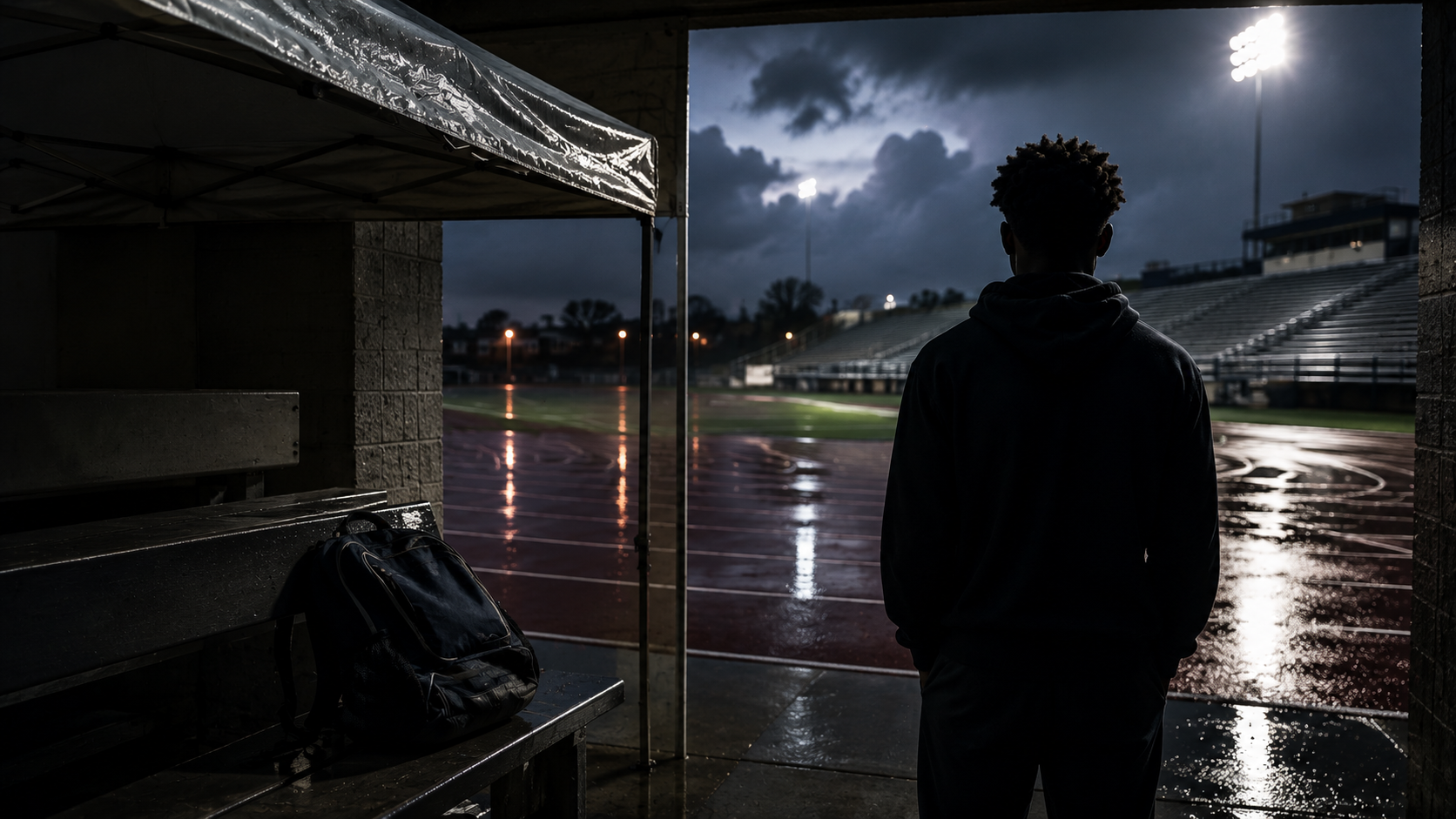
Rain is falling over David Kuykendall Stadium in Frisco, Texas. It is April second, two thousand and twenty-five, and students from several local schools are gathered for a district track meet. The weather pushes athletes towards the covered team tents in the stadium bleachers, places normally associated with waiting, joking, warming up and watching teammates compete.
Austin Metcalf is seventeen years old and represents Memorial High School. Karmelo Anthony is also seventeen and attends Centennial High School. The two teenagers are not friends and available accounts indicate they do not know one another personally. Anthony does, however, know at least one student connected to the Memorial group gathered beneath the tent.
Inside that crowded shelter, a disagreement develops over whether Anthony should remain there. The precise movements and words will eventually matter enormously, but at this moment there is no legal argument, no competing courtroom reconstruction and no verdict. There are teenagers sheltering from rain, a backpack, a team tent and an argument about who should leave.
The exchange lasts only a short time.
Understanding what happened inside that tent requires separating several things that were later repeatedly collapsed together online: what witnesses actually saw, what Anthony said immediately afterwards, what physical evidence established, what his lawyers argued, what jurors ultimately accepted and what his new lawyers are now challenging.
Austin Metcalf
Austin is a junior at Memorial High School in Frisco. His life revolves heavily around sport, particularly football. He plays linebacker, competes in track and field and has been voted the football team's most valuable player. His family describes someone ambitious enough to be thinking seriously about playing football beyond high school.
Academically, he is also performing strongly. Family accounts put his grade-point average at approximately four point zero. His father, Jeff Metcalf, says colleges have already shown interest in his football ability.
There is another relationship that matters far more than any statistic. Austin has an identical twin brother, Hunter. They grow up playing sport together, spend time outdoors with their father and share the kind of familiarity that comes from having moved through childhood side by side. Hunter also plays football at Memorial.
Austin enjoys hunting and fishing with his father and brother. Football, however, appears to dominate his ambitions. Track is partly another way of improving himself athletically: greater speed can make him a better football player.
The track meet at Kuykendall Stadium is therefore not an unusual destination for him. It is part of the ordinary rhythm of school sport.
Karmelo Anthony
Karmelo Anthony is also a student-athlete within the Frisco school system. He attends Centennial High School and competes in athletics. Contemporary accounts describe him as academically capable and involved in school sport. He has no publicly documented criminal history before the events at Kuykendall Stadium.
That absence of prior criminal history later becomes relevant during arguments about how the public should view him, but it does not answer what happens inside the Memorial tent. Character is not a substitute for evidence in either direction.
Anthony is at the stadium because of the same district athletics event. The rain matters because it changes where students congregate. Athletes who might otherwise have been spread around the stadium are seeking cover.
Trial testimony much later establishes that Anthony has previously spent time around Memorial students and knows at least one teenager under the tent. One witness says Anthony is greeted normally when he arrives. That detail becomes important because it complicates the simplistic idea that he entered a completely hostile group from the first second.
But the atmosphere does not remain relaxed.
The Memorial Tent
Accounts gathered by police begin to clarify the sequence in the days following the incident.
Anthony is beneath the Memorial High School tent in the bleachers. Austin and other Memorial athletes question why he is there and tell him to leave. The request is repeated.
Witnesses do not describe Anthony simply getting up and walking away. Instead, the verbal exchange becomes confrontational. According to the arrest affidavit and subsequent witness accounts, Anthony reaches towards or into his backpack while responding to the teenagers confronting him.
One phrase becomes central to the early police account. Witnesses report Anthony saying words to the effect of, “Touch me and see what happens.” Another version recalled during later testimony is that Anthony tells them they will have to make him leave.
At this stage, the teenagers around him do not appear to know that there is a knife in the backpack.
That matters because the same words can carry a dramatically different meaning depending on what the speaker and listener know. To those around Anthony, the argument appears to concern removing another student from a team tent. Anthony's hand inside the backpack does not immediately reveal what is there.
Witness descriptions differ slightly over precisely how physical contact begins. One says Austin touches Anthony. Others describe Austin placing both hands around Anthony's shoulder area and pushing or attempting to move him.
The differences are small enough to describe the same general confrontation but significant enough to matter later when the legal question turns to self-defence.
Anthony is still seated or low when Austin approaches in at least some witness accounts. Austin is physically larger. Later testimony places the difference at roughly fifty to sixty pounds, and the defence will place considerable emphasis on the crowded environment, Anthony's seated position and the physical disparity between them.
Then the incident changes completely.
The Knife Comes Out
When Austin makes physical contact, Anthony removes a folding knife from his backpack.
He strikes Austin once in the chest.
There is no prolonged knife attack described in the record. The central physical act is a single stab wound. That fact becomes important to both sides for different reasons: the defence later argues that Anthony reacts rapidly to a perceived physical threat, while prosecutors later argue that producing a knife against an unarmed teenager is a deliberate and grossly disproportionate escalation.
But those arguments have not yet begun. In the stadium, what matters first is that Austin has sustained an immediately serious injury.
Panic spreads through the tent.
Students move away. Hunter Metcalf is there. Emergency help is summoned. Police officers and medical personnel begin attempting to save Austin.
Anthony moves away from the tent.
The ordinary object from the opening — the backpack sitting with a teenager beneath a shelter from the rain — now has a different significance. Investigators know that a knife has come from it. They need to establish who used it, why it was used and whether the physical contact immediately beforehand can explain what happened.
The Emergency Response
First responders administer intensive aid.
Austin receives cardiopulmonary resuscitation, and emergency personnel attempt blood replacement as they work to keep him alive. He is transported from the stadium to hospital.
Despite those efforts, Austin Metcalf is pronounced dead. He is seventeen.
The wound has penetrated his chest and heart. Medical evidence later confirms the seriousness of that single injury.
Hunter has been close to the emergency unfolding around his twin. Family accounts describe Austin dying in his brother's arms during the desperate effort to save him. The exact clinical sequence belongs to the medical record, but the human reality is simpler: one twin watches emergency workers trying to save the other.
The track meet has stopped being merely a school sporting event.
Police now have a death, numerous teenage witnesses, a knife and another student still inside or around the stadium complex.
They also soon have something unusually direct from Anthony himself.
What Anthony Said To Police
Police locate Anthony and take him into custody.
According to the arrest affidavit, Anthony begins making statements before a formal interrogation develops. He acknowledges stabbing Austin. He also immediately frames what happened as an act of protection rather than an unexplained attack.
Among the statements attributed to him are “I did it” and “I was protecting myself.” The arrest record also describes Anthony reacting to language suggesting he was only alleged to have committed the act by emphasising that he had in fact done it.
That admission radically narrows one question while opening another.
Identity is not the central mystery. Anthony is not claiming someone else held the knife.
The dispute becomes why he used it.
Under Texas law, admitting an act does not automatically establish murder. A person can intentionally use force and still argue that the force was legally justified. Self-defence therefore becomes relevant almost from the beginning because Anthony himself raises the idea immediately after the incident.
Police arrest him on suspicion of murder.
He is seventeen years old.
Austin's Family Begins To Grieve
In the days after Austin's death, his family speaks publicly about who he was outside the stadium.
Jeff Metcalf describes his son as his pride and joy. Austin's academic performance, football ambitions and role as a leader are repeatedly mentioned. His family says he hoped to play college football, while those closest to him emphasise the bond between Austin and Hunter.
A memorial service is arranged for April twelfth at Hope Fellowship Frisco East. A private burial follows.
His obituary remembers sport, family, hunting and fishing rather than reducing him to a single violent encounter.
That distinction becomes increasingly important as the case expands online. Austin is rapidly turned into a symbol by people who never met him. Anthony is also turned into a symbol. The actual teenagers begin disappearing behind competing political narratives.
The Bond Fight
Anthony is initially held on a bond of one million dollars.
His lawyers seek a reduction. In April, a judge reduces the amount to two hundred and fifty thousand dollars. Anthony is subsequently released subject to restrictions that include house arrest and electronic monitoring.
Bond is frequently misunderstood in highly emotional cases. It is not a judgment about innocence, guilt or the seriousness of a death. Its purpose is principally to address whether an accused person can safely await proceedings outside custody and whether conditions can reasonably secure their appearance.
The reduction nevertheless generates anger among people who believe Anthony should remain jailed.
At almost the same time, fundraising produces another flashpoint.
The Fundraisers And The Online War
Anthony's family launches an online fundraiser to help pay for legal costs and relocation after receiving threats. The amount quickly grows into hundreds of thousands of dollars and eventually exceeds half a million dollars.
Supporters argue that a teenager facing a murder prosecution is entitled to fund an effective defence and that Anthony must remain presumed innocent unless a jury decides otherwise.
Critics interpret the donations as a celebration of Austin's death or support for Anthony personally rather than support for due process.
Those are not the same proposition, but online debate rarely preserves the distinction.
Fundraising also develops around Austin's family. The sums being donated on both sides become news in themselves, further transforming what happened between two teenagers into a national cultural argument. The crowdfunding platform eventually disables comments on prominent campaigns after what it describes as an unacceptable volume of racist and derogatory material.
Both families report threats. Anthony's family says its address has been exposed and that relocation is necessary. Austin's mother is subjected to a swatting incident.
The public conversation is no longer confined to what happened under the tent.
Why Race Became Part Of The Story
Anthony is Black. Austin is white.
That fact quickly dominates parts of the online discussion despite there being no established evidence that the confrontation itself began because of race.
Some supporters of Anthony argue that racial assumptions are affecting how he is described and judged. Some commentators opposed to him frame the case within broader political narratives about crime. Others invoke unrelated high-profile self-defence cases involving defendants of different racial backgrounds.
The result is a strange displacement. Instead of asking the narrow legal question — whether the use of deadly force in this specific confrontation was justified — thousands of strangers begin treating Anthony and Austin as representatives of racial or ideological groups.
Both sides of the eventual criminal case reject the idea that race itself caused the confrontation.
That does not mean race has no effect on public reaction. It means there is an important difference between the social debate surrounding a case and the evidence proving why an event occurred.
The distinction becomes even more important as misinformation spreads.
Fake documents circulate. Rumours about the families' finances appear. Claims about autopsy material and motives move through social media faster than official information can correct them.
The case has acquired two separate histories: what can actually be established from evidence, and what millions of people have been told online.
The Grand Jury Decision
The investigation continues through the spring.
On June twenty-fourth, two thousand and twenty-five, a Collin County grand jury indicts Anthony for murder. Court records place the case in the two hundred and ninety-sixth District Court under cause number 296-83565-2025.
An indictment is not a conviction. It establishes that the case can proceed as a felony prosecution and formally identifies the accusation Anthony must answer.
Anthony's lawyers continue to maintain that the evidence supports self-defence.
His age produces an important Texas-law consequence. Although he was seventeen at the time of the incident, Texas treats seventeen-year-olds as adults for criminal prosecution. The case therefore proceeds through the adult criminal justice system rather than a juvenile proceeding.
A trial date is eventually fixed for June first, two thousand and twenty-six.
The long interval gives lawyers on both sides months to study witness statements, police evidence, video material and the physical evidence from the stadium.
It also gives the internet months to form conclusions of its own.
The Year Between The Stadium And The Trial
Austin's family continues to memorialise him.
His absence becomes visible in moments that should have belonged to the ordinary progression of school life. In May two thousand and twenty-six, Memorial High School honours Austin at graduation. Hunter accepts a posthumous diploma for his twin after receiving his own, and the ceremony responds with a standing ovation.
Jeff Metcalf also develops the Austin Metcalf Foundation, focusing on Austin's memory and conflict resolution.
Anthony, meanwhile, prepares for trial while facing a murder charge carrying potentially decades of imprisonment.
Judge John Roach Jr. imposes restrictions intended to control an unusually intense proceeding. Cameras are barred from the courtroom. Public and media access is limited by available seating. A gag order restricts participants from publicly discussing aspects of the case.
Those rules become controversial, but their significance is not fully apparent until much later.
First, a jury has to decide what happened beneath the tent.
The Case Reaches A Jury
Jury selection begins in June two thousand and twenty-six.
The racial composition of the panel attracts attention because no Black juror ultimately sits among the twelve jurors or six alternates. The defence challenges prosecutors' removal of Black potential jurors, while prosecutors provide race-neutral explanations that the judge accepts.
The legal significance is narrower than the political reaction. A jury is not constitutionally required to contain members of every racial group, but prospective jurors cannot lawfully be removed because of race.
Opening arguments and testimony then shift attention back towards Kuykendall Stadium.
The central facts are unusually concentrated. Anthony used the knife. Austin was unarmed. Physical contact took place immediately before the stabbing. The fight lasted only moments.
The jury's job is not to determine whether Anthony stabbed Austin. It is to determine whether the killing constituted murder or whether Anthony's use of deadly force was legally justified.
What The Student Witnesses Said
Several teenagers who were beneath or near the Memorial tent testify.
Their accounts share important elements. Anthony is repeatedly asked to leave. He refuses. Verbal challenges are exchanged. Anthony has a hand in his backpack. Austin approaches him and eventually places his hands on Anthony or pushes him.
Then Anthony pulls the knife and stabs Austin.
But the testimony contains nuances.
One teenager accepts under cross-examination that Austin pushed Anthony with both hands around the shoulder area. Another describes Austin as larger and broader. A witness acknowledges that Anthony is still sitting shortly before the physical encounter.
Those details are useful to the defence because self-defence law depends heavily on what a person reasonably perceives in the seconds when force is used.
Other evidence is useful to the prosecution.
Multiple witnesses describe Anthony as provoking the confrontation rather than attempting to disengage. They recall the warnings about touching him or making him leave. Some say they saw no threat from Austin that justified a knife.
A jury cannot simply count witnesses. It has to decide which details matter most.
The Knife And The Physical Evidence
Jurors see the folding knife recovered during the investigation.
The weapon is not illegal merely because Anthony possessed it. Defence questioning establishes that the knife itself could lawfully be carried under Texas law in circumstances relevant to the case. That does not automatically answer whether possessing it at a school athletic event complied with school policy, nor does legality of possession determine legality of use.
The distinction is important.
Owning or carrying a legal knife does not give someone permission to use deadly force.
Equally, carrying a knife does not by itself prove that a later killing was planned.
The prosecution therefore has to establish Anthony's criminal intent from the confrontation itself and surrounding evidence, not merely from the existence of the weapon.
Medical testimony establishes the consequence of its use. Austin sustained a single penetrating chest wound that entered the heart. The prosecution argues that the nature and placement of the stab support an intentional act capable of causing death.
The defence does not need to dispute that the knife caused Austin's death. Its argument concerns justification.
The Self-Defence Argument
Anthony's lawyers build their case around the seconds immediately before the stabbing.
Austin is larger. Anthony is seated. The tent is crowded. Several Memorial athletes are nearby. Anthony has been confronted repeatedly and then physically pushed.
From the defence perspective, the question is what Anthony reasonably believed at that instant.
Texas self-defence law can justify force when a person reasonably believes it is immediately necessary to protect against another person's unlawful force. Deadly force requires a higher threshold. The perceived danger must justify that level of response.
That is where the prosecution sees the case completely differently.
Its argument is that Anthony helped create the confrontation. He could have left when asked. He warned others while reaching into his backpack. Austin's push was non-deadly physical force. Pulling a knife and stabbing him in the chest was therefore not a reasonable or proportionate response.
The jury must judge an event measured in seconds using testimony collected over days.
Why Anthony Did Not Testify
After the prosecution finishes presenting evidence, the defence calls only a small number of witnesses.
Attention eventually turns to whether Anthony will speak.
He does not.
A criminal defendant has an absolute constitutional right not to testify, and jurors cannot treat silence as evidence of guilt. Defence lawyers often make the decision strategically because putting a defendant on the stand exposes that person to cross-examination.
At the time, Anthony's decision not to testify appears to be part of the defence strategy. His lawyers instead rely on the statements he made immediately after the stabbing, witness testimony describing the physical contact and evidence concerning the environment under the tent.
This decision later becomes one of the most important issues in the attempt to overturn the result.
But first the jury has to decide the original case.
The Closing Arguments
The two versions of the encounter are now placed directly against each other.
The prosecution asks jurors to concentrate on Anthony's words, his refusal to leave and his decision to reach for a knife. From that perspective, Austin's shove does not transform the situation into one where deadly force becomes legally reasonable.
The defence asks jurors to put themselves in Anthony's physical position: sitting beneath a crowded opposing team's tent, confronted by a significantly larger athlete and then physically moved.
Neither side disputes that Austin touched or pushed Anthony.
The legal disagreement is about what that contact permitted Anthony to do next.
That is an important correction to one of the most common online misunderstandings of the case. The trial is not principally a contest between people who believe Anthony stabbed Austin and people who believe he did not.
Everyone knows who used the knife.
The question is whether the law excused the use of it.
The Verdict
On June ninth, two thousand and twenty-six, the jury returns its answer.
Karmelo Anthony is found guilty of murder.
The verdict means jurors reject the self-defence claim under the evidence and instructions placed before them. They are not persuaded that the stabbing was legally justified.
Anthony is now nineteen.
The same proceeding moves into punishment. Under Texas law, the offence exposes him to a lengthy prison sentence. His age, background, lack of prior criminal history and the circumstances surrounding the offence are relevant to how much punishment the jury should impose.
Austin's family has lived with his absence for more than a year.
Anthony's family now waits to learn how much of his adult life he may spend in prison.
Thirty-Five Years
The jury sentences Anthony to thirty-five years in prison.
His mother asks for mercy and speaks about her son. Austin's family addresses the consequences of what happened. The emotional symmetry is uncomfortable but unavoidable: one family has permanently lost a son, while another watches its son begin a decades-long prison sentence.
The conviction is legally significant because it settles Anthony's guilt at the trial level. It does not mean every factual dispute disappears.
The jury was not required to determine precisely what Anthony felt internally or reconstruct every movement beneath the tent with photographic certainty. It decided the narrower legal question placed before it: whether the state had proved murder beyond a reasonable doubt despite the claimed justification.
It found that the state had.
Court records record the murder conviction and thirty-five-year term.
The Case Does Not End There
Anthony files notice that he intends to appeal almost immediately.
Then, in July, a new legal team seeks a new trial.
This is different from simply asking another jury to disagree with the original jury. A motion for a new trial generally argues that something about the original proceedings was legally defective enough that the verdict should not stand without another trial.
Anthony's new lawyers raise several issues.
One concerns his decision not to testify. They argue that circumstances surrounding agreements between the original defence and prosecution effectively prevented or improperly discouraged him from exercising his right to tell the jury his own account.
Another concerns jury instructions.
Another challenges restrictions imposed during the proceedings, including public and media access.
The defence also focuses increasingly on the conduct of Judge John Roach Jr.
The Gentleman's Agreement
Post-trial filings reveal an unusual feature of the original proceedings.
Before the trial, lawyers had reached what has been described in court filings as a “gentleman's agreement” limiting certain character and background evidence that either side might otherwise attempt to introduce.
The arrangement appears designed to keep the trial focused tightly on what occurred at the track meet and avoid potentially prejudicial material.
According to the subsequent filings, the prosecution refrained from introducing certain material concerning Anthony, while the defence agreed not to introduce certain allegations or character evidence concerning Austin or Hunter. Other background material involving Anthony's upbringing was also kept outside the case presented to jurors.
Anthony's new lawyers now argue that aspects of that arrangement affected his ability to testify freely because taking the stand could have opened the door to material that had otherwise been excluded.
The prosecution disputes the claim that this deprived Anthony of a fair trial.
That disagreement matters because a defendant's decision not to testify is ordinarily treated as a highly personal and strategic choice. Overturning a verdict requires more than showing that another strategy might have been better.
The question is whether the process itself became constitutionally or legally unfair.
The Judge Gives An Interview
Two days after the trial, Judge Roach gives a television interview discussing the case.
Among the remarks that attract attention is his statement that the jurors “got it right.”
For the new defence team, that creates a problem.
Anthony still has post-trial issues that could come before the same judge. If Roach has publicly said the jury reached the correct decision, the defence argues, can he appear impartial when asked to consider whether errors in the proceedings require the verdict to be set aside?
The question is not whether Roach privately believes the jury was correct. Judges routinely form views after hearing evidence.
The issue is the public expression of that view while post-trial proceedings remain possible.
Anthony's lawyers therefore ask for Roach to be removed from deciding the motion for a new trial.
August Nineteenth
The recusal request comes before visiting Judge Sid Harle on August nineteenth, two thousand and twenty-six.
Harle does not conclude that Roach is personally incapable of acting fairly. Instead, he applies the broader legal test concerning the appearance of impartiality.
A neutral observer aware of the interview, Harle concludes, could reasonably question whether Roach should determine Anthony's request for another trial.
The motion is granted.
John Roach Jr. is removed from the post-trial proceedings.
It is a genuine legal victory for Anthony's new defence team, but it is important not to exaggerate what it means.
Roach's recusal does not overturn the murder conviction.
It does not declare Anthony innocent.
It does not decide that the original jury was wrong.
It means a different judge will determine whether the arguments raised in Anthony's motion justify a new trial.
Judge Michael Chitty is assigned to consider that question.
August Twentieth
The next hearing is set for nine a.m. Central Time on August twentieth, two thousand and twenty-six, in Collin County's four hundred and ninety-fourth District Courtroom.
The county's official case page confirms that the hearing concerns Anthony's request for a new trial. It also confirms that public-access arrangements and an overflow video room remain in place because of the exceptional interest surrounding the case.
At the time this article was checked on August twentieth, two thousand and twenty-six, reliable sources had not yet reported a final ruling on the new-trial request. The conviction and thirty-five-year sentence therefore remain in force unless and until a court grants relief.
That is the exact legal position.
A recused judge and a pending motion are significant developments.
They are not an acquittal.
What A New Trial Would Mean
If Anthony's motion is granted, the original conviction would no longer operate as the final trial-level resolution and prosecutors could potentially try the case again.
A new jury could hear substantially similar evidence under different procedural conditions. The state could again argue that the stabbing constituted murder. Anthony could again assert self-defence.
A new trial would not mean the first jury was factually proven wrong.
It would mean the legal system had concluded that the process leading to its verdict contained an error serious enough to require the question to be tried again.
If the motion is denied, Anthony can continue pursuing appellate remedies.
An appeal is also not a second jury trial. Appellate judges ordinarily examine whether legal errors occurred and whether any error was serious enough to undermine the judgment.
The distinction matters because headlines about a “fight to overturn the conviction” can create the impression that the stabbing itself is being newly disputed.
It is not.
The post-conviction battle is increasingly about how the first trial was conducted.
What The Record Cannot Prove
The public record cannot tell us with certainty exactly what Anthony felt during the seconds before he used the knife.
A statement that he was protecting himself establishes what he said, not automatically whether his belief was legally reasonable.
The record also cannot establish that Austin intended to inflict serious injury merely because he pushed or grabbed Anthony. Nor does Austin's larger size, by itself, establish that Anthony faced deadly danger.
Conversely, Anthony's refusal to leave the tent and confrontational words do not mathematically prove that he intended from the beginning to kill someone.
Those are precisely the kinds of questions jurors infer from behaviour, circumstances and evidence.
The jury made that inference against Anthony and convicted him.
Post-trial litigation concerns whether that decision was reached through a legally fair process.
Why The Case Became So Divisive
Several ingredients made the case almost perfectly designed for online polarisation.
Both teenagers were young.
Both were athletes.
The confrontation was brief.
The physical contact before the stabbing was real.
Anthony immediately invoked self-protection.
Austin was unarmed.
Anthony had a knife.
The two teenagers were of different races.
There were enormous fundraising campaigns, grieving relatives, political commentators, viral rumours and competing claims about who was being treated unfairly.
That combination encourages people to choose a side before understanding the law.
Some discussion reduced Austin to the white teenager who was killed by a Black teenager.
Other discussion reduced Anthony to the Black teenager whom supporters believed was being railroaded.
Neither description does justice to the record.
Austin was a student, twin, linebacker and aspiring college athlete whose family lost him at seventeen.
Anthony was a seventeen-year-old student-athlete with no prior criminal record who made a decision during a brief confrontation that a jury ultimately found constituted murder and punished with thirty-five years in prison.
Both truths can exist without cancelling the other.
The Question At The Centre Of The Case
Strip away the fundraising totals, racial arguments, political commentary and internet misinformation and the case becomes remarkably narrow.
Anthony was told to leave a tent.
He resisted.
Austin physically confronted him.
Anthony used a knife.
The legal system then had to decide whether that final act was a justified response to the threat Anthony faced.
The original jury said no.
That answer produced a murder conviction.
Now Anthony's lawyers are asking a different question: whether the jury that reached that answer did so inside a trial process sufficiently fair to withstand constitutional and procedural scrutiny.
That is why the case remains alive more than a year after the track meet.
Austin Beyond The Case
The legal fight can easily dominate the story because legal proceedings generate documents, hearings and headlines.
Austin does not get to participate in any of them.
His family has tried to preserve something separate from the prosecution: the ordinary person who existed before strangers began searching his name online.
The Austin Metcalf Foundation describes him as a son, twin brother, student, athlete and teammate. It has promoted conflict resolution as part of the legacy attached to his name.
That focus matters.
True-crime coverage can accidentally transform the person who died into little more than evidence against someone else.
Austin's significance is not limited to the wound described by a medical examiner or the physical movement reconstructed by witnesses.
His life existed independently of the case.
The Backpack Under The Tent
The most important objects in major criminal cases are often painfully ordinary.
Here there is no elaborate crime scene and no long chain of mysterious forensic discoveries.
There is a team tent protecting teenagers from the rain.
There is a backpack on or beside a student.
There is a folding knife inside it.
There is an argument over whether that student should leave.
Everything the legal system has spent more than a year analysing comes back to a few seconds around those objects.
The original jury decided what those seconds meant under Texas murder and self-defence law.
Anthony's lawyers are now challenging whether the process that produced that decision was fair enough to stand.
As of August twentieth, two thousand and twenty-six, that is where the Karmelo Anthony and Austin Metcalf case remains: not an unsolved mystery about who held the knife, but an evolving legal dispute about justification, proportionality, trial fairness and whether one moment beneath a rain-soaked school tent was judged correctly the first time.
