True Crime: Madeleine McCann - The Evidence, The Suspect And The Questions That Still Won't Go Away
What Does The Evidence Really Show?
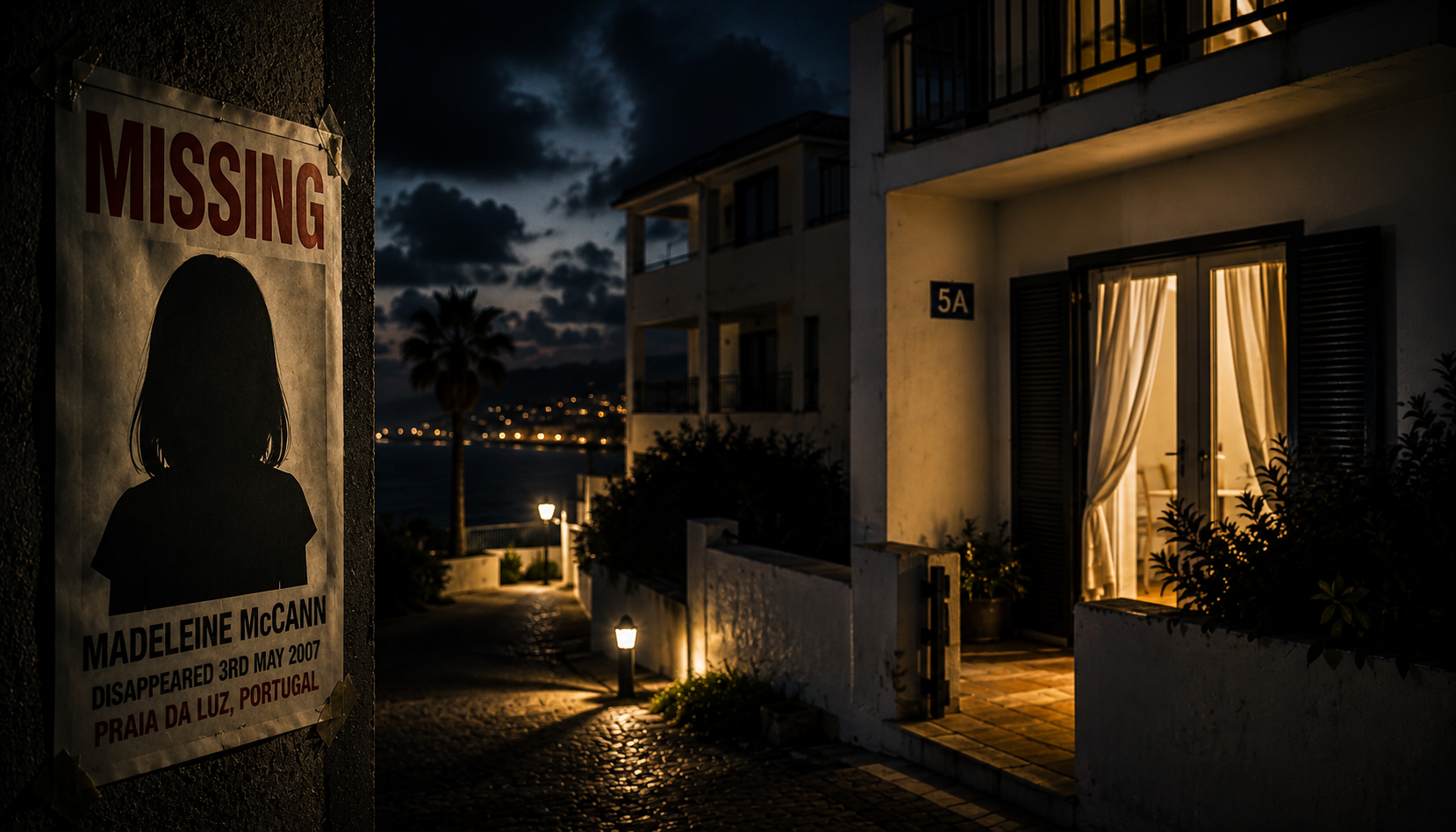
What Happened In Apartment Five A?
Praia da Luz is a small Algarve resort built around low-rise apartments, whitewashed villas and roads leading down towards the Atlantic. In early May two thousand and seven, it is busy enough to feel like a holiday destination but quiet enough for families to settle into routines quickly. Among them are Kate and Gerry McCann and their three young children, staying at the Ocean Club resort.Madeleine is three years old, a few days short of her fourth birthday. She is on holiday with her parents and her younger twin siblings, Sean and Amelie. Their apartment, numbered five A, sits on the ground floor close to the edge of the complex. In the evenings, the adults in the group eat at a tapas restaurant while periodically returning to check on the sleeping children.
On the evening of Thursday, the third of May, that routine begins again. The children are put to bed. The adults gather for dinner nearby. Checks are made during the evening. Nothing about the arrangement yet tells the people around that table that one particular interval of time is about to become one of the most scrutinised periods in modern missing-person history.
Shortly after ten o'clock, Kate McCann returns to apartment five A. Madeleine is not there.
There is no immediate explanation that accounts for where she has gone. Within minutes, people begin searching the resort. Within hours, police are involved. Before long, the image of a small girl with distinctive colouring in one eye is travelling around the world.
The question is initially simple: where is Madeleine?
Nineteen years later, the investigation has accumulated witnesses, search operations, phone records, forensic controversies, competing theories and a German suspect whom prosecutors say they believe was responsible. Yet Madeleine has never been found, and no person has been charged over her disappearance.
The McCann Family Arrives In Praia Da Luz
Kate and Gerry McCann are doctors living in Rothley, Leicestershire. Their holiday group includes several other families, and the Ocean Club offers the kind of self-contained environment designed to make travelling with young children easier. During the days, the adults use resort facilities while the children attend activities and spend time together.
The family's apartment is significant because it is not isolated inside a locked hotel corridor. Apartment five A is accessible from the street side of the complex. The tapas restaurant used by the group is nearby, but it is not inside the apartment building itself.
During the holiday, the adults develop a system of checking on their children while eating. Exactly who checked which apartment, at what time, and what each person noticed becomes increasingly important once investigators begin reconstructing the evening.
For now, however, the arrangement is simply part of the group's routine.
On Thursday, the third of May, the McCann children spend the day around the resort. By evening, Madeleine and the twins are in the apartment and the adults prepare to dine together again.
The Evening Begins
The adults gather at the tapas restaurant at roughly half past eight. The children have been left sleeping in their respective apartments, and members of the group intend to return periodically to check them.
Gerry McCann makes one of the checks at approximately five past nine. He enters apartment five A and sees the children. Madeleine appears to be asleep. He then leaves and encounters another holidaymaker outside, stopping briefly to speak with him.
That conversation becomes relevant because another member of the group, Jane Tanner, is also walking through the area.
At around a quarter past nine, Tanner notices a man crossing a road near the apartment complex carrying a young child. She describes the child's clothing as similar to the pyjamas Madeleine is wearing. At the time, the sighting appears potentially important. If the child is Madeleine, it could place somebody carrying her away from the apartment shortly after Gerry's check.
Investigators do not yet know whether that interpretation is correct.
Another member of the group, Matthew Oldfield, checks the McCann apartment later. His observation is less complete. He does not establish visually that Madeleine is in her bed.
The window of uncertainty is beginning to narrow.
The Ten O'Clock Check
At around ten o'clock, Kate returns to apartment five A.
Madeleine is missing.
The immediate response is not a carefully controlled police operation. It is confusion, searching and alarm. Friends and staff begin looking around the complex and surrounding streets. Police are contacted.
The physical state of the apartment quickly becomes part of the story. Questions emerge about doors, windows and shutters, about which entrances had been used by the family and whether somebody could have entered unnoticed.
But the first priority is simpler: find the child.
Police initially work on the possibility that Madeleine may still be nearby. Searches spread through Praia da Luz. Streets, open areas and properties are examined. Staff and residents are questioned.
On the fifth of May, investigators publicly indicate that they believe Madeleine could still be alive and might be being held relatively close to the resort. Two days after she disappeared, police say hundreds of incidents and pieces of information are already being examined.
None provides the answer.
A Search Becomes International
The disappearance rapidly moves far beyond Portugal.
Madeleine's photograph appears across Europe. Her parents appeal publicly for information. Travellers are asked to remember anything unusual they may have seen in Praia da Luz. Claimed sightings arrive from multiple countries.
The volume of information presents its own problem. A high-profile missing-child investigation can generate thousands of sincere but mistaken reports alongside speculation, rumours and deliberate falsehoods.
Kate and Gerry travel to keep attention on the search. Their campaign reaches politicians, celebrities and international audiences.
Meanwhile, investigators in Portugal continue examining what happened inside and around apartment five A.
The case has no confirmed abduction scene, no identified abductor and no verified route out of Praia da Luz.
That absence will shape almost everything that follows.
Robert Murat Becomes A Formal Suspect
On the fourteenth of May, Portuguese investigators search the nearby home of Robert Murat, a British-Portuguese man living close to the Ocean Club.
Murat had become involved around the investigation and had helped with translation. Police now examine whether he might know more about Madeleine's disappearance than he has said.
He is given formal suspect status under Portuguese law.
The development produces intense attention, but investigators do not establish that Murat took Madeleine. No prosecution follows.
The inquiry keeps moving.
The crucial difficulty remains unchanged: Madeleine has disappeared from an apartment, but investigators have not established how.
The Apartment Comes Under Greater Scrutiny
As the initial search produces no recovery, attention turns increasingly towards forensic examination.
Specialist British dogs are brought into the inquiry during the summer. One is trained to alert to human blood; another is trained to detect the scent associated with human decomposition.
The dogs produce alerts at locations connected with the case, including inside apartment five A and around a vehicle hired by the McCanns after Madeleine disappeared. Samples are collected and submitted for laboratory analysis.
This becomes one of the most misunderstood parts of the entire case.
A dog alert is not equivalent to identifying a particular person's remains. It can guide investigators towards an area requiring examination, but it does not independently establish who produced a scent, when it was deposited or what event caused it.
The laboratory results also fail to provide the clean forensic conclusion that public speculation often assigns to them.
Some biological material produces partial or mixed profiles. The material does not establish that Madeleine's body had been inside the hired vehicle, nor does it prove that her parents concealed her death.
Yet by late summer, the direction of the Portuguese investigation is changing.
Kate And Gerry McCann Become Arguidos
In September two thousand and seven, Portuguese police formally question Kate and Gerry and give both arguido status.
An arguido is a formal suspect under Portuguese criminal procedure. It provides legal protections as well as indicating investigative suspicion. It does not mean a person has been charged or convicted.
The development radically alters the public atmosphere around the case.
Instead of an investigation focused entirely on an unknown outside offender, one strand is now testing whether Madeleine might have died accidentally in the apartment and whether her parents could have concealed what happened.
Kate and Gerry deny involvement.
The theory faces substantial practical problems. Any concealment scenario must explain when a death occurred, where Madeleine's body was placed, how it was moved without detection, how the parents maintained their public behaviour while surrounded by friends, police and international attention, and why no remains or conclusive forensic evidence emerged.
Investigators do not assemble sufficient evidence to charge them.
The McCanns return to Britain with the twins.
The investigation continues, but its momentum is weakening.
The First Portuguese Investigation Ends
On the twenty-first of July two thousand and eight, Portuguese authorities archive the investigation.
The arguido status of Kate and Gerry McCann and Robert Murat is lifted.
The prosecution's conclusion is important because it is frequently obscured by later internet theories. Investigators had explored the possibility of parental involvement, but they had not established evidence sufficient to show that the McCanns caused Madeleine's disappearance. No charges are brought against them.
That does not solve the case.
It simply removes one investigative status without answering the original question.
Madeleine remains missing.
Britain Starts Again
Years pass, but the case does not disappear.
In two thousand and eleven, the Metropolitan Police establishes Operation Grange. Its initial task is to review the enormous quantity of material gathered by previous investigations. The review eventually develops into its own investigation.
Detectives reconsider witness statements, timelines, sightings and people who had been in and around Praia da Luz.
The scale is substantial. Investigators process thousands of documents and examine hundreds of potential persons of interest and sex offenders.
One of the most significant changes concerns the sighting made by Jane Tanner shortly after nine o'clock on the evening Madeleine disappeared.
For years, the man Tanner saw carrying a child had appeared to offer a possible image of an abductor.
Operation Grange eventually identifies another explanation.
The Tanner Sighting Changes Meaning
British detectives trace a holidaymaker whom they believe Tanner saw.
He had collected his own child from a resort night crèche and was carrying her home. Investigators photograph him in clothing similar to that described by Tanner and establish that his daughter's pyjamas were compatible with what Tanner remembered seeing.
Detectives conclude they are almost certain Tanner's sighting is unrelated to Madeleine's disappearance.
The implications are substantial.
If the man was simply another parent, the disappearance does not necessarily need to have occurred before approximately a quarter past nine.
The usable timeline expands.
Another sighting now receives greater attention.
The Smith Family Sighting
Later that evening, members of the Smith family, visiting Praia da Luz from Ireland, encounter a man carrying a young child through the town.
The sighting occurs closer to ten o'clock.
Unlike Tanner's observation, Operation Grange does not identify the person the Smith family saw.
That does not prove the child was Madeleine. Nor does it prove that the man was responsible for her disappearance.
But once Tanner's sighting is largely removed from the central timeline, the Smith sighting acquires greater potential importance.
British investigators reconstruct the evening again.
The window during which Madeleine could have disappeared is now broader than previously believed.
It also becomes possible that an offender had observed the apartments before acting.
Was Apartment Five A Being Watched?
Operation Grange identifies accounts of unfamiliar men seen near the McCann apartment block during the days surrounding the disappearance.
Some witnesses describe people apparently watching the building. Others recall unusual approaches to properties in the area.
British investigators publicly consider whether an abduction could have involved prior reconnaissance. On one reading of the evidence, detectives say, the event has characteristics consistent with planning.
This introduces another possibility.
Perhaps the McCanns were not individually targeted.
Holiday apartments can attract burglars because visitors carry cash, cameras and valuables. An offender familiar with the resort might also understand staff routines, access points and when apartments were likely to be empty.
A burglary interrupted by the presence of a child becomes one line worth examining.
So does deliberate child abduction.
Neither can be proven.
Portugal Reopens The Investigation
In October two thousand and thirteen, Portuguese authorities reopen their inquiry after new information emerges.
The British investigation is also generating fresh appeals and renewed scrutiny of the timeline.
Searches follow.
In two thousand and fourteen, British officers conduct extensive ground searches around Praia da Luz. Areas of scrubland are examined. Specialist equipment is used.
Again, there is no discovery that resolves the disappearance.
By now, investigators have accumulated an extraordinary quantity of information.
What they still lack is the thing that matters most: a direct evidential bridge between Madeleine and a specific offender.
Then, more than thirteen years after she disappeared, investigators in Germany announce a development that changes the direction of the case again.
A German Investigation Emerges
In June two thousand and twenty, German authorities reveal that they are investigating a German man in connection with Madeleine's disappearance.
The man is Christian Brueckner.
He had lived for periods in the Algarve and had connections to Praia da Luz. German investigators say telephone data places his mobile phone in the wider Praia da Luz area on the evening Madeleine disappeared. A call involving his phone lasted for roughly half an hour around the relevant period.
Investigators appeal for information about both numbers involved in the call, his vehicles and his movements.
One vehicle draws particular attention: a Volkswagen camper van associated with Brueckner. Another is a Jaguar that was transferred into another person's name shortly after Madeleine disappeared.
None of those facts independently proves involvement.
But investigators are no longer dealing simply with an unidentified theoretical offender.
They now have a named man whose movements, communications and history can be examined.
Who Is Christian Brueckner?
Brueckner spent considerable periods in Portugal and lived in the Algarve during the years surrounding Madeleine's disappearance.
His established criminal history includes sexual offending. Most significantly, he was convicted in Germany of raping a seventy-two-year-old woman in Portugal in two thousand and five, in the same Algarve region. He received a seven-year prison sentence.
That conviction matters when explaining why investigators examine him. It does not prove that he harmed Madeleine.
The distinction is essential.
A person's criminal history can make an investigative hypothesis more plausible, but propensity is not the same thing as evidence establishing responsibility for a separate offence.
German prosecutors nevertheless go considerably further than simply calling Brueckner someone worth investigating.
They announce that they believe Madeleine is dead and that they suspect Brueckner of killing her.
The McCanns do not adopt that conclusion. They continue to seek definitive answers and have repeatedly said they have not abandoned hope of finding Madeleine.
Brueckner denies any involvement.
What Actually Links Brueckner To The Case?
This is where the difference between a compelling suspect and a prosecutable case becomes critical.
The publicly established connection begins with geography. Brueckner knew the Algarve, had lived around Praia da Luz and was in the region during the relevant period.
Telephone data places his phone in the Praia da Luz area on the evening of the disappearance. Investigators have also examined his vehicles and properties.
German prosecutors have repeatedly indicated that they possess evidence they regard as significant but have not disclosed all of it publicly.
That creates an unusual information gap.
The authorities responsible for investigating Brueckner say their confidence is greater than the evidence available to the public would appear to justify.
Yet confidence inside an investigation and admissible proof capable of sustaining a prosecution are different standards.
In January two thousand and twenty-five, the German prosecutor leading the investigation acknowledged that there was no immediate prospect of charging Brueckner in the McCann case.
That admission defines the central problem.
Investigators may believe they know what happened.
They have not publicly demonstrated that they can prove it.
The Alleged Statements And Witness Evidence
Several witnesses connected with Brueckner have attracted investigative attention.
One former acquaintance has claimed Brueckner made a disturbing remark during a conversation about Madeleine. Such accounts have been treated as potentially significant, but they remain witness evidence rather than a recorded confession.
That distinction is particularly important because credibility became a central issue in separate proceedings involving Brueckner.
In two thousand and twenty-four, he was tried in Germany over allegations of unrelated sexual offences said to have occurred in Portugal.
He was acquitted.
The presiding judge criticised weaknesses in the evidence and raised serious concerns about the reliability of some witnesses, including the possibility that exposure to extensive media coverage had affected accounts. German prosecutors appealed the acquittals.
The acquittal did not relate to Madeleine.
But it demonstrated something investigators already understood: a disturbing allegation and a prosecutable allegation are not the same thing.
The Searches Move Towards Brueckner's World
Investigators continue testing locations associated with the German theory.
In May two thousand and twenty-three, Portuguese authorities, assisted by German officers, search around the Arade reservoir in the Algarve.
The reservoir had connections with Brueckner's movements and had attracted investigative interest before.
The operation produces no publicly announced breakthrough.
Two years later, investigators return to Portugal.
This time, the search is extensive and explicitly connected to the German investigation into Brueckner.
The June Two Thousand And Twenty-Five Search
At the beginning of June two thousand and twenty-five, Portuguese police execute a European Investigation Order requested by German authorities.
The operation covers locations in the municipality of Lagos. Portuguese authorities state formally that the German investigation concerns a German citizen suspected of killing Madeleine McCann.
Any evidence seized is to be transferred to the German Federal Criminal Police Office subject to the appropriate Portuguese authorisation.
Teams search land and abandoned structures in areas between Praia da Luz and locations associated with Brueckner.
The operation involves specialist search methods and excavation.
Once it ends, German prosecutors issue an unusually restrained statement.
The search has been completed as planned.
They will not disclose the results.
That silence inevitably produces speculation.
It does not establish that investigators found incriminating evidence.
Nor does it establish that the search failed.
The official position is simply that its results are not being made public.
Brueckner Leaves Prison
The investigation then reaches a practical deadline.
Brueckner is still imprisoned because of his conviction for the unrelated two thousand and five rape. That sentence, however, is finite.
On the seventeenth of September two thousand and twenty-five, he is released from prison in Germany after completing it.
Authorities do not have a McCann-related charge capable of keeping him detained.
Conditions imposed after his release include electronic monitoring.
For investigators, the significance is obvious.
The man German prosecutors have publicly identified as their central suspect is no longer incarcerated.
And still, no Madeleine McCann charge exists.
The British Case Intensifies Again
During two thousand and twenty-six, another potentially important development emerges.
British detectives are reported to be working towards assembling a case capable of being considered for prosecution against Brueckner. The possibility of bringing him to Britain is explored, though extradition presents complex legal difficulties because Brueckner is a German citizen and Britain is no longer an EU member state.
The crucial point remains unchanged: this is investigative work, not a charge.
No British court has found that Brueckner abducted Madeleine.
No German court has found that he killed her.
No Portuguese court has established his involvement.
He continues to deny responsibility.
The Evidence Against Brueckner: Stronger Than A Coincidence, Weaker Than A Conviction
The public case against Brueckner can be separated into several layers.
First is opportunity. He knew Praia da Luz and was in the Algarve.
Second is geographical and telecommunications evidence. His phone was active in the relevant area on the evening Madeleine disappeared.
Third is his established criminal history, including the rape committed in the Algarve and previous offences involving children.
Fourth are witness allegations concerning things he allegedly said.
Fifth is material and information obtained by German investigators that has not been fully released.
Sixth is the continued focus of major German-led searches in locations connected to him.
Taken together, these elements explain why investigators have devoted years to examining him.
But several essential pieces are publicly absent.
There is no disclosed DNA result connecting Brueckner to Madeleine.
There is no publicly established fingerprint linking him to apartment five A.
There is no recovered possession conclusively shown to have belonged to Madeleine.
There is no publicly verified CCTV image of him taking her.
There is no body.
There is no confession accepted by investigators as definitive proof.
There is no charge.
That does not make the German theory wrong.
It demonstrates why the distinction between suspicion and proof matters so much.
Documented Behaviour
Brueckner's established record provides legitimate context but must be used carefully.
He was convicted of the rape of an elderly woman in Portugal, an offence committed in the Algarve approximately two years before Madeleine disappeared. He has also accumulated other convictions.
Those facts establish that he was capable of serious offending.
They cannot establish that he committed this particular crime.
The legitimate behavioural question is therefore not whether his history makes him seem capable of abducting Madeleine. Many people are capable of offences they never commit.
The relevant question is whether his documented movements, communications, access, behaviour and other evidence connect him to this disappearance strongly enough to move beyond propensity.
So far, the public record does not provide a complete bridge.
What Qualified Experts And Courts Have Said
The separate German proceedings against Brueckner provide an important warning against reverse-engineering guilt from reputation.
When he was acquitted of unrelated sexual-offence allegations in October two thousand and twenty-four, the court found the evidence insufficient and criticised the reliability of witnesses. Prosecutors disputed that assessment and sought review.
That does not weaken his existing rape conviction.
It does show why evidence must be tested allegation by allegation.
What Can Reasonably Be Inferred
German investigators appear genuinely convinced that Brueckner is central to the McCann case. Their repeated searches, public statements and continued investigative commitment make it difficult to dismiss the theory as a casual lead.
It is also reasonable to infer that some evidence remains undisclosed, because prosecutors have explicitly indicated that their assessment relies on information they cannot reveal publicly.
What cannot reasonably be inferred is that undisclosed evidence must therefore be decisive.
If it were already sufficient to support the required legal process, the absence of charges becomes harder to explain.
The more cautious interpretation is that investigators possess material they find persuasive in combination but still face evidential gaps.
What Cannot Be Known
The public cannot responsibly diagnose Brueckner's personality or infer his guilt from photographs, demeanour, previous convictions or descriptions of his lifestyle.
Nor can anybody outside the investigation know precisely how strong the unreleased German evidence is.
A disturbing criminal history can explain why police investigate somebody intensely.
Only evidence specific to Madeleine can establish whether that investigation has reached the right person.
Why The Early Investigation Still Matters
Almost every modern theory eventually collides with decisions made during the first hours and days.
A crime scene is most valuable before it has been contaminated.
Witness memory is strongest before witnesses discuss events repeatedly with others.
CCTV is easiest to recover before systems overwrite recordings.
Vehicles can move.
People can leave.
Physical traces degrade.
Praia da Luz was not sealed off as though investigators already knew precisely what type of crime had occurred because they did not.
The initial event was a missing child report with several possible explanations.
That uncertainty was understandable.
Its consequences may have been permanent.
If an outsider entered apartment five A and removed Madeleine, the best opportunity to capture trace evidence, identify movements and preserve nearby records existed immediately.
Nineteen years later, almost every new investigative avenue has to work around what was not preserved then.
The McCanns And The Persistence Of Suspicion
Despite the lifting of their arguido status in two thousand and eight, theories accusing Kate and Gerry have never disappeared.
Part of the reason is structural.
When a child vanishes from an apartment without a confirmed abductor, people naturally examine those closest to the child.
The Portuguese police did exactly that.
Another reason is the forensic-dog evidence, which has often been presented online without the limitations attached to it.
But suspicion is not evidence simply because it persists.
The first investigation had the power to pursue the McCanns. It questioned them, examined forensic material and tested theories involving them.
It did not produce charges.
Portuguese authorities closed that stage of the investigation and removed their suspect status.
Any claim that parental guilt has been established therefore goes beyond the evidence.
The Most Important Unanswered Questions
The first unanswered question is still the largest: what happened between the last reliable observation of Madeleine in apartment five A and the discovery that she was missing?
The second concerns entry and exit. Did somebody enter through an unlocked door, another access point or by some method never conclusively reconstructed?
The third concerns the Smith sighting. Who was the man carrying a child through Praia da Luz later that evening?
The fourth concerns Brueckner's phone. Precisely where was he when the relevant call occurred, who was on the other end and what, if anything, did the conversation have to do with Madeleine?
The fifth concerns the German evidence. What do prosecutors possess that has given them such confidence while apparently remaining insufficient for a charge?
The sixth concerns the repeated searches. Were they directed by specific intelligence, broader geographical reasoning or information supplied by witnesses?
And the final question is the one every investigative theory must ultimately answer.
Where is Madeleine?
What The Record Cannot Prove
The open record cannot prove that Madeleine left apartment five A voluntarily.
It cannot prove that an unknown intruder abducted her.
It cannot prove that the Smith family saw her being carried away.
It cannot prove that her parents caused her disappearance.
It cannot prove, from the evidence publicly available, that Christian Brueckner removed her from the apartment.
German prosecutors have stated their own stronger conclusion, but an investigative belief is not a judicial finding.
The absence of a body does not mean a homicide is impossible.
The absence of a charge does not mean a suspect is innocent of the underlying event.
But neither absence can be filled with certainty created by speculation.
That is why the McCann case remains unusually resistant to resolution.
It contains numerous pieces that can be assembled into plausible stories.
None has yet produced an answer capable of closing the case.
Nineteen Years Later
On the nineteenth anniversary of Madeleine's disappearance in May two thousand and twenty-six, her family again states that the search continues and that they will not give up.
Operation Grange remains listed by the Metropolitan Police as ongoing. The Portuguese missing-person database continues to list Madeleine Beth McCann. German authorities continue to regard Brueckner as their suspect.
Brueckner is out of prison after completing his unrelated sentence.
He has not been charged with Madeleine's disappearance.
Madeleine has not been found.
The case is therefore suspended between two radically different possibilities.
German investigators may have identified the right man but lack the final evidence required to prove it.
Or investigators may have spent years constructing an increasingly persuasive circumstantial case around a man whose presence in the Algarve, criminal history and movements make him an obvious suspect but do not ultimately explain what happened inside apartment five A.
Until evidence separates those possibilities, neither can responsibly be presented as the ending.
The most remarkable feature of the case is no longer simply its longevity. It is how much investigative activity has occurred without producing the one fact capable of reorganising everything around it.
A child disappeared.
Witnesses saw fragments.
Investigators built theories.
Forensic evidence generated arguments rather than certainty.
Suspects emerged and disappeared.
One suspect now dominates the investigation.
And yet the bedroom in Praia da Luz remains the centre of the story because every theory must eventually return there.
At around ten o'clock on the third of May two thousand and seven, Kate McCann went back into apartment five A and found one bed empty.
Nineteen years of investigation have followed.
The question created in that room has never been answered.
