True Crime: The Scream Murder - Cassie Jo Stoddart And The Night The Power Went Out
Inside The 2006 Idaho Investigation
The House, The Camera And The Missing Hours
In September two thousand and six, a house on Whispering Cliffs Drive outside Pocatello, Idaho, offers Cassie Jo Stoddart something ordinary: a weekend responsibility. The sixteen-year-old is staying there while relatives are away, looking after the property and pets. There is nothing inherently remarkable about the arrangement. It is the kind of favour families entrust to teenagers every weekend.
On Friday evening, September twenty-second, Cassie has company. Her boyfriend, Matt Beckham, is there. Two classmates, Torey Adamcik and Brian Draper, also arrive. They are all teenagers, and for a while the evening follows an uncomplicated pattern: talking, spending time together and watching a film.
Then Adamcik and Draper say they are leaving. Roughly fifteen minutes after their departure, the electricity goes out. The interruption is strange enough to notice but not, by itself, enough to explain anything. Matt phones his mother and asks whether he can stay overnight. She says no.
Later, Matt leaves too. By the following day, he is trying to contact Cassie. His calls are not being answered.
At this point there is still no police theory, no recovered evidence and no explanation for the silence. There is only a quiet house, a telephone that keeps going unanswered and a Friday night whose apparently ordinary details are beginning to matter.
Cassie Jo Stoddart Before The Case
Cassie is sixteen and attends Pocatello High School. Accounts from the period describe a teenager embedded in the normal routines of school, friendships, family and a new relationship. She and Matt Beckham are dating, and the evening at Whispering Cliffs is meant to be social rather than secretive or unusual.
That distinction matters. True-crime retellings can make every ordinary detail appear sinister once the ending is known. The chronology does not allow that shortcut here. When Cassie agrees to house-sit, there is no reason for her to treat the residence as dangerous. When friends visit, there is no reason for her to understand the evening as anything beyond teenagers spending time together.
Brian Draper and Torey Adamcik are also sixteen. They know Cassie through school. Their presence therefore does not automatically create alarm. Matt knows them as well, and the four teenagers spend part of the evening together.
The house itself is significant because of its relative isolation and because Cassie is temporarily responsible for it. Yet that significance only develops as the events unfold. On Friday afternoon, it is simply the place where she is staying.
Two Classmates And A Video Camera
Away from Cassie, another thread has been developing.
Around the end of August, according to the later-established record, Adamcik contacts eighteen-year-old Joe Lucero and asks whether he will buy knives for him. Lucero accompanies Adamcik and Draper to a pawn shop. Draper supplies most of the forty-five dollars used for the purchase, while both teenagers participate in selecting the knives.
There is also a video camera.
Adamcik and Draper have started recording themselves talking about violence. At this stage, those recordings are not known to Cassie, her family or investigators. They exist privately, forming part of a world the two teenagers are constructing between themselves.
The night before Cassie is house-sitting, that camera records increasingly specific conversations. The teenagers talk about becoming notorious, killing people and avoiding capture. They travel towards another girl's home and discuss whether she might be alone. When that possibility does not develop as they hope, their conversation moves elsewhere.
Eventually Cassie and Matt enter the discussion.
The recording is important not because teenagers making disturbing jokes automatically proves that they intend to act on them. It is important because the language grows operational. They discuss checking whether people are alone, entering houses, creating distractions and attacking people who come to investigate.
At one point Draper tells the camera that they want to be like Scream, but in real life. The reference eventually gives the case its enduring public label. The larger evidential significance, however, lies less in the name of a horror film than in the specificity of the plans being spoken aloud.
The Night Before Whispering Cliffs
On Thursday, September twenty-first, the recordings continue.
The two teenagers drive around discussing potential targets. Their conversation shifts between dark humour, grandiosity and increasingly explicit talk of violence. They speak about becoming famous and about committing more than one killing.
Then Cassie's name appears.
The recording captures a discussion about going to see whether Cassie and Matt are alone. The teenagers talk about leaving and returning, getting into the house, making a noise and drawing Matt outside.
A little later, Draper identifies Cassie by name as their intended first target. The conversation is no longer merely about an unidentified hypothetical person.
The court record ultimately treats these recordings as important evidence of planning. But Cassie knows none of this on Friday. The chronological divide is stark: on one side, a teenager accepting visitors she knows; on the other, two classmates recording conversations she has never heard.
That divide is essential to understanding what happens next.
Friday Evening At The House
On September twenty-second, Cassie is staying at the Whispering Cliffs residence as part of her house-sitting duties. Matt is with her.
Adamcik and Draper arrive at approximately six-thirty or seven p.m. The four spend roughly two hours together. The evening is social enough that later investigators can reconstruct who was present and approximately when people came and went.
Eventually Draper says he needs to leave. He and Adamcik depart.
But another segment of their video is time-stamped at approximately nine-fifty-three p.m. Both teenagers are sitting in a car in darkness. Draper says the house is down the street. He talks about the doors and places to hide. Most importantly, he says that he has left doors unlocked.
The meaning of the earlier visit changes with that recording. It was not merely an opportunity to socialise. According to their own words, they had inspected the property and deliberately created a way back inside.
At the house, meanwhile, the power goes out roughly fifteen minutes after the pair have ostensibly left.
Matt telephones his mother and asks for permission to stay overnight. His request is denied. He then phones Adamcik and tells him that he will be going home.
Matt later recalls something unusual about the call: Adamcik is speaking in a whisper and says he is at a movie.
Matt has no reason at that moment to know whether this detail matters.
Eventually he leaves Cassie at the house.
The Calls That Went Unanswered
The next day, Matt spends time with Adamcik.
He also repeatedly tries to telephone Cassie.
There is no answer.
An unanswered phone can mean almost anything. A person can be asleep, busy, away from the handset or simply unwilling to talk. In two thousand and six, before smartphones made constant availability seem normal, silence alone does not immediately establish an emergency.
But the calls continue to fail.
The circumstances also contain another unresolved detail. Adamcik and Draper have said they went to see a movie after leaving the house. Matt has already spoken to Adamcik during the night and remembers him whispering while claiming to be at the cinema.
Nothing yet explains why Cassie is not answering.
On Sunday, September twenty-fourth, the owners return to the Whispering Cliffs residence.
The uncertainty ends.
The Discovery Inside The House
Cassie is found inside.
Police and paramedics respond. They confirm that she is dead.
The investigation has now changed completely. What had been an unanswered telephone and a silent house becomes a homicide scene. Officers observe extensive injuries, and the people who were with Cassie on Friday evening immediately become important to reconstructing the timeline.
Cassie is sixteen years old.
The medical examination the following day establishes the physical scale of the attack. Dr Steve Skoumal documents approximately thirty knife-related wounds, with twelve considered potentially fatal. The cause of death is determined to be stab wounds to the trunk. Further forensic examination identifies evidence consistent with at least two different blades: one serrated and one non-serrated.
Those findings will eventually matter greatly. For the detectives beginning work on Sunday, however, the first task is simpler: determine who was in the house, who left, when they left and what happened after that.
Matt can provide part of the answer.
He tells investigators about the two classmates who visited earlier that evening.
Police now need to speak to Brian Draper and Torey Adamcik.
The Movie Story
Detectives contact the teenagers on Sunday.
Adamcik tells investigators that he and Draper went to the Whispering Cliffs house for a party. When it became apparent that there would be no party, he says they left and went to see a movie in Pocatello.
There is a problem when detectives ask about the film.
Adamcik cannot adequately describe it.
Draper gives a similar account. He says that they had planned to watch one film but were too late, so they watched Pulse instead. When questioned about what happened in the movie, he also struggles to explain the plot.
A false or poorly remembered movie story does not by itself prove participation in a killing. It does, however, create an obvious investigative question. If the teenagers did not spend the relevant period in a cinema, where were they?
That question begins pulling detectives away from the original alibi.
Further interviewing exposes additional inconsistencies. The teenagers' movements include a convenience store and a trip towards Black Rock Canyon. Their explanations are becoming harder to reconcile with the emerging record.
Then the investigation makes its decisive physical breakthrough.
Black Rock Canyon
On September twenty-seventh, Brian Draper leads law enforcement to a concealed cache in the Black Rock Canyon area.
Investigators recover multiple knives, dark clothing, gloves, masks, matches, partially burned papers, a container associated with hydrogen peroxide and a homemade Sony videotape. Some of the material has been burned or partially damaged.
Among these objects is the tape.
For detectives, its significance is extraordinary. Evidence normally requires interpretation: fingerprints need comparison, statements need verification, timelines need reconstruction. Here, the investigation has recovered a recording made by the two teenagers themselves.
The tape does not run in straightforward chronological order, but its time stamps allow investigators and, eventually, the courts to reconstruct important sections.
It contains the conversations from before Cassie's night at Whispering Cliffs.
It contains the planning.
It contains her name.
And it contains another recording, made after the attack.
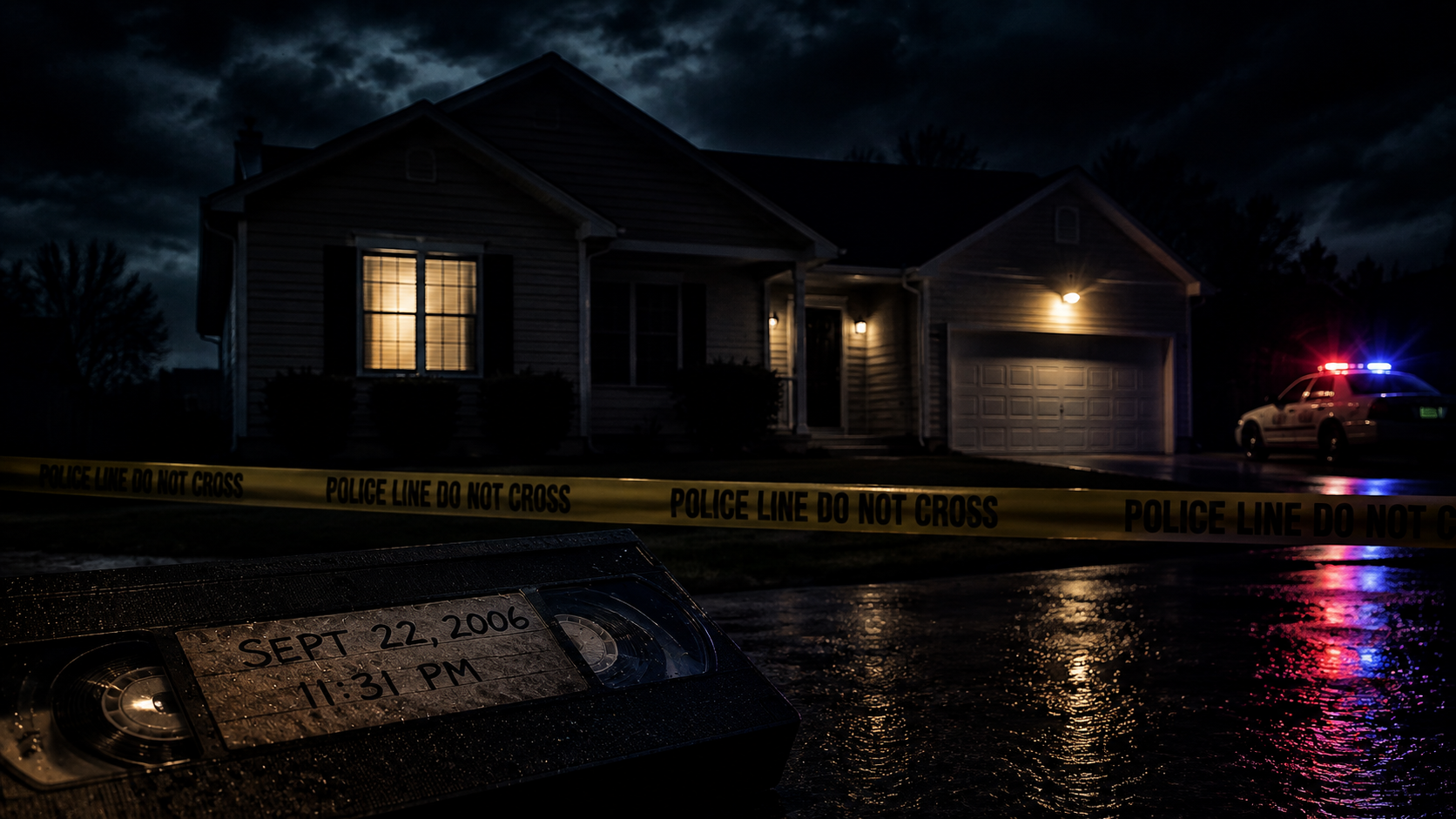
In that segment, recorded at approximately eleven-thirty-one p.m. on September twenty-second, Draper and Adamcik are driving. Draper says that they have just killed Cassie and that they have just left the house. Adamcik says he is shaking. The exchange then turns immediately towards maintaining their movie explanation.
The investigation is no longer dealing merely with two teenagers who gave an implausible cinema story.
Police now have their own recorded words.
The Evidence Begins To Converge
The strength of the case does not depend on the videotape alone.
The tape establishes planning and post-event statements, but physical and forensic evidence develops alongside it. Investigators have recovered knives and clothing from Black Rock Canyon. Adamcik acknowledges that his handwriting appears on partially burned paper found with the cache. The surviving writing describes a scenario involving Cassie, Matt and an attack inside or around the house.
Medical evidence also becomes significant.
The autopsy identifies approximately thirty knife wounds. Expert examination supports the conclusion that two different knives were used. Eleven of the twelve potentially fatal wounds are attributed to a serrated blade, while another potentially fatal injury, involving the right ventricle of Cassie's heart, is consistent with a non-serrated blade.
That distinction becomes especially important because the question is not simply whether Adamcik and Draper jointly planned an attack. Their separate trials will require jurors to consider what each teenager actually did and what the evidence proves about individual participation.
The events of Friday evening also align with the recording made shortly after the two teenagers first leave the house. Draper says doors have been unlocked. The power subsequently fails. Matt's telephone call places Adamcik speaking quietly while claiming to be elsewhere.
Each detail now has context that it did not possess when it first occurred.
The power outage, especially, is a good example of how evidence changes meaning. On Friday night it is simply an interruption. Once the recordings, movements and later evidence are known, it becomes part of the sequence investigators must reconstruct.
The Arrests And Charges
By September twenty-seventh, the case has moved from questioning to arrest.
Draper and Adamcik are taken into custody and accused of first-degree murder and conspiracy to commit first-degree murder. Because both are juveniles, one of the case's immediate legal realities is striking: they will nevertheless be prosecuted as adults.
Their statements during police interviews become contested evidence.
Draper's questioning includes a later interview in which he makes incriminating admissions. Adamcik's second interview becomes significant both factually and legally. When detectives tell him that witnesses place him at a convenience store, he adjusts his account and acknowledges travelling to Black Rock Canyon. After detectives disclose what has been recovered there, Adamcik asks to speak to an attorney and questioning stops.
The two teenagers do not ultimately present one unified account of the killing.
That matters because the evidence establishes collaboration in planning, but the precise mechanics of the attack become an important courtroom dispute.
What The Record Shows About Planning
The recovered recordings make the case unusual because they preserve behaviour before the crime in the defendants' own voices.
Weeks earlier, knives have been purchased. Before September twenty-second, the teenagers have recorded discussions about killing. The night before the attack, the discussion becomes specific to Cassie and the house. On Friday night, after visiting the property, a recording describes unlocked access points and waiting nearby. After the killing, another recording contains an immediate admission.
The Scream connection therefore needs to be understood carefully.
The teenagers explicitly reference Scream on their own recording. That makes the association evidence-based rather than a label invented afterwards. But saying that a horror film "caused" the killing would go considerably beyond what the evidence can prove.
Fiction does not supply a complete psychological explanation. The recordings also contain references to serial killers, notoriety, killing multiple people and a desire to "make history." Their language points towards a broader fascination with infamy and transgression rather than one isolated piece of entertainment functioning as a simple cause.
The film reference is part of the record.
It is not the whole explanation.
Documented Behaviour
The strongest behavioural evidence comes from actions rather than labels.
Draper and Adamcik acquired knives through an older acquaintance. They recorded violent planning. They discussed checking homes for isolated occupants. They identified Cassie. They visited the house, and Draper recorded that he had intentionally left doors unlocked. After the attack, evidence was transported to Black Rock Canyon, partially burned and concealed.
These behaviours are consistent with preparation and concealment rather than a wholly spontaneous confrontation. The timing of the recordings also makes it difficult to reduce the case to a single impulsive moment.
Their post-event behaviour is similarly important. The recorded conversation immediately after leaving the house turns towards buying movie tickets, while both later tell police versions of a cinema alibi they struggle to substantiate.
None of those observations requires a psychiatric label. The conduct itself is sufficiently revealing.
What Qualified Experts Said
Psychological evidence becomes particularly important at sentencing because both defendants are juveniles.
In Adamcik's later post-conviction litigation, the Idaho Supreme Court records that expert evidence had addressed adolescent brain development, impulsivity and the greater potential young people may have for rehabilitation. The sentencing court nevertheless concluded that Adamcik's actions were not adequately explained by transient adolescent immaturity and imposed a fixed-life sentence.
That legal conclusion should not be confused with a clinical diagnosis. The public record does not justify casually diagnosing either teenager with psychopathy, sociopathy or another personality disorder based simply on the crime or their language on the recordings.
What Can Reasonably Be Inferred
The documented sequence may suggest several behavioural dynamics.
There is evidence of mutual reinforcement. Ideas are spoken aloud, answered, amplified and converted into increasingly practical planning. The camera also appears to offer an imagined audience: the teenagers repeatedly speak as though someone in the future will watch them. That may be consistent with fantasies of notoriety and self-mythologising.
The preparation and concealment are also consistent with awareness that the conduct is criminal. Their comments about avoiding capture, constructing a cinema story and disposing of evidence sit uneasily beside any suggestion that the pair simply failed to understand the seriousness of what they were contemplating.
An alternative explanation for some of the rhetoric is adolescent posturing. Teenagers can say grotesque things to impress one another without intending to act. In this case, however, that explanation cannot account for the subsequent physical preparations, entry into the house, killing, concealment and recorded admissions.
What Cannot Be Known
The record cannot provide a complete internal map of either teenager's mind.
It cannot establish that Scream transformed otherwise nonviolent teenagers into killers. It cannot precisely measure how much one teenager influenced the other. It cannot tell us whether every boast captured on camera reflected sincerely held beliefs or performative exaggeration.
And although a legal verdict can establish criminal guilt beyond reasonable doubt, it cannot make every psychological question equally certain.
Brian Draper's Trial
Brian Draper is tried separately.
The prosecution can now present a sequence built from his own recorded words, the recovered evidence, police interviews and forensic findings. The question is not whether the case contains disturbing material; it is whether the State proves the legal elements of first-degree murder and conspiracy beyond reasonable doubt.
Draper's defence challenges important parts of the case, including the interpretation of the videotape. His lawyers argue that the recordings relate to a horror movie project rather than proving a genuine plan to kill.
The jury rejects the defence position.
Draper is convicted of first-degree murder and conspiracy to commit first-degree murder.
He receives a fixed life sentence for the murder conviction, meaning life without parole, and a separate life sentence with thirty years fixed for conspiracy.
The legal process is not finished.
Torey Adamcik's Trial
Adamcik's separate trial places particular emphasis on whether the evidence proves that he personally participated in the stabbing.
The medical evidence becomes central because experts have identified wounds consistent with two blades. Prosecutors argue that the presence of both a serrated and non-serrated weapon supports participation by both teenagers.
The defence disputes the State's interpretation and challenges whether the evidence proves Adamcik personally inflicted a fatal wound. A defence expert offers a competing view of the wound evidence.
Jurors also see the broader evidential picture: the recordings, the planning, Adamcik's presence, the Black Rock Canyon evidence and the post-event behaviour.
On June eighth, two thousand and seven, the jury finds Adamcik guilty of first-degree murder and conspiracy to commit first-degree murder. He is sentenced to fixed life for murder and an indeterminate life term with thirty years fixed for conspiracy.
The verdict does not end the debate over precisely which wounds each defendant inflicted. That issue becomes part of Adamcik's appellate arguments.
The Two-Knife Question
One of the most important distinctions in the case is between proving that two teenagers participated in a planned killing and proving which defendant caused which injury.
The State's forensic evidence identifies at least two knives. Eleven potentially fatal wounds are associated with the serrated blade. Another potentially fatal wound is associated with a non-serrated blade.
Adamcik argues on appeal that the evidence is insufficient to prove he personally inflicted a fatal wound. The Idaho Supreme Court examines the competing expert testimony and the entire evidential picture.
The majority concludes that sufficient evidence exists for a reasonable jury to find him guilty beyond reasonable doubt. His murder conviction remains intact.
But the appellate record also illustrates why careful language matters when recounting the case. Courts can affirm a defendant's legal responsibility without resolving every physical second of an attack with scientific certainty.
The verdict establishes Adamcik's criminal guilt.
It does not give an omniscient camera view of every movement inside the house.
Brian Draper's Appeal
Draper also challenges his convictions and sentences.
In September two thousand and eleven, the Idaho Supreme Court affirms his first-degree murder conviction and fixed-life sentence.
His conspiracy conviction receives a different result.
The court finds a problem with the jury instructions relating to conspiracy and vacates that conviction, remanding the issue for further proceedings. The ruling does not disturb the murder conviction or the fixed-life sentence attached to it.
That distinction is sometimes lost in simplified retellings. Saying Draper's conviction was "overturned" without qualification would be misleading. His first-degree murder conviction was affirmed; it was the separate conspiracy conviction that was vacated.
The fixed-life murder sentence therefore remained in force.
Torey Adamcik's Later Challenges
Adamcik continues challenging both his conviction and sentence.
His arguments include questions about trial counsel, forensic testing, evidence obtained during the investigation and the constitutionality of imposing life without parole for an offence committed at sixteen.
The juvenile-sentencing issue grows more significant as United States Supreme Court precedent develops around mandatory and discretionary life-without-parole sentences for minors.
In two thousand and seventeen, the Idaho Supreme Court again considers Adamcik's case. It concludes that the original sentencing judge had sufficiently considered his youth, adolescent development and potential for rehabilitation before imposing fixed life. His request for post-conviction relief is denied.
A subsequent federal habeas corpus challenge also fails. In November two thousand and nineteen, the United States District Court for the District of Idaho denies relief from the murder conviction and fixed-life sentence.
The legal record therefore leaves Adamcik's murder conviction and life-without-parole sentence intact.
Where Brian Draper And Torey Adamcik Are Now
As of August sixteenth, two thousand and twenty-six, both men remain in Idaho Department of Correction custody.
The department's current resident records list Torey Michael Adamcik, now thirty-six, as incarcerated at Idaho Maximum Security Institution.
Brian Lee Draper, also thirty-six, is listed as incarcerated at Idaho State Correctional Institution.
The two men therefore remain imprisoned almost twenty years after Cassie's killing.
Their circumstances have generated continuing public interest, particularly because both were only sixteen when the crime occurred and because modern juvenile-sentencing law has forced courts across the United States to confront difficult questions about punishment, maturity and rehabilitation.
Those questions matter.
They do not erase the person at the centre of the case.
The Problem With Calling It The Scream Murder
"The Scream Murder" is an instantly recognisable label.
It is also incomplete.
The phrase can make the story sound like a cultural curiosity: two teenagers watch a horror film, imitate it and turn fiction into reality. The actual evidence is more complicated.
The recordings show an explicit Scream reference, so the connection cannot reasonably be dismissed. But they also reveal fascination with serial killers, mass killing, notoriety and the idea of being remembered. The preparations begin before the night at Whispering Cliffs and include knives, surveillance of potential targets, recorded planning and discussion of further violence.
Reducing all of that to "a movie made them do it" produces a cleaner headline but a poorer explanation.
Millions of people consume violent fiction without committing violence. The legally meaningful facts here are choices and actions: acquiring weapons, selecting a target, planning access, returning to a house, attacking Cassie, hiding evidence and constructing a false account afterwards.
The film became part of the pair's imagined mythology.
Responsibility remained theirs.
What The Record Cannot Prove
Some questions remain narrower than the certainty of the verdicts.
The public record cannot reconstruct every second inside the house. It cannot state with absolute certainty which defendant inflicted every individual wound. Adamcik has repeatedly contested the claim that he personally caused a fatal wound, although courts have found the evidence sufficient to sustain his first-degree murder conviction.
The record also cannot quantify motive as though it were a formula.
Notoriety appears in the recordings. Scream appears in the recordings. Violent fantasy appears in the recordings. Peer reinforcement is visible. Yet none can be isolated scientifically as the single cause.
What can be established is the sequence of behaviour.
Planning came before the attack.
Concealment came after it.
And a teenager who regarded the people entering the house as classmates and friends was never given access to the private information that might have allowed her to understand the danger.
Cassie Beyond The Evidence
The most notorious objects in this case are easy to remember: the masks, knives, videotape and darkened house.
Cassie risks becoming harder to see precisely because the evidence surrounding her killing is so unusual.
She was not a character in the film-inspired story Draper and Adamcik were constructing for their camera. She was a sixteen-year-old student house-sitting for relatives, spending an evening with her boyfriend and allowing classmates into the home.
That ordinariness is not a minor detail.
It explains the betrayal at the centre of the case.
The defendants' own recordings show that Cassie's familiarity was part of the opportunity available to them. She knew them. They could arrive without triggering the fear that strangers might have caused.
When true crime focuses overwhelmingly on the psychology or theatricality of offenders, it can unintentionally reproduce the attention they appeared to crave. This case creates that danger more than most because the perpetrators literally recorded themselves imagining a future audience.
The better way to understand the tape is therefore not as their movie.
It is as evidence against them.
The House After The Story
Return to Whispering Cliffs Drive.
On Friday evening, the house contains four teenagers watching a film. Two leave. The lights fail. A boyfriend asks if he can stay and is told to come home. On Saturday, a telephone rings without being answered.
Those details eventually become pieces of a prosecution, but they did not begin that way.
The power outage is not frightening because darkness is inherently cinematic. It matters because of where it sits in a verified sequence. The unlocked door matters because one of the teenagers records himself saying he deliberately left access open. The cinema story matters because both boys struggle to explain the film they claim to have watched. The videotape matters because it converts private planning into evidence investigators can test against events.
That is the enduring power of the Cassie Jo Stoddart case.
The investigation did not need to invent a horror story around what happened.
Two teenagers had already tried to do that themselves.
The legal system ultimately stripped away the performance and treated the recording for what it was: evidence of decisions made before, during and after the killing.
Cassie deserves to be remembered outside that performance.
She entered the Whispering Cliffs house to look after someone else's home for a weekend. The ordinary responsibility should have remained ordinary. Nearly twenty years later, the case carrying the Scream label remains famous because of a videotape and its extraordinary contents.
But the silence that first made people worry about Cassie came from something much simpler.
A phone kept ringing.
And she did not answer.
