True Crime: Chris Watts Case - The Timeline, Lies And Evidence
The Lies, The Camera And The Missing Timeline
What Happened In Frederick, Colorado?
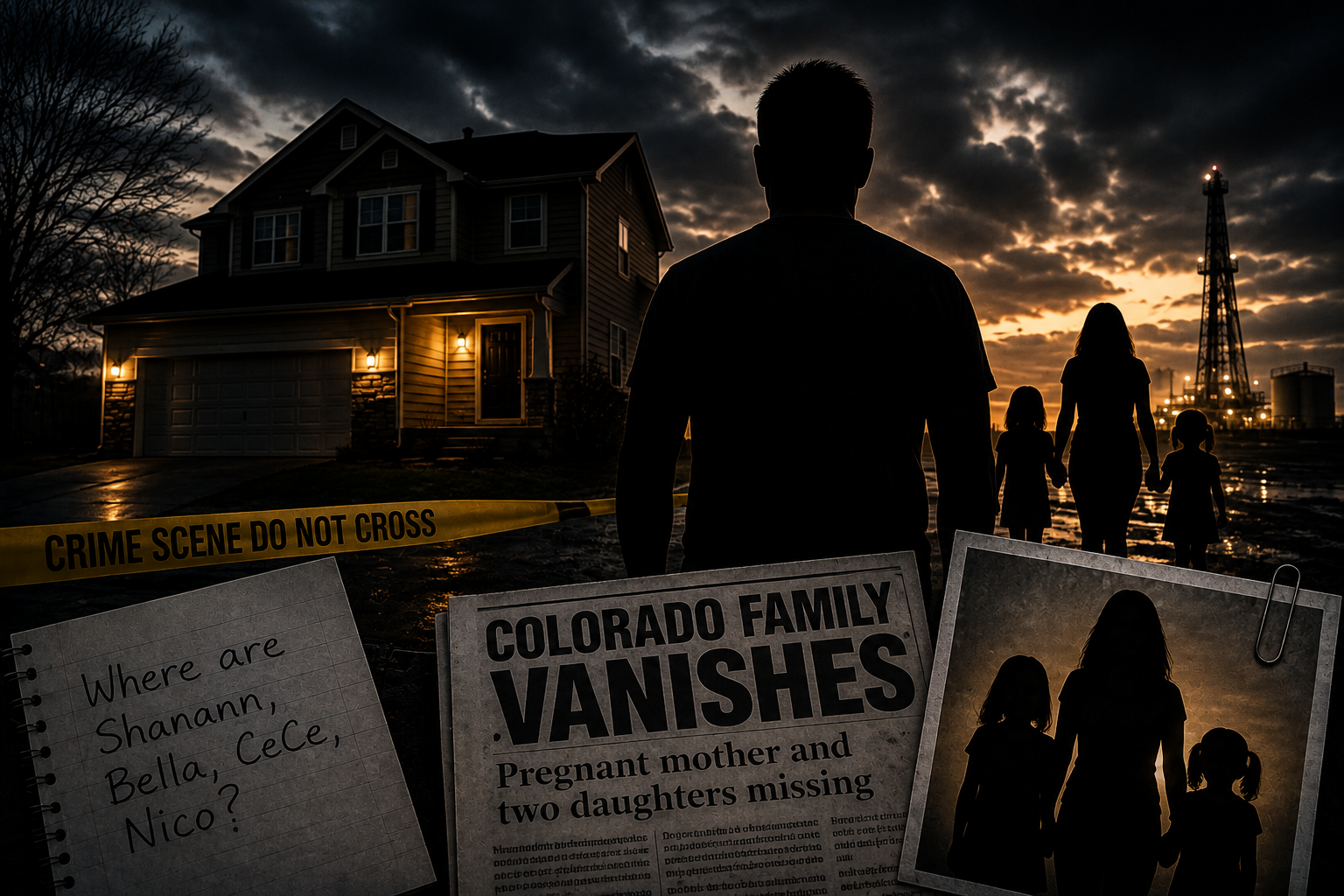
At around lunchtime on Monday, August 13, 2018, a house on Saratoga Trail in Frederick, Colorado, begins to attract attention for an ordinary reason: somebody who should be answering her phone is not answering it. Shanann Watts has recently returned from a work trip. She has an appointment that morning. Her friend Nickole Atkinson expects to hear from her. Instead, messages go unanswered and the appointment is missed.Atkinson goes to the house. Shanann's car appears to be there. There is no obvious sign that she has simply gone somewhere with her daughters, Bella and Celeste. Atkinson contacts Shanann's husband, Chris Watts, who is at work, and the police are called for a welfare check. An officer arrives that afternoon.
Inside, the situation does not become clearer. Shanann's belongings remain at home. Her purse, keys and medication are there. The family dog is there. The two girls are not. Shanann is not. Chris has an explanation: his wife has taken the children somewhere after the couple discussed separating. At that moment, it is one possible explanation among several.
Yet one basic question is already difficult to answer. If Shanann has simply left the house with Bella and Celeste, why does so much of what she would normally take with her remain behind?
The Family On Saratoga Trail
In the summer of 2018, Chris and Shanann Watts are living with their daughters in a large suburban home in Frederick, north of Denver. Chris works for Anadarko Petroleum. Shanann works from home promoting Thrive products for the multi-level marketing company Le-Vel, an occupation that also makes social media part of her daily life.
The couple's story begins far from Colorado. Both have roots in North Carolina. They meet through Facebook in 2010 and marry in November 2012. Bella arrives in December 2013. Celeste, usually called CeCe, follows in July 2015. By 2018, Shanann is pregnant again. The family expects a boy and plans to call him Nico.
From the material Shanann shares publicly, much of family life is visible. There are children playing, celebrations, trips, affectionate messages and pregnancy announcements. That online record will become unusually important because it preserves ordinary moments without requiring a narrator to reconstruct them years afterwards.
It also creates a distinction that matters when examining the case. Social media shows selected pieces of a family's life. It does not prove that everything behind the camera is equally contented. The Watts household has experienced financial pressure, including a Chapter 7 bankruptcy filing in 2015. Bankruptcy documents reportedly listed liabilities of more than $448,000.
Financial difficulty alone explains very little. Millions of families struggle with debt without anything resembling the events that follow. It matters here because it forms part of the wider pressure surrounding the household, not because it provides a simple explanation for what is happening inside the marriage.
By early summer 2018, another change is becoming more significant.
A Marriage Under Strain
Shanann spends part of the summer away from Colorado with Bella and Celeste, including an extended visit to North Carolina. Chris later joins the family. Friends and messages from the period increasingly reflect Shanann's concern that something between them is different.
She tells friends that Chris has changed. His physical affection appears to have diminished. She wonders whether he could be seeing somebody else. Whatever Chris is communicating directly to Shanann, she does not appear to believe she is looking at an ordinary temporary rough patch.
Unknown to Shanann at first, Chris has developed a relationship with a co-worker, Nichol Kessinger. Kessinger's later account places the beginning of their romantic relationship around early July. She says Chris presents himself as a man whose marriage is ending and who is moving towards a separate life.
According to Kessinger's account, they see one another frequently. She believes the separation is mutual and sufficiently advanced that she discusses practical questions about his future, including finding somewhere for him to live. Days before the family vanishes, she says Chris gives the impression that the divorce process is effectively settled.
The two versions of Chris's domestic reality therefore begin to diverge. Shanann is trying to understand why her husband has withdrawn. Kessinger believes she is seeing a man leaving a marriage through an apparently conventional separation. Chris occupies the space between those realities.
There is still nothing in those facts, taken alone, that tells anybody outside the household what will happen next.
The Morning Nobody Could Explain
During the weekend of August 11 and 12, Shanann is away in Arizona on a work trip while Chris remains in Colorado with Bella and Celeste. In the early hours of Monday, August 13, Shanann returns. Nickole Atkinson drives her home and drops her at Saratoga Trail at approximately 1:48 a.m.
Several hours later, Chris leaves for work. The girls are supposed to have normal commitments. Shanann has a medical appointment connected with her pregnancy. But as the morning advances, people who expect to hear from her cannot reach her.
Atkinson's concern becomes practical rather than abstract. She knows Shanann's routine. She knows the pregnancy matters to her. She goes to the house and finds enough inconsistencies to believe somebody should check inside. Eventually police arrive and Chris comes home from work.
The home is searched with his permission. Shanann's possessions create an immediate puzzle. If she has voluntarily taken two young children away from home, she appears to have done so without several things people close to her would expect her to carry.
Chris tells police that he and Shanann have been having marital problems. He suggests they have discussed separation. He says he does not know where she or the girls are.
The uncertainty is genuine at this point. Police have an absent pregnant woman, two absent children, a husband who says he does not know their location and a house containing belongings that make a spontaneous departure difficult to understand.
Then a neighbour's camera begins to add another piece.
The Search Begins
A neighbouring security system has recorded activity outside the Watts house during the early morning. Footage shows Chris backing his work truck towards the property before leaving. Investigators and neighbours watch the recording while Chris is present.
At first, that recording does not itself explain where Shanann, Bella and Celeste are. What it does provide is a fixed point in a timeline increasingly dependent upon digital evidence. Chris's movements can be compared against what he says happened.
That distinction becomes central to the investigation. A camera does not need to determine motive. A phone does not need to understand a marriage. Digital records simply preserve times, locations, contacts and movements. When those records are placed beside somebody's account, agreement or disagreement can become visible.
Outside the house, public attention grows rapidly. Chris speaks about wanting Shanann and the children to come home. He presents himself as a husband and father waiting for information. Investigators, meanwhile, are attempting to establish whether the family's absence can be reconciled with the movements recorded around the property.
The case is still being treated as a search. But interviews are now producing questions that require more precise answers.
One involves the state of the marriage.
Another involves Chris's movements.
And another involves whether there is anybody else in his personal life.
The Story Starts To Fracture
Investigators discover that Chris has been having an affair. The existence of that relationship directly conflicts with his earlier denial that another woman is involved. Kessinger also contacts investigators after learning that Shanann and the children are missing.
Her account gives investigators a second perspective on Chris's recent life. He has portrayed his marriage to her as ending. At home, Shanann has been communicating uncertainty and distress to friends. The separation Chris describes is therefore not necessarily understood in the same way by the different people around him.
This still does not prove what has happened to the missing family. An affair is not evidence of murder. Marital dishonesty is not a substitute for forensic evidence. What the contradiction does establish is that Chris has not been fully truthful about circumstances investigators consider relevant.
By August 15, federal and state investigators are involved. Chris agrees to undergo a polygraph examination. Investigators have already interviewed him at length, and the test becomes another attempt to assess the account he is giving them.
He does not pass it.
The interview that follows changes the case.
The Polygraph And The First Admission
After the polygraph, investigators confront Chris with their belief that he is being deceptive. His insistence that he has nothing to do with the disappearance becomes harder to maintain. He eventually asks to speak with his father, Ronnie Watts.
What he says next is the first major break from his original story.
Chris admits responsibility for Shanann's death, but his first account attempts to place responsibility for Bella and Celeste elsewhere. He claims he saw Shanann harming the girls after a discussion about separating and then attacked Shanann in rage.
Investigators now know that the search for a voluntarily absent family has become something entirely different. Chris gives information about an oil site connected with his work.
He is arrested on August 15.
Even then, his account leaves investigators with a fundamental problem. It depends upon accepting that Shanann killed the children and that Chris's violence towards her occurred in reaction to what he witnessed.
The physical evidence has not yet completed its answer.
The Oil Site
Investigators go to the Anadarko oil location identified in connection with Chris's movements. There, the uncertainty surrounding Shanann, Bella and Celeste ends.
Shanann, aged thirty-four and fifteen weeks pregnant, is found buried in a shallow grave. Bella, aged four, and Celeste, aged three, are recovered from separate crude-oil storage tanks.
The discovery is devastating not only because three missing people have now been confirmed dead, but because the locations connect directly to Chris's workplace and movements.
Medical examinations establish that Shanann died from strangulation. The girls died from smothering. Those findings do not support Chris's attempt to establish Shanann as the person responsible for their deaths.
The language of the story can now change because the evidence has changed it.
Shanann, Bella and Celeste are no longer missing.
Their deaths are being investigated as homicides.
Chris's first admission has not solved the case. It has produced a version of events investigators do not accept.
A Story Investigators Did Not Accept
The arrest affidavit preserves the account Chris gives after failing the polygraph: he claims Shanann killed the girls and that he killed Shanann after seeing what she had done. Investigators continue building a case that places responsibility for all three deaths on him.
Digital records, interviews, surveillance footage and the recovery site now have to be considered together. The affair becomes relevant not as proof in isolation, but as part of an emerging picture of a man pursuing a different relationship while telling different people different things about the state of his marriage.
Kessinger tells investigators she believed Chris was separating from Shanann. She is not charged with wrongdoing, and the available record does not establish that she had advance knowledge of the murders. Her relevance to the case is primarily evidential: she helps investigators reconstruct Chris's concealed personal life and the statements he was making before the family disappeared.
That distinction remains important because the case has generated years of speculation around people who were never accused of participating in the killings. A responsible reconstruction has to separate unanswered curiosities from evidence of criminal involvement.
For Chris, however, the legal process is now beginning.
The Charges
On August 20, 2018, prosecutors formally charge Christopher Lee Watts with nine felony counts. They include five counts of first-degree murder, one count relating to the unlawful termination of Shanann's pregnancy and three counts of tampering with a deceased human body.
The five murder counts reflect different provisions of Colorado law, including charges connected with Bella and Celeste being children under twelve in the care of a person occupying a position of trust.
At this stage, the original story Chris gave investigators has become a formal criminal case. Yet a trial would require prosecutors to prove the charges and potentially expose the full evidence to adversarial testing.
That trial never happens.
A plea agreement changes the legal path.
The Guilty Plea And The Sentence
On November 6, 2018, Chris Watts pleads guilty to all nine counts. The agreement removes the possibility of a death sentence. Shanann's family supports taking capital punishment off the table, making clear that they do not want another death.
The plea is legally decisive. Chris is no longer merely the accused man whose first account blamed Shanann for Bella and Celeste's deaths. By admitting guilt to the murder charges, he accepts criminal responsibility for killing all three.
On November 19, he is sentenced to five life terms without the possibility of parole. Three of the life sentences are imposed consecutively. He also receives forty-eight years for unlawfully terminating Shanann's pregnancy and thirty-six years for the three counts of tampering with the bodies.
The practical meaning is uncomplicated: Chris Watts is not expected to leave prison.
At sentencing, prosecutors characterise his motive in terms of wanting a fresh start and a new relationship. Yet even a motive theory cannot completely answer the question that has followed the case ever since. Wanting to leave a marriage explains why somebody might seek a divorce. Wanting another relationship explains infidelity. Neither, by itself, explains killing a pregnant wife and two children.
The guilty plea establishes who committed the murders.
It does not automatically explain the psychological path by which he reached them.
What Watts Later Said Happened
One unusual feature of this case is that the most detailed account from Chris himself does not arrive until after conviction and sentencing.
On February 18, 2019, investigators from the Colorado Bureau of Investigation, the FBI and Frederick Police travel to Wisconsin and interview him in prison for roughly five hours. The interview is subsequently released publicly.
In that interview, Chris abandons the claim that Shanann killed Bella and Celeste.
He says he killed Shanann inside the family home after a confrontation about their relationship. He then describes transporting Shanann from the house in his work truck while taking the girls to the oil site. There, according to the account he gives investigators, he kills Celeste and Bella before placing them inside separate tanks.
The account is horrific even when described without unnecessary graphic detail. More importantly, it finally places Chris's own version broadly in line with the guilt he had already admitted through his pleas.
Even this later confession should not be treated as an infallible documentary record of every minute. A confession can establish admissions without necessarily resolving every detail of chronology, state of mind or premeditation. Chris's stories changed significantly between August 2018 and February 2019.
His statement that he felt as though the murders were somehow already implanted in his mind provides insight into how he retrospectively describes his mental state. It does not transfer responsibility elsewhere, nor does it prove an external force or clinical condition.
The evidence establishes his actions.
The precise internal process that converted resentment, deception or desire for another life into family annihilation is necessarily harder to reconstruct.
The Behaviour Behind The Double Life
Documented Behaviour
The strongest behavioural observations do not require diagnosing Chris Watts.
He concealed an affair. He presented different versions of his marital situation to Shanann and Kessinger. When his family was reported missing, he initially denied knowing where they were. When the investigation narrowed, he denied involvement. After the failed polygraph, his first admission still shifted responsibility for the children's deaths onto Shanann. Only after pleading guilty did he provide investigators with the later account accepting responsibility for all three killings.
That sequence demonstrates repeated deception under escalating pressure.
It also demonstrates something more specific: his explanations changed in ways that initially reduced his own culpability. First there was no knowledge. Then there was responsibility for Shanann but not the girls. Eventually there was responsibility for all three.
The pattern is documented. The psychological label is not.
What Qualified Experts Said
Public discussion of the case has frequently used the term family annihilation or familicide, describing the killing of multiple members of one's own family. That is a behavioural category, not a diagnosis explaining why every offender who commits such crimes behaves as they do.
Experts commenting on familicide more generally have identified differing patterns involving relationship breakdown, control, financial pressure, perceived humiliation, resentment or a desire to erase one life before beginning another. Those frameworks can provide context, but they cannot be applied mechanically to Watts simply because his crime falls within the broad category.
There is no publicly established psychiatric diagnosis that supplies a complete medical explanation for the murders.
What Can Reasonably Be Inferred
The documented sequence is consistent with a growing divide between the life Chris already had and the life he was presenting elsewhere.
The affair appears to have created an alternative future in which he saw himself outside his marriage. His lies allowed incompatible versions of reality to coexist temporarily: husband and father at Saratoga Trail, separating husband in conversations with Kessinger, and concerned family member when Shanann and the girls were first reported missing.
That may suggest compartmentalisation and avoidance of consequences. It may also be consistent with a person who wanted radical change without accepting the ordinary social, financial and emotional costs of separation.
But inference must stop before it becomes remote diagnosis.
Debt cannot explain murder. An affair cannot explain murder. Marital conflict cannot explain murder. Millions of people experience all three without violence.
The legally significant fact is not that Chris wanted another life. It is that he chose murder as part of attempting to create one.
What Cannot Be Known
No public psychological analysis can establish exactly what Chris Watts was thinking at every stage on August 13.
His changing statements make retrospective self-report especially difficult to treat as unquestionable truth. Even his later confession came after conviction, after months of reflection and after his first version had already been disproved.
The record can establish acts, lies, movements and admissions far more confidently than it can establish a complete inner motive.
Explanation should also never become excuse. Whatever combination of resentment, emotional withdrawal, fantasy, self-interest or conflict existed inside the marriage, the criminal responsibility established by his pleas remains his.
From Colorado To Wisconsin
After sentencing, Watts is moved out of Colorado because of security concerns surrounding his incarceration. By December 2018, Wisconsin authorities confirm that he is being housed at Dodge Correctional Institution in Waupun.
Dodge is a Wisconsin Department of Corrections institution that also functions as a central reception centre for adult men entering the state's prison system. Wisconsin's correctional system controls matters including visits, communications, property and institutional assignments.
Watts's circumstances differ fundamentally from the suburban life documented only months earlier.
Saratoga Trail had bedrooms, family routines, school plans, work schedules, smartphones and freedom of movement.
Prison reduces life to institutional rules, controlled movement, restricted communication and a schedule largely determined by the correctional system.
For Watts, that is not temporary detention while awaiting another proceeding.
It is the rest of his life.
His New Life Behind Bars
As of August 2026, recent reporting continues to place Watts at Dodge Correctional Institution, serving his life sentences without parole. Accounts of his prison routine describe him as living under protective conditions because of the hostility his crimes can provoke among other prisoners.
Wisconsin corrections information reported in connection with his imprisonment has shown that Watts has worked as a custodian. He has also accumulated a small number of institutional conduct reports. Earlier reporting identified two such violations and said one resulted in a temporary loss of electronics privileges.
Exercise, custodial work, reading and correspondence appear to form part of the routine described by sources familiar with his incarceration. Watts has also publicly associated himself with Christianity and has reportedly kept a Bible in his cell.
One of the most controversial details has involved photographs.
Reports in 2019 said Watts kept photographs of Shanann, Bella and Celeste in his cell. A petition demanding that authorities remove them attracted more than twenty thousand signatures. Corrections officials said there was no legal basis to confiscate otherwise permitted family photographs simply because of the crimes for which an inmate had been convicted.
The detail produces an understandable emotional reaction, particularly because the people in those photographs are the people Watts murdered.
Yet prison rules do not exist solely to express public disgust. Unless an item violates correctional regulations, officials require a legal or institutional basis to remove it.
That gap between punishment and public expectation appears repeatedly in discussion of Watts's prison life.
The Women Who Write To Him
Another feature of Watts's incarceration has been correspondence from women outside prison.
Accounts dating back years describe unsolicited letters arriving from women who regard him as attractive, misunderstood or worthy of attention. Sources have said some correspondence contains flirtatious or sexual material and that Watts has replied to some of those who contact him.
The phenomenon is not unique to Watts. High-profile offenders sometimes receive romantic attention precisely because their identities are publicly known. In his case, however, it creates a particularly jarring contrast with the reason he is imprisoned.
According to a source quoted in reporting about his incarceration, correspondence has become one of his principal outlets to the world beyond prison, particularly because he is unpopular inside and has been kept in protective conditions.
It would be easy to over-psychologise those exchanges. The public record does not allow confident conclusions about every correspondent's motives or Watts's internal reasons for replying.
What can be said is simpler.
Eight years after he destroyed the family life he already had, he continues to receive opportunities for personal relationships with strangers who know exactly who he is.
In August 2026, that story took a new turn.
The Reported Marriage Application
Recent reporting says Watts has developed a relationship with a woman named Lizzie Henderson and has reportedly submitted a request to marry while incarcerated. Henderson, described as a thirty-nine-year-old woman originally from Ohio, has acknowledged the relationship.
Reports say Henderson relocated to Wisconsin and has visited Watts repeatedly, with one account placing the number at twenty-three visits across roughly fifteen months. She has also reportedly taken steps towards changing her surname.
The distinction between an application and a completed prison marriage matters.
As of August 16, 2026, the available reporting describes a request or application and does not provide authoritative confirmation that Wisconsin corrections officials have approved and completed the marriage. It should therefore not be reported as though Watts has unquestionably remarried.
The development nevertheless gives the phrase "new life behind bars" an extraordinary literal dimension.
Watts cannot rebuild the conventional freedom he once possessed. He cannot create the ordinary post-divorce life that might have existed had he simply left his marriage. Yet within prison regulations, he can still receive correspondence, form relationships, receive visits and potentially seek permission to marry.
That fact can feel profoundly uncomfortable without being mysterious.
A life sentence removes liberty.
It does not necessarily remove every possibility of human attachment.
Why The Prison Story Provokes Such Anger
Much of the fascination with Watts's current existence appears to rest on an unstated question: what is somebody who committed these murders supposed to be allowed to experience afterwards?
Should he be allowed family photographs?
Should women be allowed to write to him?
Should he be permitted religious practice?
Should he be able to have a prison job?
Should he potentially be allowed to marry?
For victims' families and members of the public, even minor privileges can appear grotesquely disproportionate beside lives that can never be restored.
But imprisonment in the United States is punishment through deprivation of liberty under law. It is not ordinarily designed to remove every possession, relationship, belief or form of daily activity indefinitely.
Watts has no parole date waiting decades ahead.
He has no realistic return to Saratoga Trail.
He has no ordinary retirement, private home, spontaneous journey, family holiday or unrestricted relationship in his future.
His sentence is already the permanent removal of almost every freedom people outside prison consider normal.
The Families Left Outside The Story
The danger in revisiting a notorious case through the offender's prison life is that the murderer can gradually become the central celebrity while the people he killed become supporting characters in his biography.
That reverses the moral weight of the case.
Shanann Watts was thirty-four. Bella was four. Celeste was three. Shanann was pregnant with Nico. Their family members did not simply lose relatives in August 2018; they also watched private loss become a global true-crime story repeatedly reconstructed through interrogation video, photographs, messages and speculation.
Chris's continuing ability to generate headlines—from prison correspondence to religion to a possible marriage—creates an asymmetry that cannot be solved by ignoring developments altogether.
The more responsible response is context.
His prison relationship is noteworthy because it is an extraordinary development in a globally known case.
It is not more important than why he is in prison.
What The Record Cannot Prove
The Watts case is unusually rich in digital material, recorded interviews, police footage, messages and subsequent confession evidence. That abundance can create the illusion that every question must therefore have a definitive answer.
It does not.
The public record does not provide a reliable clinical diagnosis explaining the murders.
It does not establish that financial pressure caused them.
It does not establish that Kessinger participated in or knew in advance about them.
It does not prove every detail of Chris's later reconstruction merely because he finally accepted responsibility for all three killings.
And it cannot measure the sincerity of his prison religious beliefs, remorse or relationships.
Those are important limits.
A case can be legally solved while psychologically incomplete.
Chris Watts pleaded guilty. He is serving life without parole. Responsibility for the murders is not an unresolved legal mystery.
The unanswered question is narrower and more disturbing: how a man who appeared capable of functioning as an ordinary father, employee and husband crossed the distance between wanting another life and eliminating the people occupying his existing one.
No later interview can make that transition rational.
Why The Case Still Endures
There was no prolonged unknown attacker stalking Frederick.
There was no years-long hunt for an unidentified suspect.
There was no complex criminal organisation.
For much of August 13, the visible ingredients looked mundane: a suburban house, a missed appointment, a friend worried by unanswered messages, a husband returning from work and a neighbour with a security camera.
That ordinariness is precisely why the case retains its power.
It asks people to confront the unreliability of appearances without drawing the equally dangerous conclusion that every apparently happy family is secretly violent.
The videos of the Watts family were real moments.
So were the marital problems.
So was the affair.
So were the lies.
Human lives can contain contradictory realities at the same time.
The failure was not that outsiders somehow missed an obvious murderer hidden in every photograph. The evidence supporting that conclusion did not exist for them then.
It emerged afterwards, piece by piece.
The House, The Possessions And The Question That Changed
On August 13, 2018, Nickole Atkinson stood outside the Watts home because her friend was not responding.
Inside were ordinary possessions that did not fit the first explanation.
Shanann's purse.
Her medication.
Her car.
The objects mattered because they transformed absence into concern.
Then the camera next door mattered.
Then the affair mattered.
Then the polygraph mattered.
Then Chris's first admission mattered.
Then the oil site changed the language of the entire story.
Then the physical evidence undermined the story he had tried to construct.
Then the guilty pleas established responsibility.
And months later, his prison interview supplied an account far darker than the version investigators first heard.
Today, Chris Watts is forty-one years old and remains incarcerated in Wisconsin. Recent accounts describe custodial work, protective conditions, correspondence with women and a reported attempt to marry. Unless his sentence is somehow overturned through an extraordinary legal development for which there is currently no established basis, prison is not a chapter preceding another conventional life. It is his life.
The contrast with August 2018 is absolute.
Then, a friend stood outside a suburban home wondering why Shanann would leave without the things she normally needed.
Now there is no uncertainty about where Chris Watts is going.
He is serving multiple life sentences without parole for killing Shanann, Bella and Celeste, and for ending the pregnancy of the son Shanann planned to call Nico.
The unanswered part of the Watts case was never ultimately who did it.
It was how an apparently ordinary domestic life could contain a decision so extreme that eight years later, every new detail from a Wisconsin prison still sends people back to the same house, the same morning and the same impossible question.
Why did he not simply leave?
