True Crime: The Idaho Four – The House, The Sheath And The Investigation
Timeline, Evidence And Questions
What Happened In Moscow, Idaho?
On a cold Saturday night in Moscow, Idaho, the streets around the University of Idaho are filled with the ordinary rhythms of a college weekend. Students move between bars, fraternity houses, restaurants and rented homes. At 1122 King Road, a six-bedroom house close to campus, several friends are following separate plans before gradually making their way back for the night.
Madison Mogen and Kaylee Goncalves are both twenty-one. They have been close friends for years. Xana Kernodle and Ethan Chapin are both twenty. Xana lives at King Road; Ethan is her boyfriend and belongs to the Sigma Chi fraternity. Two other women also live in the house. Nothing about the evening initially places the property at the centre of anything beyond student life.
Shortly before two o'clock in the morning, Madison and Kaylee return to King Road after spending part of the night in downtown Moscow. Xana and Ethan also return after being at Sigma Chi. By the early hours of Sunday, November thirteenth, twenty twenty-two, the people inside the house are settling into a night that, from outside, offers no obvious reason for alarm.
Hours later, however, unanswered questions will begin inside this house. They will spread from King Road through Moscow, across state lines and eventually into one of the most intensely scrutinised criminal investigations in modern American history.
The central question at first is brutally simple: what happened inside 1122 King Road?
Four Students In Moscow
Moscow is a small university city in northern Idaho, close to the Washington state border. The University of Idaho shapes much of its identity. Students walk between campus accommodation, fraternity and sorority houses, bars and rented properties that sit only a short distance from university buildings.
King Road is part of that landscape. The house at number 1122 is spread across three levels, with bedrooms distributed throughout the property and access from more than one point. It is the kind of shared accommodation in which people come and go at different times and social gatherings are not unusual.
Madison Mogen is a senior studying marketing. Friends know her as Maddie. She and Kaylee Goncalves have a friendship stretching back years, a closeness that has become part of both women's families as well as their own lives. Kaylee is studying general studies and is preparing for the next stage of life beyond university.
Xana Kernodle is studying marketing. Ethan Chapin, one of triplets, is studying recreation, sport and tourism management. Ethan does not live at King Road, but he is dating Xana and spends time there. The friendships among the group overlap through university life and Greek organisations.
Later memorials created by the University of Idaho will place all four names together: Ethan Chapin, Xana Kernodle, Madison Mogen and Kaylee Goncalves. But on Saturday, November twelfth, they are students moving through an ordinary weekend, not names on a memorial.
That distinction matters. To understand what follows, the King Road house has to be seen first as they know it: a home, a meeting place and part of the social geography of college life.
Saturday Night
Madison and Kaylee spend part of Saturday evening at a bar in downtown Moscow before visiting a late-night food truck. Video from the food-truck area captures them among other people waiting for food. They then travel back towards King Road.
Xana and Ethan spend part of the evening at the Sigma Chi fraternity house. Their movements will eventually become one of the timelines investigators work to establish, but during the night there is nothing publicly visible suggesting an emergency.
By approximately two o'clock in the morning, the residents and their guests have largely returned to the King Road property. Two surviving housemates are also at home. The building contains six people connected through the ordinary circumstances of university friendship and shared accommodation.
As the next two hours unfold, however, a series of small digital and physical details begin accumulating. At the time, none of those details is being viewed as evidence.
Xana receives a food delivery at around four o'clock in the morning. Records will also indicate activity on her phone shortly afterwards. The importance of those timings is not yet apparent because no investigation exists. They are simply fragments of one person's early morning.
Outside, another sequence is occurring.
A White Car Near King Road
Security-camera footage in the wider neighbourhood records a white sedan moving through the area during the early hours. Investigators will eventually devote considerable attention to the vehicle, but nobody watching the street in real time has reason to know that.
The vehicle is seen making repeated passes through the neighbourhood. At approximately four o'clock, it returns again towards King Road. The movements become important only after detectives begin reconstructing the period in which something happened inside the house.
Within the property, one of the surviving roommates later describes waking at around four o'clock to noises upstairs. According to the subsequent investigative account, she initially believes Kaylee may be playing with her dog.
She hears more sounds.
At one stage, she opens her bedroom door. Later, she hears what sounds like crying from Xana's room. A male voice is also heard saying words to the effect of helping or reassuring someone. These observations will not become publicly known until much later.
At approximately four seventeen, a security camera less than fifty feet from Xana's bedroom picks up distorted audio. Investigators will describe sounds resembling voices or a whimper, followed by a loud thud. A dog can also be heard barking.
The surviving roommate opens her door again.
This time, she sees a person.
The Figure In The Hallway
The figure is described as male, dressed in black clothing and wearing a mask that covers his mouth and nose. One physical feature stands out in the surviving roommate's recollection: bushy eyebrows.
She watches the man move past her towards the rear sliding-glass door.
The account does not describe a prolonged confrontation between them. He passes and leaves the immediate area. The roommate locks herself inside her bedroom.
At that point, she does not know the scale of what has occurred elsewhere in the property.
The white sedan captured on cameras nearby is recorded leaving the King Road area at high speed at approximately four twenty in the morning. Investigators will eventually place the critical period inside the house within a remarkably compressed window.
But morning arrives before the outside world understands that King Road contains an emergency.
There is a gap of several hours between the sounds recorded in the early morning and the call that finally brings police to the property. That delay becomes one of the most discussed features of the case, frequently stripped of the uncertainty and confusion that existed inside the house.
What the surviving roommates understood, when they understood it and what occurred during those hours would later attract enormous speculation. The public record, however, cannot responsibly convert incomplete knowledge into certainty.
The next documented turning point comes shortly before noon.
The Call At Eleven Fifty-Eight
At approximately eleven fifty-eight on Sunday morning, a call is placed to emergency services using the phone of one of the surviving roommates. Multiple people speak with the dispatcher.
The initial report concerns an unconscious person.
Police officers are sent to 1122 King Road.
Whatever explanation anyone inside or around the property may have considered during the morning changes when officers enter the house.
Inside, they discover four people who are not simply unconscious.
Ethan Chapin, Xana Kernodle, Madison Mogen and Kaylee Goncalves are dead.
All four have suffered wounds caused by what investigators believe to be a large edged weapon. The house is immediately transformed from a student residence into a major crime scene. Moscow police begin a homicide investigation.
Only now can the language of the story change.
Four young people have been killed inside a home occupied by six people. Two housemates have survived. No murder weapon is immediately recovered. No attacker is waiting at the scene. Investigators must work backwards through the night.
Inside The House
The physical layout of 1122 King Road makes the reconstruction complicated.
Madison and Kaylee are located on the upper level. Xana and Ethan are on the floor below. The surviving roommates are elsewhere in the property.
Police begin processing a house that contains not one isolated scene but several overlapping spaces. Biological evidence, footwear impressions, personal belongings, digital devices and countless objects associated with everyday shared living all potentially require examination.
One item quickly attracts particular attention.
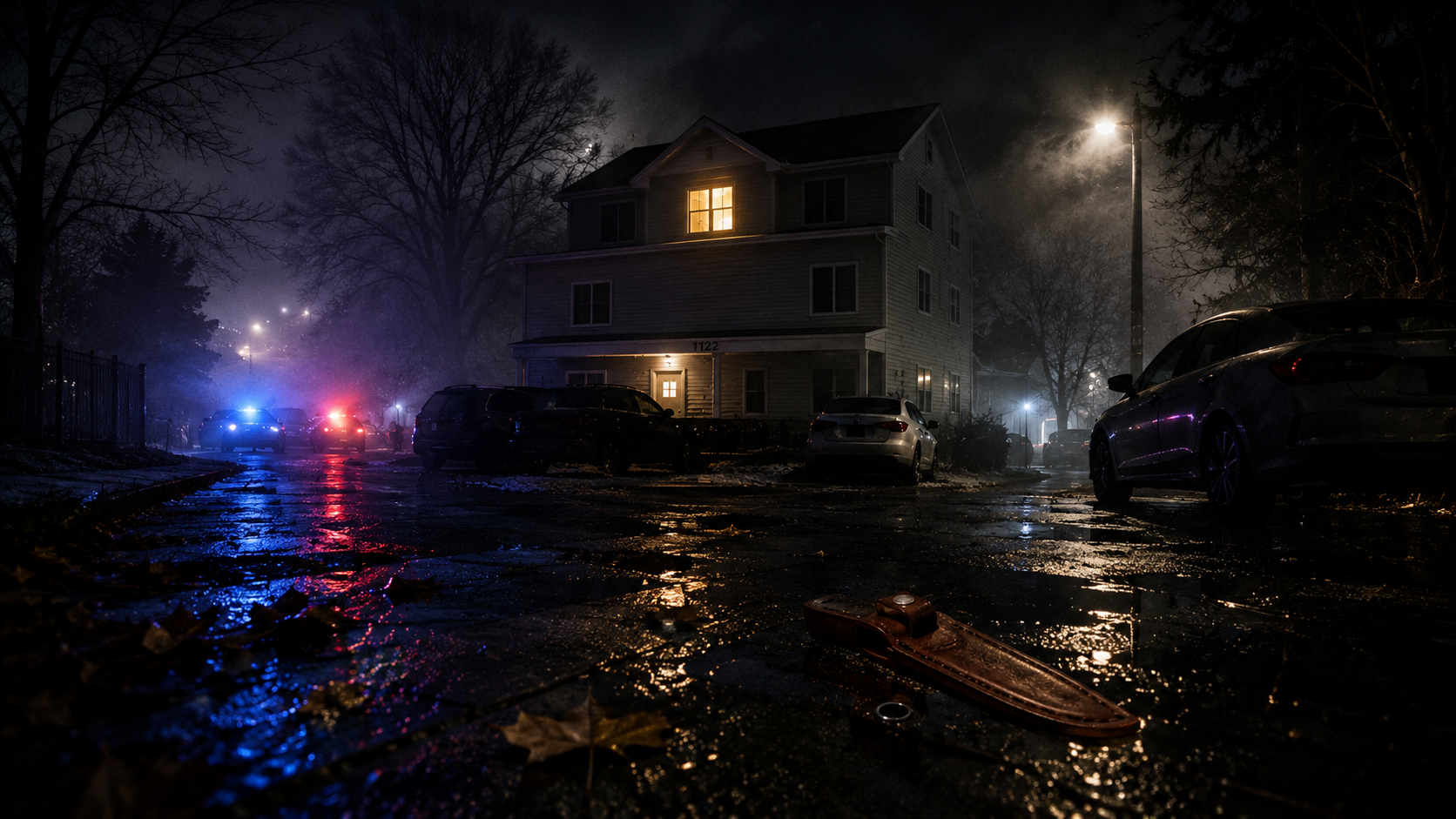
Near Madison Mogen, investigators find a tan leather knife sheath.
The knife itself is not there.
The sheath carries markings associated with a Ka-Bar-style knife. On the button snap, investigators recover a small DNA sample. At this point, the sample does not automatically identify anybody. It is evidence without a confirmed name.
The distinction is important. The existence of DNA and the identification of the person who left it are separate stages.
Meanwhile, officers interview witnesses, collect surveillance footage and begin constructing the movements of the four students and others around the property.
The crime appears to have occurred rapidly.
The question is now no longer whether a crime happened.
It is who entered the house, why they entered it and where they went afterwards.
Moscow Searches For An Answer
The killings create fear across the university community. Police initially say they believe the attack was targeted, although exactly what or whom that description refers to is unclear.
That uncertainty creates its own problems.
If the killings are targeted, who was targeted? One person? Several people? The house itself? A group connected to it? Investigators do not publicly provide an answer because the evidence has not provided one.
Rumours spread rapidly online. Friends, former partners, people seen on video and others connected only loosely to the victims are subjected to speculation. Police repeatedly state that several individuals encountered during the early investigation are not believed to be involved.
The digital attention illustrates a recurring danger in high-profile criminal cases: visibility is not evidence.
Detectives instead continue building a timeline from records that can be tested.
One strand involves the unidentified white car.
The Hyundai Elantra
Investigators collect surveillance recordings from around Moscow and begin trying to identify the sedan seen near King Road.
An initial assessment focuses on a white Hyundai Elantra from a particular range of model years. Police eventually issue a public request for information about such a vehicle, saying its occupant or occupants may have information critical to the case.
Thousands of tips follow.
The search expands beyond Moscow.
Across the state border, Washington State University is only around ten miles from the University of Idaho. Police there search vehicle registration information.
A white Hyundai Elantra is registered to a graduate student living in Pullman.
His name is Bryan Kohberger.
At this stage, that name means little to the public.
Kohberger is studying for a doctorate in criminology at Washington State University. His academic background inevitably attracts attention once it becomes public, but academic interest in crime is not evidence of committing one. Investigators need connections grounded in records, forensics and movement.
They begin examining whether the Elantra and its owner fit the timeline.
The Phone Records
Investigators identify a mobile telephone number associated with Kohberger and examine historical cellular records.
Those records place the phone in the wider Moscow area on multiple occasions before November thirteenth. Cell-site evidence does not provide a perfect GPS trail and cannot, by itself, show that a person entered a specific house. Its value comes from how it interacts with other evidence.
The crucial period is the night of the killings.
Records indicate that Kohberger's phone connects to the cellular network in Pullman during the early morning before apparently leaving the area. Shortly before the suspected attack window, however, the device stops reporting to the network.
It remains absent from cellular network activity during the central period surrounding the killings.
Later in the morning, the phone reconnects while moving through areas south of Moscow and towards Pullman.
Investigators do not treat the absence of network activity as proof by itself. Phones can lose service, be switched off or enter aeroplane mode for many reasons.
But detectives now have three strands capable of being compared: the movements of a vehicle resembling Kohberger's Hyundai, the activity pattern of his phone and the unidentified DNA recovered from the knife sheath.
The investigation begins narrowing.
Following The Car East
By December, Kohberger is no longer in Washington.
He drives east across the United States with his father, travelling towards the family home in Pennsylvania for the Christmas period.
Investigators continue tracking the case.
Police in Indiana stop the Hyundai twice on December fifteenth for traffic-related reasons. At that stage, neither roadside encounter results in an arrest connected to the Idaho investigation.
The car eventually reaches Pennsylvania.
For investigators, however, the forensic question surrounding the sheath remains.
If the DNA recovered from King Road can be connected to the man whose car and phone are now under examination, the significance of the evidence changes dramatically.
Genetic genealogy and conventional DNA comparison become central to that process.
Investigators use genetic information to develop a possible family connection. Surveillance around the Kohberger family residence then allows authorities to recover discarded rubbish.
A DNA sample obtained from that rubbish is tested.
According to the investigative findings, the result strongly supports the conclusion that the biological father of whoever left the DNA on the knife sheath is present within the Kohberger family.
Investigators now seek an arrest warrant.
The Arrest In Pennsylvania
In the early hours of December thirtieth, twenty twenty-two, police enter the Kohberger family home in Albrightsville, Pennsylvania.
Bryan Kohberger is arrested.
He is twenty-eight years old.
For the first time, the public investigation has a named suspect.
Authorities in Idaho accuse him of four counts of first-degree murder and one count of felony burglary. He remains in Pennsylvania briefly before agreeing to extradition.
When he arrives in Idaho in early January twenty twenty-three, the previously sealed probable-cause material becomes public.
The document gives the public its first detailed look at the evidence detectives used to identify him: the white Hyundai Elantra, cellphone records, the surviving roommate's description, surveillance footage and the knife sheath recovered from the house.
Investigators then obtain a direct DNA sample from Kohberger.
The forensic comparison becomes stronger still.
The state will eventually say the DNA profile recovered from the knife sheath corresponds to Kohberger at an extraordinarily high statistical level.
Yet even powerful DNA evidence has to be interpreted carefully. It can support identity at the location of the sample; by itself it does not narrate every event inside the house.
That is why the prosecution's developing case does not rely on the sheath alone.
Building The Case
Search warrants produce a vast quantity of digital and physical material.
Authorities examine Kohberger's apartment, office, vehicle, phone records, online accounts and other devices. The investigation eventually generates tens of terabytes of discovery.
The car receives particular attention.
Prosecutors prepare evidence concerning the vehicle's movements, while specialists analyse cellphone records and location information. Expert disclosures show that investigators intend to explain how Kohberger's phone interacted with the cellular network before, during and after the relevant period.
One of the case's persistent misconceptions is that cellular evidence can place a phone at an exact bedroom or doorway. It cannot. Cell-site analysis generally operates at a broader geographic level.
Its significance in this case comes from combination.
A car resembling Kohberger's appears repeatedly in surveillance around King Road. The phone associated with him follows a movement pattern before and after the critical period but does not report normally to the network during it. DNA matching him is recovered from the snap of a knife sheath inside the house.
Each strand has limitations.
Together, the state argues, they describe one person.
The defence spends the following years challenging that conclusion.
The Case Moves Towards Trial
A grand jury indicts Kohberger in May twenty twenty-three on four first-degree murder counts and one burglary count.
At arraignment, he does not personally enter a plea. The judge records not-guilty pleas on his behalf.
Prosecutors later announce that they intend to seek the death penalty.
From there, the case becomes an enormous pre-trial legal battle.
The defence challenges aspects of the DNA evidence, investigative genetic genealogy, discovery process and death-penalty framework. Lawyers argue over what jurors should be allowed to see and hear, how expert evidence should be presented and whether alternative-perpetrator evidence meets the threshold for admission.
The location of the trial also becomes contentious.
With extraordinary publicity surrounding the killings in Latah County, the defence argues that seating an impartial jury there will be difficult. In September twenty twenty-four, the proceeding is moved to Ada County, placing the eventual trial in Boise.
Judge Steven Hippler takes over the case.
By twenty twenty-five, a jury trial is approaching. The planned proceedings are expected to require weeks of testimony and an extraordinary volume of forensic and digital evidence. A defence filing refers to approximately sixty-eight terabytes of discovery.
The prosecution and defence are preparing to contest what the evidence can actually prove.
Then the legal direction changes.
The Plea That Stopped The Trial
On June thirtieth, twenty twenty-five, the victims' families learn that prosecutors have reached a plea agreement with Kohberger.
The agreement removes the death penalty.
In return, Kohberger must plead guilty to every charged count. He will receive four consecutive life sentences without the possibility of parole for the murders, followed by a fixed ten-year sentence for burglary. He also agrees to waive significant rights to challenge the convictions through the ordinary appellate process.
Two days later, on July second, Kohberger enters the courtroom.
This moment alters his legal status completely.
Judge Hippler questions him about whether he understands the agreement, whether anyone has improperly forced him to accept it and whether he is pleading guilty because he is guilty.
Kohberger answers yes.
For each murder count, the judge asks for his plea.
Guilty.
For the burglary count, guilty.
The trial that had consumed more than two years of preparation will not take place.
The admissions establish legal guilt, but they do not provide the answer many people have expected the trial to explore.
Why?
Kohberger offers no motive.
What The Guilty Plea Established
The plea resolves the central legal question of responsibility.
Bryan Kohberger admits entering 1122 King Road unlawfully with the intention of committing murder and killing Madison Mogen, Kaylee Goncalves, Xana Kernodle and Ethan Chapin.
The state no longer needs to convince a jury beyond reasonable doubt.
That does not mean every evidential question disappears.
No murder weapon has been publicly recovered. The precise reason Kohberger selected the house or its occupants remains unknown. The public record has never established a clear prior relationship between him and any of the four students.
Those gaps matter because criminal responsibility and motive are not the same legal question.
A person can be convicted of murder without investigators ever discovering an explanation that satisfies the public's desire to understand why.
In the Idaho case, that missing motive becomes one of the defining unresolved questions.
The Evidence A Jury Never Had To Decide
Because the guilty plea ends the planned trial, many evidential disputes never receive jury findings.
The knife-sheath DNA is among the strongest forensic components of the state's case. The prosecution was also prepared to rely on vehicle surveillance, cellular records, digital material, witness testimony and specialist analysis.
The defence had prepared challenges.
It questioned elements of the state's reconstruction and sought permission to introduce alternative-perpetrator theories. Shortly before the planned trial, the court rejected the proposed alternate-perpetrator evidence as failing the required legal threshold.
None of this means that every disputed pre-trial claim became a proven historical fact simply because Kohberger later pleaded guilty.
The distinction is essential in responsible true-crime reporting.
His guilty plea conclusively establishes his criminal responsibility unless the conviction is successfully overturned through a later legal process. It does not automatically validate every theory, inference or disputed evidential interpretation advanced during years of litigation.
What is established is narrower and more powerful: Kohberger admitted the crimes themselves.
Why The Motive Remains Unknown
The search for motive has encouraged some of the weakest speculation surrounding the case.
Kohberger's criminology studies have been treated as though they automatically explain the killings. His personality has been analysed by strangers. Unverified theories have circulated about possible obsessions, encounters or fixation on one of the women.
The available record does not justify turning those theories into fact.
There are documented psychological and neuropsychological assessments connected to the pre-trial death-penalty litigation. A defence expert evaluation that became public identified several diagnoses and historical conditions. Those clinical findings should not be converted into explanations for murder without evidence connecting them to the crimes.
Mental-health or neurodevelopmental diagnoses do not establish violence, motive or criminal intent.
Nor does studying criminology.
The legally responsible conclusion is less satisfying but more accurate.
The motive has not been established.
Sentencing In Boise
On July twenty-third, twenty twenty-five, the case reaches sentencing.
Families and survivors finally address Kohberger directly in court.
The hearing returns the focus to the people whose lives were destroyed by what happened at King Road. Parents, siblings and friends describe the absence left by Madison, Kaylee, Xana and Ethan. The surviving roommates describe trauma that extends far beyond the morning police entered the house.
Kohberger is given an opportunity to speak.
He declines to explain himself.
Judge Hippler imposes four consecutive life sentences without the possibility of parole for the murders and another fixed ten years for burglary, consistent with the plea agreement. Financial penalties and restitution are also imposed. The judgment entered that day concludes the underlying criminal prosecution.
A trial might have tested competing interpretations of evidence in public.
The plea prevents that trial.
A sentencing hearing can recognise damage and impose punishment, but it cannot manufacture an answer to a motive the defendant refuses to provide.
The House On King Road
Long before sentencing, another difficult decision has been made in Moscow.
The University of Idaho takes ownership of 1122 King Road after it is donated to the institution.
For some, the house is evidence and a physical connection to what happened. For others, its continued presence is a source of pain in a neighbourhood filled with students.
The prosecution and defence are given access.
In December twenty twenty-three, after the defence conducts another examination of the property, the university demolishes the house.
The removal sparks disagreement, particularly among those who believe the building should remain available until the case is fully tried.
But the anticipated jury trial ultimately never happens.
In its place, the university develops something intentionally different.
The Vandal Healing Garden and Memorial opens as a space for remembrance. A railing carries the names of Ethan Chapin, Xana Kernodle, Madison Mogen and Kaylee Goncalves. The garden is designed not only for them but as a place to remember University of Idaho students who have died while enrolled there.
The physical centre of the story shifts from a house associated with violence to a space built around memory.
The Case Opens Again In A Different Form
For almost exactly a year after sentencing, Kohberger's convictions appear settled.
Then, on July twenty-seventh, twenty twenty-six, he files a petition for post-conviction relief from prison.
His position is now radically different from the one he stated under oath at his plea hearing.
Kohberger claims ineffective assistance of counsel. He alleges that his plea was not knowingly and voluntarily made, that promises were not kept and that lawyers improperly pressured him. He also raises claims concerning evidence he says should have affected his decision to plead guilty.
Most significantly, he now asserts actual innocence and seeks permission to withdraw the guilty pleas.
That does not erase the convictions.
A post-conviction petition is a request for judicial relief, not a finding that the original plea was invalid. Kohberger must overcome the sworn answers he gave Judge Hippler when he said he understood the consequences, had not been improperly coerced and was pleading guilty because he was guilty.
The contradiction will sit at the centre of whatever happens next.
The Hair Claim And The New Challenge
One point raised in the new petition concerns hair or trace evidence associated with Ethan Chapin.
Kohberger argues that potentially exculpatory material was not adequately explained to him during the plea process.
The existence of biological or trace material belonging to other people inside a shared college house would not automatically demonstrate an alternative killer. Context, testing, location and provenance matter.
Available information about the particular hair claim further illustrates why raw evidence cannot be interpreted in isolation. Subsequent reporting on the underlying testing indicates that defence-related analysis did not establish the simple exculpatory result suggested by the petition.
That dispute is now part of the post-conviction process.
Kohberger has been appointed new counsel to assist with the challenge. As of August sixteenth, twenty twenty-six, there has been no ruling allowing him to withdraw the plea and no new murder trial has been ordered.
His convictions and sentences therefore remain in force.
What The Record Cannot Prove
The Idaho college murders generated an enormous amount of information, but volume should not be confused with certainty.
The record proves that four students were killed inside 1122 King Road in the early hours of November thirteenth, twenty twenty-two.
It establishes that investigators recovered a knife sheath carrying DNA linked to Bryan Kohberger, traced a Hyundai Elantra associated with him, examined cellphone activity and built a wider circumstantial case around his movements.
It establishes that Kohberger was arrested, charged and spent more than two years contesting the prosecution.
It establishes that on July second, twenty twenty-five, he stood in court and pleaded guilty to every count.
It establishes that he received four consecutive life sentences without parole.
And it establishes that in July twenty twenty-six he reversed his position and began seeking post-conviction relief.
What the record still does not establish is motive.
It does not produce a definitive explanation for why these four students were selected.
It does not recover the knife used in the killings.
It does not transform every internet theory into evidence merely because the case generated millions of comments, videos and posts.
And until a court rules on Kohberger's new petition, it does not establish that his guilty plea was invalid.
The Four People At The Centre
The extraordinary attention surrounding Kohberger risks distorting the proportions of the story.
The longest-lasting consequence of November thirteenth is not the notoriety of the person who admitted committing the murders.
It is the absence of four young adults.
Ethan Chapin's family has supported scholarships and remembrance projects built around the energy and relationships that defined him rather than the manner in which he died.
Xana Kernodle's name sits alongside his at the university memorial.
Madison Mogen and Kaylee Goncalves remain linked in public memory not simply because they were found in the same room, but because their friendship existed long before the case.
The Vandal Healing Garden makes that point physically. Their names are preserved in a place designed for reflection rather than spectacle.
True crime often works backwards. It begins with the killer, the evidence or the verdict and reconstructs everyone else around those events.
The chronology of King Road suggests a better way to remember the case.
Start with the students.
The Night Seen Differently
Return to King Road before four o'clock on Sunday morning.
The food delivery is still simply food.
A phone being used is still simply a phone.
The white car has not yet become an investigative lead.
The leather sheath has not been discovered.
No DNA comparison exists.
No suspect has been named.
No courtroom has heard a guilty plea.
There are only students in a shared house at the end of a Saturday night.
That ordinary beginning is precisely why the case continues to resonate.
The investigation that follows is technologically sophisticated and legally enormous. Detectives combine surveillance video, forensic biology, genetic genealogy, vehicle records, cellular analysis and conventional police work. Lawyers spend years testing the limits of those strands. A trial is prepared and then abandoned when the accused man admits responsibility.
Yet the most obvious question survives all of it.
Why?
Bryan Kohberger had the opportunity to answer that question at sentencing.
He chose not to.
A year later, he began attempting to withdraw the plea through which he admitted the crimes. Whether that challenge changes his legal position is now for the Idaho courts to determine.
As of August sixteenth, twenty twenty-six, it has not done so.
Kohberger remains convicted of murdering Madison Mogen, Kaylee Goncalves, Xana Kernodle and Ethan Chapin and of burglarising the King Road house. He remains sentenced to four consecutive terms of life imprisonment without parole plus ten years for burglary while his post-conviction challenge proceeds.
The house itself is gone.
The four names remain.
And that may be the most important distinction in the entire story.
