True Crime: Michael Stone, Lin Russell, Megan Russell And The DNA Review
The Lane, The Conviction, And The DNA Question
The Case That Never Stopped Being Tested
A country lane can look harmless until the record teaches people to read it differently.
On July 9, 1996, Dr Lin Russell walked near Chillenden in Kent with her daughters, Megan and Josie, and the family dog after a swimming gala. It was the sort of ordinary journey that should not have needed witnesses, maps, appeals, forensic files, or courts. It belonged to family routine, not national memory.
The first question was simple: what had happened on that lane?
The harder question came later. It was not only about the attack itself. It was about what could be safely proved, what had been assumed, what forensic science could not yet answer, and why a conviction can still be examined decades after a jury has spoken.
This article follows the case through the latest confirmed legal developments as of July 5, 2026. The answer has never lived in one object alone. It has moved through a lane, a surviving witness, prison-cell evidence, appeal courts, an untested possibility, and now a DNA review that asks whether old exhibits can still speak.
The Life Before The Case
Lin Russell was not a symbol before she became a name in a criminal file. She was a doctor, a wife, a mother, and part of a family whose ordinary life was later forced into public language. Her daughters, Megan and Josie, were children, not case references. That distinction matters because the story has often been compressed into legal argument, forensic debate, and the name of the man convicted.
Public records give the core facts. Lin was 45. Megan was six. Josie was nine. Shaun Russell, Lin’s husband and the girls’ father, was left to live with the consequences of a case that moved from family devastation into police investigation, court history, and long-running review.
The available public detail does not give the full private shape of their lives. That absence should not make them feel less real. It means the article has to treat the known facts carefully: a family walking home, a child who survived, a father who endured public attention, and two lives now discussed through evidence, law, and the limits of what the record can show.
Megan’s age is one of the details that still stops the story from becoming abstract. Six is not a legal category. It is school, routine, dependence, ordinary noise, and the small world of a child who should have been defined by far more than what happened on a summer afternoon.
Josie’s survival would later become central to the investigation, but before it became evidence, it was survival itself. The case began with people, not exhibits.
The People Around Them
The Russell family’s world was not built around danger. That is part of why the case left such a long public mark. The route home, the family dog, the lane, and the quiet Kent setting all sat against the later violence of the case in a way that made the public story feel impossible to file away.
Shaun Russell became part of the public aftermath because he had to. His place in the case was not that of a witness to the central event, but of a husband and father left to absorb what the legal system, press attention, and public suspicion could not repair. The open record describes Josie as surviving and recovering, but that legal phrase carries more weight than it can hold.
Michael Stone belonged to a separate world until police attention later turned toward him. He was not part of the Russell family’s life. The connection made by the criminal case was not personal relationship, domestic history, or known conflict. It was built later through identification, background, alleged admissions, and circumstantial reasoning.
That distinction is important. Some true-crime cases turn on an intimate relationship. This one became harder for the public to process because the prosecution case did not begin with a familiar motive or an obvious link. It became a case about whether the evidence could tie a man to a place, a moment, and a violent act without forensic proof placing him there.
The supporting cast would eventually include police officers, prison witnesses, lawyers, appeal judges, forensic scientists, and miscarriage-of-justice reviewers. But on the day itself, the story was still much smaller.
It was a family route. Then it became a lane no one could look at the same way.
The First Cracks
Some cases announce danger before the central event. This one did not begin with a public warning that clearly explained what was coming. The first crack was not a message, a threat, or a known confrontation inside the family’s circle. It was the sudden collapse of ordinary explanation.
The lane near Chillenden mattered because it created a narrow stage. There was a route, a rural setting, a family walking, and then a gap in what the public could understand. Early information did not hand investigators a clean suspect. It gave them a survivor, a location, and a description that still had to become an evidential path.
That is one reason the case attracted such intense attention. A stranger-attack theory creates a particular kind of pressure. It widens suspicion rather than narrowing it. It asks police to search not only for motive, but for opportunity, geography, vehicle movement, resemblance, past conduct, and any trace that can connect a person to a place.
Forensic science was expected to matter. In a case with no obvious relationship between the victims and the later convicted man, physical evidence could have simplified everything. It could have linked someone to the scene. It could have excluded someone. It could have found an unknown profile.
But the forensic story did not resolve itself quickly. That failure became one of the pressures that never left the case.
The first simple explanation was that careful police work, witness evidence, and forensic testing would converge. Nearly 30 years later, the DNA review exists because they did not converge cleanly enough for the argument to end.
The Last Ordinary Movements
The final ordinary sequence is brief because the public record is brief. Lin, Megan, Josie, and the family dog were returning after a swimming gala. The route took them near Chillenden. What should have remained a family movement through a familiar landscape became the sequence investigators, courts, and later reviewers returned to again and again.
There is a reason ordinary movement matters in a case like this. When there is no long lead-up between victim and offender, time and place do more work. A lane becomes geography. A route becomes opportunity. A passing sighting becomes possible identification. A vehicle becomes not just transport, but a question of access.
At that stage, nobody outside the scene could know what would later become legally significant. The family dog mattered. The lane mattered. The surviving child mattered. Any object handled, touched, tied, dropped, or moved might later become part of a forensic argument.
The law often reaches backward into ordinary life and asks it to become precise. What time was it? Who was nearby? Which direction were they walking? What could be seen from the road? How far was the nearest house? What object could have retained DNA? Which contact was innocent, and which was probative?
Those questions did not exist while the walk was still only a walk. They arrived afterward, when investigators needed to turn a fragment of rural time into a case.
The last ordinary movement did not look like evidence while it was happening. That came later.
The First Alarm
The attack left Lin Russell and Megan dead, and Josie seriously injured but alive. Court records later described the murders of Lin and Megan and the attempted murder of Josie, and the CCRC has repeated that Stone was sentenced for those offenses after the 2001 retrial.
The facts are severe, but the writing should remain restrained. The legal importance lies not in graphic detail, but in sequence, survival, and evidence. Josie’s survival meant police had a witness who could describe the attacker, but a child survivor’s account still had to be treated with the care required by trauma, memory, age, and the limits of observation.
The first alarm created two parallel tasks. One was human and urgent: emergency response, survival, family notification, and the immediate consequences of violence. The other was investigative: preserve the scene, collect trace evidence, identify routes in and out, record witness accounts, and test whether the attacker had left anything behind.
The case entered public awareness because the violence was extreme, the setting was ordinary, and the surviving witness made the question feel answerable. There had been an attacker. There had been a place. There had been a moment. The public wanted the line between those points to become clear.
But a witness description is not the same as proof. It can guide an investigation, but it does not automatically identify a defendant beyond reasonable doubt. For that, investigators needed corroboration.
The first alarm answered one question: this was not a misunderstanding or a delayed return home. It opened a harder one: who could be lawfully and safely connected to the lane?
The Search For An Explanation
The first phase of the investigation had to move outward. Police had a rural scene, a surviving witness, and public fear. They did not have an immediate forensic match that turned the case into a straight line. In that gap, the investigation depended on descriptions, appeals, background inquiries, and the slow sorting of possible suspects.
A national television appeal later helped generate information. After an e-fit was broadcast around the first anniversary of the case, Stone came to police attention after medical professionals who had known him contacted investigators. Reporting and later legal summaries describe that sequence as important to the narrowing of suspicion.
That kind of tip can be powerful, but it also needs discipline. A person resembling an image is not proof. A troubled background is not proof. Past violence is not proof of a specific crime. The prosecution would later rely on a wider pattern of circumstances, but the legal question was never whether Stone seemed like a possible suspect. It was whether the case proved he committed these crimes.
The early search also shows why DNA mattered from the beginning. In a stranger-attack case, physical evidence can do what suspicion cannot. It can put a person at a scene, exclude a person from a biological trace, identify an unknown contributor, or expose contamination and uncertainty.
The problem was that forensic evidence did not produce a simple public answer. There was no clean DNA link that closed the file in the way many people expected. That absence became more than a technical gap.
It became the space where doubt kept returning.
The Evidence That Did Not Fit
Stone’s case moved into legal history through alleged admissions, not through a conclusive DNA match. That is the central tension behind the modern review. The conviction did not rest on a single recovered weapon bearing his profile or a forensic trace that indisputably placed him at the lane. It rested heavily on what prison witnesses said he had said.
The 1998 conviction was later quashed after a prosecution witness retracted evidence. A retrial followed, and in October 2001, at Nottingham Crown Court, Stone was convicted again of the murders of Lin and Megan Russell and the attempted murder of Josie Russell. The Court of Appeal later dismissed his appeal in January 2005.
That procedural history is not a technical footnote. It is the spine of the case. The first jury convicted. The first conviction was set aside. A second jury convicted. The appeal court upheld that second conviction. The CCRC later refused to refer the case in 2023, then agreed to a further review after a new request from Stone’s representatives.
The legal record therefore contains two things at once. Stone remains convicted. His conviction has survived appeal. At the same time, the case has remained open to review because the evidence base has long been argued over, especially around alleged cell confessions, forensic gaps, and later claims about another possible perpetrator.
The strongest public misconception is to treat review as exoneration. It is not. A review means the conviction is being examined under a legal threshold. The CCRC does not retry cases because people remain doubtful. It asks whether new evidence or argument creates a real possibility that the Court of Appeal would not uphold the conviction.
That is a high bar. DNA may matter because it could create something the case has long lacked: a new, testable fact.
The Event At The Center Of The Case
The central event must be described carefully because the legal and human facts are already grave. Lin, Megan, and Josie were attacked near Chillenden on July 9, 1996. Lin and Megan were killed. Josie survived serious injuries. The family dog was also killed. The prosecution case later treated the attack as the work of one man; the conviction that followed legally fixed Stone as responsible, unless and until a court overturns it.
The surviving account and scene evidence mattered because investigators had to reconstruct what happened without a confession accepted by everyone as reliable and without forensic evidence publicly understood as decisive. In practical terms, the case needed to answer several questions: who was on or near the lane, how the victims were restrained, what objects had contact with the attacker, whether trace material survived, and whether any later statement contained details that only the attacker could truly know.
That last issue became one of the most contested parts of the case. Alleged prison confessions can be legally admissible, but they carry obvious dangers. Prison witnesses may have motives to lie, exaggerate, trade information, or repeat details already in the public domain. That does not make every prisoner witness false. It means the evidence has to be tested with unusual care.
Stone’s supporters have long argued that the alleged confession evidence repeated material already available publicly and did not contain enough private crime-scene knowledge. The courts, however, did not accept that the conviction was unsafe. The Court of Appeal dismissed the 2005 appeal and found no reason to interfere with the jury’s verdict.
This is where the case becomes more than a narrative about one afternoon. It becomes a question about proof. A jury may convict on witness evidence if it is sure. An appeal court may uphold that conviction if the legal test for unsafety is not met. A later forensic review may still ask whether old material can now be tested in a way that was not possible, or not pursued, at the time.
The lane created the question. The courtroom gave one answer. The DNA review asks whether the record has finished speaking.
When The Story Broke Open
The case became wider than a local investigation because it contained a rare and disturbing combination: a rural family route, a child survivor, intense public fear, and no immediate forensic answer that quieted suspicion. The public version hardened quickly because people wanted certainty.
Public attention can help investigations. It can bring forward witnesses, produce tips, and keep pressure on institutions. It can also flatten complexity. In the Russell case, the broad public story often became simpler than the legal record: a terrible attack, a man convicted, and then years of doubt. The middle of that sentence is where the real difficulty lives.
Stone was not merely suspected. He was convicted twice. His second conviction survived appeal. That must be stated plainly. But it is also true that his case has continued to generate questions because the evidence relied so heavily on alleged words spoken in custody and because no DNA match has been publicly identified as linking him to the scene.
Later claims involving Levi Bellfield added more heat, but not the same thing as proof. Bellfield, already convicted of other murders, was reported to have made statements claiming responsibility for the Russell case. Those claims have been disputed, questioned, and treated cautiously. A claim from a convicted serial murderer does not become reliable simply because it is dramatic.
That is one of the case’s clearest lessons. The public often wants a second suspect to solve the discomfort of a disputed conviction. The law cannot work that way. An alternative claim has to be credible, corroborated, and capable of changing the safety of the conviction.
The story broke open because doubt remained. But doubt alone is not the same as a legal answer.
The Case Built From Fragments
The case against Stone was built from fragments that had to be read together. There was the witness description. There were tips after the public appeal. There was Stone’s background, which the legal record later discussed in different contexts. There were alleged prison admissions. There was the absence of a conclusive forensic link. There was Stone’s continued denial.
A circumstantial case can be strong when independent strands align. The law does not require a single cinematic piece of evidence. It can accept accumulation: witness evidence, conduct, opportunity, admissions, and context. But accumulation has a weakness too. If a central strand is later attacked, the whole pattern can be re-read.
That is why the prison-confession evidence matters so much. If the alleged confession was reliable, it could carry enormous weight. If it was contaminated by public information, incentives, poor memory, or witness unreliability, it becomes a fault line. The legal system has already tested that argument and left the conviction standing. The review question is whether new material now changes the position.
The forensic side is different. DNA does not automatically answer every question. A profile can show contact, transfer, contamination, or presence, depending on the sample. A lack of DNA does not prove absence. A mixed profile can be difficult to interpret. A degraded sample may produce only partial results. But a meaningful male profile on a relevant item could change the evidential landscape, especially if it excludes Stone and points elsewhere.
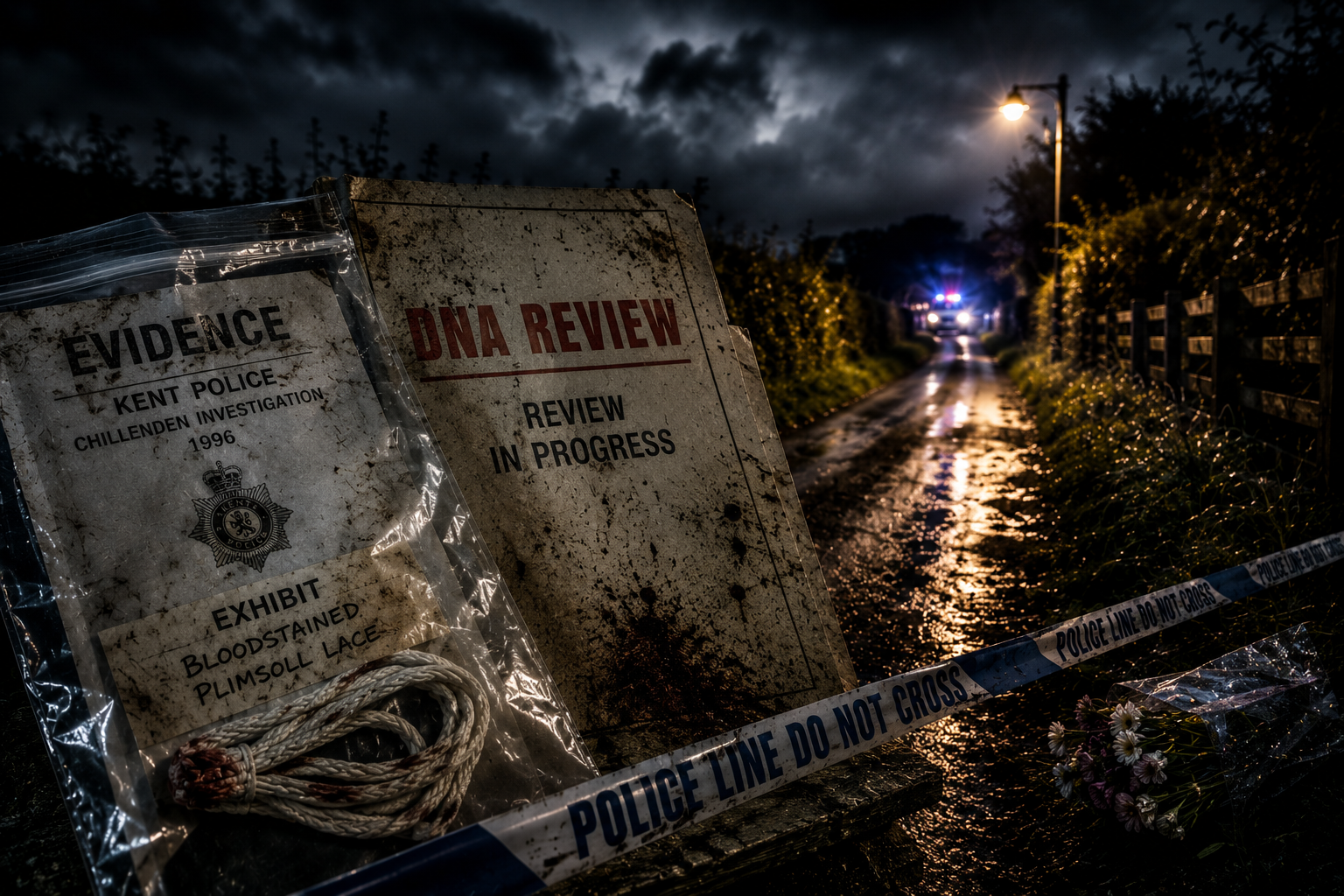
Recent reporting says the renewed forensic work may involve techniques including DNA-17 and Y-STR testing, with attention on items such as a bloodstained plimsoll lace and skin tapings from Lin and Megan. It also reports historic problems around contamination and missing exhibits, including a lunchbox said to have carried a bloody fingerprint.
That does not mean the case is about to be overturned. It means old fragments are being asked new questions.
The Outcome That Did Not End The Story
The formal legal outcome remains clear. Stone was convicted again in 2001 at Nottingham Crown Court of murdering Lin and Megan Russell and attempting to murder Josie Russell. He received life sentences. His appeal was dismissed in 2005. The CCRC announced in July 2023 that it had concluded there was no real possibility the Court of Appeal would overturn the convictions after that review.
That is the legal position. It matters because responsible coverage cannot write as if Stone is merely a suspect. He is a convicted person. It also cannot write as if the conviction has been overturned because it has not.
But the outcome did not end the story because legal finality and public confidence are not always the same thing. A conviction can stand while arguments continue. A review can be opened while the conviction remains in force. A forensic test can be pursued without any promise that it will produce usable results.
The CCRC’s July 2023 statement said it had examined substantial material, including court transcripts, judgments, police files, Forensic Science Service files, reports of alternative events and suspects, interviews, and forensic tests. It said it had not identified credible new evidence or information raising a real possibility that the conviction would not be upheld.
Then, in October 2023, the CCRC announced a fresh review following a request from Stone’s representatives. It stressed that previous conclusions were not affected by the new review, while also saying additional work can be undertaken in eligible cases.
That sequence is the legal hinge. July 2023 closed one door. October 2023 opened another. The conviction remained. The review continued.
The Aftermath People Still Argue About
The aftermath has never been only about Stone. It has also been about the Russell family, the reliability of prison witness evidence, the limits of old forensic work, and the way institutions respond when a conviction remains contested for decades.
For Shaun and Josie Russell, public debate about the conviction sits on top of private loss and survival. That can be overlooked when a case becomes a miscarriage-of-justice argument. A disputed conviction does not erase the victims. A forensic review does not turn grief into a legal puzzle. The human cost remains whether the conviction stands or falls.
For Stone and his supporters, the case has become an argument about whether the justice system relied too heavily on alleged admissions made in custody and too little on physical evidence. That argument has gained renewed force because modern DNA testing has changed what may be possible with old exhibits.
For the legal system, the case sits inside a wider debate about the CCRC and the Court of Appeal’s safety test. The CCRC’s role is not to decide innocence. It decides whether there is a real possibility that the appeal court would quash a conviction if the case were referred. That structure can frustrate campaigners because it is not designed as a broad public reinvestigation.
The Bellfield claims added another layer, but they did not resolve the case. A person already serving life sentences can make claims for many reasons. Some may be truthful. Some may be manipulative. Some may blend known facts with invention. The public cannot safely treat an alleged confession as a forensic result.
That is why the DNA review matters. It is not another story. It is a testable route through years of argument.
The Review, Appeal, Or Unanswered Question
The latest turn is forensic. As of July 5, 2026, recent reporting says Stone is expected to provide a fresh DNA sample as part of renewed testing connected to the CCRC review. The reported timing is close to the 30th anniversary of the July 9, 1996 attack, and the work is being framed around whether modern techniques can extract meaning from exhibits that earlier testing did not resolve.
The reported priority areas are significant. Skin tapings from Lin and Megan are said to matter because they came directly from the victims’ bodies. A bloodstained plimsoll lace is reported as important because it may have been used in restraint. Fingernail material identified in a forensic review has also been reported as a possible area of interest, with the argument that it may not have been tested in the original investigation.
Those details need careful explanation. DNA-17 testing can examine more markers than older systems, and Y-STR testing can help search for male DNA in certain mixed or difficult samples. But modern testing is not magic. A result still has to be relevant, interpretable, contamination-aware, and legally meaningful.
If DNA matching Stone were found on a highly relevant exhibit, it could strengthen confidence in the conviction. If DNA from another unknown male were found in a context strongly connected to the attacker, it could raise a serious question. If results are mixed, degraded, contaminated, or explainable through innocent transfer, they may not move the legal position much at all.
The appeal question is not whether the internet is satisfied. It is whether new evidence or argument could make the conviction unsafe under the law. That is a narrower and harder test.
The unanswered question is therefore precise: can science now produce a fact strong enough to change what courts have already accepted?
Why This Case Still Matters
This case still matters because it sits at the intersection of grief, proof, and forensic time. The original attack destroyed lives. The conviction gave the law an answer. The years since have shown how difficult it can be when that answer depends on evidence that many people still argue over.
The public version often wants a clean binary. Stone guilty or Stone innocent. Case closed or miscarriage of justice. Bellfield truth or Bellfield manipulation. DNA breakthrough or no breakthrough. The record is more disciplined than that. It asks what was proved, what was disputed, what survived appeal, what the CCRC has already rejected, and what new testing might still add.
The strongest lesson is not that convictions based on alleged confessions are always unsafe. Nor is it that DNA will always correct old cases. The lesson is sharper: a serious justice system has to keep separate the emotional need for certainty, the legal meaning of a conviction, and the scientific meaning of a trace.
The lane near Chillenden remains the article’s central image because it began as an ordinary route and became a legal problem that has lasted three decades. It was a place where a family’s life changed in minutes. It became a place courts had to reconstruct through words, witnesses, and fragments. Now it is being revisited through the smallest possible material: cells, contact, residue, and the hope that something preserved can still be understood.
Whatever the DNA review finds, it cannot restore Lin Russell or Megan Russell. It cannot return Josie’s childhood to what it was before the lane. It can only do what evidence is supposed to do: narrow the space between belief and proof.
The path looked ordinary until the case made every trace matter.
