True Crime: Pulse Nightclub Orlando—The Place Of Belonging That Became A National Wound
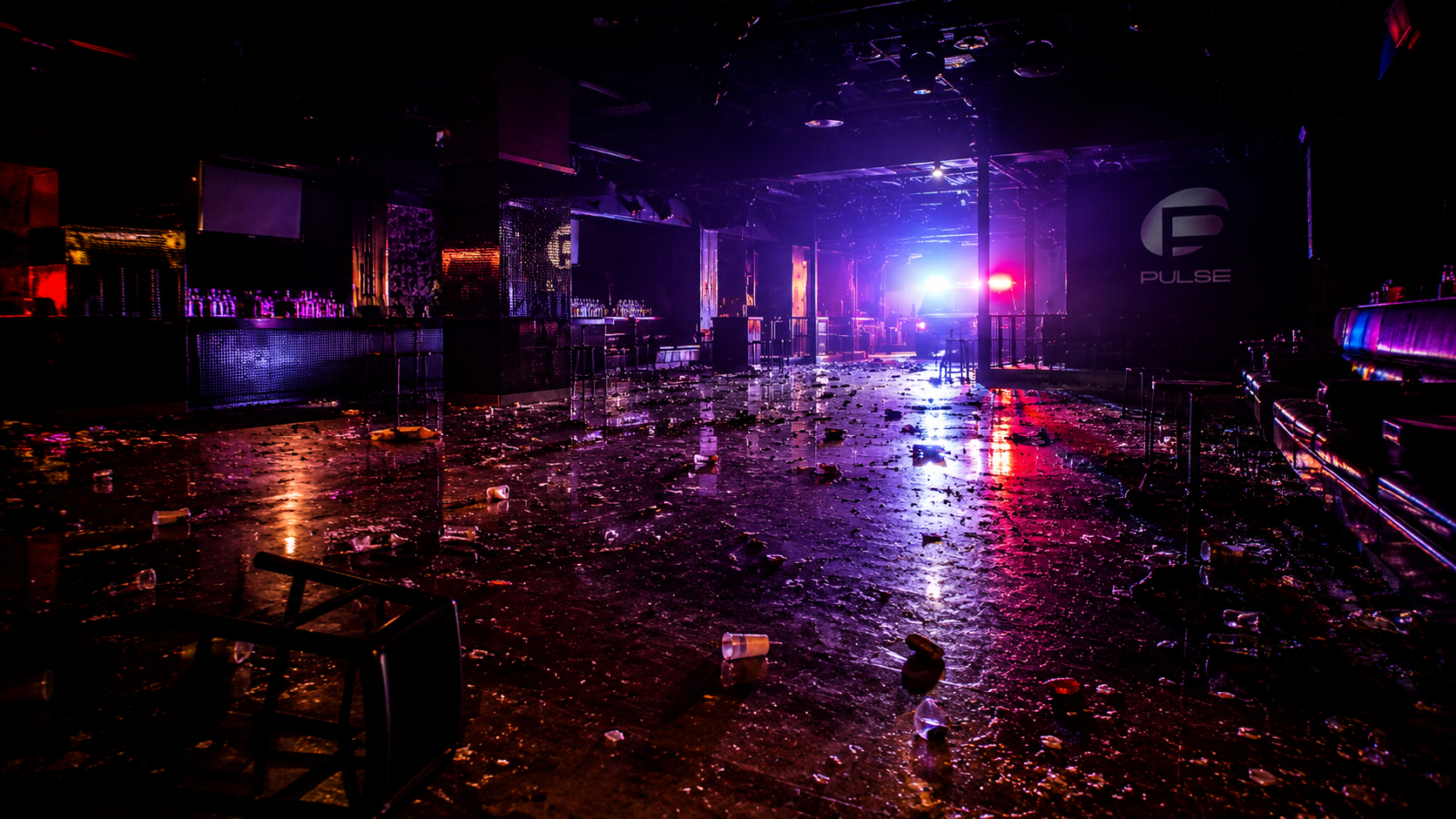
The Dance Floor, The 911 Calls, And The Legal Aftermath
Terror, Hate, Law, And Memory
The Dance Floor, The First Alarm, And The Question Orlando Still Carries
There was a dance floor on South Orange Avenue that meant something different before it became part of a national record.
On June 12, 2016, Pulse was hosting Latin Night. People were there for music, birthdays, friends, flirting, movement, and the private relief that comes when a place lets you stop translating yourself. The room was not an abstraction. It was a nightclub, a workplace, a meeting place, and for many, a kind of chosen-family living room with louder music.
The first thing the public saw was not the full record. It was fragments: unanswered phones, emergency messages, a police perimeter, names being searched online, families waiting for confirmation, and a city trying to understand how an ordinary Saturday night had become impossible to explain.
The answer did not arrive in one clean sentence. It emerged through emergency calls, witness accounts, federal investigation, court records, survivor testimony, public grief, and a memorial process that is still trying to decide what should remain on the ground where the music stopped.
The Life Before the Case
Pulse had a history before the attack. It opened in 2004 and was founded by Barbara Poma and Ron Legler in memory of Poma’s brother, John, who died from complications related to HIV/AIDS. The name carried the idea of a heartbeat continuing, not as a slogan, but as a reason for the club to exist.
That matters because Pulse was not simply a venue selected on a map. It was part of Orlando’s LGBTQ life, a place where people gathered for drag, dance, benefit events, theme nights, and ordinary nights out. The City of Orlando later described Pulse as a cherished LGBTQIA+ nightclub, a place of joy, belonging, friendship, and chosen family.
On Latin Night, that meaning narrowed and deepened. The event drew people whose identities overlapped: LGBTQ, Latino, immigrant, local, young, working, visiting, partnered, single, out, not fully out, surrounded by friends or briefly alone. The social meaning of the room was part of the case because the attack did not land in an empty public space. It landed in a room built for belonging.
Official records list the 49 people killed by name and age, from Akyra Monet Murray, 18, to Franky Jimmy DeJesus Velázquez, 50. The list includes Stanley Almodovar III, Amanda L. Alvear, Oscar A. Aracena Montero, Brenda Marquez McCool, Christopher Andrew Leinonen, Edward Sotomayor Jr., Shane Evan Tomlinson, and many others whose lives cannot be reduced to their last location.
The first duty of the story is to keep that human scale intact. A nightclub can become a symbol. A crime scene can become a legal file. A memorial can become a planning problem. But before any of that, Pulse was full of people whose night had begun with music.
The People Around Them
The people around Pulse were not one community in a simple sense. They were overlapping circles: regular patrons, first-time visitors, performers, bartenders, security staff, friends who came in groups, families who waited at home, and hospital workers who would later carry the next part of the night.
The club’s staff had the ordinary responsibilities of nightlife: managing entry, serving drinks, watching the room, moving between music and safety. Patrons had the ordinary trust people place in venues when they enter them. They expected crowdedness, noise, sweat, distraction, maybe an argument, maybe a spilled drink. They did not enter expecting to become part of a mass-casualty response.
The attacker, Omar Mir Seddique Mateen, came from outside that social world. He was a 29-year-old security guard from Florida. He had previously come to FBI attention in separate inquiries, but those inquiries had been closed before the attack. Federal officials later said they saw no indication that the attack had been directed from outside the United States or that Mateen was part of a wider operational network.
That distinction matters. The case became publicly described through several lenses at once: terrorism, hate, mass shooting, attack on LGBTQ people, attack on Latino communities, and failure of public safety imagination. Those frames were not identical. Each explained something. None, alone, explained everything.
The people around Pulse had no reason to know that a private decision made elsewhere was moving toward them. That is one of the hardest parts of the case. The room had meaning to the people inside it. To the attacker, the available record suggests it became a target late, through movement, searches, and opportunity.
The First Cracks
The first cracks in this case do not appear inside Pulse. They appear in the gap between what agencies had once seen and what they could prove before June 12.
The FBI had previously investigated Mateen after concerning statements and a separate possible connection, but officials said those earlier inquiries did not produce enough to justify further action. That fact later became part of the public debate: not because it proved negligence by itself, but because it showed the narrow line between concerning speech and actionable intelligence.
After the attack, federal officials described Mateen as radicalized at least in part through online material, while also emphasizing that the investigation did not show a foreign-directed plot. That left the public with a less satisfying but more accurate explanation: inspiration without command, ideology without clear operational control, and violence carried out by one person whose exact mixture of motives remained partly beyond the record.
There were also early claims and rumors about whether Mateen had specifically targeted Pulse because it was a gay club, whether he had visited the venue before, and whether he had hidden personal ties to LGBTQ spaces. Later court filings and evidence complicated those early assumptions. A defense filing in Noor Salman’s federal case stated that there was no evidence that Mateen or Salman’s devices accessed the Pulse website, while phone and search evidence placed Mateen in a wider search pattern involving downtown Orlando nightlife.
That does not erase the harm done to LGBTQ people. It sharpens the distinction between impact and proven selection motive. Pulse was an LGBTQ space. The people inside were targeted in fact. But the public record remains more cautious about whether anti-LGBTQ hatred was the specific reason Mateen chose that exact club.
The Last Ordinary Movements
The final ordinary movements of the night are important because they show how late the case narrowed.
Court filings later described Mateen moving through parts of Orlando before arriving at Pulse. A defense filing in Salman’s case described searches for “downtown orlando nightclubs” and placed other potential locations in the timeline before Pulse became the final destination.
That evidence mattered because it challenged a simple public story. Many people naturally assumed that Pulse must have been chosen long in advance because of what Pulse represented. The legal record suggested a more unstable picture: a man moving, searching, redirecting, and arriving at a place whose vulnerability and meaning became catastrophic together.
Inside Pulse, the night still looked normal until it did not. The official FBI summary says approximately 300 people were at the nightclub when, just after 2 a.m., Mateen opened fire on staff and patrons.
The words “just after 2 a.m.” can flatten the moment. In a club, that is not an empty hour. It is deep into the night, when people are still dancing, still deciding whether to stay, still checking phones, still trying to find friends across a room. The time matters because it explains the density of the space and the difficulty of escape.
The last ordinary detail was not dramatic. It was the assumption that the room would continue behaving like a nightclub: music, crowd, movement, exit, home. That assumption broke before many inside could understand what had changed.
The First Alarm
The first alarm moved faster than comprehension.
The attack began as an active-shooter situation and then became a hostage-taking situation when Mateen barricaded himself with victims in a bathroom area. The FBI’s summary states that law enforcement officers killed the shooter around 5 a.m.; in total, 49 victims were murdered and 58 others were wounded.
Those hours created one of the central tensions in the case. To people outside, time stretched into confusion: police lights, blocked roads, emergency updates, names missing from group chats, loved ones calling hospitals, and families waiting for information that arrived slowly or not at all.
For responders, the event changed shape while it was happening. The Department of Justice’s later critical incident review described the case as moving from an active-shooter response into a barricaded-suspect and hostage situation, then into a terrorism response and final rescue operation.
That transition became a source of later argument. Some praised the response under extreme conditions. Others, including families and survivors, questioned whether more lives could have been saved if the building had been breached earlier. The official review found that Orlando police and law enforcement partners responded in a manner consistent with recognized practices, while also drawing lessons for future mass-casualty and terrorism incidents.
The first alarm therefore did not end when the shooting stopped. It became a longer question about time, command, uncertainty, and what emergency systems can realistically know while people are still trapped.
The Search for an Explanation
The first public explanation was terrorism.
During the attack, Mateen made 911 calls in which he claimed allegiance to several figures, including the leader of the so-called Islamic State, and referenced other attackers. The FBI later concluded that the attack was an act of terrorism and described it as the worst terrorist attack on U.S. soil since September 11, 2001.
That finding gave the case a federal frame, but it did not answer every human question. Terrorism explained part of the language Mateen used and part of the ideological environment he invoked. It did not fully explain the location, the timing, the personal pathway, or the gap between online radicalization and physical action.
President Barack Obama, speaking while the investigation was still young, called the shooting both an act of terror and an act of hate. That language captured the dual public meaning of the attack: ideological violence and targeted harm against people gathered in a place known for LGBTQ belonging.
Still, a careful article has to separate public meaning from courtroom proof. The attack undeniably struck LGBTQ and Latino communities. It also became part of the national story of mass shootings, terrorism, gun access, emergency response, and the vulnerability of spaces built for marginalized people.
The explanation people wanted was singular. The record was not. It showed a terrorist act, an attack on a protected social space, and a mass shooting whose full motive could not be reduced to one clean label.
The Evidence That Did Not Fit
The evidence that did not fit was not one object. It was the pattern of movement before Pulse and the absence of proof behind some early claims.
Court records in the Salman case became important because they opened a second layer of the story. Noor Zahi Salman, Mateen’s widow, was charged in 2017 with aiding and abetting Mateen’s attempted provision and provision of material support to ISIL, and with obstruction of justice. The Department of Justice stated at the time that an indictment is only a formal charge and that every defendant is presumed innocent unless proven guilty.
The case against Salman forced prosecutors and the defense to test claims about what she knew, what she did, what Mateen planned, and what the digital record showed. That trial did not retry the attack itself. It asked whether the government could prove Salman’s criminal responsibility beyond a reasonable doubt.
One key issue was whether she had knowingly helped scout or support the attack. Defense filings challenged parts of the government’s theory, including claims around prior web access to Pulse material and the meaning of location and search evidence.
That is where the public version and the legal version separated. Public grief often looks for a circle of responsibility wide enough to hold the scale of the harm. Criminal law asks a narrower question: what can be proven against a specific person, on specific counts, under a specific burden.
The evidence did not fit a simple expansion of guilt. It narrowed responsibility back toward the man who carried out the attack and forced the court to decide what the government had actually proved about anyone else.
The Event at the Center of the Case
The central event began shortly after 2 a.m. inside a crowded club. The FBI’s official summary describes Mateen opening fire on staff and patrons, after which the situation evolved from an active shooter event into a hostage-taking situation.
The exact lived sequence inside the building varied by person. Some escaped quickly. Some hid. Some were injured. Some called or texted family. Some were trapped in places where movement became dangerous. Emergency communications later became part of the public record, but the City of Orlando emphasized that Florida law required protection for victim privacy and that some recordings could be released only as transcripts or after redaction.
Mateen’s phone calls during the attack became central evidence for the terrorism classification. In those calls, he claimed allegiance to extremist figures and linked the attack to broader political violence. But a phone call can show what a perpetrator wanted to announce. It cannot, by itself, fully reconstruct why he chose each step before he made it.
The physical response outside the building changed as information changed. First responders had to confront active gunfire, injured survivors, possible explosives claims, hostage communications, and the difficulty of entering a structure where victims were still inside. The later federal review emphasized both the complexity of that evolving incident and the need for lessons around planning, training, policy, and mass public violence response.
The event ended when officers breached and killed Mateen around 5 a.m. The legal case against him ended there too, because a dead perpetrator cannot be tried. That absence of a trial matters. It left the public to piece together motive, planning, and responsibility through investigation, official summaries, and a later prosecution of someone else.
The event at the center of the case was therefore both brutally clear and legally incomplete. The act was known. The dead and wounded were known. The person who fired was known. But the courtroom process that often explains a crime in public never happened for the man who committed it.
When the Story Broke Open
By daylight, Pulse was no longer only an Orlando story.
It became a national and international symbol because of where the attack happened, who was harmed, and when it occurred. Pride Month gave the timing added force. Latin Night made the grief especially sharp in Latino and queer communities. The number of dead made it, at that time, the largest mass shooting in U.S. history, according to the City of Orlando’s memorial history.
But the public story also broke open in ways that were messy. Early reports mixed confirmed facts with witness memories, speculation about motive, claims about prior visits, and political argument. That is common after mass violence, but it is also dangerous. The faster a case becomes symbolic, the easier it is for untested claims to harden into public memory.
The public needed names. The city eventually released the list of victims, each with an age, creating the first official human outline of the loss.
The public also needed language. “Terrorism” described the federal classification. “Hate” described the moral and social impact. “Mass shooting” described the method and scale. “Attack on LGBTQ people” described the place and the people harmed. “Attack on Latino Orlando” described the night and many of the families left grieving.
No single phrase carried the whole truth. The case became larger than the first explanation because each community saw a different part of itself in the damage.
The Case Built from Fragments
The legal case built from fragments was not against Mateen. It was against Salman.
Prosecutors alleged that she aided and abetted material support and obstructed justice. The defense disputed the government’s interpretation of her statements, knowledge, and actions. The judge and jury were not being asked whether the attack was horrific. That was beyond dispute. They were being asked whether the prosecution had proved Salman’s guilt on the charged counts.
That legal distinction was hard for many people because the emotional scale of Pulse made acquittal feel, to some, like a failure to match the harm. But criminal law does not convict by emotional arithmetic. It requires proof attached to the defendant.
Court records show that Salman’s trial ran from March 1 to March 30, 2018. The jury found her not guilty on both counts, and the court entered a judgment of acquittal on April 3, 2018.
That outcome did not mean nothing suspicious had been argued. It meant the government did not carry its burden. The difference matters because it protects the integrity of every legal conclusion in the case.
The prosecution of Salman also exposed the limits of trying to answer a mass-casualty event through a secondary defendant. Mateen was dead. He could not be cross-examined. His private decision-making could not be tested in the ordinary way. The government tried to prove that someone close to him had criminal knowledge. The jury did not accept that proof beyond a reasonable doubt.
The case built from fragments ended with a legal answer narrower than the public grief.
The Outcome That Did Not End the Story
The immediate criminal outcome was stark. Mateen was killed by law enforcement at the scene. No criminal trial against him followed. Salman, the only person later federally charged in relation to the attack, was acquitted of both charges.
That left Pulse with a kind of legal closure but not emotional closure. The perpetrator was dead. The widow was acquitted. The victims remained dead. Survivors remained injured or traumatized. Families still had questions about response time, medical rescue, public records, memorial planning, and why a place of safety became the site of so much loss.
The legal meaning of Salman’s acquittal is precise. It does not erase the attack. It does not make the government’s questions irrational. It means a jury did not find proof beyond a reasonable doubt that she committed the charged crimes.
The legal meaning of Mateen’s death is also precise. It ended the threat and prevented a trial. It did not create a full public record of motive, planning, or mental state through adversarial proceedings.
So the case moved from courtroom and investigative files into another arena: memory. That arena has its own disputes. Who gets to design a memorial? What should happen to the building? How much should be preserved? How should survivors be supported? When does remembrance become spectacle?
Those questions became the next phase of Pulse.
The Aftermath People Still Argue About
The aftermath of Pulse has never been only ceremonial.
The City of Orlando purchased the Pulse site in late 2023 and committed to a collaborative memorial process involving survivors, victims’ families, and the broader community. The city’s memorial page states that the goal is a place of solemn reflection that honors the 49 victims and those affected.
That step followed years of controversy around earlier private memorial plans, fundraising, scale, and trust. The public debate was not simply about architecture. It was about ownership of grief. Families and survivors did not all want the same thing, and no memorial process could make them want the same thing.
In March 2025, Orlando issued a request for proposals for memorial design and construction. The conceptual plan included a memorial and reflection space formed by the footprint of the original building, a survivor’s commons, a private gathering space, 49 canopy feature columns, a reflection pool where the dance floor was, a healing and prism garden, and a visitor pavilion. The city stated that completion was slated for the end of 2027.
By 2026, the process had moved further. The memorial process page says the design-build team is transforming the conceptual design into detailed design, with design expected to be finalized in August 2026 and the memorial anticipated to open by the end of 2027.
The argument now is not whether Pulse should be remembered. It is how to remember without turning pain into a destination stripped of its human meaning.
The Review, Appeal, or Unanswered Question
There is no pending criminal appeal that can change the core legal outcome. Mateen is dead. Salman was acquitted. The formal criminal process is over.
The unresolved question is different: what did Pulse reveal about the limits of prevention, response, public certainty, and memorial responsibility?
The Department of Justice’s critical incident review found that Orlando police and partners responded consistently with recognized practices, while also identifying lessons for planning, policy, training, and future incidents.
That official finding does not end every survivor or family concern. Reviews can assess policy and practice; they cannot fully answer the counterfactual question that haunts mass-casualty events: who might have lived if one decision had changed sooner?
The motive question also remains less simple than many summaries suggest. The FBI classified the attack as terrorism. The public understood it as an attack on LGBTQ life. The president called it terror and hate. Later court evidence complicated the claim that Pulse had been selected long in advance specifically because it was a gay club. Those statements can coexist if handled carefully.
That is the uncomfortable lesson. A case can be morally clear in its harm and still legally complex in its motive evidence. It can devastate a community even when investigators cannot prove every internal reason for the target selection.
Pulse refuses the false comfort of a single explanation.
Why This Case Still Matters
Pulse still matters because it sits at the crossing point of several American failures and several forms of American resilience.
It is about terrorism without a foreign command structure. It is about mass shooting response under pressure. It is about LGBTQ spaces as places of safety and visibility. It is about Latino families mourning in two languages and across borders. It is about public records, privacy, survivor care, memorial politics, and the law’s inability to turn grief into a complete answer.
It also matters because the building itself changed meaning. The dance floor became evidence. Then it became a memorial question. In the current design concept, the reflection pool is planned for the place where that dance floor once was. The site is being asked to hold joy, violence, absence, remembrance, and public education without collapsing them into spectacle.
The perpetrator has no life now to report. He died at the scene after killing 49 people and wounding dozens more. The more important question is not what became of him, but what became of the people whose names now define the site more than his ever should.
A strong memory of Pulse should not center the attacker. It should return to the room before the case machinery arrived: music, friends, movement, a place created from a brother’s heartbeat, and people who had every reason to believe the night would end with them going home.
