True Crime: The Charlie Kirk Case: The Rifle, The Roof, And The Questions Still Burning
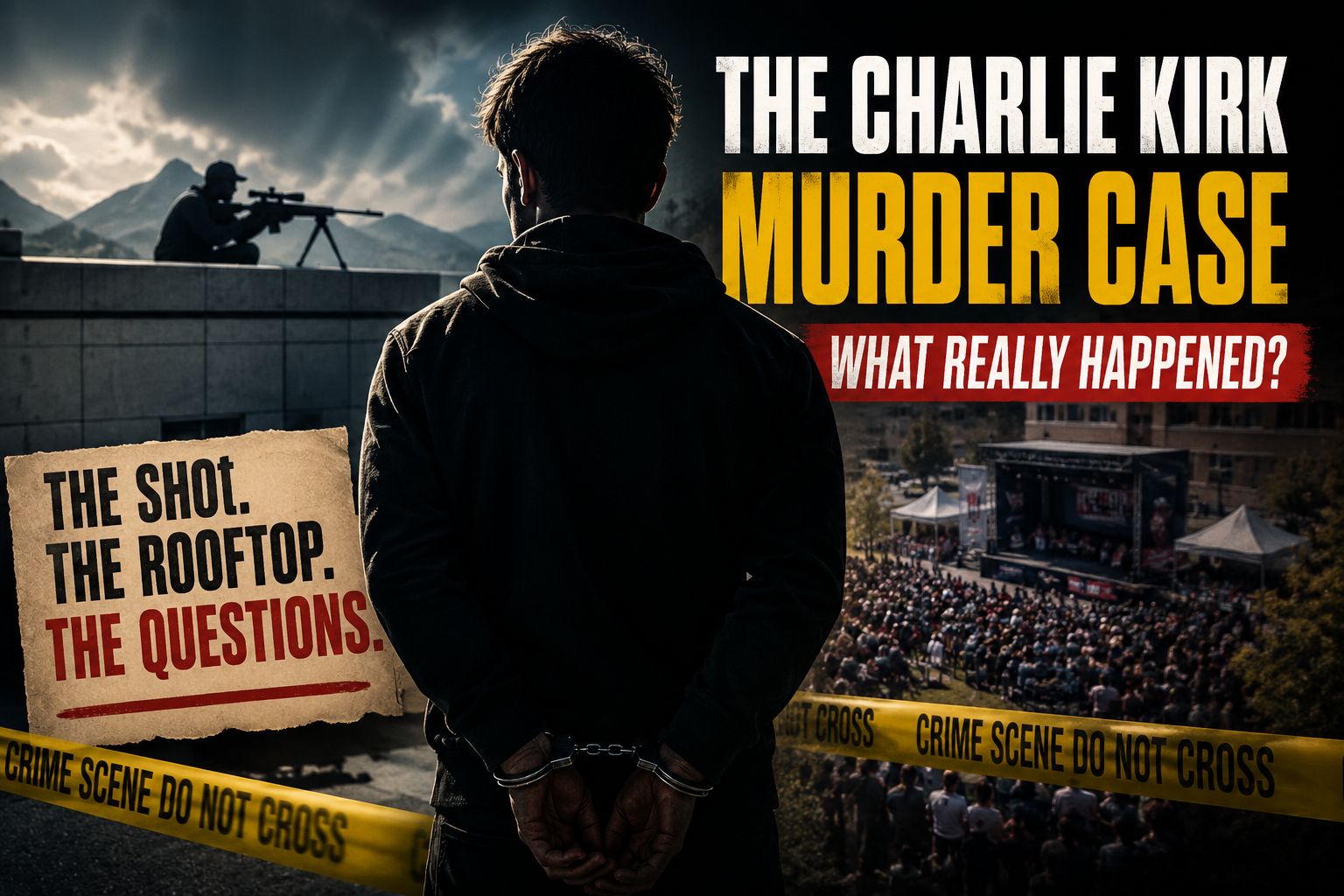
The Timeline, The Accused, And The Evidence Under Fire
The Evidence, The Gaps, And The Conspiracies
The Roof, The Crowd, The Five-Day Hearing, And The Questions Still Unanswered
A campus event can look ordinary until one detail changes the whole shape of it.
At Utah Valley University, the ordinary details were familiar: a public political event, a crowd gathered around a speaker, a portable canopy, a table, a microphone, students moving through campus, security trying to watch a space that was open, busy, and difficult to control.
Then the case narrowed to a roof.
Not at first. At first, there was a shot, panic, a wounded public figure, and a rush to understand where the danger had come from. What investigators later focused on was more specific: a rooftop line of sight, a patch of gravel, a camera angle, a route away from campus, and a rifle found in a wooded area.
This is the case prosecutors are now trying to build against Tyler James Robinson, the 23-year-old Utah man charged in the killing of conservative activist Charlie Kirk. Robinson has not entered a plea, and the case remains active. The current preliminary hearing is not a trial. It is the stage where prosecutors must show enough evidence for the case to move forward.
The central question is no longer only what happened at Utah Valley University on September 10, 2025. It is whether the evidence prosecutors have presented is strong enough to carry the case into a capital murder trial — and whether the defence can turn gaps, uncertainties, forensic limits, and pre-trial publicity into reasonable doubt.
What Happened At Utah Valley University
Charlie Kirk was at Utah Valley University in Orem, Utah, on September 10, 2025, for a public outdoor event organized by Turning Point USA. Prosecutors’ charging document says the event was scheduled for noon and that Kirk sat beneath a portable canopy behind a table and microphone, taking questions from attendees in his usual debate format. The crowd surrounded him on several sides, with temporary fencing only a short distance from the stage area.
According to the probable cause statement, the shot came roughly fifteen minutes into the event while Kirk was answering a question about mass shootings by transgender individuals. The filing says the bullet struck him in the neck, passed close to other people near him, and that children were visible near the stage. Kirk was taken to a nearby hospital and later declared dead.
The court document also describes the Hall of Flags, an indoor walkway with glass windows overlooking the plaza where Kirk was seated. That geography matters because prosecutors allege the shooter used a nearby roof position with a clear line of sight. The official charging paper states that a university officer heard the shot, believed it sounded like a rifle, scanned for possible sniper positions, and moved toward a roof area about 160 yards away.
The first phase of the case was therefore not a neat arrest story. It was a fast-moving search in a crowded public space. Investigators had to determine the direction of fire, identify a possible firing position, trace a route away from that position, and connect a person to that route. The early panic became a question of geometry: where could a shooter have been, and what would a camera have seen?
The Man At The Center Of The Case
Kirk was 31 when he was killed. He was one of the most visible conservative activists in the United States, known for campus debates, youth-focused political organizing, and the organization he co-founded, Turning Point USA. Prosecutors’ own filing describes him as a “well-known conservative activist” whose events drew both strong support and strong opposition.
That public profile is important, but it also creates a problem for the case. A killing of a prominent political figure immediately becomes symbolic. People start arguing about ideology before the evidence is complete. Online communities build theories before court has tested facts. Supporters, critics, opportunists, and foreign propaganda accounts all compete to define what the killing “means.”
The court, however, has a narrower task. It must decide what the evidence proves about one charged defendant. Prosecutors have charged Robinson with aggravated murder and related offences. The defence is not required to explain every political argument around the case. The prosecution must prove the legal case.
That distinction matters. Kirk’s public life explains why the case became nationally explosive. It does not, by itself, prove who fired the shot.
The First Alarm And The Search
The probable cause statement says a university police officer went to the suspected roof position immediately after the shot. The officer found what prosecutors describe as impressions in the rooftop gravel, potentially left by the elbows, knees, and feet of someone lying prone in a firing position. The same filing says the officer confirmed a clear shooting corridor between that spot and Kirk’s seat.
That was the first physical anchor. The case was no longer only about a sound heard in a crowd. It had a suspected firing position.
Investigators then reviewed campus surveillance. Prosecutors allege that cameras showed a person in dark clothing crossing from a public walkway over a railing onto the roof at about 12:15 p.m. The filing says the person later appeared running across the roof, low-crawling toward the suspected shooting position, then rising and running away after a time matching the known moment of the shot.
The surveillance evidence became the spine of the investigation. Prosecutors say it showed a person entering campus from the north at about 11:51 a.m., wearing a black shirt with an American flag, a dark cap, and large sunglasses. The filing says the person kept his head down, rarely raised his face clearly toward cameras, and walked with an unusual gait that investigators interpreted as consistent with a rifle hidden in his pants.
This is a central prosecution claim, not a finished jury finding. Video can show movement, clothing, route, timing, and sometimes posture. It does not automatically prove identity, intent, or what was inside clothing. That is why the defence has focused on what the video does not conclusively show.
The Timeline As It Is Currently Understood
The public timeline begins before noon on September 10, 2025.
Prosecutors say Kirk’s event was scheduled at noon. The charging document places the shooting at approximately 12:23 p.m. It says the suspected shooter entered the UVU campus at about 11:51 a.m., crossed toward the relevant rooftop route, and was captured on camera crossing onto the roof at about 12:15 p.m.
Immediately after the shot, prosecutors say cameras captured the suspect running across the roof carrying an item shaped like a rifle, climbing down, appearing to drop it during a controlled fall, picking it up, and running toward the northeast end of campus. Officers later followed that escape path toward a wooded area. There, investigators found a bolt-action rifle wrapped in a towel.
The manhunt lasted into the next day. The official probable cause statement says police released surveillance photos and asked the public for help. On the evening of September 11, Robinson went to the Washington County Sheriff’s Office with his parents and a family friend to surrender.
Formal charges followed on September 16, 2025. The Utah County charging document lists seven counts: aggravated murder, felony discharge of a firearm causing serious bodily injury, two obstruction of justice counts, two witness tampering counts, and violent offence committed in the presence of a child. It also includes victim-targeting enhancement language alleging Kirk was selected because of Robinson’s belief or perception regarding Kirk’s political expression.
The preliminary hearing began July 6, 2026, and was expected to run for five days. Its purpose is not to decide guilt. The judge must decide whether there is sufficient evidence to proceed toward trial.
The Evidence Prosecutors Say They Have
The prosecution case is currently built from several strands. None should be treated as a conviction. Together, they explain why prosecutors are pursuing a capital case.
The first strand is video and surveillance evidence. At the preliminary hearing, prosecutors presented footage that investigators say shows Robinson’s movements on the day of the killing, including time on campus before the shooting, access to a rooftop, and movement away after the shot. A state investigator testified that video showed the defendant going onto the roof and taking a sniper position.
The second strand is the suspected weapon. The charging document says investigators found a bolt-action .30-06 rifle wrapped in a towel in a wooded area near the route the suspect allegedly used to leave campus. The rifle contained one spent round and three unspent rounds. Prosecutors say this matched the scene evidence because no shell casings were found on the roof, which was consistent with a bolt-action weapon and a single shot.
The third strand is DNA. The probable cause statement says DNA consistent with Robinson’s was found on the rifle’s trigger, other parts of the rifle, the fired cartridge casing, two unfired cartridges, and the towel. That is one of the prosecution’s strongest public claims because it links the accused to objects the state says were central to the shooting.
The fourth strand is the engraved ammunition. The charging document records inscriptions on the fired and unfired cartridges. The inscriptions include internet-meme-style language, political or anti-fascist phrasing, and lyrics from “Bella ciao.” This matters less because of what the words mean by themselves, and more because prosecutors allege Robinson later discussed engraving bullets in messages.
The fifth strand is family identification and surrender. Prosecutors say Robinson’s mother saw a news image of the suspected shooter and thought it looked like her son. His father allegedly agreed and believed the rifle in the case resembled a rifle given to Robinson. The charging document says Robinson did not respond when asked to send a photo of the rifle, later spoke with his father, implied he was the shooter, and was persuaded by family and a retired deputy sheriff to turn himself in.
The sixth strand is messages and the alleged confession note. Prosecutors say Robinson sent his roommate a message telling the roommate to look under his keyboard, where the roommate found a note stating that he had the opportunity to “take out Charlie Kirk” and was going to take it. The filing says police found a photograph of the note. It also quotes messages in which Robinson allegedly admitted involvement, discussed retrieving the rifle, described leaving it wrapped in a towel, referred to engraved bullets, and told the roommate to delete the exchange and stay silent if police asked questions.
The seventh strand is residence evidence. The probable cause statement says police found a shell casing with etchings similar to those found on the rounds in the rifle, plus targets with bullet holes, during a search of Robinson’s residence.
Prosecutors do not need each strand to do the same job. The video is meant to establish movement and opportunity. The rifle and DNA are meant to connect Robinson to the alleged weapon. The messages are meant to show admission, planning, motive, and consciousness of guilt. The family account is meant to explain identification and surrender. The residence search is meant to support preparation or familiarity with the ammunition.
The power of the prosecution case is accumulation. The defence will try to separate those strands and expose weaknesses inside each one.
What Is Lacking Or Still Unproven
Several important things remain unproven in court.
First, there has been no trial verdict. Robinson is charged, not convicted. He has not entered a plea, and his lawyers have not publicly conceded guilt. That means every central prosecution claim remains an allegation until tested through the criminal process.
Second, the preliminary hearing standard is lower than trial proof. At this stage, prosecutors only need to persuade a judge there is enough evidence to move forward. A trial jury would later be asked to decide guilt beyond a reasonable doubt. Those are different legal thresholds.
Third, some forensic evidence appears contested or incomplete. Earlier defence filings cited an ATF analysis that could not conclusively connect a bullet fragment recovered during the autopsy to the rifle found near the scene. Later explanations emphasized that an inconclusive firearms result is not the same as exoneration; it means the available fragment did not allow an examiner to identify or exclude the rifle.
Fourth, the defence is probing chain of custody and evidence handling. During cross-examination at the preliminary hearing, defence attorney Kathryn Nester questioned the investigator about autopsy involvement, the gun’s chain of custody, and discrepancies in eyewitness accounts. That signals a likely trial strategy: not simply denying the state’s narrative, but attacking whether each item was collected, preserved, interpreted, and connected correctly.
Fifth, motive remains legally sensitive. Prosecutors allege political targeting, and the charging document includes victim-targeting enhancement language. It also quotes family and message evidence suggesting Robinson believed Kirk spread hate. But motive is often less precise than the public wants. A jury may not need to find one clean ideological explanation if the state proves the legal elements.
Sixth, some video evidence appears to be interpretive. Footage may show clothing, movement, route, posture, timing, or a carried object. Whether it proves identity beyond reasonable doubt depends on quality, continuity, corroboration, and how it fits with the DNA, messages, and other records.
Seventh, the court has not finished hearing the preliminary evidence. As of July 7, 2026, prosecutors were still presenting videos, testimony, and expected evidence from the roommate. That means the public record is expanding in real time.
The missing pieces do not mean the case is weak. They mean the case is not finished.
What Is Known About Tyler James Robinson
Robinson is from Washington, Utah. The official charging document lists his date of birth as April 16, 2003, making him 22 at the time of the September 2025 killing and 23 by the current preliminary hearing.
The public record describes him through three main lenses: family, politics, and digital communication.
His mother told police, according to the charging document, that he had become more political over the previous year and had started leaning further left, becoming more oriented toward gay and trans rights. The document says he had begun dating his roommate, described in the filing as a biological male transitioning genders, and that this contributed to discussions with family members, especially his father, whose political views differed from his.
The same filing says Robinson had mentioned Kirk’s upcoming UVU event before the shooting, called the venue “stupid,” and accused Kirk of spreading hate. Prosecutors later framed the case as politically targeted, which is why the charging document includes victim-targeting enhancement allegations.
This background should be handled carefully. A person’s politics, relationship, family tension, or online culture do not prove murder. Prosecutors are using those details to argue motive and premeditation. The defence may challenge whether those details are being overread, simplified, or unfairly turned into a political story.
What is publicly known about Robinson’s life before the case is still thin compared with the volume of evidence about the alleged offence. That imbalance matters. The court record is not a biography. It shows a young man through the narrow and distorted lens of a criminal prosecution.
What His Life Is Like Now
Robinson’s current life appears to be defined almost entirely by custody, court appearances, legal preparation, and public scrutiny.
The Utah County Attorney’s Office said after his arrest that Robinson was being held without bail. Subsequent public reporting has described him as held in Utah County jail, with his case before the Fourth Judicial District Court in Provo.
He is facing the possibility of the death penalty if convicted of aggravated murder. The charging document states that aggravated murder may carry death, life without parole, or an indeterminate term of at least 25 years to life, depending on the legal outcome.
His court life has also been shaped by media access. Earlier hearings dealt with whether records should be unsealed, whether proceedings should be public, what cameras may show, whether he could appear in civilian clothing, and how to prevent pre-trial publicity from contaminating a future jury pool. A judge allowed the July preliminary hearing to be public, rejecting defence arguments that closing portions was necessary to protect fairness.
The personal reality is likely stark: a 23-year-old accused in one of the most politically charged killings in recent American life, held without bail, watched by national media, defended by capital-case lawyers, and facing proceedings where even routine evidence arguments become public events.
But the public should be cautious about assuming his emotional state. Court records show legal status. They do not reliably show private life inside jail.
What The Defence Is Saying
The defence has not publicly offered a full alternative theory of what happened. That is normal at this stage. Defence lawyers do not need to prove innocence at a preliminary hearing. Their immediate task is to test whether the state’s evidence is enough to move the case forward and preserve issues for trial.
So far, the defence approach appears to have several clear lines.
First, they have challenged publicity and fairness. Robinson’s team argued that parts of the preliminary hearing should be closed and that public presentation of evidence could prejudice a future jury. The judge rejected the closure request, saying the defence had not shown that public evidence presentation would deny Robinson a fair trial.
Second, they challenged prosecution conduct. The defence argued that prosecutors violated a gag order through public comments and asked the court to remove the death penalty as a possible punishment. The judge found a prosecutor in civil contempt but declined to take the death penalty off the table, instead looking to jury-pool and questionnaire measures as possible protections against bias.
Third, they have questioned forensic certainty. Earlier defence filings highlighted the inconclusive ATF bullet-fragment analysis. That does not prove the rifle was not used. It gives the defence a way to argue that at least one expected forensic connection is weaker than the public may assume.
Fourth, they are testing the state’s evidence chain. At the preliminary hearing, defence cross-examination focused on issues including chain of custody, autopsy involvement, and discrepancies in eyewitness accounts. Those are not minor procedural points in a capital case. They are the foundation for reasonable-doubt arguments later.
Fifth, they have pushed against prejudicial presentation. The defence objected to at least some video material as potentially prejudicial, though the judge allowed a compilation video to be shown publicly.
The defence has not yet had to reveal its full trial strategy. At trial, it could argue mistaken identity, forensic insufficiency, unreliable interpretation of video, problems with the alleged messages, contamination of public opinion, gaps in chain of custody, lack of conclusive ballistics, or some combination of those. None of those arguments is automatically strong or weak. Their strength depends on how the evidence survives testing.
The Conspiracy Theories
The case became a conspiracy engine almost immediately because it joined three volatile ingredients: political violence, a famous victim, and an early information vacuum.
Some online theories claimed there was a second shooter. Others suggested foreign involvement, government involvement, staged footage, a false flag, or a wider political operation. Some claims focused on Israel, the Trump administration, Kirk’s own allies, security staff, or supposed suspicious gestures by people near the stage. The public record has not established those claims.
The most responsible way to handle conspiracies is not to pretend they do not exist, but to ask what evidence would be needed. A second-shooter claim would require reliable ballistic, audio, trajectory, wound, shell casing, witness, or video evidence supporting more than one firing position. The public case currently presented by prosecutors points to one rooftop position, one fired round, one recovered bolt-action rifle, and one charged defendant.
Claims that the video was fake, that foreign intelligence ordered the killing, or that political groups orchestrated it require more than motive speculation. They require documents, communications, payments, operational links, witness testimony, or forensic contradictions strong enough to survive court scrutiny. At present, the official public case does not show that.
The strongest fuel for conspiracy claims has been uncertainty around the evidence. The inconclusive bullet-fragment analysis became a major online talking point. But inconclusive does not mean exculpatory. It means the fragment did not allow a definitive firearms identification or exclusion. That is a gap the defence can use. It is not, by itself, proof of a different shooter.
Another source of confusion is the engraved ammunition. Early public discussion tried to read the inscriptions as a clean ideological map. The court filing itself shows a stranger mixture: memes, insults, anti-fascist phrasing, and song lyrics. That ambiguity matters. Internet-coded language can indicate subculture, provocation, ideology, irony, or chaos. It should not be treated as a complete manifesto.
The court process is now forcing the case out of the fog. Public evidence presentation does not kill every conspiracy. It does something more useful: it separates claims that can be tested from claims that only circulate.
The Evidence That Looks Strongest
The strongest public evidence against Robinson is not any single item. It is the apparent alignment of several independent strands.
The rifle was found along the alleged escape route. DNA consistent with Robinson’s was reported on the rifle, cartridges, and towel. The messages allegedly discuss leaving the rifle wrapped in a towel, engraving bullets, trying to retrieve the rifle, and telling the roommate to delete the exchange. Surveillance allegedly tracks the suspect’s route to and from the roof. Family members allegedly identified him from images and connected the rifle to him.
That is why prosecutors likely believe the case can survive the preliminary hearing. It is not just “a person looked like him.” It is video plus weapon plus DNA plus messages plus surrender.
For a jury, the question would be sharper: whether those strands are reliable, properly collected, properly interpreted, and sufficient beyond reasonable doubt.
The Evidence That Looks Most Vulnerable
The most vulnerable parts of the case appear to be the pieces that require interpretation rather than direct proof.
Video of a person moving across campus may not always show face, identity, or what exactly was hidden under clothing. The charging document itself says the suspect kept his head down and rarely raised his face enough for a clear image. Prosecutors interpret the unusual gait as consistent with a rifle hidden in pants; the defence may argue that interpretation is not proof.
The ballistic evidence also has a vulnerability. If the autopsy bullet fragment cannot be conclusively matched to the rifle, the defence can argue the weapon connection is less complete than prosecutors suggest. Prosecutors can answer that with DNA, location, cartridge evidence, video, and messages. But the inconclusive firearms result remains a genuine defence opening.
The alleged messages are powerful if authenticated and admitted. But digital evidence always invites questions: device control, context, metadata, extraction method, preservation, and whether the messages mean exactly what prosecutors say they mean. The defence will likely scrutinize those issues closely.
Finally, pre-trial publicity is not just background noise. The judge has already found a prosecutor in civil contempt over public comments, though he did not remove the death penalty. That creates a live appellate and trial-management issue: can a fair jury be selected after months of intense national coverage?
What Happens Next
The preliminary hearing is expected to continue through the week of July 6, 2026. Prosecutors are expected to present dozens of exhibits, including video, testimony, forensic material, and recorded evidence connected to Robinson’s roommate.
If Judge Tony Graf finds probable cause, the case should proceed toward arraignment and trial preparation. Robinson would eventually be asked to enter a plea. If the aggravated murder charge remains and prosecutors continue seeking death, the case becomes a capital trial with heightened procedural demands.
If the judge finds insufficient evidence on any count, parts of the case could be narrowed. That appears less likely based on current reporting and the low preliminary-hearing threshold, but the hearing is still legally meaningful. It forces prosecutors to show evidence in public and gives the defence an early chance to test weaknesses.
The next major questions are therefore procedural and evidentiary:
Will the judge bind Robinson over for trial on all counts?
Will the alleged roommate evidence be admitted in the form prosecutors want?
Will further forensic testing strengthen or weaken the firearms link?
Will the defence seek suppression of statements, digital evidence, or specific videos?
Will pre-trial publicity require a larger jury pool, deeper questionnaires, a venue change, or other protections?
And ultimately, will prosecutors prove the capital murder charge beyond reasonable doubt?
Why This Case Matters
The Charlie Kirk murder case matters for more than one reason.
It is a criminal case about a specific defendant, a specific victim, a specific campus, and a specific set of charges. That must remain the centre. Political symbolism should not outrun legal proof.
It is also a case about public violence in a polarized country. Kirk’s killing immediately became part of a larger argument about rhetoric, extremism, security, and the danger of turning political opponents into enemies. Prosecutors allege political targeting. The defence has not conceded that allegation. The court must test it, not inherit it from public anger.
It is a case about how evidence works in the modern information environment. Video can narrow a timeline. DNA can connect a person to an object. Messages can suggest intent or panic. Ballistics can help, but sometimes produce limits instead of certainty. None of those strands should be treated as magic. The legal question is what they prove together.
It is also a case about misinformation. The first hours after a political killing are now almost guaranteed to produce false claims, edited images, ideological blame, and speculative theories. The hearing is important because it puts evidence under rules. It does not answer every public suspicion. It asks what can be proved.
The roof began as a vantage point. It is now the central legal object in the case: a place prosecutors say explains the shot, the route, the rifle, and the man they have charged. Whether that account becomes a conviction is still for the court to decide.
For now, the strongest honest summary is this: prosecutors have presented a serious, multi-strand case against Tyler James Robinson, built around surveillance, a recovered rifle, DNA, alleged messages, family identification, and surrender. The defence is attacking the reliability, fairness, admissibility, forensic certainty, and public handling of that case. Robinson remains presumed innocent unless and until a jury decides otherwise.
