True Crime: South-East London Familial DNA Rape Hunt
The Abbey Wood Appeal And The Familial DNA Trail
Two Linked Rape Investigations And The DNA Search Across Britain
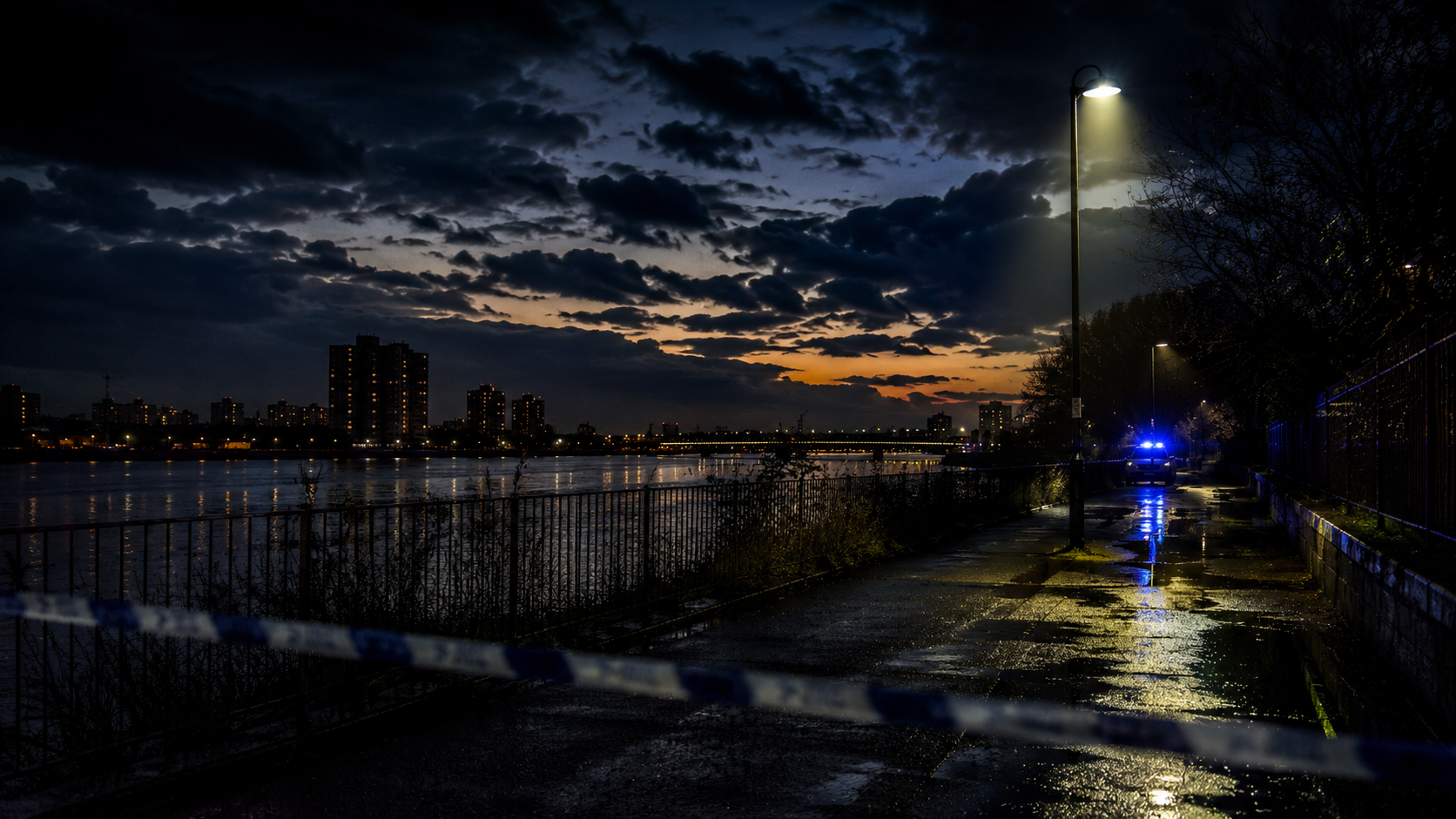
The Thames Path, Sewell Road, And The Genetic Clue Still Without A Name
The path mattered before the DNA did.
In south-east London, the Thames does not always feel like a landmark. In places, it becomes a line behind housing, walkways, derelict pockets, transport routes, and the overlooked spaces people pass through without thinking about them as evidence.
One woman was attacked near the Thames Path in Thamesmead in May 2020. Four years later, another woman reported being raped after being led toward a derelict area in Sewell Road, Abbey Wood. Police say the two investigations are now linked by DNA, by CCTV, and by a man they still have not publicly identified.
This article follows the case through the latest confirmed public developments as of July 5, 2026.
The question is no longer only who the man is. It is what happens when a case has a genetic signal, a public image, two vulnerable complainants, and still no name.
The Life Before The Case
The women at the center of this investigation are not named. That is not an omission. It is a legal and ethical boundary.
In England and Wales, rape complainants have lifelong anonymity in media reporting, including protection from publication of names, photographs, and identifying details. The Crown Prosecution Service states that this protection applies even if support for a prosecution is withdrawn or a defendant is found not guilty.
That means the public record gives only a narrow human picture. Police have described both women as vulnerable. It does not give the full shape of their lives, their routines, their families, their private histories, or what those days meant before they became part of a serious criminal investigation.
That absence should not make them feel less real. It should make the article more careful. These were not case labels. They were women moving through public or semi-public spaces in daylight, in places where ordinary life continued around them.
The People Around Them
The most visible people in the case are not the women themselves, but the institutions now speaking around them.
The Metropolitan Police are leading the investigation. Detective Chief Inspector Zoe Hendrick is named publicly as the officer leading the inquiry. The National Crime Agency has supported the forensic side by compiling a familial DNA list. Crimestoppers has entered the case with a reward offer designed to reach people who may know something but do not want to speak directly to police.
There is also a man police want to speak with. He has not been publicly named. He has not been convicted. The public appeal describes him as a male captured on local CCTV in June 2024, connected by enquiries to the two rape investigations.
This matters legally. A CCTV image is not a conviction. A DNA link is not a public identity. A familial search is not a final answer. The case sits in the space between strong investigative pressure and the evidential threshold required to identify, arrest, charge, and prove.
The First Cracks
The first known public crack came in May 2020 near the Thames Path in Thamesmead.
Police have not released a detailed public reconstruction of that incident. The available record says a vulnerable woman was raped near the Thames Path, and that the offence later became linked to the Abbey Wood investigation through further enquiries.
At that stage, the public did not yet have the full shape of the later pattern. There was no public name. No public charge. No courtroom narrative. No confirmed suspect moving through a trial.
The early case appears to have remained a serious unresolved investigation rather than a story with a clean public arc. That is often where the gap begins: not because nothing is happening, but because the most important work is private, forensic, and slow.
Four years later, a second report would make the Thamesmead attack look different. What had appeared as one unresolved case became part of a possible pattern.
The Last Ordinary Movements
The second known incident took place on Wednesday, June 19, 2024, in Sewell Road, Abbey Wood.
Police say the suspect was seen on CCTV leading a vulnerable woman to a derelict area. A short time later, she contacted police to report that she had been raped.
That sequence is short, but it carries the weight of the case. A street. A derelict space. A camera. A report made soon afterward.
The CCTV did not publicly answer everything. It did not name the man. It did not place a conviction in the record. But it gave investigators an image to circulate and a route through which members of the public might recognize someone.
The ordinary geography of Abbey Wood became part of the investigation because a place people might pass every day had become a legal and forensic scene.
The First Alarm
After the Abbey Wood report, the case entered a new stage.
Met officers launched an investigation following the June 2024 rape report. Specialist officers and partner agencies have continued to support the victims, according to the Met’s appeal.
The first alarm was not only the report itself. It was the connection that followed. Further enquiries linked the man seen in the CCTV footage to the earlier Thamesmead rape in May 2020.
That link changed the scale of the problem. It moved the inquiry from a single reported attack to two serious sexual offences separated by four years, both involving vulnerable women, both in south-east London, both in daylight, and both now treated as connected by investigators.
The public version remained simple. The investigative version was not. It had CCTV, DNA, geography, timing, vulnerability, and an unidentified man still outside the public record.
The Search For An Explanation
In many stranger-attack investigations, the first problem is not motive. It is identity.
Police do not have to explain every private thought before they can investigate. They have to identify the person responsible, test the evidence, rule people in or out, and build a case that can survive legal scrutiny.
Here, investigators say they carried out extensive enquiries using DNA matched from the scenes of both investigations. The public appeal does not disclose the full forensic profile, the number of samples, or the laboratory process. It does say the DNA was strong enough to link the two cases and to justify a specialist familial DNA route.
That route is rare for a reason. Familial searching is used when DNA from a crime scene does not produce a direct match on the National DNA Database, but may resemble the profile of a close biological relative. Official material describes familial searches as capable of producing possible relatives, with police then using other intelligence such as age and geography to narrow the list.
The search, then, is not just for a man. It is for the right branch of a family tree.
The Evidence That Did Not Fit
The strongest public evidence strand is the DNA link.
Police say DNA matched from the scenes of both investigations has driven extensive enquiries. The National Crime Agency compiled a list of men who share familial DNA with the suspect, and officers have traveled across the country to obtain voluntary evidential samples from people who could potentially be biologically related to him.
That does not mean every person approached is suspected of rape. It means they may sit somewhere near the unknown suspect on a biological map.
This is the part casual summaries often flatten. Familial DNA does not simply reveal a name. It creates leads. It can highlight possible relatives, exclude innocent people, and direct investigators toward a family line, but it still needs police work, consent where voluntary samples are sought, corroboration, and a final evidential match.
The case also has CCTV. Police are recirculating an image of a man they want to speak with, and the public portal asks anyone with information about the pictured male to come forward.
DNA gave the inquiry a direction. CCTV gave the public something to recognize. Neither has yet produced a publicly named suspect.
The Event At The Center Of The Case
The central event cannot be reconstructed like a closed trial because the case has not reached that stage publicly.
What can be said is limited but serious. In May 2020, a vulnerable woman was raped near the Thames Path in Thamesmead. In June 2024, another vulnerable woman was approached in Sewell Road, Abbey Wood, and the offence took place there. Police say the June 2024 CCTV captured a man they want to speak to.
The Abbey Wood account contains the clearest public sequence. A woman was led toward a derelict area. A short time later, she contacted police. The legal language remains careful because no public defendant has yet been charged or tried.
The forensic link is what turns the two incidents into one investigation. Investigators are not relying only on geography or similarity. They say the DNA from both scenes matched.
But DNA has limits. It can link biological material to a source. It can connect scenes. It can identify, exclude, or support an investigative route. It does not, by itself, explain every movement, every word spoken, or every moment of coercion. That is why the case still needs witnesses, recognition, corroboration, and a suspect who can be tested against the evidence.
When The Story Broke Open
The story widened on July 2, 2026, when the Met issued a fresh appeal and Crimestoppers announced a reward of up to £10,000.
The reward is specifically for information passed anonymously to Crimestoppers that leads to the conviction of the man responsible. The Met also gave a police reference, CAD 3842/30JUN2026, and directed people with information to call 101, contact @MetCC, use the Major Incident Public Portal, or contact Crimestoppers anonymously.
Crimestoppers’ role is important because some cases stall not from lack of evidence, but from lack of usable human information. A person may recognize a face. Someone may remember a changed routine. A relative may know why officers asked for a voluntary DNA sample. A person may have stayed silent because of fear, loyalty, shame, uncertainty, or not realizing the significance of what they knew.
The reward changes the public pressure. It tells the community that police still need the missing human link.
The Case Built From Fragments
The investigation now appears to rest on fragments that point toward the same unknown person.
There is the Thamesmead allegation from May 2020. There is the Abbey Wood allegation from June 2024. There is CCTV from the later case. There is DNA said to match across both scenes. There is a familial DNA list compiled with National Crime Agency support. There are voluntary samples being taken from people across the country. There is a public image police believe may unlock recognition.
The legal question is not whether the public finds that pattern alarming. The question is whether investigators can identify a person, connect that person to the forensic profile, and build a case strong enough for charging and prosecution.
That distinction matters. Suspicion may move quickly. Law does not. A person can be wanted for questioning without being publicly established as guilty. A family member can share DNA markers without being responsible for anything. A CCTV image can be important without being the final proof.
The case is powerful precisely because it is incomplete. It has enough evidence to sustain a rare national forensic hunt, but not yet enough public information to close the gap.
The Outcome That Did Not End The Story
There is no public conviction. No public charge has been confirmed. No suspect has been publicly named in the official appeal.
As of the Met’s July 2, 2026 appeal and the active police portal entry, the investigation remains open, the appeal remains live, and police are still asking for help identifying the male shown in the circulated images.
That is the uncomfortable current status. Two women have reported serious sexual offences. The police say forensic work has linked the cases. The public has been shown an image. The national DNA process has reached beyond London.
Still, the official file has not reached the point the public most expects from a true-crime story: a name, a charge, a trial, a verdict.
This is not a finished case. It is a live hunt with a forensic trail still searching for a human answer.
The Aftermath People Still Argue About
The aftermath is already happening, even without an arrest.
For the women involved, the aftermath includes support from specialist officers and partner agencies. For local residents, it includes the knowledge that two daylight attacks in familiar south-east London spaces are being treated as linked. For police, it includes the resource-heavy work of following genetic leads across the country.
For the wider public, the case raises a harder question about forensic power. Familial DNA can be an extraordinary tool in serious crime. It can also pull innocent relatives into an investigation because biology has created a lead they did not choose.
Official material on familial searching emphasizes why it is reserved for serious offences: it carries privacy, cost, and staffing implications, and it requires governance.
That tension is not a reason to avoid the method. It is a reason to explain it properly. In this case, familial DNA is not a shortcut around proof. It is a way of generating leads when the direct route has not yet named the suspect.
The Review, Appeal, Or Unanswered Question
The unanswered question is precise: who is the man police want to identify?
The official appeal does not ask the public to solve the case by speculation. It asks for information. Recognition. Context. A name that can be checked. A lead that can be tested.
That difference matters in sexual-offence cases. Public guessing can harm complainants, wrongly implicate innocent people, and contaminate the serious work that has to happen before a case can reach court.
The responsible public role is narrower and more useful. If someone recognizes the man in the police images, knows anything about the incidents, or has information that could assist the investigation, police and Crimestoppers have provided routes to report it. Crimestoppers says its process is anonymous, with no names, no statement, and no court appearance for people who contact the charity.
The case now depends on that narrow bridge between forensic science and human memory.
Why This Case Still Matters
The South-East London familial DNA rape hunt matters because it shows both the reach and the limits of modern policing.
A DNA profile can connect scenes four years apart. A specialist search can move across family lines. CCTV can place a man into public view. A reward can reopen attention. But none of that automatically produces justice.
The Thames Path and Sewell Road are not just locations now. They are the two points between which investigators believe the same unknown man moved through the public record.
The final answer may come from science. It may come from recognition. It may come from a person who knows more than they thought they knew.
Until then, the case remains suspended between a genetic clue and a missing name.
