True Crime: The Night Trayvon Martin Never Made It Home
The Florida Case That Redefined Suspicion
Trayvon Martin and the Rainy Night That Changed the Country
A police cruiser pulls up outside a townhouse in Sanford, Florida, just after sunrise. The rain from the night before has not fully left. A father is waiting for his son to appear, believing there must be some ordinary explanation for why the boy never came back. Instead, officers ask for photographs. Then they bring out one more image. It is not the one he expects.
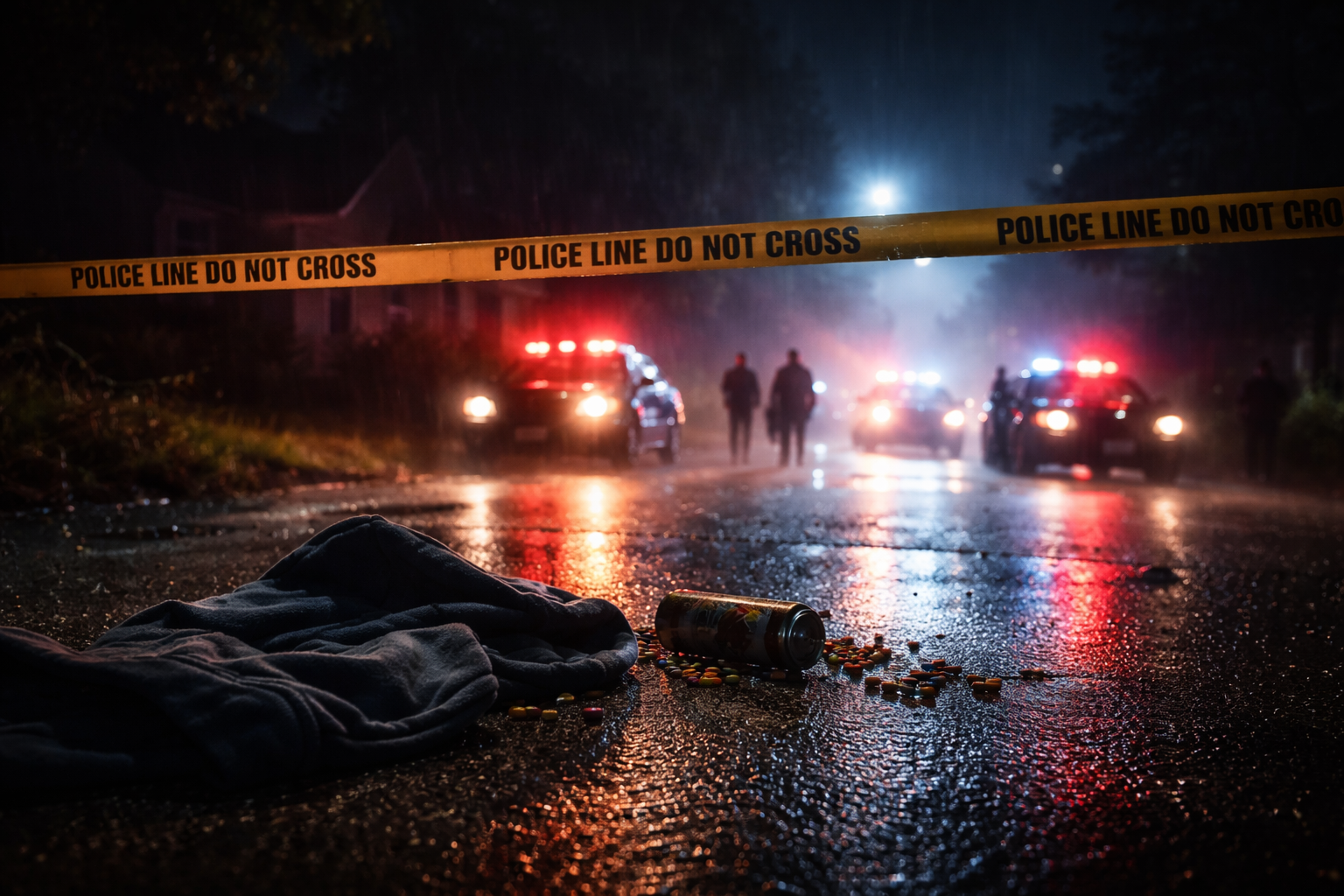
Hours earlier, neighbors had heard shouting in the dark and then a single gunshot. Someone called 911. Someone said there had been a fight. Someone was dead by the time police arrived. But in those first hours, outside a small gated community, the country knew almost nothing.
For days, the story barely moved. No cable frenzy. No national uproar. No marchers in hoodies. Just a dead 17-year-old, a man who said he acted in self-defense, and a case that looked, at first glance, as if it might disappear into local files.
It did not disappear. It became one of the defining true-crime and civil-rights stories of modern America. And the reason was not only what happened that rainy night. It was what happened next.
A Teenager Between Two Homes
Trayvon Martin is 17 years old. He lives in Miami with his mother, but in late February 2012 he is visiting his father and his father’s fiancée at the Retreat at Twin Lakes, a gated townhouse community in Sanford, about 20 miles north of Orlando. He is not a hardened criminal. He is not a shadowy mystery figure. By family accounts in early reporting, he is a high school junior who wants to become a pilot. He is a teenager moving between parents, routines, and the normal mess of adolescence.
That matters because true crime often starts by stripping the victim down to the final headline. A body. A case. A file number. But before he becomes a symbol, Trayvon Martin is a boy with a family, a younger brother, and the kind of ordinary errand nobody remembers until it becomes the last one. Reuters reported that he stepped away from watching the NBA All-Star Game and walked to a convenience store to buy snacks, including Skittles requested by his 13-year-old brother. He was returning to the townhouse where he was staying when everything changed.
The detail became famous because it was so small. Skittles. A drink. A hoodie in wet weather. None of it sounded like danger. That contrast is part of what made the case explode. Americans could see the gap between the image of threat and the image of a teenager on a snack run. The narrower that gap felt, the more unsettling the case became.
And there was another reason the story hit so hard. Trayvon was Black. The man who reported him as suspicious was later identified as George Zimmerman, a neighborhood watch volunteer described in Reuters reporting as white and Hispanic. From the beginning, the case carried a question that was larger than one street in Sanford: what exactly had made this teenager look dangerous?
That question would haunt every stage of the investigation. But on the night itself, nobody outside that neighborhood knew how consequential it would become.
The Walk Back Through the Rain
The scene is ordinary until it is not. Trayvon Martin is walking back through the community after buying snacks at a nearby convenience store. He is wearing a hoodie. Reporting from the time describes the weather as wet, and later accounts of the case repeatedly fix on that image: a teenager moving through rain in a sweatshirt with the hood up, on his way back to where he is staying.
Somewhere nearby, a man in a vehicle notices him. That man is George Zimmerman, who is participating in neighborhood watch activity and who tells police he believes the teen looks suspicious. In the first critical minutes, this is not yet a national morality tale. It is just a perception, a judgment, and then a phone call. But in true crime, the first judgment often matters more than the first piece of evidence. Before anyone knows the ending, somebody has already decided what kind of person they are looking at.
There had been recent break-ins in the area. That detail helped shape the atmosphere. It gave fear a local address. But fear in criminal cases is never neutral. It latches onto someone. It chooses a target. Reuters later reported that Zimmerman told dispatchers there had been break-ins in the neighborhood and described Martin as suspicious. That description, and what followed, became central to the case.
At this point in the story, the country still knows nothing. There is no viral tape yet. No million-signature petition. No crowds carrying candy and tea as symbols. There is only a teenager on foot and an adult man who has made a decision about him. Whether that decision was caution, profiling, overreaction, or some mix of all three would later divide a nation. But the chain starts here: observation, suspicion, pursuit.
And once that chain starts, it becomes very hard to stop.
The Call That Changed Everything
When George Zimmerman called police, he described Trayvon Martin as suspicious. Later reporting and court coverage made those words famous. The call became one of the most dissected audio recordings in modern American crime coverage because it captures the shift from watchfulness to pursuit. Reuters reported that Martin was wearing a hoodie and returning from a convenience store when Zimmerman called police and said the teen looked suspicious, then followed him.
This is where the case begins to harden into competing narratives. One side saw a neighborhood watch volunteer reacting to a context of local break-ins. The other saw a grown man escalating a harmless situation because a Black teenager in a hoodie looked, to him, like trouble. In between those positions sat the most important reality of all: Trayvon Martin was unarmed.
The recording mattered because it created a real-time trace of suspicion. The words could be replayed. The tone could be studied. The timing could be argued over. And in cases that later become political and cultural flashpoints, recordings do something witness memory cannot: they freeze the mood of the moment. Once the 911 tapes were released on March 16, Reuters reported that the story went viral within hours. A local death became a national debate.
But the call did not answer the biggest question. It only sharpened it. What happened in the gap between the report and the gunshot? What began as suspicion ended in a violent confrontation, with neighbors hearing screams for help and then a shot. Early reporting noted that it was unclear whose voice was screaming. That uncertainty fed the case for months. Families, lawyers, media figures, and investigators all pressed on the same wound: who was in danger, and when?
By the time America heard the call, the legal and moral battle lines were already forming. But on the ground in Sanford, police had already made the first decision that would set the nation on fire.
The Single Shot in Sanford
On February 26, 2012, Trayvon Martin was shot in the chest during a confrontation in the Retreat at Twin Lakes community. By the time police arrived, he was dead. Zimmerman later told police he had acted in self-defense after being attacked. Reuters reported his account as claiming Martin punched him, knocked him down, and repeatedly slammed his head into the pavement before he fired the fatal shot.
There were witnesses, but not clarity. Neighbors heard cries for help. Some saw fragments of the struggle. One of the hardest parts of the case, then and now, is that there is no clean, universally accepted visual record of the final moments. There are calls. There are statements. There are injuries. There are interpretations. And in that absence of certainty, both sides found room to build an argument.
That is why the case became more than a homicide investigation. It became a contest over narrative architecture. If you start with the image of an armed adult following an unarmed teenager, the encounter looks reckless at best and predatory at worst. If you start with the image of a man on the ground fearing great bodily harm, the shooting looks like self-defense. The entire national argument would turn on which part of the story people treated as the beginning.
And then came the decision that transformed anger into outrage: police briefly detained Zimmerman and released him. Reuters’ early timeline reported that there was no arrest that night and that Zimmerman soon went into hiding. For many people, that was the true ignition point. Not just that a teenager was dead, but that the machinery of law appeared, at first, to stop moving.
In true crime, public obsession often begins where official certainty ends. Trayvon Martin’s death entered that gap immediately.
The Morning After and the First Fracture
The next morning, Trayvon’s father was still looking for an ordinary answer. Reuters later reconstructed the moment with brutal simplicity: Tracy Martin thought his son might have gone to the movies and fallen asleep somewhere safe. When officers arrived and asked for recent pictures, the logic of hope collapsed. He was shown a photograph of his dead son taken at the scene.
That detail did more than humanize the case. It exposed the emotional distance between bureaucracy and loss. For police, the scene had already become evidence. For Trayvon’s family, it was still a missing-person mystery right up until it wasn’t. That brutal handoff, from uncertainty to catastrophe, shaped how the family and their lawyer would push the case into public view.
Attorney Ben Crump quickly began pressing for an arrest and for access to the 911 material. In Reuters’ March 8 reporting, he argued that if Zimmerman had never gotten out of his car, there would have been no reason to claim self-defense. The line was sharp and memorable because it condensed the whole case into a single contrast: “Trayvon only has Skittles. He has the gun.” Crump also told Reuters that Trayvon was a good kid, a high school junior who wanted to be a pilot.
This was the first major fracture in the case. It was no longer just police paperwork versus a shooter’s statement. It was a grieving family publicly challenging the logic of law enforcement. They were not merely asking what happened. They were asking why nobody had been arrested. That question turned a local case into a story about credibility, institutional judgment, and race.
For roughly 10 days, Reuters reported, the case remained relatively obscure. Then the recordings came out. Social media lit up. Petition numbers exploded. The silence ended. And once it ended, it never really went quiet again.
When a Local Killing Became a National Uproar
The turning point was exposure. On March 16, police released 911 tapes from the night of the shooting. Reuters reported that within hours the story went viral. Two days later, a Change.org petition calling for Zimmerman’s arrest was launched; Reuters’ timeline says it quickly passed 2 million signatures. The federal government took notice as well: on March 19, the Justice Department’s Civil Rights Division and the FBI opened an investigation.
Now the case had crossed the line from homicide investigation to national referendum. Protesters gathered around the country. Reuters described rallies in Washington, Chicago, and other cities where people wore hoodies like the one Trayvon Martin had on when he was shot. Others carried tea and Skittles. The symbols were not complicated. That was the point. They reduced a sprawling legal argument to a blunt moral image: a teenager in everyday clothes carrying candy should not end up dead.
Pressure fell not only on Zimmerman but also on local authorities. Reuters reported that Sanford city commissioners passed a motion of no confidence in Police Chief Bill Lee Jr., who then stepped aside. The originally assigned prosecutor also removed himself. Florida Governor Rick Scott appointed Angela Corey as special prosecutor and created a task force to examine public safety and the state’s controversial Stand Your Ground law.
President Barack Obama’s remarks added another layer. In March 2012, Reuters reported that Obama said, “If I had a son, he’d look like Trayvon.” More than a year later, after the verdict, Obama would expand that thought, saying Trayvon Martin “could have been me 35 years ago.” Those remarks mattered because they framed the case not only as a question of law but also of lived Black experience in America.
By then, the case had become impossible to contain. The central mystery was still unresolved. But the country had already decided that what happened in Sanford was about more than Sanford.
The Arrest That Came Forty-Four Days Later
For weeks, Zimmerman remained free. Reuters later noted that he “famously walked free for 44 days,” a fact that became one of the defining elements of the case’s public outrage. Every day without an arrest fed the perception that the justice system saw the death of Trayvon Martin differently than millions of Americans did.
Then, on April 11, 2012, Angela Corey announced that Zimmerman had been charged with second-degree murder. Reuters reported that the protests and media storm had helped force major personnel changes around the case and created the conditions for Corey’s appointment. The charge did not end the argument. It widened it. To supporters of Trayvon’s family, the arrest was overdue. To Zimmerman’s defenders, it was evidence that politics and public pressure had overtaken due process.
The probable-cause theory presented by the state was severe. Court-related reporting linked to the charging documents said Zimmerman profiled and followed Trayvon Martin, disregarded a dispatcher’s advice not to pursue him, confronted him, and then shot him. But the defense answer was immediate and simple: Zimmerman would plead not guilty and maintain self-defense. Reuters reported that position within hours of the charge being filed.
From that point on, the case moved into the classic true-crime middle phase: evidence dumps, witness statements, contradictory narratives, and endless argument over what the record could actually prove. A homicide that had once looked as if it might vanish into local bureaucracy had become one of the most closely watched criminal cases in the country.
But charging someone and convicting them are not the same thing. And what the public felt the case meant was not necessarily what prosecutors could prove beyond a reasonable doubt. That gap would decide everything.
A Trial Built on Fragments, Fear, and Reasonable Doubt
By the time the case reached trial in 2013, the national debate had hardened. Reuters described the jury selection process beginning in June 2013 in a trial that revolved around the killing of an unarmed Black teenager and the self-defense claim of the man who shot him. The emotional stakes were obvious. The evidentiary problem was harder: nobody could fully reconstruct the final seconds with complete certainty.
The prosecution tried to tell a story of escalation: Zimmerman saw Trayvon Martin, judged him suspicious, followed him, and created a confrontation that never needed to happen. The defense told a story of sudden physical danger: a man knocked to the ground, struck, and forced to fire in fear for his life. Those competing frames had existed from the first week of coverage. Trial simply formalized them.
Witnesses did not erase the ambiguity. Reuters reported that neighbors who saw or heard parts of the struggle offered accounts that varied in important ways. One witness testified that he saw Martin on top during the struggle. Others could not clearly determine who was on top, who was on bottom, or whose cries were heard. This is the kind of evidentiary field that defense teams love and prosecutors fear: noisy, emotional, incomplete.
Race hung over the courtroom even when it was not the formal legal issue. FBI interviews later reported by Reuters found no evidence from dozens of friends, neighbors, and coworkers that Zimmerman was racist, and Detective Christopher Serino reportedly told federal investigators he believed Zimmerman’s suspicion was driven not by Martin’s skin color alone but by his attire and Zimmerman’s own overzealous mindset. That did not settle the public argument. It only showed how different legal proof is from public moral judgment.
The case came down to an old criminal-law truth that frustrates almost everyone outside the jury box: suspicion is not proof, outrage is not proof, and even a deeply troubling series of decisions may still leave room for reasonable doubt.
The Verdict That Shocked Half the Country and Confirmed the Other Half
On July 13, 2013, a six-woman jury found George Zimmerman not guilty of second-degree murder and manslaughter. Reuters reported the acquittal and the immediate national backlash. For many Americans, the verdict felt like a second trauma layered on top of the first. For others, it was the correct application of a legal system built around reasonable doubt and self-defense.
One of the most misunderstood pieces of the case involved Florida’s Stand Your Ground law. Reuters later clarified that Zimmerman’s defense team did not formally cite Stand Your Ground at trial, but the jury was instructed that under Florida law he had no duty to retreat if he reasonably believed deadly force was necessary in self-defense. That distinction mattered. The case became a symbol in the national fight over Stand Your Ground even though the courtroom strategy was framed as traditional self-defense.
The streets filled almost immediately. Reuters described protests in New York, Atlanta, and elsewhere, with chants of “no justice, no peace.” Trayvon Martin’s parents joined demonstrations, and the acquittal reignited arguments about profiling, vigilance, guns, and the fragility of Black life in encounters defined by suspicion.
President Obama responded first with a written appeal for calm and then, days later, with some of the most personal remarks of his presidency. In the White House briefing room, he said Trayvon Martin “could have been me 35 years ago,” connecting the case to a broader historical experience of suspicion and unequal treatment. It was not a legal intervention. It was something more cultural and more enduring: a presidential acknowledgment that millions of Americans were not reacting only to one verdict but to a pattern they believed they recognized.
In a narrow courtroom sense, the case was over. In the American imagination, it was just beginning.
The Federal Review and the Limits of Civil Rights Law
After the acquittal, attention shifted to the federal government. Could the Justice Department bring civil rights charges? In 2015, the department announced that it would not. Its official statement said the independent federal investigation found insufficient evidence to pursue federal criminal civil rights charges against Zimmerman.
That statement is worth reading closely because it explains the gap between social conviction and legal possibility. The Justice Department said federal investigators reviewed witness statements, crime-scene evidence, cell-phone data, ballistics, autopsy and medical reports, depositions, and the trial record. They also conducted 75 witness interviews, examined electronic devices, and retained an independent biomechanical expert. After that review, the department concluded there was insufficient evidence to prove beyond a reasonable doubt that Zimmerman had violated federal civil rights statutes.
The DOJ was careful with its language. It called Trayvon Martin’s death a “devastating tragedy” and said the case had sparked a “painful but necessary dialogue.” It also emphasized that the decision not to prosecute federally did not condone the shooting; it reflected the high legal standard required under federal hate-crime and civil-rights law. This is a crucial distinction in true crime: a failure to meet a particular criminal standard is not the same as moral exoneration.
For the Martin family and many observers, the federal closure deepened the sense that the system had no answer proportionate to the loss. For others, it confirmed that the case, however tragic, could not be made to fit statutes unsupported by the evidence. That tension remains one of the central lessons of the story. The law can investigate thoroughly, publicly, and sincerely and still conclude that it cannot prove what much of the public believes happened in spirit.
That is not comforting. But it is real. And cases like this force societies to decide what to do with that reality.
Why This Case Still Matters
Trayvon Martin’s killing still matters because it changed the language Americans use to talk about race, threat, youth, and self-defense. It forced a national confrontation with a simple but explosive question: when does suspicion become danger, and to whom? The case also helped shape the cultural conditions that produced the Black Lives Matter movement. Pew Research notes that the hashtag #BlackLivesMatter first appeared in July 2013, after Zimmerman’s acquittal in Trayvon Martin’s killing.
It matters because of symbols too. The hoodie became political. Skittles and tea became shorthand for innocence interrupted. Marches in Sanford, New York, Washington, Chicago, and beyond turned a local death into a national civic drama. Reuters documented how those protests gathered force even before the arrest and how they surged again after the verdict.
It matters because the case exposed how differently Americans understand the same evidence. One reading saw reckless pursuit and a fatal chain of avoidable choices. Another saw a chaotic fight in which prosecutors could not disprove self-defense beyond a reasonable doubt. Those competing readings did not disappear with the verdict. They became part of the country’s permanent argument about policing, guns, and Black vulnerability in public space.
And above all, it matters because behind every political slogan and courtroom argument there was a 17-year-old boy who left a townhouse for snacks and never came back. That is the simplest fact in the case and the one least likely to lose its force. The legal file closed. The national memory did not.
Trayvon Martin’s story endures because it sits at the point where true crime stops being entertainment and becomes a mirror. What people saw in that mirror in 2012 and 2013 is still shaping the country now.
