True Crime: Tony Parsons—The Journey Beyond The Hotel Lights
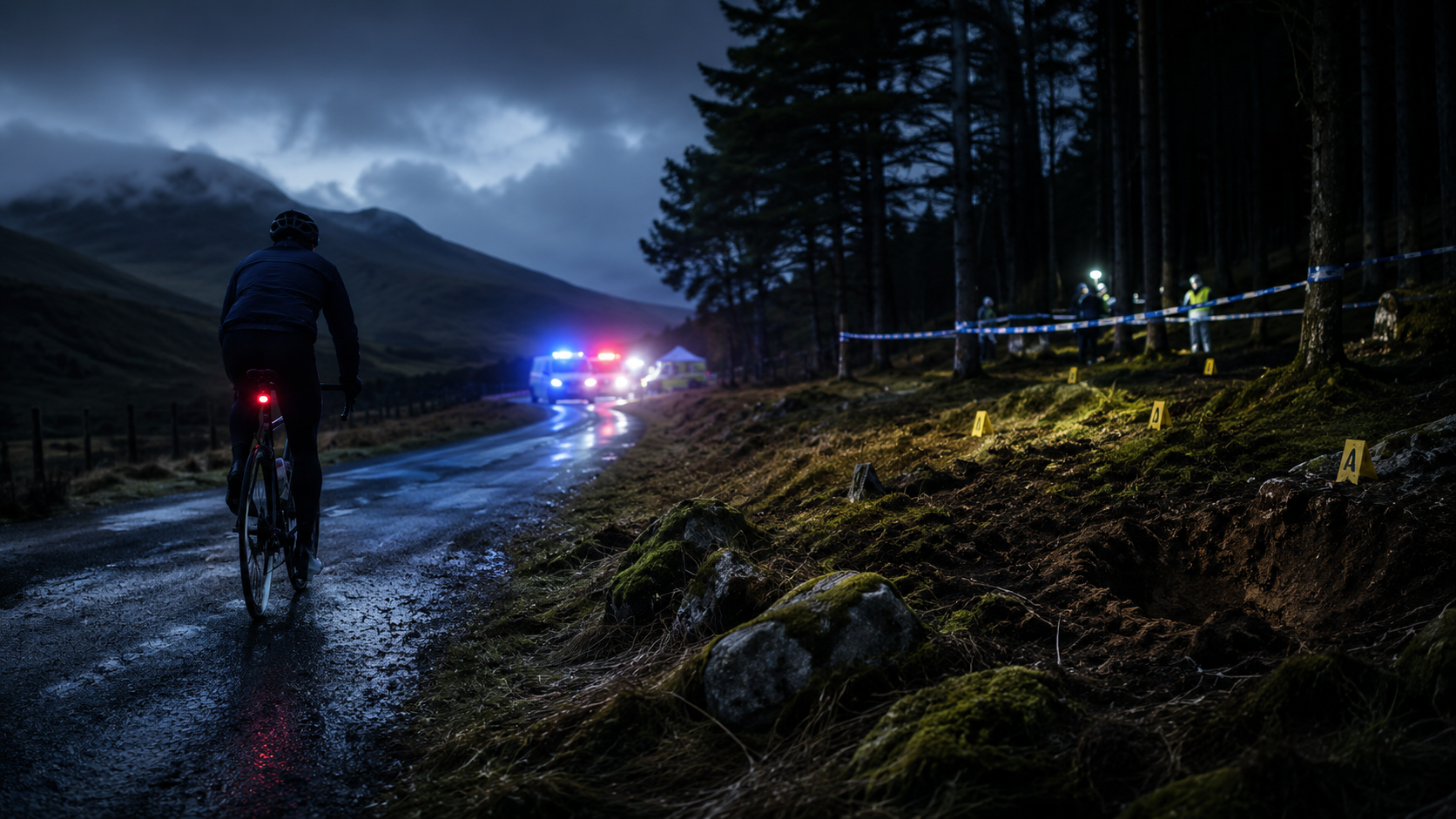
The Yellow Bicycle And The Highland Gap
The Charity Ride Through The Highlands
The coffee cup was ordinary. So was the decision facing Tony Parsons inside the Bridge of Orchy Hotel: stop for the night, or continue south through the Highlands.
Outside, rain was falling over the A eighty-two. It was late on Friday, September twenty-ninth, two thousand and seventeen, and the road beyond the hotel ran through long stretches of darkness, exposed hills, and scattered buildings. Staff urged the sixty-three-year-old cyclist to stay. Tony had already traveled many miles, but the ride was a personal challenge and a charity effort. He chose to continue.
The Life Around Tony Parsons
Tony Parsons is a husband, father, grandfather, former Royal Navy petty officer, and cancer survivor. He has spent more than two decades in the Navy, including service connected with Britain’s submarine fleet, before building a life in Tillicoultry, Clackmannanshire. His family describes a man whose interests are active and practical rather than performative: fishing, golf, rugby, and time with his grandchildren.
Fishing carries particular weight. Tony teaches his grandson how to fish, turning patience beside the water into a family routine. Rugby has also occupied years of his life. He plays, coaches younger age groups, and referees.
The charity cycle from Fort William to Tillicoultry is roughly one hundred miles, depending on the route described. It is connected to prostate cancer, a cause with personal relevance after Tony’s own experience of the disease. This is not an impulsive outing. He travels north, checks in with his family, and begins a ride that requires stamina, route judgment, and the acceptance that some sections may be completed after dark.
His family is accustomed to independence. Margaret, his wife, has known long periods of separation during his naval career. Their children, Mike and Victoria, also understand police procedures through their own professional backgrounds. None of that makes the first silence easier. It means they know both how many harmless explanations can exist and how quickly a lack of contact can become serious.
The People Closest To The Story
Margaret is central to the human timeline because the ride begins with communication. Tony confirms that he has reached Fort William and is setting off. A long marriage has taught her that travel can create gaps without creating panic. For a time, the missing call can still be interpreted as delay rather than danger.
Mike and Victoria bring a different form of awareness. Both have policing experience, and Mike has worked in search operations. That knowledge sharpens rather than resolves uncertainty.
The wider cast is initially small: hotel staff who see Tony late that night, people who may have passed along the A eighty-two, police officers receiving the report, mountain rescue volunteers, and members of the local community.
Another pair of men is also in the area that evening. Twin brothers Alexander and Robert McKellar live and work as farmhands on the Auch Estate near Bridge of Orchy. They are at the hotel with a hunting group and have been drinking.
The social worlds are otherwise separate. Tony is riding toward home. The brothers are traveling toward the estate. The road between those destinations is narrow enough to bring them together, yet remote enough to hide what follows.
The First Detail That Did Not Fit
The first detail that refuses to fit is not a dramatic clue. It is the complete absence of ordinary aftermath.
A cyclist who abandons a ride usually leaves a trace: a booking, a call, a card payment, a request for help, or the bicycle itself. A person leaving voluntarily may produce movement through transport records or later communication. Tony’s known route produces none of those answers.
His phone goes directly to voicemail. On Saturday, the family begins comparing what he said he planned to do with the time the journey should have taken. By Sunday, Victoria decides to drive along the route. She looks for her father, his bicycle, or any sign that he has stopped. She finds nothing. That absence turns concern into action.
On Monday, October second, the missing-person report moves the problem into an official search. The early facts are sparse but clear: Tony set off from Fort William; cameras and witnesses place him moving south; he reached Bridge of Orchy late on Friday; he drank coffee at the hotel; and he left despite being advised to stay because of the conditions.
The next expected point is Tyndrum. He is not confirmed there. The gap between Bridge of Orchy and the road south becomes the center of the inquiry.
At first, the lack of evidence can still support several theories. He may have left the carriageway. He may have entered water or rough ground. He may have suffered a medical event. Yet each search that fails to locate either Tony or the distinctive bicycle makes one possibility harder to ignore: perhaps the evidence is not where the journey says it should be.
The Ordinary Movements That Day
The route begins in Fort William, where transport records and camera images help establish that Tony arrived and started his return journey. He is dressed for distance cycling and carries the equipment needed for a long ride. His bicycle has a yellow frame, a feature that should make it noticeable in daylight and memorable to anyone who passes him.
The A eighty-two south of Fort William runs through some of Scotland’s most dramatic terrain, but beauty does not make it forgiving. The road carries fast traffic through Glencoe, across open moorland, and toward Bridge of Orchy.
By late evening, Tony reaches the hotel. He stops for coffee rather than alcohol. The manager recognizes the difficulty of the next section and encourages him to take a room. Tony declines. He wants to continue the challenge.
Around the same period, Alexander and Robert McKellar finish dinner and drinking with a hunting party. Alexander takes the wheel of a white Isuzu D-Max pickup. Robert sits in the passenger seat. They head toward the Auch Estate.
The later agreed legal narrative establishes that Alexander is driving too fast and is unfit through alcohol. The pickup and bicycle meet on the A eighty-two near Bridge of Orchy. The front of the vehicle sustains extensive damage, evidence of the force involved.
Before the collision becomes publicly known, however, the timeline simply stops. Tony leaves the hotel. No reliable sighting carries him to the next village. The ordinary movements end in a stretch of road that appears empty when the family comes looking.
The First Concern
Victoria’s drive north is the family’s first physical search. It is also an attempt to preserve a normal explanation. A tired rider might be walking. A mechanical problem might have slowed him. Tony might accept a lift and fail to update anyone.
By Sunday evening, those possibilities have weakened. Tony has not called Margaret, Mike, Victoria, or anyone else who would expect to hear from him. His phone remains unavailable. No hospital or police contact explains the silence. Victoria reports him missing on Monday morning.
Police then face a difficult search problem. The last confirmed point is late at night beside a road surrounded by steep slopes, woodland, water, open ground, and estate land. Mountain rescue teams and volunteers join officers. Appeals ask drivers, residents, and visitors to remember a lone cyclist or the yellow bicycle. Search areas expand across difficult terrain.
The family’s policing knowledge creates a second timeline beneath the official one. Mike understands that survival assumptions narrow as days pass. Margaret still listens for the front door. Victoria knows that reporting her father missing is not the same as accepting that he will not return.
The search remains focused on where a lone rider might have gone. That is reasonable from the evidence available. Yet it contains a hidden weakness: it assumes Tony and his possessions remained near the place where the journey ended. If somebody moved the cyclist, the bike, and the personal items, search logic based on accident geography could repeatedly miss the truth.
The family did not yet know that the road had been cleared of almost everything that could have explained the absence.
The Search For An Explanation
The initial inquiry treats Tony as a missing person. Officers reconstruct the route, review available camera footage, question witnesses, and search the landscape. Public appeals widen the potential witness pool. The case receives national attention, but attention cannot replace a physical trace.
Several explanations remain open. An accident is plausible because of the weather, hour, and terrain. A medical emergency is plausible because Tony is sixty-three and undertaking an exhausting challenge, despite his fitness and determination. Voluntary disappearance is harder to reconcile with his close family ties, the purpose of the ride, and the lack of later activity, but investigators cannot discard possibilities merely because relatives consider them unlikely.
The bicycle is a major problem. A yellow-framed cycle is not easy to conceal accidentally. If Tony had fallen into a ditch or left the road, searchers might expect the bike to mark the area. Its absence suggests either a location not yet searched or human intervention.
Later accounts indicate that police received an anonymous letter pointing toward local twins and that the McKellars were questioned. Even a specific suspicion is not the same as evidence. Without a body, bicycle, reliable eyewitness, confession, or forensic link, investigators could not lawfully turn rumor into proof. The brothers continued their lives while the inquiry gradually became a long-term missing-person case.
This distinction matters. Police may suspect, interview, and compare accounts, but suspicion does not reveal a concealed grave on a large private estate.
For more than three years, the case remains trapped between a strong family belief that Tony would not leave and an evidentiary record that cannot show where he went.
The Evidence That Did Not Fit
The decisive evidence arrives from outside the original search. In two thousand and twenty, Alexander McKellar begins a relationship with Dr. Caroline Muirhead, a pathologist. The relationship develops quickly. When they discuss engagement, she asks whether anything in his past could affect their future.
Alexander answers with a confession. He says that he and Robert were involved in a collision with a cyclist years earlier and that the man was buried on the estate. The disclosure changes the case, but it also creates an immediate evidentiary problem. A private confession reported by a partner can be denied. Police need corroboration: a location, recording, physical evidence, or details that only a participant would know.
Muirhead’s later account describes a period of fear, divided loyalty, and covert cooperation. She contacts police and provides information. Alexander takes her to a remote section of the Auch Estate where he says Tony is buried. In a landscape with few fixed markers, she crushes a Red Bull can into the ground to identify the spot.
The object is almost absurdly ordinary. It is not forensic proof by itself. It does not identify remains or establish who caused injuries. Its importance is geographic. It converts a confession about a huge estate into a searchable point.
Police arrest the brothers in December two thousand and twenty and begin specialist searches. The estate’s peat, woodland, tracks, and animal-disposal areas create a demanding recovery operation. On January twelfth, two thousand and twenty-one, teams excavate the location indicated by the can. Clothing, gloves, and a wedding ring emerge with human remains.
The long gap is finally filled, not by a trace left on the road, but by a marker placed more than three years later on ground the original searches had no reason to isolate.
The Event At The Center Of The Case
The recovery allows investigators and medical experts to reconstruct what the empty road could not show. Tony had been struck with substantial force by the Isuzu pickup while cycling near Bridge of Orchy. The collision caused multiple rib fractures, complex pelvic injuries, spinal fractures, and severe trauma affecting his ability to breathe. The court later heard that he was unlikely to survive more than twenty to thirty minutes without medical treatment, but that death was not necessarily instantaneous.
That medical interval is central to the legal and moral meaning of the case. Alexander and Robert did not call emergency services. They left the scene and traveled back to the estate. They then changed vehicles and returned to the roadside, where Tony was still present with his bicycle and belongings. The brothers placed him and the other items into the second vehicle and took them away.
The first concealment point was within the Auch Estate. Tony was moved into woodland or ground near the estate buildings before Alexander later placed him in a remote peat area associated with the disposal of animal carcasses. The brothers also dealt with the objects that could connect the collision to them. Alexander admitted destroying Tony’s mobile phone and SIM card and burning his rucksack, wallet, and helmet. The bicycle was hidden behind a waterfall and has never been recovered.
The pickup required repair. The brothers presented the damage as the result of striking a deer. That false explanation mattered because the front-end damage reflected a violent collision, while the repaired vehicle removed one of the strongest potential links to the roadside event.
No camera recorded the collision itself. No independent witness described the full sequence. The reconstruction rests on the agreed legal narrative, the confession, the condition of the vehicle, the recovered remains, medical findings, and the brothers’ admitted acts of concealment. The evidence could establish what they did after the impact with far greater clarity than it could reveal Tony’s final awareness or every decision made during those minutes.
What it did establish was enough: help was available in principle, but no call was made. The men chose removal over rescue.
When The Story Broke Open
The discovery of Tony’s remains transformed a missing-person inquiry into a criminal case. It also ended the possibility that he had voluntarily left his family or vanished through an unexplained accident that nobody else had seen. The open record now contained a burial site, a concealed vehicle history, destroyed possessions, and admissions connecting the McKellar brothers to the road.
For the Parsons family, certainty arrived in the harshest possible form. They had spent years living without a place to grieve and without an account of what had happened. Mike later described how one phone call overturned the uneasy acceptance he had built around the idea that his father might never be found. Margaret and Victoria faced the same reversal: the search was over, but the answer exposed deliberate choices that had prolonged the family’s uncertainty.
Forensic recovery from peat required specialist work. The cold, wet ground had preserved clothing and identifiable features. The wedding ring offered a particularly human point of recognition, but identification did not depend on symbolism. Scientific examination confirmed that the remains were Anthony Parsons.
The brothers were charged, and the case entered a long pretrial period. Yet neither alone explained the full evidentiary structure. The confession supplied knowledge. The can supplied location. The remains supplied identity and medical evidence. The repaired pickup, destroyed property, false deer account, estate access, and admitted movement of Tony supplied corroboration.
The story had not been solved by one object. It had been unlocked by one witness and then proved through accumulation.
The Case Built From Fragments
The original charges included murder, a legal accusation requiring proof beyond reasonable doubt of the necessary criminal intent. By the time the case reached the High Court in Glasgow in July two thousand and twenty-three, the Crown accepted amended pleas. Alexander McKellar admitted culpable homicide and attempting to pervert the course of justice. Robert McKellar admitted attempting to pervert the course of justice.
Culpable homicide in Scots law covers unlawful killing where the facts do not establish murder. In Alexander’s case, the admitted conduct was not limited to careless driving. He drove at excessive speed while unfit through alcohol, struck Tony, left him in darkness and severe weather without obtaining help, and participated in removing and concealing him. The legal narrative treated those actions as causing the death.
Robert’s criminal liability was different. He was the passenger rather than the driver, and the accepted plea did not convict him of homicide. His admitted offense concerned the sustained attempt to defeat justice: leaving, returning in another vehicle, moving Tony and his possessions, concealing the remains, and supporting the false account of the vehicle damage.
The distinction is important because public anger can flatten different forms of responsibility into one label. The court could punish Alexander for the culpable homicide and the cover-up. It could punish Robert for the cover-up proved and admitted against him. It was not entitled to sentence Robert as though he had been convicted of causing the collision or the death.
The defense mitigation emphasized panic, fear, regret, and the escalating difficulty of reversing the first decision. That explanation did not excuse the conduct. It addressed sentence and state of mind. The prosecution narrative emphasized repeated opportunities to call for help or disclose the truth, followed by years in which the family continued searching.
The case did not turn on a claim that every private thought was known. It turned on conduct. Alcohol consumption, speed, collision damage, abandonment, retrieval, concealment, destruction, deception, confession, and recovery formed a sequence in which each fragment supported the next.
The Outcome That Did Not End The Story
On August twenty-fifth, two thousand and twenty-three, Lord Armstrong sentenced Alexander McKellar to twelve years in prison. Robert McKellar received five years and three months. Together, the sentences totaled seventeen years and three months.
The judge focused on the force of the collision, Tony’s injuries, the failure to obtain help, the concealment, and the continuing emotional harm to the family. He also made clear that no sentence could compensate them. Criminal punishment could mark legal responsibility, but it could not return the years spent searching or undo the knowledge that Tony had been moved while gravely injured.
The legal outcome answered several questions precisely. Alexander accepted responsibility for culpable homicide, not murder. Both brothers accepted responsibility for attempting to pervert the course of justice. The pleas removed the need for a full murder trial and meant that disputed evidence was not tested before a jury in the way it would have been had the original charges proceeded.
That does not make the accepted narrative uncertain. A guilty plea is a formal admission to the crime charged. It does mean the court did not issue findings on every allegation, every reported conversation, or every criticism surrounding the investigation. The legal record is strongest where the charges, agreed facts, and sentences speak directly.
Tony’s family described him after the pleas as a much-loved husband, father, and grandfather. They thanked search volunteers, mountain rescue teams, investigators, and court staff. Their statement also asked for privacy so they could finally grieve.
Justice, in that sense, arrived late and incompletely. It established criminal responsibility. It did not restore the ordinary family future interrupted on the road beyond Bridge of Orchy.
The Aftermath People Still Argue About
The case continued beyond sentencing through civil action, documentary scrutiny, and debate over how a key witness was treated. In January two thousand and twenty-five, solicitors acting for the Parsons family reached a six-figure settlement with the insurer of the vehicle Alexander had driven. The civil claim settled out of court shortly before a trial was due to begin.
Compensation carries a different purpose from imprisonment. It does not increase the criminal sentence or produce a new verdict. Civil damages recognize loss and provide financial protection where legal liability is accepted or resolved. The family’s solicitor emphasized that money could not heal the harm.
Renewed public attention has also shifted focus toward Caroline Muirhead. Her account describes reporting the confession, returning to a dangerous relationship environment, gathering information, marking the grave, and then experiencing serious psychological consequences. She has criticized the protection and support she received from police and prosecutors. Authorities have defended aspects of their handling and said witnesses are treated with care, while later complaint processes reportedly upheld only a limited part of her concerns.
Those competing claims should not be blended into settled fact. Muirhead’s role in locating Tony is established and was acknowledged by prosecutors. The broader institutional dispute concerns what support was offered, what operational choices were justified, and whether her vulnerability was recognized quickly enough.
The issue matters beyond one witness. Police sometimes need continued cooperation from people who remain emotionally connected to suspects. That cooperation may create intelligence, recordings, or access that officers cannot obtain directly. It also creates risk.
The public debate therefore contains two distinct questions: how Tony was found, and whether the person who made that possible was adequately protected. The first is resolved. The second remains contested.
The Witness Who Changed The Geography
True-crime retellings often reduce Muirhead’s action to the crushed can, as though quick thinking alone solved the case. The more important point is that she changed the geography of the investigation.
Before her information, police had a vast corridor between Fort William, Bridge of Orchy, Tyndrum, surrounding water, hills, forestry, and estate land. The original route suggested a roadside disappearance. Her account redirected attention to a private burial location chosen by people with detailed knowledge of the terrain.
The can served as a field marker because the grave itself did not present an obvious surface feature to an outsider. Alexander’s confession gave her the reason to ask to see the place. Her later report gave police the legal and investigative basis to act. Specialist teams then converted the marker into evidence through controlled excavation and identification.
This sequence also explains why the case remained unresolved despite earlier suspicion. Knowing that local men may have relevant information is not the same as knowing where evidence is buried. Large estates contain countless areas that cannot be excavated on speculation. Even a search warrant or arrest must be supported by grounds capable of surviving legal scrutiny.
Muirhead’s information narrowed thousands of possible points to one.
The evidence could not prove every reported private conversation or reconstruct every second after the collision. It could prove that Tony had been concealed where Alexander said he was, that his injuries matched a high-force impact, and that the brothers’ admitted actions had removed the visible traces from the A eighty-two.
The can did not solve the case by magic. It made the hidden place searchable.
What The Internet Version Often Misses
The most common shorthand describes the case as a hit-and-run followed by burial. That summary is accurate but incomplete. A conventional hit-and-run involves leaving a collision scene. Here, the brothers returned, collected Tony, took his bicycle and possessions, moved him onto private land, destroyed items, arranged vehicle repairs, and maintained a false explanation for years.
The second misunderstanding concerns the medical evidence. Tony was not shown to have died instantly at impact. The accepted case was that his injuries were catastrophic and survival without prompt treatment was unlikely beyond roughly twenty to thirty minutes. That does not prove that emergency care would certainly have saved him. It does establish that abandoning him removed any chance of timely assistance and formed part of the culpable-homicide narrative.
A third misconception is that the confession alone guaranteed conviction. Confessions can be withdrawn, disputed, misunderstood, or attacked as unreliable. This confession became powerful because it contained verifiable knowledge: the burial site, the estate, the disposal methods, and the destruction of belongings. Recovery transformed words into corroborated evidence.
Finally, the reduced charge does not mean the conduct was treated as a minor road offense. Alexander received a twelve-year sentence for culpable homicide and attempting to pervert justice. The difference between murder and culpable homicide concerns the legal elements proved or admitted, not the family’s level of loss.
The headline version is a story about one collision and one can. The court record is a story about a chain of choices. The collision created an emergency. The abandonment deepened it. The return to the road converted panic into coordinated concealment. The years of silence extended the harm far beyond the night itself.
Why The Road Still Matters
Tony’s family eventually gained a grave, a legal account, and formal responsibility. They did not regain the ordinary future represented by the journey home. Margaret lost the husband she had known since youth. Mike and Victoria lost their father. His grandchildren lost the man who taught fishing through patience rather than spectacle.
The case also leaves a practical lesson about missing-person investigations. Search teams work from the geography the evidence gives them. When offenders remove a person, vehicle, phone, clothing, and other belongings, they do more than hide individual objects. They manufacture a false landscape. Every empty ditch and unproductive search area appears to support uncertainty because the true location has been deliberately disconnected from the last confirmed sighting.
That is why the early investigation could be extensive and still fail. It was trying to solve the wrong physical problem. The relevant evidence no longer sat beside the A eighty-two. It was dispersed: a repaired pickup, a false story about a deer, burned possessions, a bicycle behind a waterfall, and a body in peat on private land.
The later legal outcome shows how circumstantial evidence gains force through alignment. No single fragment recorded the entire event. Together, the fragments established a coherent sequence supported by admissions and physical recovery. The law did not need access to every private thought. It needed proof of conduct, causation, and concealment strong enough to support the pleas accepted by the court.
The truth did not emerge because the landscape yielded it. It emerged because one person carried an admission into the open, allowing investigators to reconnect the road, the estate, the vehicle, the remains, and the family.
The final image is still the road outside Bridge of Orchy. At the beginning, it appears to contain no answer. By the end, the emptiness itself has meaning. The road looked clean because the evidence had been taken from it.
