True Crime: Leah Croucher - The Walk To Work That Made No Sense
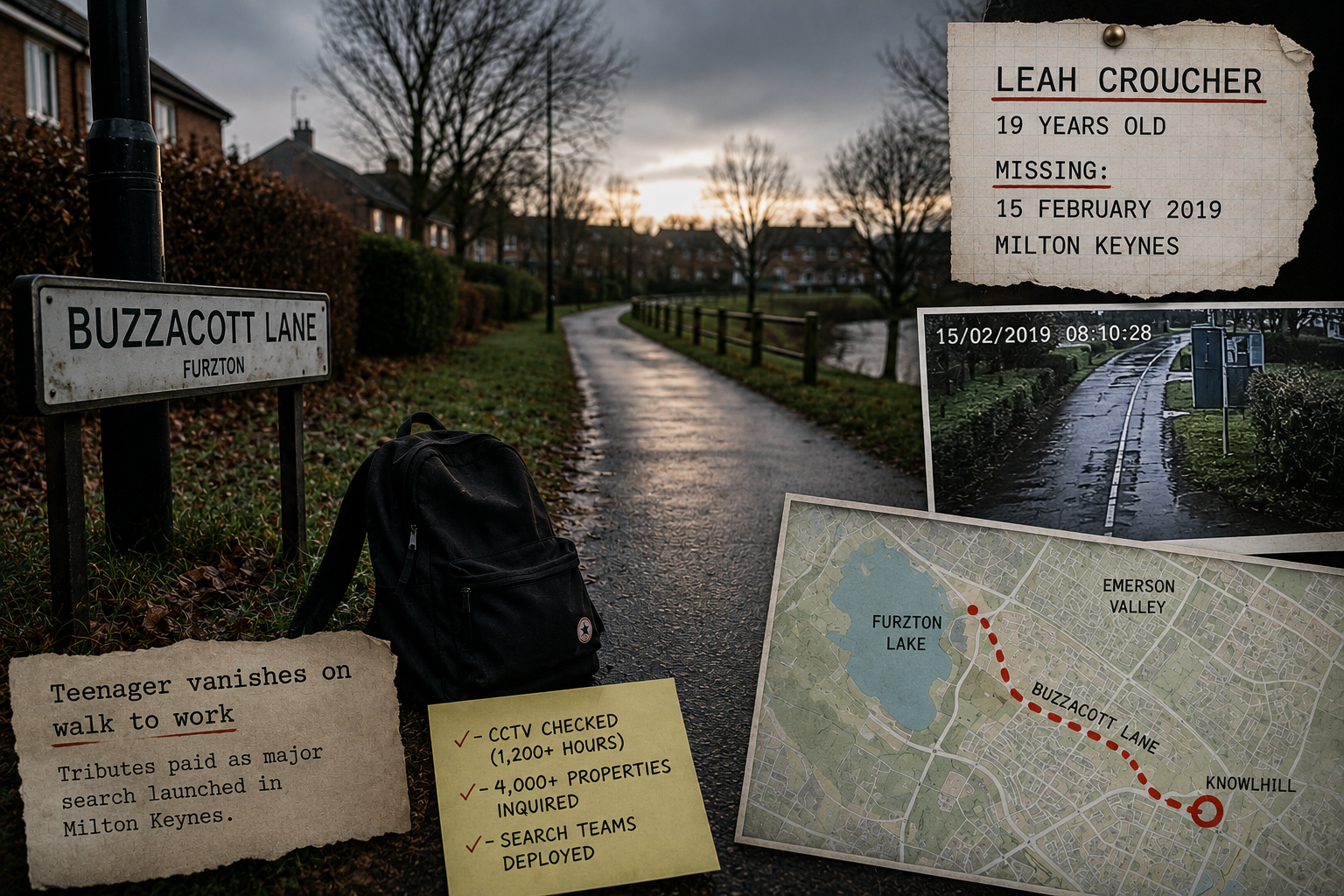
The Silent Phone On Buzzacott Lane
The Silent Phone On Buzzacott Lane
A Familiar Route, A Silent Phone, And A Morning That Refused To Explain Itself
At about eight o’clock on a Friday morning, Leah Croucher leaves her family home in Emerson Valley, Milton Keynes. She is dressed mainly in black, carrying a small rucksack and beginning a journey she knows well.
Her workplace is roughly two miles away. The walk normally takes about forty minutes. There is nothing unusual about a nineteen-year-old going to work, nothing remarkable about the paths, residential streets and lake-side routes connecting one part of Milton Keynes to another.
The Life Around Leah Croucher
Leah is nineteen years old and living with her parents, John and Claire Croucher, in Emerson Valley. Her family describes her as bright, funny, loyal and caring. Friends speak of an infectious laugh and a forceful personality that does not fit the image of someone helpless or easily defined by the events surrounding her name.
Taekwondo is a central part of Leah’s life. She holds a second-dan black belt, competes at national and European level and helps coach younger athletes at the family club she runs with her father. That detail matters first because it belongs to her ordinary identity. She is not merely a face on an appeal poster. She is disciplined, physically capable and accustomed to teaching others.
Her family’s later descriptions also correct an easy misconception. Quietness and strength are not opposites. Leah had grown from a shy child into a more confident young woman, according to her mother. She cared about whether other people felt comfortable, yet she also possessed the focus required to train, compete and coach at a high level.
She works in administration for a direct-debit collection business in Knowlhill. The journey from home is familiar enough to be routine. The walk takes her through areas of Milton Keynes built around paths, estates, roads and green spaces, where several plausible routes can lead toward the same destination.
There are private pressures in Leah’s life, as there are in most lives. Her family had concerns about an emotionally difficult relationship involving an older man. That relationship became a major focus of public speculation after she failed to return, but police investigated it and did not establish that it explained what happened. The distinction is essential: emotional distress can shape behavior without identifying the person responsible for a later event.
The public record does not provide every intimate detail of Leah’s private world, nor should it. What it does show is a young woman moving between family, employment, martial arts and relationships while beginning adult life. Her plans extended beyond one morning and one route.
On Thursday, February fourteenth, two thousand and nineteen, the family sees Leah at home at about ten p.m. By the following morning, the ordinary structure of her life is still apparently intact: work is due to begin at nine, and the usual journey should place her there on time.
The first fracture is not a dramatic confrontation. It is a place where Leah should be, and is not.
The People Closest To The Story
John and Claire Croucher become the most visible voices in the search because they have the clearest measure of what is unusual. Their daughter does not simply skip a shift. She becomes unreachable, does not return home and leaves no explanation that fits her established behavior.
Leah’s siblings, including her sister Jade and brother Haydon, are pulled into the same uncertainty. For a family, an unexplained absence creates two competing demands. They must keep hope alive while repeatedly confronting the possibility that the person they love is in danger.
That uncertainty also changes how every relationship around Leah is examined. Friends, colleagues and people who had been close to her are asked about messages, plans, tensions and movements. In a disappearance inquiry, intimacy becomes investigative material. Private conversations are no longer merely private; they can establish state of mind, planned meetings or reasons for deviating from routine.
The relationship that caused the most early speculation involved an older man. Leah’s family believed it had affected her emotionally and questioned whether it had been fully understood. Police examined him and said no evidence linked him to Leah’s absence. That conclusion did not erase the family’s concern, but it prevented suspicion from being treated as proof.
This is one of the case’s most important early lessons. A person can be central to someone’s emotional life without being responsible for a crime against them. Arguments, secrecy and distress may produce a compelling public story, but they do not replace evidence.
Other people enter the story only through fragments. Colleagues know Leah has not arrived. Residents and walkers may have seen someone matching her description. Cameras record sections of public space but not every path or doorway. Police receive statements from people attempting to reconstruct an ordinary morning after the fact.
Each account is limited by what the person could see. A witness may remember clothing but not a face. A camera may establish direction without destination. A phone may establish when it stopped communicating without explaining who held it or why it became silent.
Leah’s family knows her habits, but even they cannot see every part of her adult life. Investigators can access records, yet records do not automatically reveal meaning. The search therefore begins with an uncomfortable division: those closest to Leah understand how abnormal the silence is, while those responsible for finding her must establish where the silence began.
By the end of that first day, the social world around Leah is no longer a source of reassurance. It has become a map of possibilities.
The First Detail That Did Not Fit
The simplest explanation for a young adult missing work is that the absence is voluntary. She may have changed plans, stayed with someone, avoided a difficult conversation or needed time alone.
That theory weakens when behavior across several systems changes at once.
Leah does not arrive for her nine a.m. shift. Her telephone cannot be reached. She does not return home after the working day. No message accounts for the change. Her family reports her missing that evening because the combined pattern is far outside what they expect from her.
The phone is particularly important. A silent phone does not prove violence. Batteries fail. Devices are switched off. Network coverage varies. A person choosing privacy may deliberately disconnect.
Yet the timing narrows the problem. Leah is seen walking along Buzzacott Lane shortly after eight. Her phone leaves the network at about eight thirty-four. The gap between those two events is short enough to concentrate attention on a limited portion of the route, but not precise enough to identify one doorway, path or encounter.
Several later witness accounts complicate the timeline. Three people report seeing a young woman resembling Leah near Furzton Lake between approximately nine thirty a.m. and eleven fifteen a.m. Two describe her as visibly upset, angry or crying, at points appearing to use a phone. Police cannot confirm that the woman was Leah.
If the sightings are accurate, the timeline extends beyond the phone’s disconnection and away from the direct assumption that something happened immediately after the CCTV recording. If they are mistaken, they introduce a false branch that can consume time, searches and public attention.
Witness evidence often looks stronger in summary than it is in practice. Clothing may be common. Distance affects recognition. Memory can be reshaped by later photographs and appeals. A person who resembles someone missing can become that person in recollection without dishonesty.
The accounts cannot be ignored, but they also cannot be made certain. They create a disputed gap rather than fill it.
The first version of the morning is therefore deceptively simple. Leah leaves home. She walks toward work. She does not arrive. Between the camera and the workplace lies a network of paths, houses, roads and open spaces—and no confirmed explanation for where she went.
The Ordinary Movements That Morning
On Friday, February fifteenth, two thousand and nineteen, Leah leaves Quantock Crescent at about eight a.m. Her clothing is later described as a black coat, black skinny jeans and black Converse-style high-top shoes. She carries a small black rucksack.
The visual description becomes crucial because the clearest public evidence is a brief CCTV sequence. The camera shows Leah on Buzzacott Lane in Furzton shortly after eight, walking in the general direction of Knowlhill.
A camera records presence, not intention. It can show that Leah is moving along a road, but it cannot establish whether she plans to complete her usual journey. It cannot show whether she expects to meet someone, notices someone nearby or changes direction beyond its field of view.
The walk normally takes around forty minutes. Starting at eight should give her enough time to reach work for nine without rushing. The routine itself becomes a baseline against which every later deviation is measured.
Her mobile phone remains active for roughly another twenty minutes after the CCTV sighting. Then it stops connecting to the network at around eight thirty-four. Phone-network evidence can narrow a period, but it does not create a continuous track. It cannot show the exact room or precise action that led to disconnection.
By nine, Leah’s colleagues know she is absent. That is the first external confirmation that the journey did not end in the expected place.
The possible lake sightings begin later. One witness places a similar-looking young woman near Furzton Lake between nine thirty and ten. Two others describe seeing her around ten to ten fifteen, then again after a further interval. Police treat the information seriously but cannot authenticate it as a confirmed continuation of Leah’s route.
The uncertain sightings encourage a search of open spaces and water. They also create a public image of Leah distressed beside the lake. That image becomes memorable because it offers a scene where none otherwise exists.
But memory is not the same as evidence. The last securely documented movement remains the short CCTV recording. After that, the route is no longer a line. It branches.
One branch leads toward the lake. Another continues toward work. Others pass residential properties where a person can leave public view in seconds.
The last detail that still looks ordinary is Leah walking through an area she knows. The first extraordinary detail is how completely the route seems to stop recording her.
The First Concern
When Leah fails to return home after work, her parents contact police. The report arrives on the same day she leaves, allowing officers to begin with a relatively narrow period rather than an absence already several days old.
The concern is immediate, but the investigative problem is broad. Leah is legally an adult. She has the right to go elsewhere without telling her family. Officers must consider voluntary absence alongside accident, self-harm, coercion, abduction and an encounter with someone known to her.
Her family’s certainty that the behavior is unusual carries weight, but concern must be translated into searchable facts. Police need confirmed sightings, communication records, financial activity, transport use, messages, CCTV and witnesses.
A public appeal follows within the first week. John and Claire say they are beside themselves with worry and emphasize that Leah’s behavior is highly unusual. Images of her clothing are released. Officers attempt to identify anybody who saw her during the walk or near Furzton Lake.
The search quickly expands beyond detectives. Police dogs, mounted officers, marine specialists, air support and search teams examine areas across Milton Keynes. Furzton Lake receives particular attention because of Leah’s route and the later witness accounts.
Dozens of officers review CCTV from homes, businesses, roads and public areas. The total examined eventually exceeds one thousand two hundred hours. Officers conduct house-to-house inquiries at approximately four thousand addresses.
That scale matters when the investigation is later criticized. This is not a case ignored from the outset. A large volume of work is completed, and the absence is treated seriously.
Scale, however, does not guarantee discovery. A search can be exhaustive within its rules and still fail if the decisive location does not generate grounds for entry. A leaflet through a door is not a search warrant. A house without an answering occupant may remain a closed space even when officers are standing outside it.
In the first days, the family knows Leah’s silence is wrong. Police know the route contains gaps. Neither knows which ordinary-looking boundary separates the public path from the place where answers may exist.
The Search For An Explanation
Investigators test the voluntary-absence theory first because it is plausible and because treating every missing adult as the victim of a crime would be neither lawful nor proportionate.
Leah’s relationships and emotional state are examined. The older man connected to her private life is interviewed and investigated. The information does not produce evidence that he is responsible. The public may remain suspicious, but the investigative record does not support converting that suspicion into a conclusion.
The possible Furzton Lake sightings strengthen another line. If the woman seen crying is Leah, she may have stopped near the lake instead of continuing to work. Searches of the area and water produce no confirmed trace.
A later report of clothing at the Blue Lagoon nature reserve in Bletchley leads to an intensive operation involving divers, dogs and drones. The search continues for more than two weeks, but nothing belonging to Leah is found.
False leads are not pointless simply because they end without discovery. They eliminate locations, test witness memories and reduce the number of viable explanations. Yet they also consume finite time and attention.
The absence of telephone, banking or confirmed travel activity keeps the voluntary theory under pressure. Someone beginning a new life generally needs money, communication, shelter, transport or assistance. A complete break from ordinary systems is possible, but it becomes harder to sustain without help.
Public campaigns keep Leah visible. Posters appear across Milton Keynes. Appeals are renewed on anniversaries and birthdays. Rewards are offered. Online groups examine routes, images and theories.
That attention has two effects. It can reach a witness police have missed. It can also produce confident speculation built from incomplete records. A blurred figure becomes a lead. A property becomes suspicious because it looks empty. A private relationship becomes a complete theory.
The police inquiry must separate information that can be tested from stories that merely sound coherent. This is slow work. The absence of a confirmed scene means there is no single place from which to collect fingerprints, DNA, fibers or a clear camera sequence.
As the months turn into years, investigators repeatedly return to the same central difficulty: Leah disappears within a small geographical area, but no reliable evidence establishes where she left public view.
The search has size. It has persistence. What it lacks is a location with a legal and evidential reason to open it.
The House Inside The Search Area
Loxbeare Drive sits in Furzton, close to Leah’s route. One possible walk toward Knowlhill passes the street. The property that becomes central is not hidden in remote countryside. It is inside the area covered by house-to-house inquiries.
Officers visit the house during the early investigation. Nobody answers. Under the approach used across thousands of properties, a leaflet is placed through the door. Police do not have evidence connecting Leah to the address, nor information linking a relevant offender to it.
This fact later acquires enormous emotional force. Police stood at the correct door and left.
It is also easy to misunderstand. Officers conducting general inquiries cannot lawfully force entry into every unoccupied house near a missing person’s route. Proximity is not sufficient. An unanswered door does not prove danger, and a leaflet may be the proportionate action where no other intelligence exists.
The failure was therefore not simply that one officer did not insist on entering. The deeper problem was that information held elsewhere did not combine into a reason to view the address differently.
The property’s owners lived abroad and used it intermittently. They were not present when Leah went missing. That reduced the chance of ordinary occupancy producing a quick response to the leaflet or revealing something unusual.
The house remained outside the investigation’s focused attention. It was geographically close but evidentially distant.
Police later reviewed their original inquiry after the property’s importance became known. The regional police commissioner said the review found no evidence available at the time that reasonably linked Leah to the house or connected the relevant individual with it. The force had consulted national specialists and pursued extensive CCTV, public-appeal and house-to-house work.
That defense is significant, but it does not make the outcome less disturbing. A search system can act reasonably on the information visible to it and still fail catastrophically because the most important information is fragmented across agencies.
For more than three years, the house remains closed to the investigation.
Then, on Monday, October tenth, two thousand and twenty-two, a maintenance worker enters because of a persistent smell and alerts police.
The search has not discovered the house. The house has finally generated its own alarm.
The Loft And The Answer Nobody Wanted
Police responding to Loxbeare Drive find Leah’s rucksack and personal possessions inside the property. In the loft space, they discover human remains concealed in plastic bags. Some limbs had been removed, a fact the coroner later considered part of the attempt to place and hide the remains in the attic.
The discovery changes the inquiry immediately. What had been a missing-person investigation becomes an investigation into unlawful death.
Formal identification takes time. Dental records establish that the remains are Leah’s. The post-mortem examination cannot determine a medical cause of death because decomposition has erased crucial information.
This limitation shapes everything that follows. Medical evidence cannot say whether Leah died from strangulation, blunt-force injury, another form of violence or a mechanism no longer detectable. There is no recoverable sequence of injuries from which intent can be reconstructed with certainty.
The condition of the remains does establish concealment. Someone placed Leah in the loft and took steps that reduced the likelihood of discovery. That conduct supports an inference that her presence in the house was not accidental and that the person responsible wanted the location to remain unknown.
It does not, by itself, identify that person.
The rucksack and belongings make the property the missing scene the investigation had lacked. They connect Leah directly to a house positioned along a possible route to work. Investigators can now examine access, ownership, maintenance arrangements and the people capable of entering without attracting attention.
The discovery also corrects years of public speculation. Leah had not traveled to a distant city, entered the lake or created a new life elsewhere. The answer had remained within the same part of Milton Keynes from which the search began.
Her family releases a tribute describing the fragile hope they had maintained. They speak of a young woman with humor, warmth, coaching ability and plans for promotion, marriage, children and a home of her own. They can now prepare to bury her, but confirmation replaces uncertainty with a different form of grief.
The house becomes the case’s central object because its meaning changes three times. At first, it is one address among thousands. During the long search, it is an unremarkable closed property. After October two thousand and twenty-two, it is the place that reveals how little an ordinary exterior can show.
Investigators now possess a scene, but time has damaged much of what the scene might once have proved.
The next question is no longer where Leah went. It is who had the opportunity to take her inside.
The Man With The Only Keys
Property records and witness information direct police toward Neil Maxwell, a maintenance worker who had access to the Loxbeare Drive house from November two thousand and eighteen. While the owners were abroad, police said he was the only person known to possess keys.
Maxwell was not an unknown local handyman with no criminal history. He had previous convictions for sexual offenses against women. In February two thousand and eighteen, he was convicted of sexual assault and placed under community supervision.
Later evidence showed that the risk he posed had been underestimated. A risk matrix indicated a high likelihood of reoffending, but that assessment was professionally overridden. He was managed as a medium-risk offender and at the lowest MAPPA level rather than as the high-risk person later reviews said he should have been considered.
In November two thousand and eighteen, another woman reported a sexual attack in Newport Pagnell. Police attempted to arrest Maxwell the following day, but he was not at the address they visited.
He knew officers wanted him. Police made eighteen arrest attempts across different locations. Maxwell used false names, changed vehicles and telephone arrangements and moved around the country. Investigators believe he altered his appearance, losing weight and growing a beard.
His details were circulated nationally in December two thousand and eighteen, yet a public wanted appeal was not issued until April fourth, two thousand and nineteen.
On April twentieth, Maxwell was found dead after taking his own life. He had evaded arrest for nearly five months.
This creates the case’s central convergence. A convicted sexual offender, wanted over a further alleged attack, possesses the only known keys to the property where Leah is found. That property lies along a possible route she takes on the morning she disappears.
Maxwell’s death prevents police from questioning him, searching his current devices in real time or placing allegations before a criminal court. There can be no interview account to test and no jury trial in which a prosecution and defense examine the evidence under the criminal standard.
His name had reached the missing-person investigation through information received in May two thousand and nineteen, after his death, but officers found no link to Leah at that stage. They also did not know he was connected to the Loxbeare Drive property.
Once the house is opened, the facts that had existed separately begin to align: sexual offending, evasion, access, location and concealment.
None of those strands reveals the precise encounter. Together, they produce a case far stronger than any one strand alone.
The Case Built From Fragments
The case against Maxwell is circumstantial. That does not mean weak. Circumstantial evidence proves facts through inference rather than through a witness who directly observed the central event.
The strongest strand is exclusive access. Police identified Maxwell as the only person with keys while the owners were abroad. Leah’s remains and belongings were inside the property, in a concealed part of the building.
The second strand is geography. The house sits close to the last confirmed CCTV sighting and along a possible route toward Leah’s workplace. An encounter could move from public space to private property without requiring a vehicle journey across the city.
The third strand is behavioral and criminal context. Maxwell was a repeat sexual offender who was actively evading arrest over another alleged sexual attack. His use of false identities, changed vehicles and altered appearance demonstrates concealment from police, although evasion relating to the earlier allegation does not alone prove what happened to Leah.
The fourth strand is opportunity. The property was largely unoccupied. Maxwell’s maintenance role gave him a legitimate reason to enter, remain inside and return without arousing the suspicion that a forced intruder might create.
The fifth strand is what the house does not show. No publicly identified evidence indicates that Leah knew the owners or had an ordinary reason to be inside. Her belongings and concealed remains are inconsistent with an innocent visit ending in an openly reported accident.
What the evidence cannot prove is equally important. It does not establish the exact time Leah entered the property. It does not reveal the precise cause of death. No eyewitness publicly places Maxwell with her. Police were unable to locate anyone who saw him at the house around the relevant period.
There is also no public evidence of prior communication between Leah and Maxwell. That limits theories about planning. Investigators concluded that an abduction and sexual attack were the most likely explanation, not that a documented relationship or arranged meeting had been established.
Suspicious conduct must also be separated by purpose. Maxwell’s efforts to avoid arrest began before Leah disappeared and related to the Newport Pagnell allegation. Those efforts explain why he was difficult to locate and why later witnesses may not have recognized him, but they cannot automatically be treated as concealment of Leah’s killing.
The evidentiary force comes from accumulation. A wanted sexual offender has access to the exact private space where Leah is concealed. The house lies on her route. No credible alternative person with equivalent access is identified. The official investigation says no other suspect is under active consideration.
The evidence answers responsibility more strongly than it answers sequence.
The phone does not record the encounter. The house does not preserve an undamaged medical explanation. Maxwell cannot be questioned. The most probable account therefore remains a reconstruction rather than a complete recording of events.
That is enough for one form of legal conclusion. It could never produce a conventional criminal trial.
What The Inquest Had To Decide
An inquest opens after Leah is formally identified and concludes on June nineteenth, two thousand and twenty-four. Its purpose is not to conduct a criminal prosecution or impose a sentence. The coroner must determine who died and how, when and where the death occurred, using the evidence available.
For a conclusion of unlawful killing, a coroner applies the civil standard: whether it is more likely than not that the death resulted from murder, manslaughter or another qualifying unlawful act. That is different from a criminal jury deciding guilt beyond reasonable doubt. An inquest conclusion does not amount to the conviction of a named defendant.
Detective evidence presented at the hearing identifies Maxwell as the person responsible. The investigating officer says that, had Maxwell been alive, police would have approached prosecutors for charging advice.
The officer’s reconstruction is that Leah died on or very close to February fifteenth, two thousand and nineteen. He believes Maxwell subjected her to an unprovoked sexual attack and that Leah, an experienced martial artist, defended herself. That resistance may have escalated the violence.
This remains an investigative inference rather than a medical finding. The post-mortem cannot establish the cause of death. No surviving witness describes the encounter, and no account from Maxwell exists.
Senior Coroner Tom Osborne nevertheless concludes that Leah was unlawfully killed by Maxwell on or around the day she disappeared. The official Prevention of Future Deaths report records that police obtained strong evidence identifying him as the perpetrator and that Leah was abducted and murdered either that day or shortly afterward.
The legal conclusion is therefore clear even though the physical mechanism remains unknown.
That distinction matters. “Unlawful killing” answers whether Leah died through a criminal act on the balance of probabilities. It does not recreate every movement, prove one specific method or substitute for the criminal trial that Maxwell’s death made impossible.
There is formal accountability in the record, but no cross-examined defense from the person blamed and no conviction entered against him.
For Leah’s family, the inquest provides a finding but not the answer to the question they still carry: exactly what happened inside the house?
The Failures Behind The Name On The File
The inquest does more than consider the evidence against Maxwell. It examines how a known repeat sexual offender remained at large while subject to police and probation supervision.
Maxwell had been classified as medium risk after his earlier conviction. Evidence at the inquest showed that his risk assessment should have placed him in the high-risk category. The probability of reoffending indicated by the assessment tool had been overridden through professional judgment.
Professional judgment is necessary because no risk tool can understand every person or circumstance. Yet overriding a high score demands strong reasoning, accurate information and active review. In Maxwell’s case, later examination found that the danger he posed had been underestimated and inadequately reported.
His supervising probation officer had limited experience managing sexual offenders. Maxwell missed appointments and did not consistently live at the address expected of him. Concerns about his lack of communication were raised in January two thousand and nineteen.
At the same time, parts of his behavior could create the appearance of compliance. He completed two hundred hours of unpaid work and sometimes reported as required. A senior probation official described him as adept at disguising compliance.
This is a crucial public-protection problem. Compliance is not a simple yes-or-no condition. A person can attend selected appointments while concealing residence, communication, travel or escalating risk.
The inquest identified failures in monitoring Maxwell’s attendance and address, shortcomings in the risk assessment and inadequate information sharing between police and probation. Access to ViSOR, the system intended to support information exchange about violent and sexual offenders, was described by the coroner as woefully inadequate.
Had the missing-person team known that a wanted repeat sexual offender had sole access to an unoccupied house on Leah’s route, the unanswered door could have carried a different meaning.
The evidence does not establish that any one officer possessed all those facts and ignored them. The problem is that separate agencies held different fragments without combining them into an operational picture.
The coroner did not find that the identified failures directly caused Leah’s death. He said it was possible they played a part. That careful wording matters. It avoids claiming that one missed appointment or one database failure can be proven to have created the encounter.
Yet prevention does not require certainty about the past. A system can present an unacceptable future risk even where exact causation in one death cannot be demonstrated.
In August two thousand and twenty-four, the coroner issues a Prevention of Future Deaths report calling for a fundamental review of how sex offenders are monitored in the community and how police and probation share information. He warns that future deaths may occur without action.
The report moves the case beyond one offender. It asks whether the institutional structure that failed to understand Maxwell could fail to understand someone else.
The Response That Promised Change
The regional probation service responds in October two thousand and twenty-four. It accepts that the coroner’s concern requires a multi-agency answer involving probation, police, prisons and the MAPPA strategic management structure.
The response says the probation system has changed substantially since two thousand and nineteen, including the abolition of the former outsourced community rehabilitation structure and the reunification of probation services in two thousand and twenty-one.
It lists revised risk-assessment processes, a national learning program for experienced probation officers, stronger expectations around home visits and new policies for people managed at the lowest MAPPA level.
The response specifically recognizes the importance of active information gathering. Probation staff should not rely only on information offered to them. They are expected to seek new material that could alter risk and invite police expertise into reviews where appropriate.
A local review was promised on information sharing at the pre-sentence stage and throughout community supervision. It was scheduled to conclude by March thirty-first, two thousand and twenty-five. A wider action plan flowing from a serious case review was expected to be fully implemented by August of that year.
The response also describes efforts to expand access to ViSOR. Nationally, the number of probation staff with access had reportedly risen from fewer than three hundred to more than three thousand five hundred, with an ambition to exceed twelve thousand before replacement by a newer system in two thousand and twenty-six.
In the South Central region, approximately thirty-five percent of relevant staff had access at the time of the response. Training capacity was set at forty staff per month, subject to timely security vetting.
These are concrete commitments, but they should not be confused with independently verified completion. The publicly available response describes what had changed and what was planned. It does not provide a later public audit demonstrating that every action was completed or measuring whether information now reaches decision-makers quickly enough.
That gap is not unique to Leah’s case. Prevention reports require recipients to respond, but coroners do not operate a continuing enforcement system capable of guaranteeing that promised reforms deliver their intended result.
The correct question is therefore not whether agencies wrote the right lessons into a letter. It is whether a future supervising officer, missing-person investigator or police intelligence team can see the complete pattern before a closed door becomes a crime scene.
Why The Walk To Work Still Matters
Leah’s disappearance affected far more than one investigation. During the long search, her brother Haydon died by suicide. His family said he had been unable to recover from the uncertainty surrounding his sister. The loss left the Crouchers grieving two children while still campaigning for answers and institutional change.
The family’s public role has continued beyond the inquest. They have pressed for stronger monitoring of violent and sexual offenders and for failures in police-probation information sharing to be addressed. Their argument is not that every offense can be predicted. It is that known risk should not remain divided between systems until someone is harmed.
As of July two thousand and twenty-six, the official conclusion remains that Leah was unlawfully killed by Neil Maxwell on or around the day she went missing. Her precise medical cause of death remains unascertained, and Maxwell’s death means no criminal trial can test the case against him.
A new two-part documentary drawing on years of access to John, Claire and Jade Croucher is in production for release during two thousand and twenty-six. Its announcement returns public attention to the family’s experience and its continuing campaign for reform.
That renewed attention carries a responsibility. Leah should not be remembered only through the loft, the wanted offender or the failures surrounding him. She was a daughter, sister, employee, coach and accomplished martial artist whose family expected her home.
The unresolved part of the story is not primarily the identity of the person responsible. The inquest has answered that question to its legal standard.
What remains unknown is the precise encounter: how Maxwell brought Leah into the house, whether she entered under deception or force, what happened inside and how she died. The missing medical evidence and absence of a trial leave those questions beyond confident reconstruction.
The wider lesson is easier to state. Public protection fails when no individual decision appears irrational, yet the combined system cannot see an obvious danger. Police searched thousands of addresses. Probation recorded appointments. Risk tools produced scores. National systems stored information. None of those actions placed the right facts together at the necessary moment.
The route Leah begins at eight o’clock is ordinary. That is why it remains powerful. It does not lead through an isolated landscape or an obviously dangerous place. It passes homes, paths and streets used every day.
One of those homes received a leaflet from officers searching for her.
For more than three years, it gave nothing back.
