

True Crime: The Black Dahlia And The Room Behind The Motel Wall
The Mystery Beneath The Heater
The Hidden Space In Los Angeles
The Motel Wall, The Unaccounted Week.
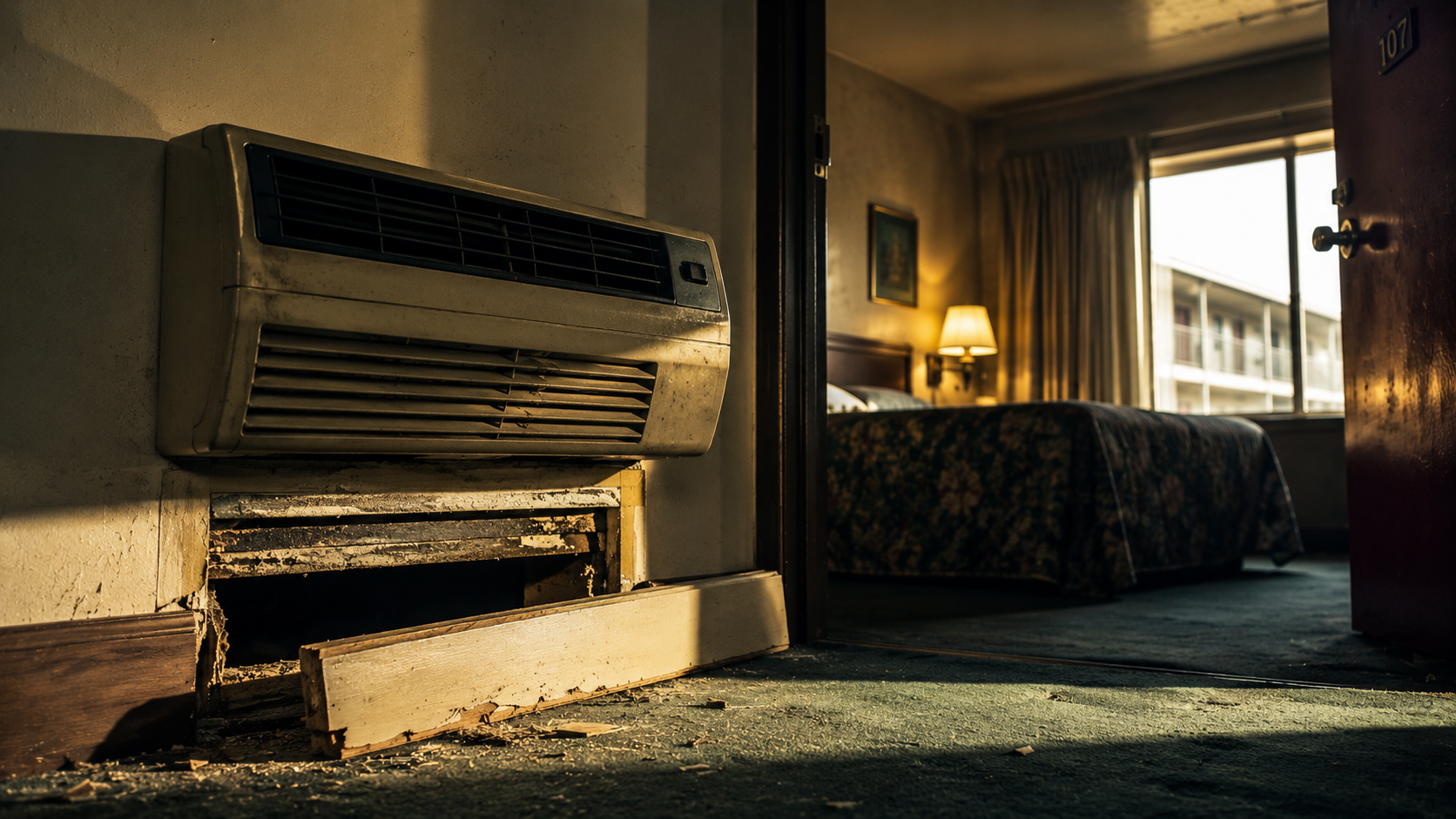
A heating unit sits against the wall of an operating Los Angeles motel. Beneath it, a piece of baseboard appears loose.
The question is whether the wall has concealed an answer—or only another theory.
The Life Around Elizabeth Short
In late nineteen forty-six, Elizabeth Short is twenty-two years old. She is a young woman from Massachusetts trying to find stability in Southern California, moving between temporary rooms, friendships, acquaintances, and uncertain plans.
The public image attached to her name develops later. At this point, she is not a noir symbol, a headline nickname, or a character frozen inside a black-and-white photograph. She is one of many young Americans whose lives have been unsettled by the war years and the social disruption that follows them.
Short was born in Boston on July twenty-ninth, nineteen twenty-four, and grew up largely in Medford, Massachusetts. Her father, Cleo Short, disappeared from the family during the Depression and was initially believed to have died. He later contacted them from California. Elizabeth eventually traveled west to stay with him, but the arrangement did not last.
Records subsequently place her around Camp Cooke, where she took civilian work and came into contact with servicemen. An arrest for underage drinking in Santa Barbara in nineteen forty-three created the fingerprint record that became important years afterward. The incident did not involve serious violence or criminal conduct; she was sent back east under juvenile procedures.
Short later spent time in Florida. There she formed a relationship with Major Matthew Michael Gordon Junior, an Army Air Forces officer. Accounts differ over the exact status of their relationship, but Short believed they planned to marry. Gordon died in an aircraft accident in August nineteen forty-five before any marriage occurred.
Her movements after that loss are often recast as evidence of recklessness. A more restrained reading shows a young woman without secure income or a permanent home, relying on social connections while searching for companionship and direction.
Later portrayals frequently claim she traveled to Los Angeles to become a film star. The surviving record is less definite. She enjoyed movies and was drawn to California, but there is little firm evidence of a sustained professional acting career, an agent, formal training, or regular auditions. The Hollywood dream may have been part of her imagination without being a practical plan.
That distinction matters. The Black Dahlia legend begins by transforming uncertainty into certainty. It converts temporary housing into rootlessness, relationships into scandal, and personal ambition into a failed pursuit of fame.
Elizabeth Short’s actual life is less polished and more recognizable: young, mobile, financially vulnerable, hopeful, and dependent on people whose reliability varied.
The People Closest To The Story
Short’s family remains primarily in Massachusetts. Her mother, Phoebe, has raised five daughters through years of financial strain after Cleo’s disappearance. Elizabeth writes home, but distance leaves her family with only fragments of her daily life.
In California, Short’s social world changes quickly. Some people know her for weeks. Others meet her through restaurants, hotels, nightclubs, military circles, or mutual friends. The instability of accommodation means an acquaintance can suddenly become the person providing a bed, a ride, or an introduction.
Mark Hansen, a nightclub and theater owner, is among the better-known figures in this network. Short spends time at a house associated with him, alongside other young women. Hansen’s name later becomes prominent because an address book bearing his name is linked to Short’s belongings, although that fact alone never establishes responsibility for anything that follows.
Robert “Red” Manley is another important connection. He is a married salesman who meets Short in San Diego and drives her north in January nineteen forty-seven. Their relationship attracts intense scrutiny, but the available record ultimately supports his account of their journey and movements.
These associations made Short easy to misrepresent. Men who had met her briefly could be described as lovers. Temporary stays could be characterized as a hidden lifestyle. Normal inconsistencies in memory became clues once investigators began reconstructing a young woman’s movements through people who did not necessarily know one another.
The result is a relationship map with many names but few people who possess a complete picture.
Short appears able to form connections quickly. She also appears reluctant to disclose hardship directly. When accommodation disappears or money becomes tight, she moves rather than openly describing a crisis.
None of this establishes danger. It establishes vulnerability.
A person without a fixed address produces a weak administrative trail. There is no regular household expecting her at a set hour, no employer immediately recording an unexplained absence, and no single friend capable of identifying every plan.
That social structure is central to the mystery. When Short’s routine breaks, there is no obvious person positioned to recognize the break immediately.
The First Detail That Did Not Fit
At the beginning of January nineteen forty-seven, Short is staying in San Diego. The arrangement becomes strained, and Manley agrees to drive her back to Los Angeles.
On January eighth, they travel north. Available accounts place them at a motel during the journey because Manley is tired and unable to continue safely. The next day, he drives Short into central Los Angeles. She tells him she is meeting her sister at the Biltmore Hotel.
Manley leaves her in or near the hotel lobby on January ninth. His account is examined closely and survives police scrutiny. His movements afterward are supported by other evidence, and investigators do not establish that he remained with Short.
The Biltmore is busy, public, and connected to several transport routes. It is the kind of place where someone can wait without attracting attention. It is also a place from which Short could have left in several directions.
Yet the expected meeting with her sister does not occur.
From that point, the record loses its shape.
There are alleged sightings, remembered conversations, and later claims from people who may have encountered Short. The difficulty is separating observations recorded close to the time from stories that develop after her photograph becomes famous.
A sighting can feel precise years later while remaining impossible to verify. A witness may sincerely remember the right face on the wrong day. Others may consciously attach themselves to a major story.
The dependable timeline therefore narrows rather than expands. Manley’s departure is a defensible anchor. What comes after is an interval composed largely of uncertainty.
That interval lasts almost a week.
Short is accustomed to moving between addresses, so her absence does not immediately trigger one coordinated search. Her family is thousands of miles away. Friends may assume she is staying elsewhere. People accustomed to her irregular movements have no reason, at first, to treat silence as an emergency.
The first explanation is therefore simple: Elizabeth has gone somewhere with someone she knows.
The problem is that no verified account identifies where.
The Ordinary Movements That January
Los Angeles in January nineteen forty-seven is a city absorbing wartime population growth while returning servicemen, industrial workers, aspiring performers, and migrants compete for housing and employment. Hotels, rooming houses, restaurants, bus stations, and nightclubs connect people who may know one another only briefly.
Short fits into that transient geography. She does not own a car. Her travel depends on rides, public transportation, and the willingness of others to help. Every journey therefore creates a possible witness, but it does not necessarily create a formal record.
The Biltmore Hotel stands near Pershing Square, an important center of downtown movement. From there, Short could reach railway stations, streetcars, restaurants, theaters, bars, residential districts, or another temporary room.
The uncertainty surrounding her movements has encouraged countless reconstructions. Some place her with a friend. Some connect her to a nightclub. Others move her rapidly between downtown Los Angeles, Hollywood, and locations farther south.
Most lack the documentation needed to become reliable chronology.
There is no authenticated diary describing those days. No bank-card trail exists. There is no mobile telephone location history, traffic-camera network, ride-booking account, or searchable collection of digital messages.
The surviving timeline depends on human recollection, paper records, physical evidence, and the decisions made by investigators working under intense public pressure.
That limitation helps explain why locations matter so much. A confirmed room, vehicle, receipt, telephone call, or witness could supply the fixed point the timeline lacks.
The newly claimed motel room is compelling for precisely that reason. It promises geography. It offers a physical place where surfaces may still exist beneath later renovations.
But the modern team reached that room through information unavailable to the public for decades. According to its account, the lead came through the family of an original investigator, followed by years of document review and site work.
Before examining whether the room fulfills that promise, the story must reach the moment when Elizabeth Short’s absence becomes something else.
The First Concern On South Norton Avenue
On the morning of January fifteenth, nineteen forty-seven, a woman walking with her young daughter notices what appears at first to be a discarded mannequin near the sidewalk on South Norton Avenue.
It is Elizabeth Short.
Her nude body has been severed at the waist and positioned in a vacant lot. The skin has been cleaned. Severe injuries include cuts extending from the corners of her mouth and evidence of blows to the head and face.
The discovery scene contains almost no blood. That absence becomes one of the first crucial conclusions: Short was not killed in the lot. Her body had been transported there after extensive preparation elsewhere.
The distinction immediately creates two locations.
One is the deposition site on South Norton Avenue. It is visible, exposed, and intentionally chosen or accepted by whoever left her there.
The other is unknown. It is where the fatal violence, dismemberment, cleaning, and preparation occurred.
That second location would have required time and privacy. It would also have contained substantial physical evidence unless the space had been thoroughly cleaned, altered, or destroyed.
Investigators recover Short’s fingerprints. Because she had previously been fingerprinted during her employment at Camp Cooke and following the Santa Barbara arrest, the Federal Bureau of Investigation can compare the prints against existing records.
Using an early image-transmission system, the prints reach Washington and produce an identification in less than an hour.
The rapid identification does not produce a rapid answer. Instead, it opens Short’s fragmented social world to an enormous inquiry.
Her recent contacts are interviewed. Medical students are examined because the clean division of the body creates an early belief that the offender may possess anatomical or surgical knowledge. Anonymous communications arrive. People confess falsely. Names accumulate faster than investigators can eliminate them.
The crime becomes famous before its geography is understood.
The empty lot is known.
The place where the crime occurred is not.
The Scene That Pointed Somewhere Else
The condition of Short’s body tells investigators that the South Norton Avenue lot cannot contain the whole event.
There is no corresponding concentration of blood in the soil. The body appears washed. Moving and positioning it would have required a vehicle or another practical means of transport. The person responsible had access to a private space long enough to complete several deliberate acts without interruption.
The medical evidence is often summarized through the phrase “surgical precision.” That wording has encouraged generations of theories involving doctors. Yet the exact skill required remains disputed. Familiarity with anatomy could have assisted the dismemberment without necessarily proving that the offender was a qualified surgeon.
Investigators nevertheless examine people with medical backgrounds, including students connected to the University of Southern California. The inquiry does not identify a match through those checks.
Another line of inquiry emerges when an envelope containing Short’s personal effects is mailed to a newspaper office. Its contents include identifying documents and the address book associated with Hansen. The envelope has been cleaned with fuel, apparently to remove fingerprints, although partial prints recovered from communications do not identify the sender.
The communications intensify public attention but do not resolve whether their sender is the killer. In a famous case, hoaxers can possess information obtained from extensive coverage, while genuine correspondence may be mixed with imitations.
False confessions create the same problem. People approach police claiming responsibility, but their accounts fail when compared with details not publicly available.
The inquiry grows wider and less manageable. Numerous men are examined. Several remain embedded in later theories despite never being charged.
The Black Dahlia label further separates Short from her own history. The nickname turns a real person into a marketable emblem of dangerous Hollywood. Contemporary coverage makes unsupported claims about her morality, sexuality, ambitions, and relationships.
The place where she died receives less lasting attention than the mythology surrounding who she supposedly was.
Yet investigators understood its importance. Somewhere in Los Angeles or its surrounding area was a room capable of containing the evidence absent from South Norton Avenue.
Finding it was never optional to a complete reconstruction. It was the missing physical center.
The Search For The Missing Room
A credible crime location would need to satisfy more than one condition.
It would need to be available during the unaccounted interval between January ninth and January fifteenth. It would need privacy, practical access, and enough control to prevent interruption. Its connection to Short or to a viable suspect would need to be established independently.
Physical evidence would then have to match the nature of the crime. A small isolated stain would not be sufficient. Blood distribution, cleaning traces, alterations, drainage, tools, fibers, fingerprints, or other material could become relevant depending on what survived.
Renovation history would matter as much as the stains themselves. A wall installed decades later could protect old material, but it could also mix construction debris and biological traces from generations of occupants.
For nearly eight decades, proposed locations have included private homes, medical facilities, garages, apartments, hotels, and motels. Most theories are built backward from a favored suspect. A property is identified, then ordinary features are interpreted as confirmation.
The strongest approach works in the opposite direction. It begins with authenticated evidence, establishes the age and origin of the material, and only then asks whom it implicates.
The motel theory is not new. Claims linking Short to a Los Angeles motel circulated within a few years of the murder and returned through later books and private investigations.
One historical version focuses on the Aster Motel on South Flower Street. Accounts associated with that theory describe a room reportedly found in an alarming condition and suggest that an early inquiry was minimized or mishandled.
The available archival record complicates that narrative. A final report prepared for the Los Angeles County district attorney in nineteen fifty stated that evidence indicated Short had never been at the Aster Motel. The same report rejected a related attempt to connect Leslie Dillon to the location and placed him elsewhere during the relevant period.
That does not prove every motel theory false. It does establish that any renewed claim must address the older investigative conclusion rather than pretend it never existed.
The Motel Theory That Never Disappeared
Motels occupy a natural place in Black Dahlia speculation because they solve several practical problems at once.
A motel room provides privacy without requiring an offender to use a permanent home. A vehicle can approach without appearing unusual. Bathrooms provide water. Noise and irregular movement may be less noticeable than in a residential property.
Those general features do not identify one motel. Thousands of innocent stays and ordinary events occur in such rooms. Investigators therefore need a specific link, not merely a plausible type of building.
The Aster Motel became prominent because later researchers connected it to descriptions of a blood-covered room allegedly seen during the period. The theory has been promoted most notably in a modern reconstruction involving Dillon and other figures from the historical file.
Critics argue that the reconstruction combines disputed newspaper accounts, unreliable witnesses, and evidence contradicted by the district attorney’s investigation. They emphasize that contemporary officials examined the claim and concluded Short had not been there.
The newly publicized motel claim resembles the older theory in broad outline but is not yet publicly transparent enough for a definitive comparison.
The current project has not formally identified the motel in its principal public account. It describes an operational property dating from the nineteen-forties and says the hidden area was found after investigators followed a private tip.
The team also says the motel had not opened to ordinary guests when Short was killed. If verified, that detail could narrow who had access to the building. It could also explain why activity inside one room attracted little notice.
However, leaving the property unnamed prevents independent examination of several basic questions.
Researchers cannot easily verify the ownership history, opening date, original floor plan, renovations, employee access, police visits, or connection to any suspected person. They also cannot determine whether the location is the Aster Motel, another previously discussed property, or an entirely different site.
Confidentiality can be justified while testing continues. It can protect owners, prevent interference, and preserve evidence.
It also places the public in the position of evaluating an extraordinary claim without being shown the premises on which it rests.
The New Room Behind The Wall
The current claim begins with a physical irregularity.
During an inspection in two thousand and twenty-two, criminalist Jim “Homer” Nieman and colleague Leslie Thompson reportedly noticed loose baseboard beneath a heating unit. When the area was examined, they found multiple layers of drywall and material covering an older section.
The team returned to the site on further occasions and says it spent more than sixty hours dismantling and documenting the room. Beneath later alterations, members reportedly reached original plaster and surfaces dating to the property’s earlier configuration.
The term “secret room” requires care.
The public description suggests a concealed or enclosed space associated with a motel room, but it is not yet clear whether this was once a separate occupiable room, a sealed recess, a changed partition, an unused service area, or part of an original layout altered through routine renovation.
Each possibility carries a different implication.
A deliberately sealed room immediately after nineteen forty-seven could be highly significant. A partition installed during an ordinary refurbishment decades afterward may have no connection to the crime. Building permits, photographs, contractor records, ownership documents, and material dating could help determine when the alterations occurred.
The project says its members documented the dismantling and preserved samples. It also says the room aligns with information drawn from witnesses and previously unseen records. Those records have not been released in a form that allows independent researchers to test the alignment.
The strongest element is that a real physical site apparently exists and has been examined. This moves the claim beyond a purely literary suspect theory.
The weakness is that almost every important conclusion remains controlled by the same project making the claim.
The room’s significance therefore depends not on how hidden it appears, but on what can be independently demonstrated about its history and contents.
A concealed wall is an investigative beginning.
It is not an answer.
What The Team Says It Found
The team says it identified close to forty areas containing suspected blood evidence within the room. Some descriptions refer to “positive blood samples,” while others more cautiously describe suspected stains.
Members say material was recovered from surfaces exposed beneath later drywall and paint. Samples have reportedly been submitted for advanced testing, including techniques intended for highly degraded or historic biological material.
If those claims are accurate, the distribution could matter more than the raw number.
A motel room can contain isolated biological material from injuries, medical emergencies, fights, accidents, menstruation, construction work, pests, or events unrelated to Elizabeth Short. Multiple stains across protected original surfaces might indicate a larger event, but their pattern would need professional interpretation.
The project has described the room as showing evidence of major bloodshed. That remains its interpretation rather than a publicly released laboratory conclusion.
No independently accessible report currently establishes that the tested material is blood. No released result establishes that it is human. No public DNA profile links it to Short.
There is also no publicly available dating result demonstrating that the material was deposited in January nineteen forty-seven.
The team’s promotional material makes broader claims. It says its investigation has assembled thousands of pages of previously unseen documents, interviewed witnesses, identified a suspect, determined a weapon, and reconstructed a location.
A former Los Angeles County district attorney working in a private or advisory capacity has expressed the opinion that the team’s accumulated material could have supported presenting a suspect to a grand jury. That is a significant endorsement, but it is not an indictment, a judicial finding, or an official reopening announcement.
The project is also developing documentary programs, films, and books. Commercial storytelling does not invalidate evidence, but it creates a reason for unusually clear separation between independently verified findings and material being retained for future releases.
At present, the most defensible description is narrow.
A private investigative and filmmaking team says it found a concealed motel space containing numerous suspected biological stains.
Everything beyond that awaits proof.
What A Positive Blood Test Can Actually Mean
Forensic language often becomes stronger as it passes from a laboratory into publicity.
A screening reaction may indicate the possible presence of blood. It does not automatically confirm human blood, identify a person, establish the age of the stain, or explain how it arrived.
Current forensic guidance warns that labels such as “positive,” “presumptive,” and even “confirmatory” can mislead readers when the method and limitations are not explained. A screening result may support the possible presence of a biological material while still requiring further analysis.
The alleged motel evidence must pass a sequence of increasingly difficult tests.
First, analysts must determine whether the sampled material is biological and whether it indicates blood.
Second, they must determine whether it is human.
Third, they must attempt to recover a usable genetic profile. Age, moisture, heat, cleaning chemicals, paint, plaster, mold, and repeated renovations may all affect preservation.
Fourth, any profile must be compared with an authenticated reference. Elizabeth Short has been dead for nearly eighty years, so comparison might require preserved evidence from the original investigation or verified familial material, subject to legal and scientific controls.
Even a strong genetic association would not, by itself, establish when the material was deposited. Modern DNA testing can identify extremely small traces, but the ability to identify a source does not necessarily explain the activity that placed it there.
Forensic guidance distinguishes the question “Whose DNA is this?” from “How and when did it arrive?” Background material, secondary transfer, contamination, and ordinary prior contact can complicate that interpretation.
In this instance, a verified match to Short from blood beneath a structurally dated wall would be exceptionally important. Its meaning would grow stronger if the distribution aligned with the known injuries and if records showed no innocent reason for her presence.
A profile belonging to an unknown person would be less decisive. It might still generate an investigative lead, but only if its provenance and relevance were clear.
A finding of animal blood or chemically similar material would weaken the central claim sharply.
Forensic science can transform the room.
It can also empty it of significance.
The Chain Of Custody Problem
The room has reportedly remained part of an operating motel for decades. During that time, owners, guests, employees, contractors, plumbers, electricians, cleaners, and pest-control workers may have entered or altered the space.
That history makes contamination a central issue rather than a technical footnote.
DNA can move through direct contact, indirect contact, shared tools, airborne debris, gloves, packaging, laboratory handling, or equipment. Contemporary forensic standards describe contamination as an ever-present concern and recommend controls at the scene and during analysis.
A defensible chain of custody should document who discovered each item, who collected it, what protective equipment was used, how instruments were cleaned, how samples were packaged, where they were stored, and every person who subsequently handled them.
Control samples should be collected from nearby unstained surfaces. Elimination samples may be necessary from members of the examination team and others with legitimate access. Separate laboratories may be needed to replicate important results.
The project says experienced forensic personnel participated, which improves confidence in principle. Public confidence, however, depends on records rather than titles alone.
Video of dismantling can help establish the physical sequence. High-resolution photographs should show each stain in place before sampling. Notes should identify precisely which structural layer contained it.
The wall’s chronology also needs an independent construction assessment. Paint analysis, plaster composition, fastener types, timber dating, building plans, and permit records may help establish when each surface was covered.
This is especially important because “found behind drywall” can sound older than the evidence actually is. A hidden surface is merely older than the material covering it. It does not automatically date to nineteen forty-seven.
The strongest possible process would involve cooperation with the Los Angeles Police Department or another public agency, independent forensic laboratories, transparent methodology, and eventual publication of interpretable results.
Without that, critics can reasonably ask whether the same team formed the theory, selected the search site, opened the room, chose the samples, interpreted the patterns, controlled the records, and announced the conclusion.
A chain of custody is not bureaucracy surrounding evidence.
It is what turns an object into evidence.
The Aster Motel Question
The unnamed location creates an unavoidable question: is the project examining the Aster Motel or a different property?
The similarities are conspicuous. Both narratives involve a nineteen-forties Los Angeles motel, an allegedly bloodstained room, disputed historical records, and a theory that the property had not yet begun normal public operations.
Yet similarity is not identity.
The project may be withholding the location precisely because it has discovered a different site. It may also be revisiting the Aster through documents or structural areas not examined in earlier searches.
Until the motel is identified, neither possibility can be confirmed.
The historical objection is substantial. In a final report dated November twenty-second, nineteen fifty, district attorney investigator Frank Jemison wrote that the evidence indicated Short had never been at the Aster Motel. He also concluded that Dillon was in San Francisco during the murder and criticized claims used to implicate him.
Any renewed Aster theory must explain why Jemison was wrong.
That could involve a previously unknown witness, an incorrect alibi record, concealed documentation, a mistaken room search, corrupt interference, or physical evidence unavailable in nineteen fifty. Merely repeating the original allegations would not be enough.
The same standard applies if the motel is elsewhere. The team must establish a credible route from Short to the building.
A stain cannot provide that route unless it produces a genetic association. A witness cannot provide it if the witness emerged decades later without corroboration. A document cannot provide it if its provenance is unclear.
The district attorney’s conclusion is not infallible. Investigations can be wrong, especially when agencies are affected by poor coordination, political pressure, corruption, or incomplete records.
But archival findings cannot be discarded because they obstruct a new narrative.
The room claim becomes strongest when placed against the most serious contradictory evidence, not protected from it.
A genuine breakthrough should survive the Jemison report.
If it cannot, the motel remains a setting for speculation rather than a demonstrated crime scene.
The Suspect The Public Has Not Been Shown
The filmmakers say their investigation identifies the person responsible. They have not publicly named that individual in the recent presentation of the room evidence.
That decision prevents unfair accusation while testing continues. It also prevents outsiders from evaluating the claimed links among the suspect, motel, Short, weapon, records, and biological material.
The Black Dahlia story already contains an unusually crowded suspect field.
Hansen was investigated because of his connection to Short and the address book. Dillon became central to a controversial inquiry involving an informant and disputed statements. Surgeon Patrick O’Reilly appeared in historical suspect material. Physician George Hodel became the subject of later accusations advanced by his son.
No one was prosecuted for Short’s murder.
Theories involving these men differ radically in evidentiary quality. Some draw from official files. Others rely heavily on resemblance, symbolic interpretation, family suspicion, disputed recordings, or efforts to connect multiple famous crimes to one person.
Hodel remains the most culturally prominent modern suspect. Police did investigate him and placed his home under surveillance. Later authors have treated recorded remarks as incriminating, while critics argue that the wider theory overstates ambiguous language and selectively interprets the file.
A responsible new theory must do more than add another name.
It should establish opportunity during the missing week, access to the relevant location, knowledge or capability consistent with the physical evidence, and some reliable connection to Short.
It must also withstand exculpatory information.
The project’s promotional material says it possesses enough evidence to support legal action had the suspect still been alive and the crime been contemporary. That assessment comes from people connected to the project, including experienced former officials, but no grand jury has examined the claim and no court has tested it.
Withholding the name is therefore legally and ethically sound at this stage.
The danger comes from implying certainty while reserving the evidence required to assess it.
The public does not need another villain selected through narrative momentum.
It needs a suspect who emerges from proof.
The Records Still Behind Closed Doors
The physical search is now tied to a second campaign: obtaining a larger portion of the official file.
In March two thousand and twenty-six, the project and an associated foundation launched a petition seeking release of Short’s full unredacted autopsy report and additional records. The petition refers to fingerprint material, alleged DNA associated with a mailed stamp, and documents that supporters believe could test their reconstruction.
Some of its assertions remain the petitioners’ account rather than independently confirmed institutional findings. These include claims about earlier discussions with police and decisions concerning release.
The underlying demand raises a legitimate public-interest question.
The murder occurred in nineteen forty-seven. The principal historical figures are dead. The case remains officially unsolved. Researchers argue that modern forensic methods could extract value from evidence that investigators of the period could not analyze.
Agencies still have reasons to protect material. Files may contain unverified accusations against people never charged, identifying details about relatives, confidential informants, graphic medical records, or facts retained to test confessions.
An unredacted autopsy report could help evaluate the alleged motel evidence by clarifying injury patterns and aspects of the body’s treatment. It could also expose intimate material with little investigative value.
A controlled release to qualified independent experts might offer a middle course. Relevant forensic details could be examined without publishing every photograph or private record.
The alleged stamp evidence presents a similar challenge. A DNA result is useful only if the item’s provenance is secure, the sample has not been exhausted or contaminated, and its connection to an authentic offender communication is defensible.
The project says access to these records is necessary to complete its theory. That may be true. It also means the theory is not complete.
A room can generate a question.
The official evidence is required to determine whether both sides of the question meet.
What The Evidence Would Need To Prove
For the room to become a credible Black Dahlia crime scene, several independent findings must converge.
The property itself must be identified and its history documented. Investigators should establish who owned it, who controlled access, when it opened, when the relevant walls were constructed, and whether any viable suspect had a connection to it.
The original room layout should be reconstructed through plans, photographs, permits, material analysis, and witness accounts. Experts should distinguish intentional concealment from ordinary renovation.
The suspected stains must undergo validated biological testing. Results should identify the methods used, the controls, the risk of false reactions, and whether blood—or specifically human blood—was indicated.
Any recoverable DNA must be interpreted cautiously. A match to authenticated Short evidence or close relatives would be transformative. A match to a suspect could be important, but only when combined with evidence explaining why the person’s biological material was present.
Spatial analysis should examine the stain distribution. Experts would need to determine whether it represents substantial violence, transfer during construction, repeated unrelated incidents, or contamination.
The known forensic characteristics of Short’s death should then be compared with the room without forcing a match. Investigators should ask what patterns ought to exist if the theory is correct and whether those patterns are actually present.
Finally, the motel evidence must fit the human timeline. A physical location cannot solve the unaccounted week unless records, witnesses, transport possibilities, or associations place Short there.
These findings should come from independent laboratories and specialists not financially dependent on the documentary project.
That standard is demanding because the claim is demanding.
A confirmed Short blood profile inside an original protected surface, combined with a dated structural alteration and documented suspect access, could represent the most important physical development in the case for generations.
Anything materially weaker may still be interesting without being conclusive.
The evidence does not need to produce a living defendant. It does need to distinguish historical truth from an effective story.
The Outcome That Has Not Arrived
As of July fourteenth, two thousand and twenty-six, no publicly released laboratory report connects the motel room to Elizabeth Short.
The public record reviewed for this article does not establish that the stains are human blood, that they date to nineteen forty-seven, or that they produced Short’s DNA. It does not show that police have formally accepted the room as a crime scene.
The Federal Bureau of Investigation’s public history continues to describe the murder as unsolved. No identified killer appears in the official account.
This does not mean the new work has failed.
Historic biological testing can be slow. Degraded material may require repeated extraction, specialized sequencing, contamination assessment, comparison samples, and legal permission. An incomplete profile can take months to interpret and may never produce a definitive identity.
It is also possible that the team is retaining results for a coordinated documentary release. If so, public skepticism will increase for as long as definitive language is used without definitive evidence.
The most responsible status is neither dismissal nor acceptance.
A potentially important location has reportedly been found. A team with some experienced forensic and legal advisers says it recovered suspected blood evidence. Its conclusions remain unverified in the public domain.
That is a meaningful development, but not a resolution.
The Black Dahlia story has trained audiences to expect one missing clue: a confession, photograph, coded message, secret document, or hidden room capable of making every uncertainty disappear.
Real cold cases rarely end that cleanly.
The room may establish where Short was killed without proving who killed her. It may identify biological material without explaining when it was deposited. It may support one suspect while leaving another part of the timeline unresolved.
It may also prove unrelated.
The outcome has not arrived because the scientific work, documentary transparency, historical reconciliation, and official response have not yet converged.
Until they do, “secret murder room” is a hypothesis, not a finding.
Why The Room Case Matters
The hidden space matters even before its claim is proved because it returns attention to the most concrete unanswered question in the murder.
Where was Elizabeth Short during the interval after the Biltmore?
Where did the fatal violence occur?
How was her body transported, and who had access to a space capable of containing what the empty lot did not?
For decades, the Black Dahlia has been dominated by suspect personalities. Each theory presents a man, then arranges the history around him. The room offers the possibility of reversing that method.
Start with the place.
Establish what happened there.
Identify whose biological material remains.
Then ask which people the evidence can legitimately reach.
That approach could also correct some of the damage done to Short herself. She has been portrayed as a failed actress, seductress, drifter, prostitute, secret wife, symbolic muse, and willing participant in imagined scandals.
The documented person is both simpler and more complex. She is a twenty-two-year-old woman navigating unstable housing, grief, limited money, uncertain relationships, and postwar Los Angeles.
Her vulnerability created gaps in the timeline. It did not cause the crime committed against her.
The motel wall has now become the latest surface onto which the public can project certainty. Its layers look cinematic: paint, drywall, plaster, darkness, suspected stains.
Yet the value of the room will be determined by work that is less dramatic—laboratory controls, property records, peer review, comparison samples, chain-of-custody logs, and a willingness to release evidence that may undermine the project’s preferred conclusion.
The room should not be called the answer because it is hidden.
It should be called the answer only if it survives being fully exposed.
For now, the baseboard beneath the heater remains what it was at the moment it moved: an opening into a space no longer visible, carrying traces whose meaning has not yet been proved.
That is not the end of the Black Dahlia mystery.
It may be the first testable question the mystery has produced in years.
