True Crime: Virginia Tech And The Two Hours That Changed Campus History
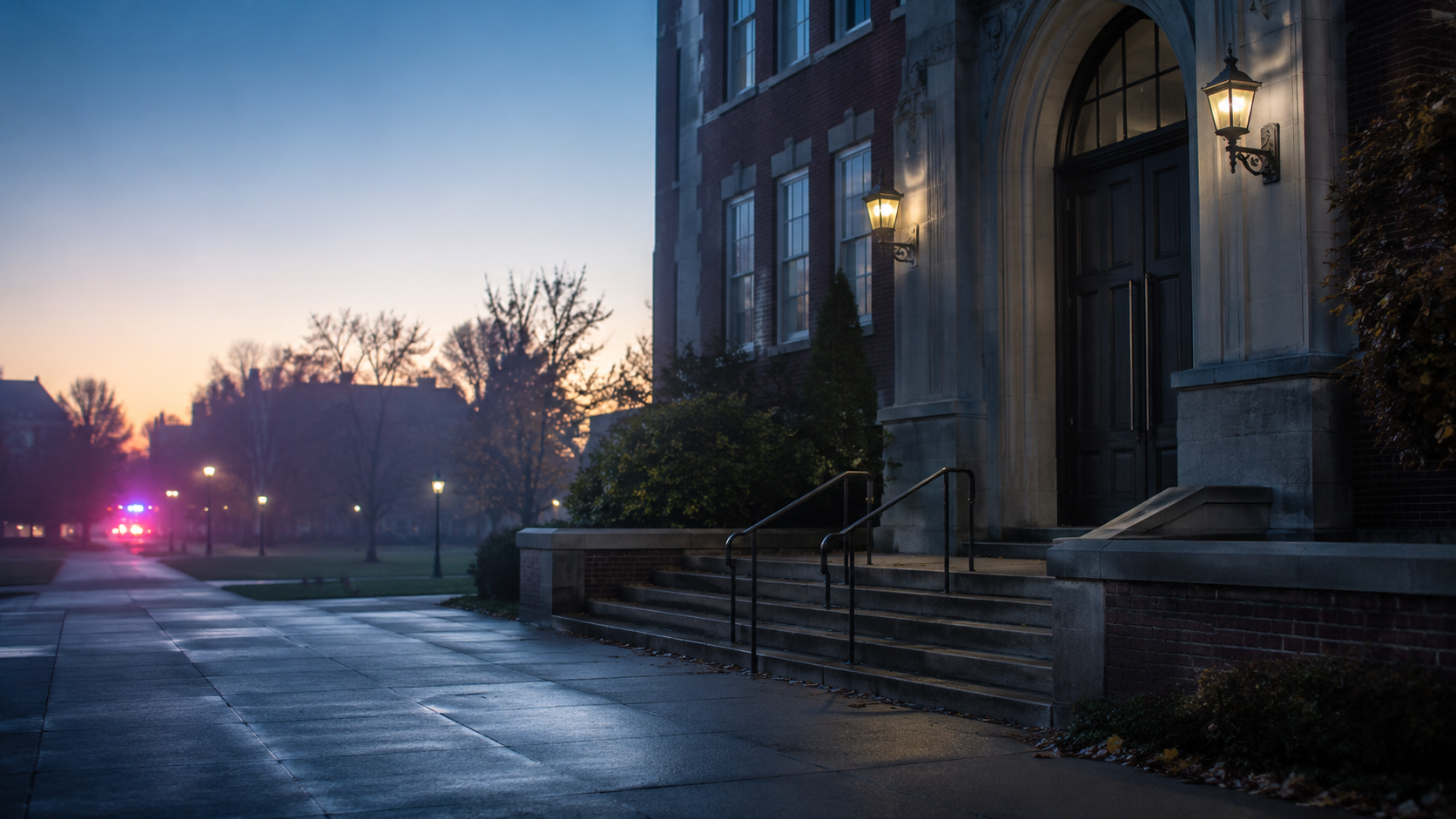
The Morning A Campus Misread The First Alarm
The Dorm, The Hall, And The Two-Hour Gap
A residence hall is not meant to be a crime scene.
It is meant to hold the ordinary pieces of student life: keys, laundry, hallway noise, a missed alarm, a friend knocking before class. On the morning of April 16, 2007, West Ambler Johnston Hall still looked like part of that routine. Students were waking up, crossing campus, checking schedules, and stepping into a Monday that had not yet announced what it was becoming.
The first visible rupture did not explain itself. There was a room, a call for help, emergency vehicles, and a narrow early theory that seemed, for a time, to make the danger smaller than it was. Across campus, classes continued. Doors opened. Students walked toward academic buildings. Faculty prepared lectures.
This article follows the Virginia Tech case through the verified record and later official reviews. The question is not only what happened. It is how a campus moved for more than two hours between the first alarm and the second attack, while the meaning of the first scene remained dangerously incomplete.
The Life Before The Case
Virginia Tech was not an abstract backdrop. It was a large public university in Blacksburg, Virginia, with classrooms, dormitories, engineering buildings, dining halls, student organizations, and the kind of daily momentum that makes a campus feel self-contained. On April 16, 2007, the people moving through that system were not symbols. They were students, faculty members, resident advisers, classmates, researchers, language teachers, musicians, future veterinarians, engineers, and friends.
The university’s official memorial pages list 32 people whose families approved biographies and photographs. The list includes 27 students and five faculty members, a detail that matters because the case is often remembered through the scale of the attack rather than the full range of lives inside it.
Emily Jane Hilscher was a freshman animal and poultry sciences major from Woodville, Virginia. Her family’s official biography described her as a skilled horsewoman, animal lover, enthusiastic cook, and imaginative artisan, with plans that pointed toward veterinary work and equine practice. She had joined the equestrian team in spring 2007 and had already competed in her first intercollegiate show.
Ryan Christopher Clark, known as “Stack,” was a senior from Martinez, Georgia. He had earned a 4.0 GPA, studied psychology, biology, and English, played baritone in the Marching Virginians, worked on campus, and served as a resident adviser in West Ambler Johnston Hall. His role matters because the first alarm of the day did not begin with a stranger noticing a headline. It began inside a dormitory where a resident adviser was close enough to respond.
Other lives would later be remembered through classrooms. Liviu Librescu, a professor of engineering science and mechanics, had survived the Holocaust as a child in Romania, built an international academic career, and joined Virginia Tech in 1985. Jocelyne Couture-Nowak taught French and was remembered for her community spirit, her love of language, and the way she welcomed French speakers into the local francophone community.
That is the first discipline this case demands. The people came before the review panels, lawsuits, warning systems, gun-law debates, and emergency protocols. Any serious account has to begin there, because the machinery of the case only matters because ordinary lives were interrupted inside it.
The People Around Them
The public version of Virginia Tech often narrows too quickly to one person. The official record eventually identified Seung-Hui Cho, a senior at Virginia Tech, as the gunman. But a case this large cannot be understood only by naming him. The people around the case included students in dorm rooms, faculty in classrooms, police officers trying to read a first scene, administrators deciding what to tell a campus, families waiting for news, and survivors whose accounts became part of the record.
Cho was born in South Korea in 1984 and immigrated to the United States with his family as a child. Later summaries of the case describe a long history of emotional and mental health concerns, including selective mutism, depression, disturbing writings, and incidents at Virginia Tech that brought him into contact with campus, mental-health, judicial, and police systems. Those contacts did not become a coordinated intervention.
That failure cannot be reduced to one missed email or one person who should have known everything. The governor’s review panel later found a broader pattern: different systems saw different fragments. A family saw one version. Faculty saw another. Police saw specific incidents. Mental-health providers saw legal and clinical limits. The university saw behavior that was disturbing, but not assembled into a complete picture of risk.
The same fragmentation shaped the morning itself. After the first scene in West Ambler Johnston Hall, police focused on a person of interest connected to Emily Hilscher’s recent movements. That early focus was not random. It came from information investigators had at the time, including her weekend with her boyfriend and the fact that he owned a gun used for target practice. The problem was not that police asked about him. The problem was that a narrow early theory was allowed to coexist with a campus that had not been placed on full alert.
This is where the supporting cast becomes crucial. A roommate’s information, a boyfriend’s mistaken suspicion, campus police, university leadership, and the Policy Group were all part of the same unfolding decision chain. No single fragment was enough to explain the day. Together, the fragments show why the first story seemed more contained than it was.
The First Cracks
The cracks in the Virginia Tech case began long before April 16. They were not, by themselves, proof of future violence. That distinction matters. Strange writing, social isolation, frightening behavior, mental illness, or contact with police does not automatically make a person dangerous. But official reviews later concluded that Cho’s history contained multiple warning signs that were seen in pieces and handled in pieces.
The record describes childhood and adolescent mental-health concerns, including selective mutism and depression. At Virginia Tech, Cho’s behavior drew concern from faculty and students. In 2005, he was involved in incidents involving female students, and after a suicidal message to a suitemate, he was evaluated through the mental-health system. A special justice found him to be a danger to himself and ordered outpatient treatment, but the follow-up did not happen in a way that produced sustained care.
That outpatient-treatment point later became one of the case’s most important legal and policy details. Because Cho had been ordered to outpatient treatment rather than committed to a facility, his name was not entered into the federal background-check system in the way that would have stopped later firearm purchases. The case did not create the background-check debate, but it gave the debate a concrete and devastating example.
The federal response after the attack did not say that mental illness explains violence in a simple way. In fact, the federal report noted that most people with mental illness are not violent, and most violent people do not have mental illness. That point is essential. The issue was not stigma. The issue was whether warning signs, treatment orders, privacy concerns, and public-safety duties could be connected before danger hardened into action.
The first cracks, then, were not a neat trail leading cleanly to April 16. They were scattered signals: disturbing behavior, legal ambiguity, weak follow-up, privacy uncertainty, and an institution that did not receive or assemble the full earlier history. The question was not whether hindsight could make everything obvious. It was whether systems built to manage risk could recognize a pattern before it became irreversible.
The Last Ordinary Movements
By spring 2007, Cho had begun purchasing weapons, ammunition, and chains, and he practiced at a shooting range. On March 31, 2007, the same day he received a speeding ticket, he bought chains, ammunition, and a hunting knife, according to later case summaries. Those purchases would only become fully meaningful after April 16. At the time, they sat outside the daily knowledge of the people who would soon share a campus with him.
The last ordinary movements of the case are hard to read because they look like normal campus life until they do not. Students returned from weekends. Faculty prepared lessons. Police shifts began. Doors opened with swipe cards. The morning did not begin with a campus-wide warning, a visible search, or a locked academic core.
Cho left his dormitory in Harper Hall early that Monday and went to West Ambler Johnston Hall. Emily Hilscher had returned to the residence hall that morning. Ryan Clark was nearby in his role as a resident adviser. What followed inside the dormitory created the first emergency call, but the first emergency did not immediately reveal the full shape of the threat.
The early timeline became one of the central issues in later reviews. Police received the first call around 7:20 a.m., officers arrived within minutes, and university officials were informed before the campus received a broad email notice at 9:26 a.m. Federal education officials later examined that gap in detail when assessing whether Virginia Tech issued an adequate timely warning under campus-safety law.
What matters in this section is not only the time. It is movement. Students were still moving. Employees were still arriving. Classes were still beginning. Some people knew there had been violence in West Ambler Johnston Hall. Many others did not know enough to understand that the first scene might still belong to an active danger.
The last ordinary movements were not dramatic on their own. That is why they matter. They were the space between a first alarm and a larger recognition.
The First Alarm
The first alarm at West Ambler Johnston Hall did not sound like a complete answer. Police found two victims. There were no clear eyewitnesses to the attack. No weapon was recovered at the scene. Bloody footprints led away from the bodies. Those details, later examined by federal education officials, were enough to show uncertainty, but uncertainty can be read in different ways under pressure.
Investigators formed an early theory that the first attack might have been a targeted domestic incident. Emily Hilscher had been dropped off after spending the weekend with her boyfriend, Karl Thornhill, a student at Radford University. Police treated him as a person of interest and sought him out. That theory later proved wrong, but in the moment it narrowed the way officials interpreted the risk.
The crucial problem was that the theory did not eliminate the unknowns. The shooter had not been identified. No suspect was in custody. No weapon had been found. The first scene did not prove that the threat had left campus. Later federal findings stressed that when the Policy Group met, the university knew there had been a double shooting, both victims were critically wounded or dead, the shooter was unknown, and the initial police impression was only that the incident was probably domestic.
At 9:26 a.m., Virginia Tech sent an email to campus staff, faculty, and students. Federal reviewers later concluded that the warning was not timely or specific enough, in part because it described a shooting “incident” without clearly telling the campus that two students had been killed and that the shooter was unknown.
This is one of the hardest parts of the case because it separates two kinds of knowledge. Police were pursuing a lead. Administrators were trying to avoid panic and manage information. But thousands of people had to make ordinary safety decisions without knowing what some officials already knew: that a violent person had not been located.
The Search For An Explanation
The first explanation was simple because it made the threat smaller. If the West Ambler Johnston Hall attack was a domestic incident, then the danger might have been specific, personal, and moving away from campus. That explanation did not make the first violence less serious, but it made it seem less likely that the entire university was at risk.
That was the lens through which the early search proceeded. Officers sought Thornhill. He learned that Hilscher had been shot and returned toward campus. Police stopped him near campus around the same time the second attack was beginning to unfold elsewhere. When reports came from Norris Hall, the mistaken domestic theory collapsed under the weight of a new emergency.
The public often treats wrong early theories as incompetence. The record is more precise than that. Early theories are built from partial information. They can be reasonable and still dangerous if they become too comfortable. The issue was not that police considered a domestic explanation. The issue was whether that theory should have delayed a stronger alert when key facts remained unresolved.
The federal review later rejected the idea that there was no ongoing threat simply because officials believed the first shooting was targeted. It found that an unknown shooter at large, with no weapon found and no suspect questioned, created an ongoing threat until the person responsible was apprehended.
The search for an explanation also exposed the limits of campus communication systems in 2007. The review panel and federal findings both pushed the question beyond one morning: Who has authority to send a warning? How quickly can it be sent? What does it need to say? Does avoiding panic justify withholding essential safety information from adults who must decide how to protect themselves?
By the time the first explanation failed, the case was no longer only a dormitory investigation. It had become a campus emergency.
The Evidence That Did Not Fit
The strongest evidence that the first explanation was incomplete was not one hidden clue. It was the continuing gap between what officials thought they knew and what the physical scene had not yet resolved. No weapon had been found. No eyewitness had identified the shooter. Bloody footprints suggested movement away from the scene. The suspect police were looking for had not yet been questioned when key warning decisions were being made.
The later review panel found that Cho had carried out the first attack and then had time to return to his dormitory, change, rearm, and move toward Norris Hall. During that window, the campus did not receive a clear, early warning that placed everyone on high alert. The gap between those two realities is the central pressure of the case.
Evidence does not always arrive in the clean order a public narrative wants. On April 16, the case was still being interpreted while it was still happening. West Ambler Johnston Hall was being processed as one crime scene. Norris Hall had not yet become the second. The meaning of Cho’s earlier history, the weapons purchases, the chains, the writings, and the warning signs only aligned after the attack.
That is what makes the case different from a simple active-shooter timeline. It was a sequence of institutional interpretation. The first scene looked local. The later record showed it was part of a larger plan. The first warning treated the danger as limited. The later findings said the uncertainty itself should have triggered more urgent campus-wide information.
A serious account has to hold both facts at once. Officials did not know the full outcome at 8:25 a.m. But they did know enough unresolved facts to make the absence of a stronger warning a central failure in later federal and state review.
The evidence that did not fit was not subtle. It was the unknown person still outside the scene.
The Event At The Center Of The Case
The second attack took place at Norris Hall, an academic building associated with engineering classes. Cho entered the building after the first dormitory attack, carrying firearms, ammunition, and chains. He chained entrances shut before moving through classrooms. Later summaries and official reviews identified Norris Hall as the site where 30 faculty and students died.
The reconstruction is necessarily clinical. Cho used two semiautomatic pistols, a 9mm Glock 19 and a .22-caliber Walther P22, according to established case summaries. The review panel reported that 32 students and faculty were killed across the two attack sites and 17 were wounded by gunfire. Six more people were injured while escaping from classroom windows.
Inside Norris Hall, the facts are not only about the gunman. They are also about the people who resisted, shielded, barricaded, hid, escaped, called for help, and later testified through memory and survival. Professor Liviu Librescu blocked the door of his classroom so students could escape through windows, according to Virginia Tech’s official memorial biography. That action became one of the case’s defining human details because it was not an abstract act of courage. It happened inside the timeline of the attack, in a room where seconds mattered.
Jocelyne Couture-Nowak was teaching Intermediate French. Her official biography described her life through family, language, community, and teaching, which makes the classroom setting central rather than incidental. The room was not a symbolic stage. It was the place where her ordinary work was happening when the case entered its worst phase.
Police were already on campus because of the West Ambler Johnston Hall shootings. When calls came from Norris Hall, officers responded quickly to the second scene. Later accounts noted that they had to deal with chained entrances before entering through another door. Cho died by suicide as police reached the area. The time between the first emergency call from Norris Hall and the end of the attack was measured in minutes, not hours.
The evidence could prove the sequence, the locations, the weapons, the number of victims, and the failure of the first theory. It could not give full access to private thought. Motive remains one of the most overclaimed parts of the case. Cho left writings and recordings, but explanation is not the same as justification, and a manifesto is not a reliable psychological map. The public wanted a clean “why.” The record gave a pattern of grievance, isolation, planning, and missed intervention, but not a complete moral answer.
What happened inside Norris Hall turned the case from a violent dormitory incident into one of the most consequential campus-safety failures in modern American history.
When The Story Broke Open
The story broke open in stages. First came emergency alerts and confusion on campus. Then came the rising death toll. Then came the identification of the gunman. Then came the discovery that Cho was not an unknown outsider but a Virginia Tech student whose earlier behavior had been noticed by multiple people and systems.
The scale of the attack forced immediate national attention, but the public story quickly split into several competing debates. One debate focused on campus warnings. Another focused on mental-health law and privacy. Another focused on firearm background checks. Another focused on media ethics after a broadcast network received and aired parts of a package Cho had mailed during the gap between the two attacks.
That media package became one of the most controversial parts of the aftermath. It included images and recordings designed to project Cho’s grievances after his death. The ethical problem was clear: showing the material could inform the public, but it also risked giving the perpetrator the spectacle he had sought. Serious coverage of the case has to avoid turning his self-presentation into the center of the story.
The more important public record came from reviews, lawsuits, official findings, and memorial work. Governor Timothy M. Kaine appointed a review panel, chaired by W. Gerald Massengill, to examine the shootings and official response. The panel conducted more than 200 interviews and reviewed thousands of pages of material before issuing findings and recommendations.
The public shorthand became “Virginia Tech.” The official record was more specific. It was West Ambler Johnston Hall, Norris Hall, a mistaken early theory, an insufficient warning, scattered mental-health records, a background-check gap, families who waited for information, and a memorial that would eventually place 32 Hokie Stones on the Drillfield.
The story could no longer be contained by the first explanation because the first explanation had missed the shape of the threat.
The Case Built From Fragments
Virginia Tech was not a courtroom whodunit. Cho died at the scene. There was no murder trial, no jury weighing guilt, and no sentencing hearing to translate evidence into punishment. The legal and investigative conflict moved elsewhere: into review panels, federal findings, civil suits, campus-safety law, mental-health policy, and the question of what institutions should have done with the information they had.
The governor’s review panel found problems across several systems. Its findings included failures in support and services for Cho in late 2005 and early 2006, flaws in Virginia mental-health laws and services, problems in reporting mental-health information for background checks, and errors in campus notification. The panel also criticized systems for helping families obtain resources after the attack.
The federal response raised overlapping themes. A June 2007 report to the president identified critical information sharing, firearm-background-check information, awareness and communication, access to mental-health services, and the need to implement known practices better as major national issues raised by the case.
The evidence did not point to one single institutional failure that, if fixed, would guarantee prevention. That is a tempting but false version of the case. The stronger reading is accumulation: weak follow-up after a treatment order, uncertainty about privacy, fragmented risk information, background-check gaps, a mistaken early theory, insufficient warning systems, and a campus population that was not given timely enough information to act.
That accumulation is why the case remains so important. It is also why it resists simple moral slogans. The record does not show that one administrator, one police officer, one professor, one family member, or one doctor held the entire answer. It shows that many people saw fragments, while no system forced the fragments into a shared risk picture.
The legal and policy question became plain: how should a university protect a community when it knows enough to be alarmed but not enough to be certain?
The Outcome That Did Not End The Story
The immediate outcome was devastating and legally final in one respect: Cho killed 32 students and faculty members before dying by suicide. Because he died at the scene, there was no criminal trial. The official investigation and later reviews instead focused on how he planned and carried out the attack, how warning signs were handled, how the campus was notified, and what should change afterward.
The review panel’s report, released in 2007, became the main public accountability document. It did not simply recount the attack. It assessed the actions taken and not taken by organizations and agencies involved before, during, and after April 16. Its recommendations covered colleges and universities, mental-health providers, law enforcement, emergency services, and lawmakers.
The federal education review later made a sharper legal finding about warnings. It concluded that Virginia Tech failed to issue adequate warnings in a timely manner and did not follow its own published policy for issuing timely warnings. The federal review focused on the 9:26 a.m. campus email and whether it gave clear, timely notice of an ongoing threat.
That finding did not mean federal officials claimed the university knew exactly what would happen at Norris Hall. It meant the known uncertainty after West Ambler Johnston Hall was enough to require a more timely and clearer warning. The difference is important. The law did not require prophecy. It required a reasonable response to a serious reported crime and an unresolved threat.
Civil litigation later created another layer. Families of Erin Peterson and Julia Pryde won jury verdicts in 2012, but the Supreme Court of Virginia reversed the verdicts in 2013, ruling that the university had no legal duty to warn or protect students from the criminal acts of a third party under the circumstances. That did not erase the policy criticism. It showed how legal duty and institutional accountability can diverge.
The outcome closed the criminal question because the gunman was dead. It did not close the institutional question.
The Aftermath People Still Argue About
The aftermath divided into memory, reform, litigation, and disagreement. For families, survivors, students, faculty, and first responders, April 16 did not end with the final police call. It continued through identification, funerals, medical care, trauma, public attention, lawsuits, records, memorial design, and the annual discipline of remembrance.
Virginia Tech’s official memorial describes how Hokies United first placed 32 Hokie Stones on the Drillfield in the hours after the tragedy. The permanent memorial now includes 32 engraved stones and a central stone honoring all fallen and injured victims. The stones are more than campus architecture. They are a refusal to let the case be remembered only through the perpetrator’s name.
Remembrance also became ritual. The university’s 2026 remembrance schedule included a ceremonial candle lit at midnight, the reading of the 32 names, a 32-minute Corps of Cadets guard, a wreath laying and moment of silence at 9:43 a.m., and a 3.2-mile Run in Remembrance. Nearly two decades later, the structure of the day still centers the victims and the community, not the attacker.
Policy changes were uneven. Governor Kaine signed an executive order in 2007 closing the gap that kept Cho’s name from being reported to the background-check registry. The General Assembly later enacted reforms connected to mental-health commitment and campus-safety policy, though advocates continued to argue that gun safety and mental-health improvements fell short of what the case demanded.
The federal report’s broader findings remain relevant because they avoided a single-cause explanation. Information sharing was difficult. Firearms-disqualification records were incomplete. Schools and communities needed better awareness and communication. Mental-health services needed capacity and follow-up. Institutions needed to do better at implementing known practices, not only inventing new ones.
That is why the aftermath is still argued about. Some see the case mainly as a story of mental-health-system failure. Others see gun-law failure. Others focus on campus-warning delay. Others emphasize media ethics, privacy confusion, or the impossibility of eliminating all risk from an open university. The record supports parts of several arguments. It does not support reducing the case to only one.
The Review, Appeal, Or Unanswered Question
Because there was no criminal trial, the later “appeal” in the Virginia Tech case was not an appeal of guilt. The review process became the substitute arena where facts, responsibility, and legal standards were contested. That process included the state review panel, federal education findings, state-court litigation, later addendums, and continuing public debate over what counted as preventable.
One unresolved question sits at the center: what warning would have changed the day? The review panel wrote that warning the campus might have made a difference by putting more people on guard, helping them recognize suspicious activity faster, report it faster, and trigger quicker police response. Federal education officials cited that reasoning when concluding that the warning was not timely and clear enough.
That statement is careful. “Might have made a difference” is not the same as “would have prevented everything.” A warning could not guarantee safety. It could not identify Cho instantly. It could not undo the first attack. It could not force every student to stay inside. But it could have given adults on campus information that some officials already had: two people had been shot, the shooter was unknown, and no weapon had been recovered.
Another unresolved question concerns how to interpret warning signs without stigmatizing mental illness. The federal report’s caution remains essential: most people with mental illness are not violent, and most violent people do not have mental illness. The useful lesson is not suspicion of people in distress. It is the need for coordinated care, lawful information sharing, risk assessment, and follow-up when a legal order mandates treatment.
The background-check issue also remains instructive. Cho’s outpatient-treatment order did not stop firearm purchases because of how reporting rules worked at the time. That gap was later addressed in Virginia, but the case still illustrates a broader national problem: a background-check system depends on what records actually reach it.
The uncomfortable lesson is that the case was not only about a gunman entering a building. It was about many systems failing to convert fragments into protection.
Why This Case Still Matters
Virginia Tech still matters because it changed how colleges think about warning, threat assessment, emergency messaging, mental-health follow-up, and memorial responsibility. It also matters because the case is still easy to misunderstand. The public version often asks why nobody “just knew.” The record shows a harder problem: several people and systems knew pieces, and the pieces did not combine in time.
The first scene in West Ambler Johnston Hall is still the clearest way to understand that problem. It looked, to early investigators, like a contained crime with a possible personal explanation. Yet the physical facts left danger unresolved. No suspect was in custody. No weapon was found. The person responsible had not been identified. That gap was not a technicality. It was the space in which the second attack became possible.
The case also warns against two bad simplifications. One says violence can be predicted easily if institutions just pay attention. The other says nothing can be done because risk is impossible to eliminate. The record rejects both. Risk cannot be reduced to certainty, but institutions can still improve information sharing, treatment follow-up, emergency notification, background-check reporting, and threat-assessment practice.
Near the end, the memorial stones matter because they change the center of gravity. The case began, for the public, as breaking news about a gunman. Virginia Tech’s memorial insists on another order: names first, lives first, community first. Thirty-two stones, arranged for gathering and reflection, keep the victims from being swallowed by the mechanics of the crime.
A residence hall is not meant to be a crime scene. A classroom is not meant to become a survival calculation. A campus warning is not meant to arrive after the meaning of danger has already changed. Virginia Tech remains a case about what can happen when the first explanation is too small, the warning is too late, and ordinary movement continues through a threat that has not yet been named.
