Andy Burnham Opens No. 10 North as Britain’s Centre of Power Breaks Beyond London
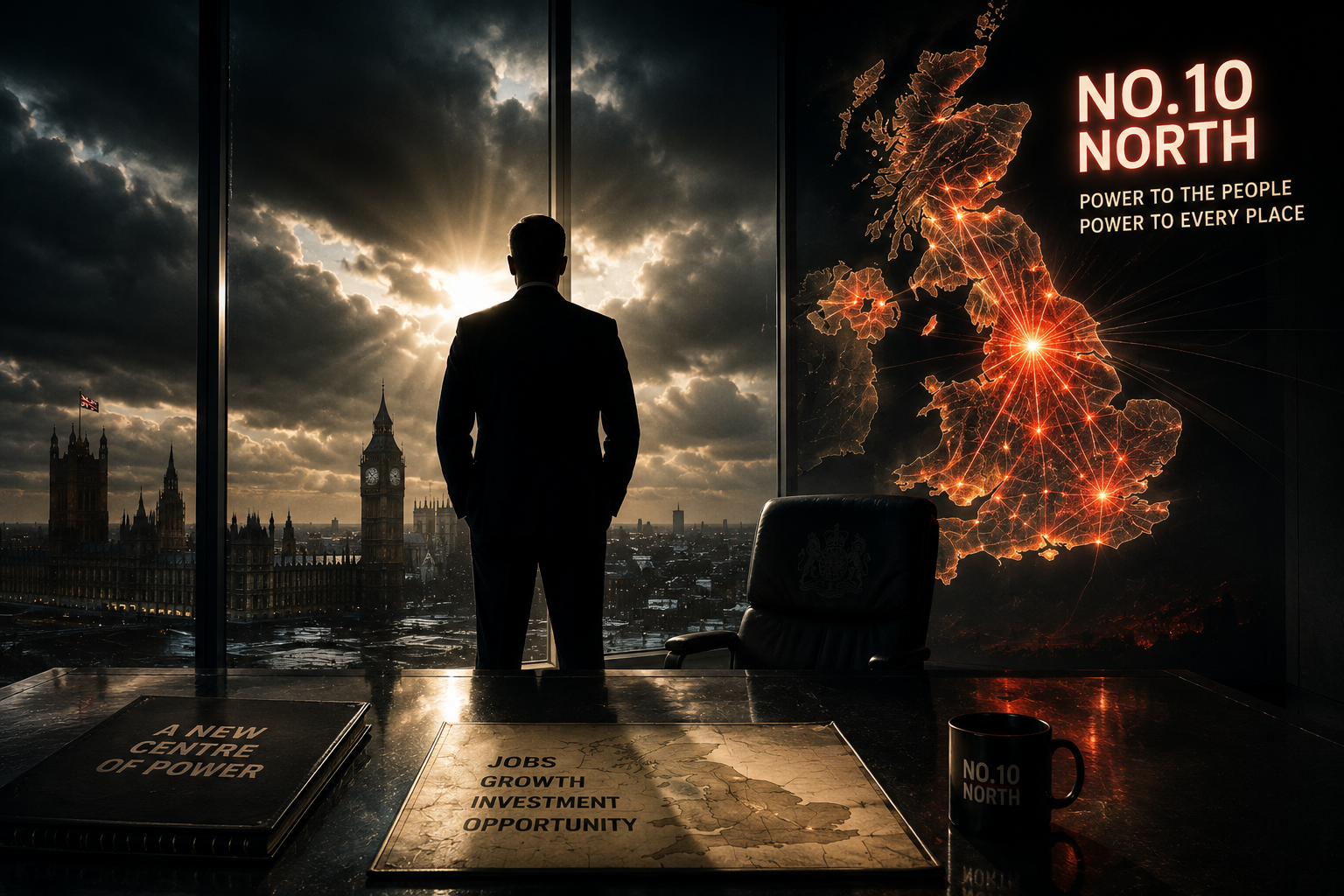
No. 10 North Opens for Business as Burnham Moves Power to Manchester
No. 10 North in Historic Shift Away From Westminster
Andy Burnham has officially opened No. 10 North in Manchester, creating what the government describes as a new prime ministerial base and “situation room” for economic growth. The move is far more significant than transferring a collection of civil servants from London: it places part of the machinery surrounding the Prime Minister inside a major English city for the first time.
Burnham will work from the Manchester office every week, while other senior ministers are expected to use it regularly. Its success will ultimately depend on whether real authority, money and decision-making power follow the Prime Minister north—or whether the operation becomes an expensive symbol attached to a government still controlled from Whitehall.
What No. 10 North Actually Is
The initial operation is based at Heron House in central Manchester, a high-security government building that already houses GCHQ intelligence, cyber and science teams. This will be an interim home rather than a northern replica of the black-doored Downing Street residence.
No. 10 North is designed as an extension of the Prime Minister’s central operation. It will bring together responsibility for devolution, local economic growth and regional development, allowing ministers, mayors, combined authorities and businesses to work through one national framework rather than pursuing disconnected departmental plans.
The government’s machinery-of-government changes transfer strategic functions into the new operation, including local economic growth and devolution policy previously held elsewhere in Whitehall. That matters because it gives No. 10 North an administrative purpose beyond holding meetings or creating favourable photographs.
Burnham Revives an Economic Command Centre
Burnham marked the opening by chairing the first meeting of a revived National Economic Council. The council brings senior ministers and regional mayors into the same decision-making structure, with business leaders, trade unions and specialist organisations invited when their knowledge is relevant.
The original National Economic Council was established by Gordon Brown in 2008 as Britain confronted the global financial crisis. Burnham’s decision to revive it suggests that his government views stagnant growth, regional inequality and weak infrastructure as an economic emergency requiring central coordination.
No. 10 North is therefore intended to operate like an economic equivalent of the government’s Cobra emergency structure: a place where obstacles are identified, responsible departments are brought together and decisions can be forced through more rapidly. Its agenda is expected to include infrastructure, housing, transport, industrial investment, public services and the expansion of regional powers.
Why Manchester Was Chosen
Manchester is inseparable from Burnham’s political identity. He spent almost a decade as Greater Manchester mayor, using the role to promote an integrated transport system, greater local control and a more confrontational relationship with central government.
The location also carries a personal message. Burnham told staff that he had left Manchester approximately 35 years earlier because he could not find suitable work there. Returning as Prime Minister to establish a national government operation in the city allows him to present No. 10 North as proof that people should not have to move towards London to obtain opportunity or influence.
However, Burnham has stressed that the project is not intended to transfer London’s dominance exclusively to Manchester. Its declared purpose is to make power flow into the Midlands, the North East, Yorkshire, the South West, the East of England, Scotland, Wales, Northern Ireland and local communities across the country. Manchester is meant to be the distribution point, not the sole beneficiary.
Is No. 10 North Unprecedented?
The precise model is unprecedented in modern British government. Civil service departments and public bodies have operated outside London for decades, and prime ministers routinely work from Chequers, travel around the country and conduct government business from temporary locations.
What Britain has not previously established is a permanent, formally branded extension of the Prime Minister’s Office in another English city, designed to host the Prime Minister every week and exercise strategic control over economic and devolution policy.
Downing Street has functioned as the Prime Minister’s central office since the eighteenth century. Although individual prime ministers have sometimes chosen not to live there or have worked from other government buildings, the political centre surrounding No. 10 has remained overwhelmingly concentrated in London.
The revived National Economic Council is not unprecedented, because an earlier version existed under Gordon Brown. Government employment outside London is not new either. The unprecedented element is the combination: a weekly prime ministerial presence, dedicated senior staff, transferred policy responsibilities and a standing alternative base presented as part of the centre of government.
The Potential Constitutional Significance
No. 10 North does not create a second capital, and it does not change Britain’s constitution by itself. Parliament, the Treasury, most government departments and the official Downing Street residence remain in London.
Its importance lies instead in political access. Decisions are often shaped by proximity: who attends early meetings, who can speak directly to senior officials and which problems reach the Prime Minister before policies become fixed. Bringing mayors and regional leaders physically into the government’s central economic process could weaken the traditional advantage enjoyed by Whitehall departments and London-based institutions.
Burnham is also creating a more powerful Prime Minister’s operation capable of coordinating spending, performance and delivery across departments. No. 10 North could therefore shift power in two directions simultaneously—away from London geographically, but towards the Prime Minister institutionally.
That is the central tension surrounding the project. A stronger regional voice does not automatically produce a less centralised state if the final authority remains concentrated around Burnham and his closest advisers.
How It Could Affect Ordinary Communities
The government says the Manchester operation will focus on reindustrialisation, regeneration and reform of essential utilities. Burnham has linked it to long-term plans covering housing, water, energy, transport and the revival of high streets and post-industrial communities.
In practice, regional leaders could take proposed transport networks, housing schemes or industrial projects directly into a structure containing ministers with the authority to unblock them. Instead of negotiating separately with multiple departments, local authorities could work from a shared growth plan supported by the centre of government.
The first test will be whether areas receive greater fiscal autonomy. Housing Secretary Angela Rayner has indicated that mayors could eventually receive additional tax-raising powers. Without control over substantial revenue, however, local government will remain dependent on grants and approvals issued by the centre, regardless of where the meetings occur.
The Risks Facing Burnham’s Experiment
The greatest risk is that No. 10 North becomes theatre rather than government. A weekly visit by the Prime Minister will attract attention, but photographs from Manchester will mean little if Treasury rules, departmental resistance and funding decisions remain unchanged.
There is also a danger that other regions view the move as Manchester replacing London at the front of the queue. Burnham must demonstrate that projects in Cornwall, the East Midlands, Scotland, Wales and the North East can receive the same access and urgency as proposals emerging from Greater Manchester.
Cost will face scrutiny as staff relocate, security is expanded and a permanent base is developed. Burnham has defended the expenditure as necessary to correct an economy in which opportunity and investment have become excessively concentrated in London. The stronger defence, however, will come from measurable results rather than rhetoric.
A Symbol That Must Become a System
No. 10 North is already historically important because it challenges the assumption that the British Prime Minister’s operation must be physically and culturally rooted almost entirely in Westminster. It transforms Manchester from a regional government centre into one of the locations from which national policy will be directed.
Yet opening the doors is the easy part. Burnham must now prove that the office can accelerate housing, unlock infrastructure, attract industry, expand local financial control and improve living standards beyond the city hosting it.
Should those changes follow, No. 10 North could become the foundation of the largest geographical redistribution of British government power in generations. Should they fail, it will be remembered as a northern address for decisions that Westminster continued to make.
