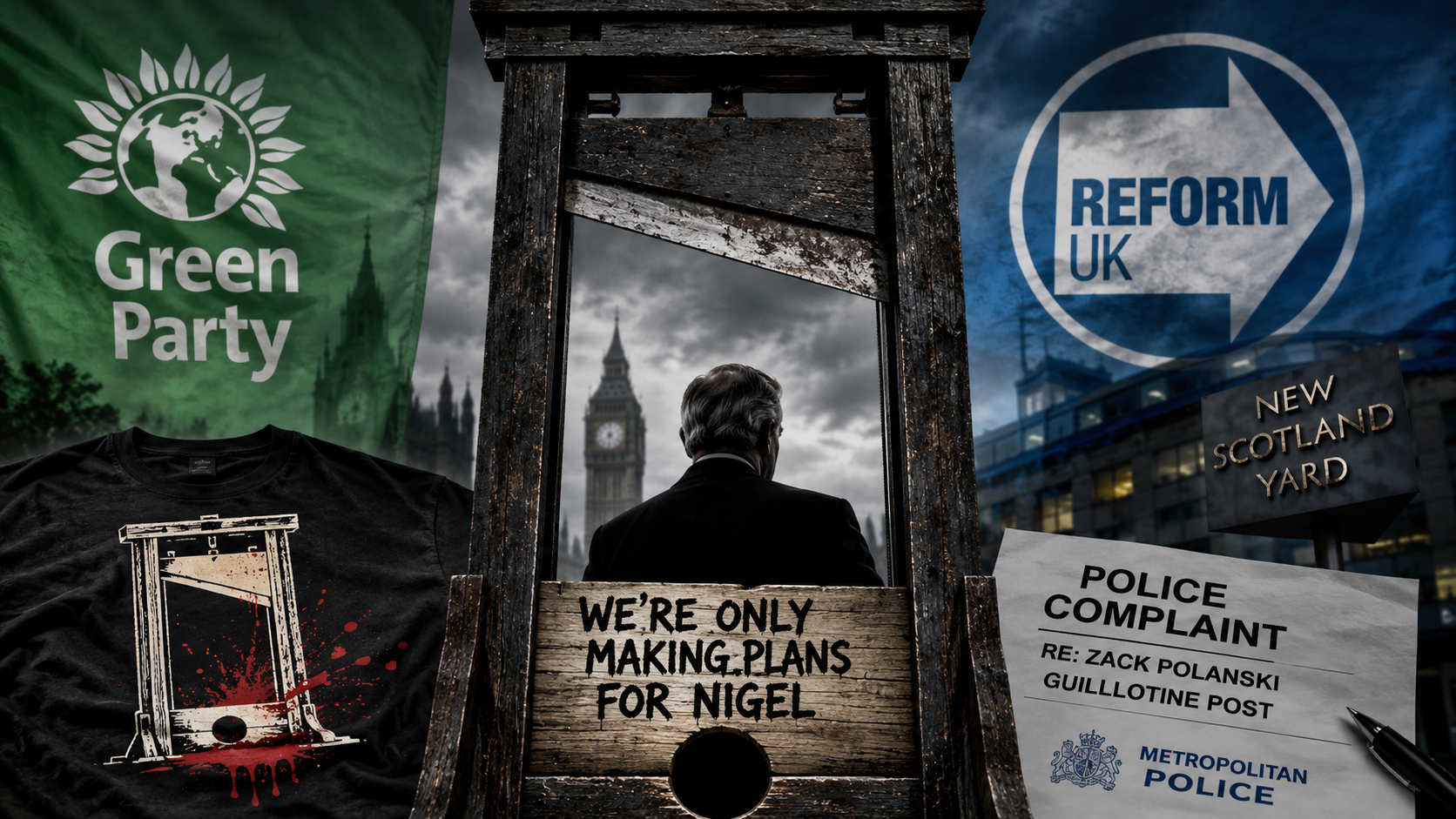
Zack Polanski’s Guillotine Post Exposes The Green Party’s Dangerous Double Standard
Reform Reports The Green Leader
The Metropolitan Police is making enquiries after Reform UK reported Green Party leader Zack Polanski over an Instagram post featuring a man wearing a T-shirt decorated with a guillotine and the words “We’re only making plans for Nigel”.
The wording appears to reference the 1979 XTC song of the same name. The guillotine, however, transformed an otherwise playful cultural reference into something far darker: a visual suggestion of political execution directed towards Nigel Farage.
Polanski reshared the image after being included in a collaborative Instagram post connected to a Green Party fundraising event in Bristol. The post was later removed. The Green Party said Polanski had not noticed the image when it was shared, did not endorse its message and condemned the shirt as being in poor taste.
Reform UK was not persuaded.
Farage accused Polanski of promoting material that appeared to incite violence against him. Reform also referred the matter to the Greater London Authority’s monitoring officer, opening a separate possible standards process alongside the police assessment.
The immediate legal question is whether the image crossed the high threshold separating offensive political expression from a criminal threat.
The larger political question is more damaging to the Greens: why does imagery that would provoke instant outrage if aimed at a progressive politician so often attract explanations, qualifications and claims of misunderstood humour when its target is on the Right?
The Excuse Does Not Remove The Responsibility
Polanski’s strongest defence is straightforward.
He did not design the shirt. He was not wearing it. The photograph appeared among several images in a collaborative post, and the party says he did not understand what had been published before it was brought to his attention.
That distinction matters legally. It may also prove decisive.
Criminal liability normally depends not only on what appeared online but on who transmitted it, what they knew, what they intended and whether they were reckless about the fear the communication could cause. The Crown Prosecution Service says threatening-communications cases require proof that a message conveyed a threat of death or serious harm and that the sender intended, or was reckless as to whether, someone encountering it would fear that the threat would be carried out.
An unnoticed image inside a multi-picture upload is therefore very different from Polanski personally writing that Farage should be killed.
But political leadership carries a lower threshold than criminal conviction.
A party leader’s social-media account is not an ordinary private feed. It is an official communications channel operated for public influence. Images shared there can be endorsed, copied and distributed to thousands of people within minutes.
The response cannot simply be: he did not notice.
That explanation may reduce culpability. It does not demonstrate competent judgement, adequate controls or an understanding of the danger created when violent imagery is circulated around named politicians.
The Green Party wants voters to trust it with councils, public institutions and potentially national power. It cannot simultaneously argue that its leader should escape serious criticism because nobody properly checked what his official account was publishing.
That is not reassurance.
It is another problem.
The Guillotine Is Not A Neutral Symbol
A guillotine is not merely a generic symbol of disagreement.
It represents execution by the state, revolutionary vengeance and the physical elimination of a political or economic enemy. Within radical political culture, it has often been deployed as shorthand for punishing elites, billionaires, landlords, monarchs and right-wing leaders.
The imagery is particularly associated with the revolutionary Left because of the French Revolution and the Jacobin tradition. Some radical-left publications, merchandise sellers and online communities have subsequently treated guillotines as ironic anti-capitalist imagery—sometimes linked to “eat the rich” rhetoric and jokes about executing billionaires.
That does not mean violent imagery is common across the democratic Left as a whole.
Most Labour, Green, socialist and progressive voters do not advocate political murder. There is no credible basis for claiming that mainstream left-wing people commonly want opponents executed.
The more defensible conclusion is narrower: a section of online and activist Left culture has become unusually comfortable treating guillotines, throat-cutting language and revolutionary violence as edgy humour when directed upwards at people classified as powerful, wealthy, right-wing or reactionary.
That distinction is essential.
Calling the imagery universal to the Left would be inaccurate. Pretending it has no identifiable home within parts of radical-left culture would be equally dishonest.
The danger begins when ironic revolutionary symbolism escapes a niche subculture and appears on the public account of a national party leader.
At that point, “it was only a joke” is no longer enough.
A Pattern Of Selective Moral Outrage
The Green Party routinely presents itself as opposing hate, intimidation and inflammatory rhetoric. Polanski has positioned the party as a direct moral and political opponent of Reform UK, while describing the Greens as a movement capable of challenging the politics represented by Farage.
There is nothing illegitimate about that strategy. Parties exist to oppose one another.
The contradiction appears when progressive politics treats language as potentially violent in one context, yet suddenly demands maximum interpretive generosity when violent symbolism travels in the opposite direction.
A crude insult directed at a minority group is often analysed through its possible effect: whether it normalises hostility, encourages harassment or makes vulnerable people feel unsafe.
By the same logic, an image combining Farage’s first name with an execution device cannot be assessed only through the claimed private intention of whoever uploaded it.
Its public effect matters too.
The image communicates that Farage is an acceptable symbolic target. It places political execution inside a joke. It encourages viewers to interpret violence as humorous because the person being depicted is disliked.
That is precisely how political dehumanisation works.
It rarely begins with a formal instruction to commit murder. It begins by turning the target into someone whose suffering is funny, deserved or morally insignificant.
Research into online abuse of British politicians has repeatedly found that hostility spikes around polarising events and prominent figures. The abuse is not confined to one ideology, and studies have found substantial targeting across the political spectrum.
That should produce one consistent democratic standard.
Threatening imagery is wrong whether aimed at Farage, Polanski, a Labour MP, a Conservative minister or a campaigner with no parliamentary seat.
The Greens cannot credibly demand that rhetoric be judged by its consequences while asking that their own leader’s post be judged only by his claimed lack of attention.
The Timing Makes It Worse
The incident has occurred during a period of acute concern about threats and violence directed at British political figures.
Farage has faced repeated threats, and police recently arrested a man following an alleged online threat to shoot him. The political climate has also been transformed by the killing of former Conservative minister and Reform figure Ann Widdecombe, whose death remains the subject of an active criminal and counterterrorism investigation.
The criminal proceedings connected to Widdecombe’s death must be treated carefully. A defendant has been charged but not convicted, and the alleged motivation remains under investigation.
Yet the broader security context is undeniable.
British politicians have been murdered before. Others have been stalked, threatened and forced to increase their security. A symbolic execution aimed at a named political leader therefore cannot be treated as abstract revolutionary theatre without real-world consequences.
Polanski’s defenders may argue that Farage and Reform are exploiting the episode for political advantage.
They almost certainly are using it politically. Any opposition party would.
That does not make the underlying complaint invalid.
Political opportunism and legitimate concern can exist at the same time.
What The Police Are Likely To Do
The phrase “police enquiries” should not be confused with a full criminal investigation, arrest or probable prosecution.
The most likely initial steps are limited and procedural:
preserve the original post and associated account data;
establish who created and uploaded the collaborative post;
determine whether Polanski personally approved or knowingly shared the image;
assess the image in its full context rather than in isolation;
consider whether Farage or another likely viewer could reasonably interpret it as a genuine threat;
examine whether the post was part of a wider pattern of communications.
The police may then decide that no criminal offence is made out.
That is currently the most plausible outcome.
Crown Prosecution Service guidance deliberately sets a high threshold for political speech. Material that is offensive, shocking, rude or disturbing can remain protected under freedom of expression. A viable prosecution requires more than evidence that people were appalled.
The threatening-communications offence under section 181 of the Online Safety Act 2023 would require evidence that the message conveyed a threat of death or serious harm and that the sender intended, or was reckless as to whether, someone would fear it would be carried out.
That may be difficult to prove where:
the image was one photograph within a larger shared collection;
Polanski says he did not notice it;
there was no accompanying call for violence;
the image was deleted when identified;
the Green Party publicly condemned its message.
A prosecution for a grossly offensive or menacing communication would face its own high threshold. The CPS expressly warns that political expression must receive substantial protection, including expression that is unwelcome or deeply offensive.
The realistic ranking of outcomes is therefore:
No further action after preliminary enquiries — most likely.
Informal police contact or voluntary interview to establish knowledge and intent — plausible.
Referral to prosecutors for charging advice — possible but less likely.
Arrest or criminal charge — currently unlikely without additional evidence showing knowledge, intention or a wider threatening context.
Conviction for incitement or threatening communications — highly unlikely on the publicly known facts alone.
That is an assessment, not a prediction of a decision that only the police and prosecutors can make.
The Standards Complaint May Matter More
The Greater London Authority referral could create a more realistic institutional problem for Polanski than the criminal complaint.
Standards processes generally operate below the criminal threshold. They can examine whether an elected representative brought an office into disrepute, failed to act responsibly or breached behavioural expectations even where no offence occurred.
Possible outcomes could include:
dismissal of the complaint;
a request for an explanation;
a finding that the post was careless but not a formal breach;
a recommendation for an apology;
criticism of social-media controls;
a formal standards finding or sanction, depending on the applicable code and evidence.
The Green Party may also conduct its own internal review, although a severe disciplinary outcome appears unlikely while the party publicly accepts Polanski’s explanation.
The political consequences are harder to contain.
Polanski had already faced scrutiny over earlier shared material, candidate controversies and questions about the Green Party’s internal discipline. Existing Taylor Tailored analysis identified a shift from Green insurgent momentum towards reputational risk, particularly because Polanski’s leadership style has become central to the party’s public identity.
This latest episode reinforces that vulnerability.
A movement built around moral authority is judged especially harshly when its own conduct falls below the standard it applies to opponents.
The Greens’ Real Problem Is Cultural
The strongest criticism of Polanski is not that he personally planned violence. There is no evidence of that.
It is that a political culture capable of producing and displaying this imagery apparently reached a Green fundraiser, appeared in material associated with the party and passed through the leader’s social-media operation without being stopped.
That suggests one of three failures.
Either nobody noticed the message.
Someone noticed but did not think it mattered.
Or someone believed that guillotine imagery aimed at Farage was politically acceptable because Farage sits outside the circle of people whose safety deserves progressive concern.
None of those explanations is good.
The Green Party’s defenders will rightly point out that the Right contains its own extremists, violent fantasies and dehumanising rhetoric. They are correct. Political violence and threatening online behaviour are not left-wing monopolies.
But that rebuttal does not absolve the Greens.
Condemning the excesses of the Right while excusing revolutionary fantasies on the Left is not moral consistency. It is tribalism disguised as principle.
The Standard Must Apply To Everyone
The police may conclude that Polanski committed no offence.
That would not make the image acceptable.
The Green Party may conclude that he accidentally shared it.
That would not make the failure insignificant.
The real test is whether Britain still possesses a political standard stronger than partisan loyalty: no jokes about executing named opponents, no romanticising political violence and no assumption that threats become harmless when the target is unpopular.
Farage does not have to be admired for the image to be condemned.
Polanski does not have to be criminally guilty for his judgement to be questioned.
And the Left does not need to accept Reform UK’s entire interpretation to confront an uncomfortable truth within parts of its own activist culture.
A guillotine is not a policy argument.
It is the symbol of what happens when argument ends.
